This Report Provides In-Depth Analysis of the Implantable Loop Recorders Market Report Prepared by P&S Intelligence, Segmented by Indication (Cardiac Syncope, Stroke, Heart Failure, Cardiac Arrhythmia, Bundle Branch Block), End User (Hospitals, Cardiac Centers, Ambulatory Surgical Centers), Distribution Channel (Direct, Indirect), and Geographical Outlook for the Period of 2019 to 2032
Explore the market potential with our data-driven report
Implantable Loop Recorders Market Outlook
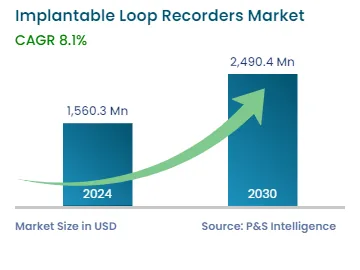
The implantable loop recorders market size was USD 1560.3 million in 2024, which is predicted to reach USD 2877.0 million by 2032, growing at a CAGR of 8.1% during 2025–2032.
This is attributed to the increasing prevalence of heart diseases, the growing aging population across all regions, the surging healthcare spending, the emerging new fields of clinical research, and the rising government’s support for creating better healthcare infrastructure.
Additionally, the growing variations in lifestyle, lack of a nutritional diet, and rising trend of junk food consumption are the major reasons behind the increasing cases of chronic health conditions in both the younger and older populations. Also, these ill health habits are the root cause of the surging incidences of CVDs and other chronic ailments. In addition, the growing mortality incidents of people suffering from chronic cardiac diseases have led to the rising adoption of implantable loop recorders (ILRs) for better information and treatment of existing heart patients.
Moreover, novel technical advancements in cardiac care, augmented demand for remote patient monitoring, and the growth and development of various heart disease treatment devices and therapies are driving the implantable loop recorders market.
Poorly managed cardiac arrhythmias are a major contributor to global cardiovascular mortality, particularly through sudden cardiac death (SCD), which accounts for approximately 40–50% of all cardiovascular deaths worldwide. With cardiovascular disease causing nearly 17 million deaths annually, this suggests up to 8 million deaths per year may stem from arrhythmia-related SCD. According to the American Heart Association, approximately 25–30% of ischemic strokes are cryptogenic, with many potentially caused by undetected atrial fibrillation, which can be identified through continuous monitoring with ILRs.
Device Miniaturization and Remote Monitoring Capabilities Are Key Trends
Advances in microelectronics and material science have enabled the production of smaller, lighter, and more energy-efficient medical devices, without compromising performance.
Miniaturized devices can be implanted or worn discreetly, improving patient comfort, compliance, and quality of life, while reducing the risk of infection or procedural complications.
Compact form factors allow for a longer battery life and extended operational periods, minimizing the need for frequent replacements or maintenance.
The integration of wireless communication modules supports seamless real-time transmission of health data to healthcare providers for the continuous monitoring and early detection of potential complications.
Remote monitoring platforms leverage cloud-based infrastructure, enabling secure storage, analysis, and sharing of patient data across multiple stakeholders in the care continuum.
The combination of miniaturized sensors and AI-driven analytics allows for predictive insights, enabling proactive intervention before critical health events occur.
Patients in rural or underserved areas benefit from remote access to specialized care, reducing the need for frequent in-person visits.
Integration with smartphones and wearable ecosystems allows patients to actively participate in their own care through personalized alerts, trends, and educational tools.
Regulatory advancements and standardization in device interoperability are further accelerating the adoption of miniaturized, remotely monitored medical technologies.
Rising Prevalence of Cardiac Arrhythmias Is Accelerating Market Growth
In 2021, atrial fibrillation had an estimated 3.6 million new cases globally, while atrial flutter accounted for around 880,000 new cases.
Ventricular fibrillation occurred in approximately 5% of patients hospitalized with acute myocardial infarction, and ventricular tachycardia affected about 5%–10% of such patients, often overlapping with VF.
The global incidence of atrial fibrillation is increasing due to the aging population, lifestyle changes, and rising prevalence of risk factors such as hypertension, diabetes, and obesity.
Cardiac arrhythmias are highly prevalent in older adults, with incidence sharply increasing after age 65.
Studies show over 10% of individuals aged ≥75 years have some form of arrhythmia, particularly atrial fibrillation.
Age-related structural heart changes and comorbidities significantly elevate the risk in this population, requiring vigilant screening.
AF is one of the most-common sustained cardiac arrhythmias, significantly elevating the risk of stroke, heart failure, and other cardiovascular complications.
Early detection and continuous monitoring are critical for effective AF management, driving demand for advanced cardiac monitoring devices such as implantable loop recorders, Holter monitors, and wearable ECG patches.
Technological innovations in arrhythmia detection, such as AI-powered algorithms, remote data transmission, and extended battery life, are enhancing diagnostic accuracy and patient compliance.
The growing clinical emphasis on preventive cardiology and timely intervention is increasing the adoption of long-term monitoring solutions to identify intermittent or asymptomatic episodes of AF.
The expanding healthcare access and reimbursement coverage in both developed and emerging markets is further supporting the uptake of cardiac monitoring devices.
Public health initiatives and awareness campaigns by organizations such as the American Heart Association and European Society of Cardiology are improving AF screening rates and early diagnosis.
The combination of clinical urgency, technological progress, and supportive policy frameworks is accelerating overall market growth in the AF and cardiac arrhythmia monitoring category.
The cardiac arrhythmia category dominated the implantable loop recorders market in 2024 with a 35% market share, driven by the high prevalence of various rhythm disorders and the critical need for accurate diagnosis to guide treatment decisions. The complexity of arrhythmia presentations, ranging from benign premature beats to life-threatening ventricular tachycardia, necessitates prolonged monitoring periods that only ILRs can effectively provide. Healthcare providers increasingly rely on implantable loop recorders to differentiate between arrhythmia types, assess burden and patterns, and evaluate treatment efficacy, particularly for patients with intermittent symptoms that escape detection during short-term monitoring.
The stroke category is projected to exhibit the highest growth rate, of approx. 8.5%, during the forecast period, fueled by the evolving clinical guidelines that recommend extended cardiac monitoring for cryptogenic stroke patients. According to the American Stroke Association, approximately 30% of ischemic strokes have no identifiable cause after standard evaluation, and studies have shown that ILR monitoring detects atrial fibrillation in up to 30% of these patients within 3 years. The growing emphasis on secondary stroke prevention and the recognition that anticoagulation therapy can reduce stroke recurrence by 70% in patients with detected atrial fibrillation has made ILR implantation a standard component of comprehensive stroke evaluation protocols.
The indications analyzed here are:
Cardiac Arrhythmia (Largest Category)
Stroke (Fastest-Growing Category)
Cardiac Syncope
Heart Failure
Bundle Branch Block
End User Analysis
Hospitals were the largest category in 2024, commanding a 60% market share, attributed to their comprehensive cardiac care capabilities, established electrophysiology departments, and role as primary referral centers for complex cardiac cases. The concentration of specialized cardiac electrophysiologists, advanced diagnostic equipment, and integrated electronic health record systems in hospital settings facilitates efficient ILR implantation, monitoring, and follow-up care. Hospitals benefit from economies of scale in device procurement, established reimbursement processes, and the ability to manage the full continuum of care from initial evaluation through long-term monitoring and subsequent interventions based on ILR findings.
Cardiac centers are emerging as the fastest-growing category during the forecast period, driven by the trend toward specialized cardiovascular care delivery and the increasing establishment of dedicated heart rhythm centers. These specialized facilities offer focused expertise in arrhythmia management, streamlined workflows optimized for device implantation and monitoring, and enhanced patient experience through reduced wait times and personalized care approaches. The growth of independent cardiac centers has been facilitated by favorable reimbursement policies for outpatient procedures, lower overhead costs compared to hospital-based services, and patient preference for specialized care settings that offer convenience and expertise.
These end users are covered:
Hospitals (Largest Category)
Cardiac Centers (Fastest-Growing Category)
Ambulatory Surgical Centers
Distribution Channel Analysis
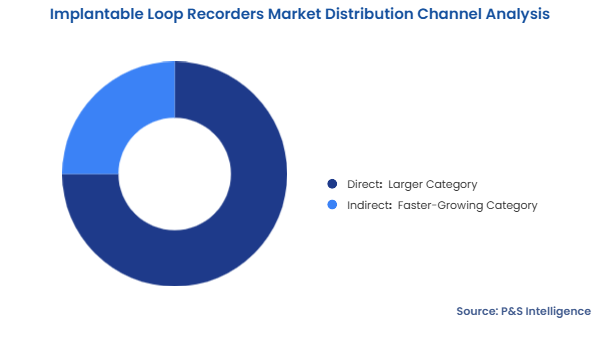
The direct distribution channel dominated the market in 2024 with a 75% share, as manufacturers prioritize direct relationships with healthcare institutions to ensure proper device support, training, and inventory management. Direct sales models enable manufacturers to provide comprehensive technical support, immediate access to new products and upgrades, and customized service agreements that include remote monitoring platforms and clinical support services. The complexity of ILR technology and the need for ongoing technical assistance throughout the device lifecycle make direct manufacturer relationships particularly valuable for healthcare providers, ensuring optimal device performance and patient outcomes.
The indirect distribution channel, while smaller, maintains importance in expanding market reach to smaller healthcare facilities and emerging markets where manufacturers may not have established a direct presence. Third-party distributors provide value through local market knowledge, established relationships with regional healthcare providers, and ability to offer bundled solutions that include multiple cardiac device options.
These distribution channels are covered:
Direct (Larger Category)
Indirect (Faster-Growing Category)
Drive strategic growth with comprehensive market analysis
North America Implantable Loop Recorders Market Size
North America dominated the global implantable loop recorders market with a 40% market share in 2024, driven by its advanced healthcare infrastructure, favorable reimbursement policies, and high awareness of cardiac monitoring technologies among both physicians and patients. The region's leadership position is reinforced by the presence of major ILR manufacturers, robust clinical research activities, and early adoption of innovative cardiac monitoring solutions. According to the National Center for Health Statistics, over 6 million Americans experience atrial fibrillation, with prevalence expected to double by 2050, creating sustained demand for long-term cardiac monitoring devices.
U.S. Implantable Loop Recorders Market
The U.S. represents the largest country market within North America, benefiting from comprehensive Medicare coverage for ILR implantation in appropriate clinical scenarios and widespread availability of specialized electrophysiology services. The Centers for Medicare & Medicaid Services expanded coverage for ILRs to include patients with recurrent unexplained syncope and cryptogenic stroke, significantly broadening the eligible patient population. The integration of remote monitoring capabilities with established telemedicine infrastructure has further accelerated adoption, particularly following the COVID-19 pandemic's acceleration of virtual care delivery models.
Europe Implantable Loop Recorders Market Share
Europe accounts for approximately 30% of the global ILR market, with growth driven by aging demographics, increasing stroke prevention initiatives, and harmonized regulatory frameworks facilitating device approval and adoption across member states. The region benefits from well-established cardiac care pathways, strong clinical evidence generation through multicenter trials, and increasing focus on cost-effective diagnostic strategies for cardiac arrhythmias. According to Eurostat, cardiovascular diseases account for 36% of all deaths in the European Union, with stroke representing the second leading cause of death, driving demand for comprehensive cardiac monitoring solutions.
Germany Implantable Loop Recorders Market
Germany represents the largest European country market, supported by comprehensive health insurance coverage, advanced cardiac care infrastructure, and strong clinical research activities in cardiac electrophysiology. The country's emphasis on preventive medicine and early diagnosis aligns well with ILR capabilities, while the presence of leading medical device manufacturers and research institutions drives continuous innovation in cardiac monitoring technologies.
Asia-Pacific Implantable Loop Recorders Market Outlook
Asia-Pacific is projected to be the fastest-growing regional market with a CAGR of approx. 9.0% during the forecast period, propelled by rapidly improving healthcare infrastructure, rising healthcare expenditure, and increasing prevalence of cardiovascular diseases associated with lifestyle changes and population aging. The region's growth is accelerated by expanding medical insurance coverage, growing medical tourism for cardiac procedures, and increasing awareness of advanced cardiac diagnostic technologies among healthcare providers. According to the Asian Pacific Society of Cardiology, the prevalence of atrial fibrillation in Asia is projected to increase by 2.5-fold by 2050, with over 72 million affected individuals, creating substantial demand for long-term monitoring solutions.
China Implantable Loop Recorders Market Outlook
China leads the regional growth trajectory, driven by government initiatives to strengthen cardiac care capabilities, rapid expansion of private healthcare facilities, and increasing adoption of innovative medical technologies in tier-1 and tier-2 cities. The National Health Commission of China has prioritized cardiovascular disease prevention and management as part of the Healthy China 2030 initiative, including emphasis on early detection and monitoring of cardiac arrhythmias. Japan demonstrates the highest adoption rate of advanced ILR technologies in the region, benefiting from universal healthcare coverage, sophisticated medical infrastructure, and strong preference for minimally invasive diagnostic approaches.
The regions and countries analyzed in this report are:
North America (Largest Regional Market)
U.S. (Larger Country Market)
Canada (Faster-Growing Country Market)
Europe
Germany (Largest Country Market)
U.K. (Fastest-Growing Country Market)
France
Italy
Spain
Rest of Europe
Asia-Pacific (Fastest-Growing Regional Market)
Japan
China (Fastest-Growing Country Market)
India (Largest Country Market)
South Korea
Australia
Rest of APAC
Latin America
Brazil (Largest Country Market)
Mexico (Fastest-Growing Country Market)
Argentina
Rest of LATAM
Middle East and Africa
Saudi Arabia (Largest Country Market)
South Africa
U.A.E. (Fastest-Growing Country Market)
Rest of MEA
Implantable Loop Recorders Market Share
The global implantable loop recorder (ILR) market is highly consolidated, with the leading multinational companies dominating the competitive landscape. Entrants face significant barriers, including rigorous regulatory requirements, the necessity of long-term clinical evidence, and substantial R&D investments. Technological innovation remains a central competitive driver, with companies continually advancing device miniaturization, enhancing diagnostic algorithms, and expanding remote monitoring functionality.
Despite strong competition among the top players, a portion of the market share is still held by smaller, niche, and emerging device manufacturers. The competitive landscape is also evolving with the integration of artificial intelligence, predictive analytics, and expansion into emerging markets where cardiac care infrastructure is rapidly developing. Strategic partnerships between device manufacturers and digital health companies are increasingly common, aimed at enhancing remote monitoring capabilities and developing novel diagnostic algorithms.
Top Implantable Loop Recorders Manufacturers:
Medtronic plc
Abbott Laboratories
Biotronik SE & Co. KG
Boston Scientific Corporation
Vectorious Medical Technologies Ltd.
NIHON KOHDEN CORPORATION
Koninklijke Philips N.V
Midmark Corporation
ZOLL Medical Corporation
SunTech Medical Inc.
Asahi Kasei Corp.
Angel Medical Systems, Inc.
Implantable Loop Recorders Market News
In March 2025, a Koninklijke Philips N.V. study reported that a two-step monitoring approach starting with 30 days of mobile cardiac outpatient telemetry (MCOT), followed by ILR monitoring, improved atrial fibrillation detection rates and significantly reduced overall costs.
In April 2024, Biotronik SE & Co. KG unveiled the BIOMONITOR IV insertable cardiac monitor in Europe, featuring AI-driven SmartECG technology. It reduces false-positive detections by approximately 86%, while preserving 98% of the clinically relevant arrhythmia episodes.
In October 2023, Boston Scientific Corporation launched the LUX-Dx II+ insertable cardiac monitor in Europe, featuring advanced dual-stage detection algorithms and remote programming functionality—without any announced AI-driven digital health platform partnership.
In May 2023, Abbott Laboratories received the FDA’s clearance for its Assert-IQ insertable cardiac monitor, featuring a battery life of up to six years and enhanced arrhythmia detection algorithms to improve long-term heart rhythm monitoring. The device also received CE mark approval in March 2024 for use in European markets.
Want a report tailored exactly to your business need?
Leading companies across industries trust us to deliver data-driven insights and innovative solutions for their most critical decisions. From data-driven strategies to actionable insights, we empower the decision-makers who shape industries and define the future. From Fortune 500 companies to innovative startups, we are proud to partner with organisations that drive progress in their industries.
Client Testimonials
Working with P&S Intelligence and their team was an absolute pleasure – their awareness of timelines and commitment to value greatly contributed to our project's success. Eagerly anticipating future collaborations.
McKinsey & Company
India
Unmatched Standards
Our insights into the minutest levels of the markets, including the latest trends and competitive landscape, give you all the answers you need to take your business to new heights
Complete Data Security
We take a cautious approach to protecting your personal and confidential information. Trust is the strongest bond that connects us and our clients, and trust we build by complying with all international and domestic data protection and privacy laws