This Report Provides In-Depth Analysis of the Hydrazine Hydrate Market Report Prepared by P&S Intelligence, Segmented by Concentration Level (24-35%, 40-55%, 60-85%, 100%), Application (Polymerization & Blowing Agents, Pharmaceuticals, Water Treatment, Agrochemicals), and Geographical Outlook for the Period of 2019 to 2032
Explore the market potential with our data-driven report
Hydrazine Hydrate Market Outlook
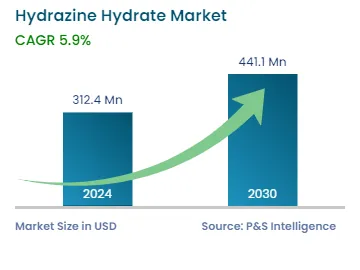
The global hydrazine hydrate market was valued at USD 312.4 million in 2024, and it is projected to grow at a CAGR of 5.9% during 2025–2032, to reach USD 488.5 million by 2032. The substantial market expansion is driven by the increasing demand from polymerization and blowing agent applications, rising pharmaceutical sector requirements, and growing water treatment activities across industrial facilities worldwide.
Hydrazine hydrate serves as a critical chemical intermediate in multiple high-growth industries, particularly benefiting from the expanding polymer foam sector. This robust growth in downstream applications directly supports hydrazine hydrate demand as a key foaming agent and polymerization catalyst.
Hydrazine hydrate derivatives, including triazole, triazine, and pyrazole compounds, are essential intermediates in manufacturing anti-tuberculosis drugs, antifungal treatments, and various therapeutic compounds, positioning the market for sustained expansion in pharmaceutical applications.
The agrochemical sector creates a substantial demand for hydrazine hydrate for pesticide and fungicide production, primarily as a key intermediate in manufacturing triazole and triazine-based fungicides and herbicides that are essential for crop protection and agricultural productivity enhancement. The compound's role in producing plant growth regulators and pest control solutions supports ongoing agricultural intensification efforts to meet global food security requirements.
The market also benefits from emerging applications in fuel cell technology, where hydrazine hydrate offers advantages as a carbon-free fuel with high energy density and superior storage characteristics compared to hydrogen. As global decarbonization efforts accelerate and alternative energy solutions gain prominence, hydrazine fuel cells present opportunities for specialized applications in aerospace, defense, and potentially automotive sectors, creating new avenues for market expansion beyond traditional chemical processing uses.
Hydrazine Hydrate Market Emerging Trends
Rising Demand in Polymerization and Blowing Agents Drives Market Growth
The rising usage of hydrazine hydrate in polymerization and blowing applications drives the market. As per studies, the sale of foam blowing agents could generate USD 1,649.9 million by 2030. Hydrazine hydrate serves as a chemical blowing agent that releases nitrogen gas upon decomposition, creating the cellular structure required for polymer foams used in automotive, construction, and packaging applications.
The expanding automotive industry significantly contributes to this demand, as lightweight polymer foams are increasingly used in vehicle interiors, seating systems, and structural components to improve fuel efficiency. The construction sector also drives substantial demand, utilizing polymer foams for thermal insulation, soundproofing, and structural applications in both residential and commercial buildings.
Manufacturing companies are investing heavily in expanding their hydrazine hydrate production capabilities to meet the growing demand for azodicarbonamide and other blowing agents. In March 2023, a new manufacturing facility by SS Blowchem in Rajasthan will have a total capacity of 2800 TPA for producing azodicarbonamide and hydrazine hydrate, with an investment of Rs. 107.1 million, demonstrating the market confidence in sustained demand growth.
Regulatory and Safety Challenges Pose Constraints on Market Expansion
The hydrazine hydrate market faces significant regulatory and safety challenges that constrain broader market adoption and impose stringent handling requirements across all applications. The compound is classified as highly toxic and potentially carcinogenic, with regulatory authorities, including the U.S. Environmental Protection Agency and international agencies, imposing strict exposure limits and safety protocols for industrial workers and environmental protection.
Occupational health and safety regulations create substantial compliance costs for manufacturers and end-users, particularly in developed markets where regulatory oversight is stringent. The National Institute for Occupational Safety and Health (NIOSH) has established extremely low exposure limits of 0.03 ppm for hydrazine compounds, with immediately dangerous to life or health concentrations set at 50 ppm for 30-minute exposures. These restrictive limits require specialized ventilation systems, personal protective equipment, and emergency response procedures, increasing operational costs significantly.
Emerging Applications in Fuel Cell Technology Is Key Opportunity
The development of the direct hydrazine fuel cell (DHFC) technology represents a transformative trend that could significantly expand market opportunities beyond traditional chemical processing applications. Hydrazine offers exceptional advantages as a fuel cell feedstock, including a high energy density of 5.4 kWh/L, theoretical cell potential of 1.56 V, and carbon-free emission characteristics, which align with global decarbonization objectives. Unlike hydrogen fuel cells that require expensive platinum catalysts, hydrazine fuel cells can operate effectively with non-precious metal catalysts such as nickel and cobalt, potentially reducing overall system costs significantly.
The recent technological breakthroughs in hydrazine fuel cell design have demonstrated impressive power densities exceeding 500 mW/cm², making them competitive with traditional fuel cell technologies while offering superior storage and handling characteristics. The liquid nature of hydrazine hydrate at room temperature eliminates the complex high-pressure storage systems required for hydrogen, enabling simpler fuel infrastructure and reducing overall system complexity. Daihatsu Motor Company has developed innovative approaches for safe hydrazine storage using polymer-based solid forms that release liquid hydrazine hydrate on demand, addressing safety concerns while maintaining fuel accessibility.
The aerospace & defense sector is driving the early adoption of the hydrazine fuel cell technology, particularly for applications requiring high energy density and reliable operation in extreme environments. Space missions and underwater vehicles represent immediate commercial opportunities where hydrazine's energy storage advantages and operational reliability justify the higher fuel costs and safety requirements. The technology's ability to operate independently of ambient air supplies makes it particularly valuable for air-independent power systems in military and aerospace applications.
Automotive applications represent the largest potential market opportunity for hydrazine fuel cells, despite current safety and infrastructure challenges. Research institutions and automotive manufacturers are exploring hydrazine's superior well-to-wheels energy efficiency compared to hydrogen, which could provide competitive advantages in fuel cell vehicle applications. The development of safe storage systems and fuel handling protocols could enable broader transportation sector adoption, creating substantial demand growth for hydrazine hydrate in automotive fuel cell applications.
The integration of hydrazine fuel cells with renewable energy systems presents additional growth opportunities, particularly for stationary power generation and energy storage applications. The high energy density and long-term storage stability of hydrazine hydrate make it attractive for grid-scale energy storage applications where space constraints and energy density requirements favor liquid fuel solutions. As renewable energy integration increases globally, hydrazine fuel cells could serve as backup power systems and load balancing solutions, supporting the transition to sustainable energy infrastructures while creating new market segments for hydrazine hydrate suppliers.
Hydrazine Hydrate Market Segmentation Analysis
Concentration Level Analysis
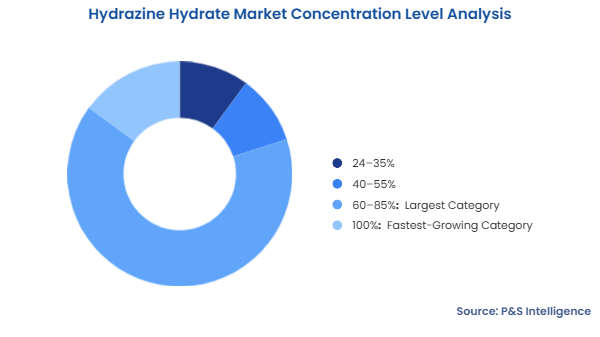
The 60%–85% concentration category held the largest market share, of approximately 65.0%, in 2024, driven by its optimal balance of effectiveness, cost-efficiency, and safety considerations across multiple applications. This concentration range is widely utilized in manufacturing veterinary drugs, chemical synthesis processes, and polymerization applications where it serves as both an initiator and blowing agent.
The 60%–85% concentration level is particularly favored in aerospace applications, where it functions as a propellant in emergency power units (EPU) for F16 and other single-engine aircraft. Additionally, this concentration provides the necessary reactivity for producing azodicarbonamide and azobisisobutyronitrile, key derivatives used in polymer foam manufacturing and rubber processing applications.
The 100% concentration category is expected to register the highest CAGR, of 6.1%, during 2025–2032, primarily due to increasing demand from specialized chemical synthesis applications and high-purity requirements in pharmaceutical manufacturing. This category serves niche applications requiring maximum purity, including cyclization reactions and semiconductor manufacturing processes, where even trace impurities can significantly impact product quality.
These concentration levels are covered:
24–35%
40–55%
60–85% (Largest Category)
100% (Fastest-Growing Category)
Application Analysis
The polymerization & blowing agents application category dominated the hydrazine hydrate market in 2024 with a market share of approximately 40.0%, reflecting its critical role in polymer foam production and chemical blowing agent manufacturing. This category benefits from the robust growth in the automotive and construction industries, where polymer foams provide essential lightweight and insulation properties.
Hydrazine hydrate derivatives, particularly azodicarbonamide and azobisisobutyronitrile, are extensively used as foaming agents in producing expanded polystyrene (EPS), polyurethane foams, and other cellular materials. The versatility of these applications across packaging, automotive interiors, construction insulation, and consumer goods manufacturing supports sustained demand growth in this category.
The pharmaceuticals category is projected to exhibit the highest CAGR, of 6.2%, during the forecast period, driven by increasing investments in drug development and the growing prevalence of chronic diseases requiring specialized therapeutic interventions. This category benefits from hydrazine hydrate's role in synthesizing various pharmaceutical intermediates and active ingredients used in anti-tuberculosis, antifungal, and oncology treatments.
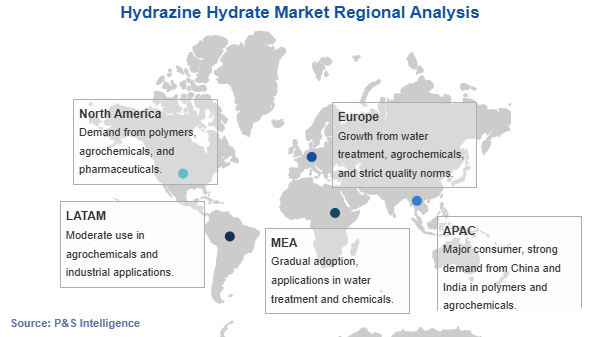
Asia-Pacific held the largest market share, of approximately 45.0%, in 2024, driven by rapid industrialization, expanding chemical manufacturing activities, and growing demand from automotive and construction sectors. The region benefits from a large-scale production ecosystem, strong government support for industrial development, and increasing investments in sustainable chemical solutions.
The region's automotive industry expansion also supports market growth, as manufacturers increasingly adopt lightweight polymer foams for vehicle weight reduction and fuel efficiency improvement. Major automotive production hubs in China, Japan, and South Korea drive consistent demand for hydrazine hydrate-based blowing agents used in automotive seating, interior components, and structural applications.
China Hydrazine Hydrate Market Growth
China dominates the regional market, supported by its extensive polymer manufacturing industry and significant pharmaceutical production capacity. The country serves as a major global supplier of generic drugs and chemical intermediates, creating substantial domestic demand for hydrazine hydrate in pharmaceutical synthesis applications. India's pharmaceutical industry, known as the "pharmacy of the world," is a major exporter of generic drugs, contributing significantly to regional hydrazine hydrate consumption.
North America Hydrazine Hydrate Market Value
North America represents the second-largest regional market, and it is expected to grow at a CAGR of 6.5% during 2025–2032, supported by advanced pharmaceutical manufacturing capabilities, stringent water treatment requirements, and robust aerospace industry demand. The region benefits from high R&D spending in pharmaceutical development and established chemical manufacturing infrastructure.
The country's leadership in biotechnology and specialty pharmaceutical development supports premium applications requiring high-purity hydrazine hydrate grades.
Additionally, the region's aerospace and defense industries utilize hydrazine hydrate in specialized propellant applications. The expanding polymer foam market, driven by e-commerce packaging demands and construction activity, also supports sustained growth in industrial applications.
These regions and countries are covered:
North America (Fastest-Growing Regional Market)
U.S. (Largest Country Market)
Canada (Fastest-Growing Country Market)
Europe
Germany (Largest Country Market)
France (Fastest-Growing Country Market)
U.K.
Italy
Spain
Rest of Europe
Asia-Pacific (Largest Regional Market)
China (Largest Country Market)
India (Fastest-Growing Country Market)
Japan
South Korea
Australia
Rest of APAC
Latin America
Brazil (Largest Country Market)
Mexico (Fastest-Growing Country Market)
Rest of LATAM
Middle East & Africa
Saudi Arabia (Largest Country Market)
U.A.E. (Fastest-Growing Country Market)
South Africa
Rest of MEA
Hydrazine Hydrate Market Share
The global hydrazine hydrate market exhibits a fragmented competitive landscape, characterized by the presence of several established chemical manufacturers alongside regional producers serving local and specialty applications. The market fragmentation stems from diverse application requirements, varying purity specifications, and regional regulatory considerations that create opportunities for both large-scale and specialized suppliers.
Market concentration analysis indicates that the top 10 key players collectively hold approximately 35.0% of the total market share, classifying the market as fragmented according to industry standards. This fragmentation reflects the specialized nature of hydrazine hydrate applications, where suppliers often focus on specific end-user industries or geographic regions to develop technical expertise and customer relationships.
Leading companies maintain their market positions through strategic investments in production capacity expansion, product quality improvements, and technological innovations in synthesis processes. Many manufacturers are adopting more environmentally sustainable production methods, such as the ketazine process, to reduce environmental impact and comply with increasingly stringent regulatory requirements.
The competitive landscape is influenced by ongoing consolidation activities, strategic partnerships between manufacturers and end-users, and investments in regional production facilities to serve local markets more effectively. Companies are also focusing on vertical integration opportunities to secure raw material supplies and develop specialized product formulations for high-value applications.
Key manufacturers are expanding their presence in emerging markets, particularly in Asia-Pacific, where rapid industrialization and growing chemical manufacturing activities create substantial growth opportunities. Strategic collaborations with pharmaceutical companies and polymer manufacturers are becoming increasingly important for securing long-term supply agreements and developing customized product solutions.
Top Hydrazine Hydrate Manufacturers:
Arkema
LANXESS AG
Weifang Yaxing Chemical Co. Ltd.
Otsuka Chemical Co. Ltd.
Nippon Carbide Industries Co. Inc.
LGC Limited
Thermo Fisher Scientific Inc.
Lonza Group AG
HPL Additives Limited
Yibin Tianyuan Group
Tanshang Chenhong Industrial Co. Ltd.
Koc Company
Hydrazine Hydrate Market News
In April 2024, LANXESS AG expanded its offering of microbial control products for the oil & gas industry with Aqucar A 20, a water treatment microbiocide tailored for long-term preservation of oilfield reservoirs.
In July 2023, Gujarat Alkalies and Chemicals Limited flagged off the first lot of hydrazine hydrate (80%) and purified phosphoric acid (85%).
Want a report tailored exactly to your business need?
Leading companies across industries trust us to deliver data-driven insights and innovative solutions for their most critical decisions. From data-driven strategies to actionable insights, we empower the decision-makers who shape industries and define the future. From Fortune 500 companies to innovative startups, we are proud to partner with organisations that drive progress in their industries.
Client Testimonials
Working with P&S Intelligence and their team was an absolute pleasure – their awareness of timelines and commitment to value greatly contributed to our project's success. Eagerly anticipating future collaborations.
McKinsey & Company
India
Unmatched Standards
Our insights into the minutest levels of the markets, including the latest trends and competitive landscape, give you all the answers you need to take your business to new heights
Complete Data Security
We take a cautious approach to protecting your personal and confidential information. Trust is the strongest bond that connects us and our clients, and trust we build by complying with all international and domestic data protection and privacy laws