HVAC Condensate Recovery and Water Management Systems Market Outlook (2027 - 2033)
This Report Provides In-Depth Analysis of the HVAC Condensate Recovery and Water Management Systems Market Report Prepared by P&S Intelligence, Segmented by Product Type (Condensate Pumps, Condensate Neutralizers & Treatment, Overflow Switches & Monitoring Controls, Drain Pans, Traps & Lines, Condensate Recovery & Reuse Systems), Equipment Type (Air Conditioning Systems, Heating Systems (Condensing Boilers, Furnaces & Heat Pumps), Refrigeration Systems, Air Handling & Dehumidification Units), End Use (Residential, Commercial, Industrial), and Geographical Outlook for the Period of 2022 to 2033
HVAC Condensate Recovery and Water Management Systems Market Statistics
Key Highlights
Study Period
2022 - 2033
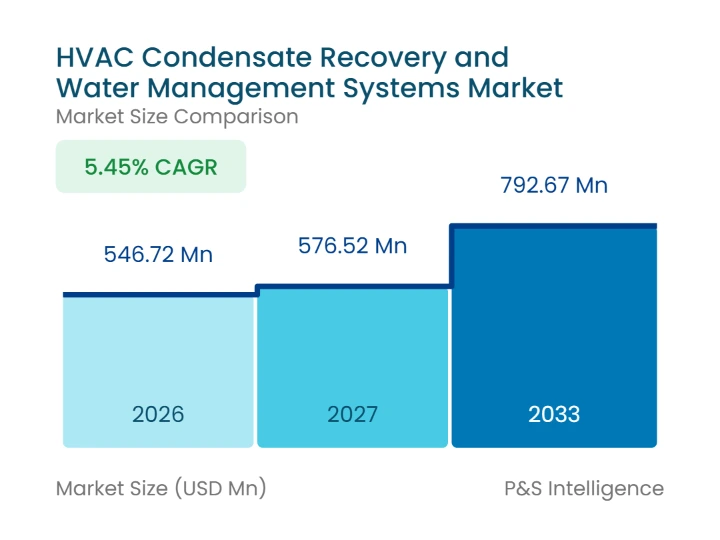
Market Size in 2026
USD 546.72 Million
Market Size in 2027
USD 576.52 Million
Market Size by 2033
USD 792.67 Million
Projected CAGR
5.45%
Largest Region
Asia-Pacific
Fastest Growing Region
Asia-Pacific
Market Structure
Moderately Fragmented
Market Size
Explore the market potential with our data-driven report
HVAC Condensate Recovery and Water Management Systems Market Outlook
The global HVAC condensate recovery and water management systems market size is estimated at USD 546.72 million in 2026 and is projected to reach USD 576.52 million in 2027. Revenue is projected to rise to USD 792.67 million by 2033, a CAGR of 5.45% during 2027-2033. Orders come from contractors fitting ductless and concealed air conditioners that cannot drain by gravity, heating installers moving homes onto condensing boilers and heat pumps, and commercial building owners who capture coil water to offset cooling tower make-up. Each of these jobs can add a pump, neutralizer, overflow switch, or recovery tank.
Split and packaged air conditioners generate the largest volume of orders for condensate pumps, drain pans, and overflow switches, because every indoor coil needs a managed drain path and many wall-mounted or ceiling units need a pump to lift water away. The Japan Refrigeration and Air Conditioning Industry Association estimates world air conditioner demand at 131.6 million units in 2024, 6% above 2023. That figure sizes the equipment base, not condensate product uptake, but each of those units needs a drain path once installed, which ties accessory orders to the yearly installation calendar.
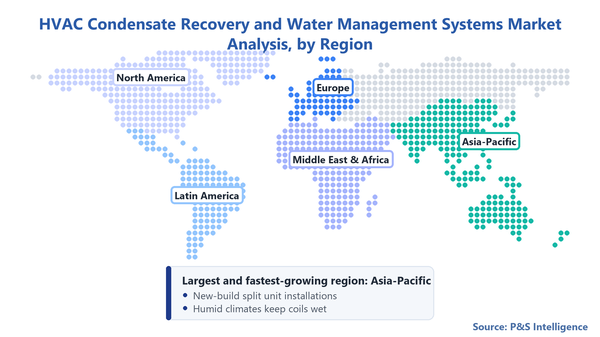
Asia-Pacific accounts for 38% of 2026 revenue and is projected to grow fastest, at a 6.7% CAGR during 2027-2033, as new apartments, offices, and factories in China, India, Vietnam, and Indonesia are fitted with wall-mounted split units that each need a drain line or mini pump. North America, led by the U.S. and Canada, is the next-largest source of demand in the HVAC condensate recovery and water management systems market. Spending there leans toward pumps, float switches, and secondary pans that protect finished ceilings and floors in homes with attic, closet, or basement air handlers.
Key market insights
By product type, condensate pumps account for the largest share of 2026 revenue, while condensate neutralizers & treatment are projected to grow at an 8.2% CAGR during 2027-2033.
By equipment type, air conditioning systems account for 59% of 2026 revenue, while heating systems (condensing boilers, furnaces & heat pumps) are projected to grow fastest during 2027-2033.
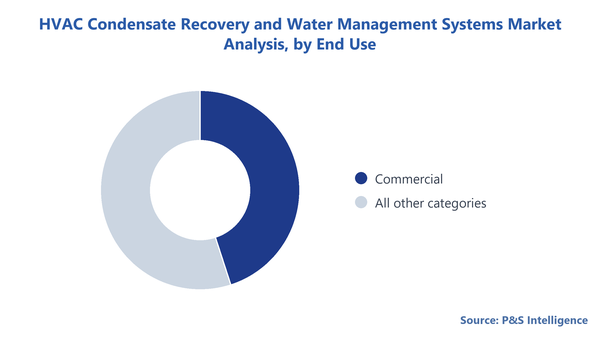
By end use, commercial accounts for 45% of 2026 revenue, while residential is projected to grow at an 8.0% CAGR during 2027-2033.
By geography, Asia-Pacific accounts for 38% of 2026 revenue and is also projected to grow fastest, at a 6.7% CAGR during 2027-2033.
HVAC Condensate Recovery and Water Management Systems Market Growth Drivers & Challenges
Float-free level sensing is reshaping mini pump design
Contractors installing ductless and concealed indoor units are now being offered mini pumps that sense water electronically and adjust motor speed to the inflow, replacing the mechanical float. A float can stick when slime or debris builds up in the reservoir, and a stuck float is one route to an overflow inside an occupied room. Variable-speed operation also lets the pump run more quietly, which matters when it sits behind a bedroom or office wall unit and the occupant hears every cycle.
At least two brands selling into North America announced mini pump lines in January 2026 that pair capacitive level sensing with variable-speed control. For installers, the selection checklist widens from flow rate and lift height to sensing method and noise rating. Pump makers still selling only float-based designs could face price pressure in residential ductless work, while sensor-based models give their makers a basis to compete on quiet, low-maintenance installations instead of on price alone.
Condensing heating and heat pump installations are fueling neutralizer and lift pump purchases
Air-to-water heat pumps and condensing boilers are moving condensate management into the heating trade. Condensing appliances produce acidic condensate that installers commonly route through a neutralizer before it reaches the drain, and where the appliance sits below the drain line, a lift pump is needed too. Reversible heat pumps used for summer cooling add indoor-coil condensate. These jobs turn heating installers, a group that once bought few drainage accessories, into regular buyers of neutralizer cartridges, neutralizing pumps, and condensate lifts.
The European Heat Pump Association puts 2025 heat pump sales at 2.9 million units across 21 European countries, a 13% rise on 2024. That count measures heating equipment entering service, not neutralizer or pump uptake, since many heat pumps drain by gravity. It does show heating installers fitting more heat pumps in 2025 than a year earlier. Accessory brands that already sell through plumbing and heating wholesalers are better positioned to capture this sale than brands that reach only cooling contractors.
Large-building water reuse is opening a market for engineered recovery systems
Owners of large commercial and institutional buildings are starting to treat air handler condensate as a water supply that can offset cooling tower make-up and irrigation. Recovering it calls for a collection tank, filtration, disinfection, transfer pumps, and controls, which lifts the condensate purchase from a low-cost drain accessory to an engineered system specified for each building. That shift raises revenue per site and brings mechanical engineers and water treatment specialists into a decision once left to the installing contractor.
According to a July 2026 summary from the U.S. Environmental Protection Agency, a 100,000 square foot building in a humid zone can produce one million gallons of air conditioning condensate a year. The same work found potential for microbial growth and metals leaching in untreated collections and advised managing them like other building water systems. Recovery packages that include treatment, monitoring, and building automation links match that guidance more closely than bare storage tanks, which favors system builders able to document water quality.
Swings in cooling equipment shipments are limiting accessory volume planning
Most condensate pumps, pans, traps, and overflow switches are bought on the same job as a new or replacement air conditioner, heat pump, or furnace, so their volume rises and falls with equipment shipments. When a cooling season disappoints, residential contractors fit fewer systems, distributors hold surplus accessory stock, and reorders to pump and switch makers slow until shelves clear. Accessory makers therefore plan production around an installation season they cannot see in advance.
The Air-Conditioning, Heating, and Refrigeration Institute recorded U.S. shipments of central air conditioners and air-source heat pumps of 6,390,257 units in January-August 2026, up 6.2% on the same months of 2025 but still below the 6,735,792 units shipped in that period of 2024. These counts size the equipment base, not condensate product sales, yet they show how far installation volume can move within two years. Companies with neutralizer sales into heating or recovery projects in commercial buildings are less exposed to a weak residential cooling year.
Segmentation Analysis
Product Type
Condensate pumps account for the largest share of the HVAC condensate recovery and water management systems market in 2026, because many installations cannot work without one. Gravity drainage only works when the coil sits above a drain, so wall-mounted splits on interior walls, ceiling cassettes, basement furnaces, and attic air handlers all need a pump to move water out. Pumps also cost more per unit than pans, traps, or treatment tablets, and many current models ship with a built-in overflow switch, folding two purchases into one line item. General sump pumps count here only when sold for HVAC condensate duty.
Condensate neutralizers and treatment are projected to record the quickest expansion, at an 8.2% CAGR during 2027-2033. Condensing boilers, furnaces, and water heaters produce acidic condensate, and installers fitting them into homes with metal drain pipes or septic systems commonly add a neutralizer cartridge to protect the pipework. Franklin Electric's Little Giant brand added the VCMA-20-NPTC neutralizing condensate pump in February 2025, combining a lift pump and neutralizing media in one housing, so a heating installer buys lift and treatment as one product. For wholesalers, heating installers become a second buyer group for a range once sold to cooling contractors.
Equipment Type
Air conditioning systems account for 59% of 2026 revenue. Cooling coils run wet for months each year, so every split unit, packaged rooftop unit, and ducted system needs a pan, trap, and drain line, and many residential and light commercial units also need a pump or overflow switch. Air conditioning is also where a blocked drain does the most visible damage, since overflow from an attic air handler or ceiling cassette lands on finished ceilings and floors. That risk supports the routine purchase of float switches and secondary pans on new installations, making them a standard line on cooling quotes.
Heating systems, covering condensing boilers, furnaces, and heat pumps, are set to post the fastest growth over the forecast period. Each switch from a conventional boiler to a condensing boiler or heat pump creates a condensate stream the old appliance did not have, so the heating job carries a drain, often a neutralizer, and sometimes a lift pump. Heating appliances also sit in plant rooms, basements, and lofts, where gravity drainage is harder to arrange than beside a wall-mounted cooling unit. Plumbing and heating wholesalers are likely to handle a growing share of condensate accessory sales as these jobs spread.
End Use
Commercial buildings account for 45% of 2026 revenue. Offices, retail centers, hotels, hospitals, and data centers run large air handlers and ceiling cassettes for long hours, which raises condensate volume per site and the number of pumps, switches, and pans fitted per project. Commercial sites are also the main end use for recovery systems, because a large air handler produces enough condensate to justify a tank, filtration, and transfer pump. Mechanical engineers specify these items at design stage, so manufacturers that get onto project specifications can win larger multi-unit orders instead of single-unit counter sales, often repeated floor by floor.
Residential is projected to grow fastest, at an 8.0% CAGR during 2027-2033. Homeowners replacing boilers with condensing models or heat pumps, and adding ductless mini-splits to rooms without ductwork, create condensate jobs in places that were never planned for drainage. A mini-split indoor unit on an interior wall typically needs a compact pump mounted in the unit or in the line-set cover, and noise matters because the pump runs in a bedroom or living room. Brands with quiet, slim pumps sold through HVAC wholesalers could capture more of these small, frequent installer orders as homeowners add cooling room by room.
The following segments are analyzed in this report:
Product Type
Condensate Pumps
Mini Pumps
Tank Pumps
Peristaltic Pumps
Condensate Neutralizers & Treatment
Overflow Switches & Monitoring Controls
Drain Pans, Traps & Lines
Condensate Recovery & Reuse Systems
Equipment Type
Air Conditioning Systems
Heating Systems (Condensing Boilers, Furnaces & Heat Pumps)
Refrigeration Systems
Air Handling & Dehumidification Units
End Use
Residential
Commercial
Industrial
Copyright P&S Intelligence. Reuse requires attribution under CC BY 4.0.
Geographical Outlook
Asia-Pacific HVAC condensate recovery and water management systems market outlook
Asia-Pacific accounts for 38% of the global market in 2026 and is also set to expand fastest, at a 6.7% CAGR during 2027-2033. The region makes and installs more air conditioners than any other, and most are wall-mounted split units fitted in new apartments, offices, and shops. Each indoor unit needs a drain line and pan, and units placed on interior walls or in older flats without a nearby drain need a mini pump. Hot, humid seasons in southern China, India, and Southeast Asia keep coils wet for much of the year, which raises condensate volume per unit.
China is the region's largest market. As per the China Household Electrical Appliances Association, domestic shipments of home air conditioners reached 110 million units in the 2025 cooling year, up 10.8%, while exports reached 99.29 million units. The domestic figure counts units shipped to the Chinese market, and the export figure shows how much Chinese output is installed in other countries. Neither measures condensate product sales, but both show the size of the equipment base that drain pans, pumps, and switches attach to, inside and outside China.
India is the region's fastest-growing market, as room air conditioner ownership climbs from a low base and new commercial floor space is cooled from the day it opens. Vietnam, Indonesia, and Thailand follow a similar path at smaller scale. Asia-Pacific's lead is likely to widen through 2033 because a large part of its demand comes from first-time installations, each of which needs a full set of drain products. Pump and accessory makers with low-cost production and supply agreements with regional air conditioner brands are better positioned in this price-sensitive market.
Copyright P&S Intelligence. Reuse requires attribution under CC BY 4.0.
North America market analysis
North America trails Asia-Pacific in revenue but buys a richer mix of products per installation. Ducted central systems are common in the U.S., and many air handlers and furnaces sit in attics, closets, and basements, where an overflow damages finished ceilings and floors. That placement supports purchases of float switches, secondary drain pans, and condensate pumps on many residential jobs. Natural Resources Canada sets a 95% AFUE minimum for most gas furnaces made on or after July 3, 2019, and furnaces at that efficiency drain acidic condensate that installers often neutralize or pump away.
Water reuse rules add a second source of commercial demand in water-stressed cities. San Antonio's City Code requires newly built commercial buildings installing air conditioning on or after January 1, 2006 to have a single, independent condensate line so the water can later serve process uses, cooling tower make-up, or irrigation. The code does not require a recovery system, but it builds a collection point into the design, which lowers the cost of adding tanks, transfer pumps, and treatment later. Builders of packaged recovery systems benefit when owners decide to use that water.
Europe market analysis
Europe's demand depends more on heating equipment than any other region's. Since September 26, 2015, Commission Regulation (EU) No 813/2013 has set seasonal efficiency floors for gas and oil boilers up to 70 kW that most non-condensing designs do not reach, and the U.K. retained it after leaving the EU. The text names no technology, yet most gas boilers now fitted in Germany, France, Italy, and the U.K. are condensing models, each sending acidic condensate to a drain, often through a neutralizer or a lift pump. Pump makers already selling circulators to plumbers have a ready route to this sale.
Southern European markets such as Italy, Spain, and Greece buy split air conditioners in volume, so pump and drain accessory sales there follow residential cooling more closely than in the north. Mini pumps for the region run on 230 V supplies and are often mounted inside the indoor unit or the line-set cover, which favors slim, quiet designs. Wholesalers serving both plumbers and air conditioning contractors are well placed to sell across the heating and cooling product streams, and they decide which pump brands installers see first.
Latin America market analysis
Latin America accounts for a smaller share of revenue, with Brazil and Mexico the main buyers. Hot, humid coastal cities and a large stock of wall-mounted split units in homes and small businesses tie most demand for drain lines, pans, and mini pumps to residential cooling. Commercial construction in northern Mexico, including factories and logistics buildings, adds rooftop and packaged units with longer drain runs and more need for pumps and overflow protection.
Argentina adds cooling-driven demand in Buenos Aires and other large cities, though spending there moves with household purchasing power. Across the region, most condensate products reach jobs through air conditioner distributors and wholesalers, and only large commercial projects are specified by engineers. Currency swings in Argentina and Brazil can raise the local price of imported pumps from one season to the next. Pump and accessory brands that ship through the same distributors as the major air conditioner brands are better placed to reach installers in volume.
Middle East & Africa market analysis
Middle East & Africa trails the larger regions in revenue, but Gulf states run air conditioning for most of the year, so coils in Saudi Arabia and the U.A.E. produce condensate for many more hours than in temperate markets. Malls, hotels, airports, and office towers use large air handling units whose condensate volume can justify collection, and the high cost of desalinated water gives owners a reason to reuse it for irrigation and cooling tower make-up.
South Africa adds demand from commercial buildings and from municipal water restrictions that have pushed property owners toward alternative water sources. In the Gulf, most condensate products are bought by mechanical contractors on new construction, which ties sales to the timing of building programs in Riyadh and Dubai. Manufacturers that hold stock in the Gulf and offer engineering support for recovery systems could gain more project specifications as owners look for cheaper water.
The following geographies are analysed in this report.
Asia-Pacific
China
Japan
India
South Korea
Australia
Vietnam
Thailand
Indonesia
Rest of Asia-Pacific
Europe
Germany
U.K.
France
Italy
Spain
Rest of Europe
Latin America
Brazil
Mexico
Argentina
Rest of Latin America
Middle East & Africa
Saudi Arabia
U.A.E.
South Africa
Rest of Middle East & Africa
North America
U.S.
Canada
HVAC Condensate Recovery and Water Management Systems Market Competition Analysis
The HVAC condensate recovery and water management systems market is moderately fragmented. Products are small and need little capital to make, and most reach installers through HVAC and plumbing wholesalers, so specialist pump brands, drain accessory makers, broad-line pump groups, and regional assemblers compete for the same shelf space. Voltage and mounting needs differ by region, which keeps local brands relevant. Many competitors also sell condensate products as one line among several. The structure is consolidating slowly through acquisitions, such as Aspen Pumps Group's purchase of Malco Tools and Verder Group's majority stake in Sauermann, both in 2024.
Specialist condensate pump makers, including Aspen Pumps Group, Sauermann Industrie, and Franklin Electric through its Little Giant brand, compete on mini pump noise, size, and sensing technology for ductless and concealed units. A second cluster, including DiversiTech Corporation and CSW Industrials through RectorSeal, sells pans, switches, traps, and treatment alongside pumps, giving wholesalers a single condensate range. Broad pump groups such as Grundfos, WILO, and Liberty Pumps reach the market through drainage and lifting products, while Spirax Group and Armstrong International, known mainly for steam condensate return, also offer condensate handling equipment for larger buildings.
Switching costs for contractors are low, since most pumps within a region share standard fittings and supply voltages, so competition for residential and light commercial work turns on wholesaler listings, installer familiarity, and warranty terms. Engineered recovery systems for commercial buildings follow a different path. Mechanical engineers write the specification, and the selection tends to favor firms that can show treatment performance, controls integration, and local code acceptance for the reused water.
Major Companies in HVAC Condensate Recovery and Water Management Systems Market:
Aspen Pumps Group Limited
Sauermann Industrie SAS
Franklin Electric Co. Inc.
DiversiTech Corporation
CSW Industrials Inc.
Xylem Inc.
Pentair plc
Grundfos Holding A/S
Spirax Group plc
Armstrong International Inc.
Zoeller Company
Liberty Pumps Inc.
Shippensburg Pump Company Inc.
Watson McDaniel Company
WILO SE
HVAC Condensate Recovery and Water Management Systems Market News
In June 2026, WILO SE unveiled NovaCON, a condensate lifting unit for condensing boilers up to 50 kW and air conditioning systems, rated at 380 l/h maximum flow and 4.5 m head, with an integrated float switch and non-return valve, at InstallerSHOW in Birmingham. The launch takes a circulator pump group directly into the heating installer’s condensate purchase.
In January 2026, Aspen Pumps Group Limited, through its North American business The Malco Group, announced Silent+ Gen5 Series and Mini White mini pumps that combine capacitance level sensing with variable-speed flow control, citing operation as low as 16 dB(A), ahead of their AHR Expo 2026 debut. Electronic level sensing lets installers choose a pump on noise and reliability as well as on lift and flow.
In January 2026, CSW Industrials Inc., through its RectorSeal brand, launched Ghost Mini Pumps for ductless mini-split systems in four mounting configurations (Elbow, External, Remote, and Internal), rated for 100-240 V and pairing a capacitive level sensor with an overflow switch. Like-for-like SKUs matching outgoing models let distributors change over inventory without re-cataloging.
Last Updated: October 2026
Frequently Asked Questions About This Report
How big is the HVAC condensate recovery and water management systems market?+
The global HVAC condensate recovery and water management systems market size is estimated at USD 546.72 million in 2026 and is projected to reach USD 576.52 million in 2027.
Why do I need a condensate pump for my HVAC system?+
Gravity drainage only works when the coil sits above a drain, so wall-mounted splits on interior walls, ceiling cassettes, basement furnaces, and attic air handlers all need a pump to move water out.
Why does a condensing furnace or boiler need a condensate neutralizer?+
Condensing boilers, furnaces, and water heaters produce acidic condensate, and installers fitting them into homes with metal drain pipes or septic systems commonly add a neutralizer cartridge to protect the pipework.
How much condensate water does a building's air conditioning produce?+
According to a July 2026 summary from the U.S. Environmental Protection Agency, a 100,000 square foot building in a humid zone can produce one million gallons of air conditioning condensate a year.
Which region leads the HVAC condensate recovery and water management systems market?+
Asia-Pacific accounts for 38% of the global market in 2026 and is also set to expand fastest, at a 6.7% CAGR during 2027-2033.
Who are the main condensate pump manufacturers?+
Specialist condensate pump makers, including Aspen Pumps Group, Sauermann Industrie, and Franklin Electric through its Little Giant brand, compete on mini pump noise, size, and sensing technology for ductless and concealed units.
Want a report tailored exactly to your business need?
Leading companies across industries trust us to deliver data-driven insights and innovative solutions for their most critical decisions. From data-driven strategies to actionable insights, we empower the decision-makers who shape industries and define the future. From Fortune 500 companies to innovative startups, we are proud to partner with organisations that drive progress in their industries.
Client Testimonials
Working with P&S Intelligence and their team was an absolute pleasure – their awareness of timelines and commitment to value greatly contributed to our project's success. Eagerly anticipating future collaborations.
McKinsey & Company
India
Unmatched Standards
Our insights into the minutest levels of the markets, including the latest trends and competitive landscape, give you all the answers you need to take your business to new heights
Complete Data Security
We take a cautious approach to protecting your personal and confidential information. Trust is the strongest bond that connects us and our clients, and trust we build by complying with all international and domestic data protection and privacy laws