Home Hydroponics Market Size & Share Analysis - Emerging Trends, Growth Opportunities, Competitive Landscape, and Forecasts (2026 - 2032)
This Report Provides In-Depth Analysis of the Home Hydroponics Market Report Prepared by P&S Intelligence, Segmented by Product Type (Hydroponic Growing Systems, Components), System Type (Aggregate Systems, Liquid Systems), Crop Type (Leafy Greens & Herbs, Fruits & Vegetables, Flowers), Distribution Channel (Online, Offline), and Geographical Outlook for the Period of 2021 to 2032
Explore the market potential with our data-driven report
Home Hydroponics Market Analysis
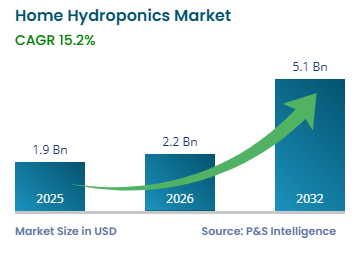
The home hydroponics market size was USD 1.9 billion for 2025, and it will grow by 15.2% during 2026–2032, to reach USD 5.1 billion by 2032.
The market growth is driven by accelerating urbanization that limits access to traditional gardening space, a growing consumer preference for pesticide-free and self-sustained food production, and the increasing availability of affordable, app-enabled growing systems that simplify cultivation for first-time users. Compact soil-less cultivation methods, including wick and drip systems as well as simplified small-scale variants of Deep Water Culture and Nutrient Film Technique, are gaining traction as space-efficient and indoor-friendly solutions tailored for residential use.
This adoption trend is further reinforced by global demographic patterns, with the Food and Agriculture Organization indicating that around 55% of the global population currently resides in urban areas, a figure projected to reach 68% by 2050, leading to increasing space constraints and driving interest in home-based food production. In addition, hydroponic systems offer significant resource efficiency, using up to 90% less water than conventional soil-based agriculture, making them highly suitable for water-constrained urban environments. Furthermore, governments across various regions are promoting controlled environment agriculture and urban farming initiatives to enhance food security and sustainability, which is further encouraging the adoption of small-scale hydroponic systems in residential settings.
Key Market Insights
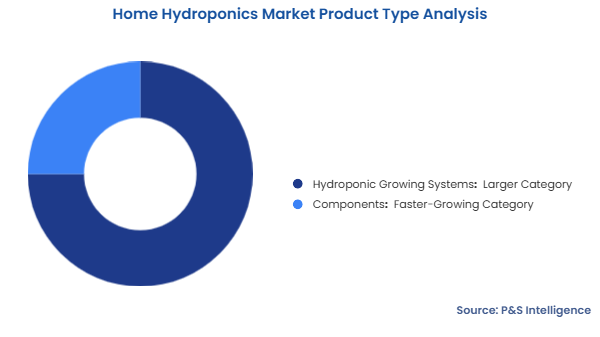
The hydroponics growing systems category holds the larger market share, of 75%, in 2025, driven by its role as the core infrastructure for indoor cultivation.
The liquid systems category will have the higher CAGR, of approximately 15.8%, driven by superior efficiency and faster plant growth rates.
The leafy greens & herbs category holds the largest market share, of 45% in 2025, driven by their short growth cycles, low maintenance requirements, and high suitability for indoor cultivation.
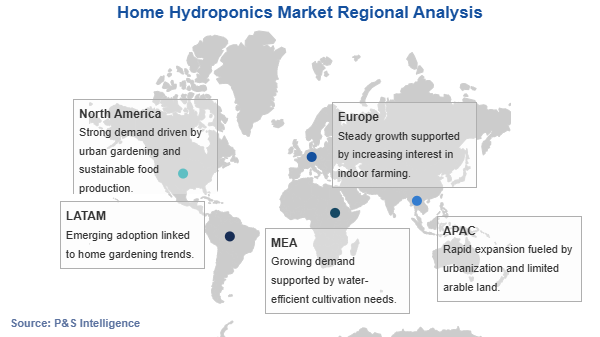
North America holds the largest market share, of 40%, in 2025, driven by strong consumer awareness, widespread adoption of indoor farming, and advanced retail and e-commerce infrastructure.
Asia-Pacific will have the highest CAGR, of approximately 16.1%, driven by rising urban density and increasing food security concerns.
Home Hydroponics Market Dynamics
Increasing Adoption of Urban Farming and Indoor Agriculture Are Key Trends
A major trend in the home hydroponics market is the increasing adoption of urban farming and indoor agriculture. Evolving consumer lifestyles and a growing preference for fresh, locally sourced food are reshaping demand for at-home cultivation. Hydroponic systems enable individuals to cultivate vegetables and herbs within compact indoor settings, such as apartments and urban residences. This compatibility makes them well-suited for modern living environments. The availability of user-friendly technologies, including LED grow lights and automated nutrient delivery systems, is simplifying system operation and expanding adoption beyond specialized growers to everyday consumers.
Institutional support is also playing a role in accelerating this trend. Governments and global organizations are promoting urban agriculture and controlled environment farming to strengthen food security and sustainability. The U.S. Department of Agriculture (USDA) has expanded its support for urban agriculture through its Office of Urban Agriculture and Innovative Production (OUAIP). In 2025, the USDA announced USD 14.4 million in grants and technical assistance funding for urban agriculture and innovative production projects, building on more than USD 53 million invested in urban agriculture initiatives since 2020, supporting indoor farming, hydroponics, vertical farming, and other controlled-environment agricultural technologies aimed at improving local food production and sustainability. Countries including Japan and Singapore are actively promoting indoor farming technologies through initiatives such as Singapore’s 30 by 30 food security goal to improve food resilience and reduce dependence on imported produce.
Rising Demand for Chemical-Free and Fresh Produce Is Biggest Driver
The increasing consumer preference for chemical-free, fresh, and locally grown produce is the primary driver of the home hydroponics market. Consumers are increasingly prioritizing transparency in food production and seeking greater control over the quality and safety of what they consume. Hydroponic systems enable cultivation in a controlled, soil-free environment, eliminating the need for conventional pesticides and allowing precise nutrient management. The Food and Agriculture Organization (FAO) reports that global demand for safe and high-quality food is rising steadily. Tightening food safety standards and increasing consumer awareness are driving this shift. This is particularly relevant for leafy greens and herbs, which are frequently consumed fresh and are more susceptible to contamination and residue concerns in conventional farming systems.
Rising awareness of nutrition and preventive healthcare is encouraging individuals to incorporate fresh vegetables into their diets, supporting the adoption of home-based cultivation solutions. The World Health Organization recommends a minimum intake of 400 grams of fruits and vegetables per day to reduce the risk of chronic diseases, highlighting the growing importance of consistent access to fresh produce. Policy support for sustainable and organic farming practices across various countries is reinforcing this shift. Governments are promoting environmentally responsible cultivation methods and encouraging reduced chemical usage in food production. Companies such as AeroGarden (Scotts Miracle-Gro) have introduced advanced smart indoor garden systems with app connectivity and automated nutrient control, making home hydroponics more user-friendly for everyday consumers.
High Initial Setup Costs and Technical Complexity Are Key Restraints
The home hydroponics market is constrained by the relatively high initial setup cost associated with system installation, including essential components such as grow lights, pumps, nutrient delivery systems, water reservoirs, and structural units. Unlike conventional home gardening, hydroponic systems require integrated hardware and controlled environment inputs, increasing the overall capital requirement for first-time users. This cost factor acts as a significant barrier, particularly for casual consumers and households considering hydroponics as a supplementary activity.
In addition to cost, operational complexity further limits widespread adoption. Effective cultivation requires careful management of nutrient balance, water circulation, and environmental conditions such as light and temperature, which can create usability challenges for first-time users. Variations in product quality and the lack of standardized system configurations add to this complexity, often requiring users to troubleshoot or adapt systems based on crop needs. The combination of high upfront investment and operational difficulty continues to restrict adoption, particularly among price-sensitive consumers.
Expansion of Smart Hydroponics and IoT Integration Is Biggest Opportunity
An important opportunity in the home hydroponics market lies in the integration of smart technologies and IoT-enabled systems. Advanced hydroponic setups equipped with sensors and control units can regulate key parameters such as nutrient levels, lighting, temperature, and water flow, improving consistency and reducing manual effort. This is enabling manufacturers to develop more user-friendly and differentiated solutions for urban households seeking convenient and low-maintenance food production systems.
The expansion of digital infrastructure and connected technologies is further supporting this opportunity. Integration with mobile applications, remote monitoring tools, and automated control platforms is becoming increasingly common, making hydroponic systems more accessible and efficient. Governments are also promoting digital agriculture and precision farming initiatives to enhance productivity and resource efficiency, with support from India’s Ministry of Agriculture and Farmers Welfare and the U.S. Department of Agriculture. In addition, the launch of smart indoor gardening systems such as Plantaform’s AI-enabled hydroponic garden at CES 2025 highlights the growing commercialization of IoT-based home farming solutions and the rising scalability of smart hydroponics.
Home Hydroponics Market Segmentation and Category Analysis
Product Type Analysis
The hydroponics growing systems category holds the larger market share, of 75%, in 2025, driven by its role as the core infrastructure for indoor cultivation. These systems integrate nutrient delivery, water circulation, and plant support, enabling efficient crop growth in controlled environments. Increasing consumer adoption of ready-to-use hydroponic kits is reinforcing the dominance of this segment.
The components category will have the higher CAGR, of approximately 15.5%, driven by rising demand for customization and system upgrades. Consumers are increasingly purchasing individual components such as LED grow lights and nutrient solutions to enhance system performance. The U.S. Department of Energy highlights that LED lighting adoption is increasing due to energy efficiency improvements of over 75% compared to traditional lighting, supporting demand for grow lights in hydroponic systems.
The product types analyzed in this report are:
Hydroponic Growing Systems (Larger Category)
Components (Faster-Growing Category)
Grow Lights
Pumps & Irrigation
Water Reservoirs
Nutrients
Others
System Type Analysis
The aggregate systems category holds the larger market share, of 70%, in 2025, driven by their simplicity, affordability, and suitability for beginner-level home users. Systems such as drip, wick, and ebb & flow require minimal technical expertise and are easier to install and maintain compared to advanced systems. Their low operational complexity and cost-effectiveness make them widely adopted among first-time users and households adopting hydroponics for basic cultivation needs.
The liquid systems category will have the higher CAGR, driven by superior efficiency and faster plant growth rates. Technologies such as Nutrient Film Technique (NFT), Deep Water Culture (DWC), and aeroponics provide direct nutrient delivery to plant roots, significantly improving yield and growth consistency. These systems are increasingly being adopted by experienced users seeking higher productivity and optimized plant performance. In addition, their compatibility with automation and smart hydroponics solutions is further accelerating adoption among tech-savvy consumers.
The system types analyzed in this report are:
Aggregate Systems (Larger Category)
Ebb & Flow (Flood & Drain)
Wick Systems
Drip Systems
Liquid Systems (Faster-Growing Category)
Deep Water Culture (DWC)
Nutrient Film Technique (NFT)
Aeroponics
Crop Type Analysis
The leafy greens & herbs category holds the largest market share in 2025, driven by their short growth cycles, low maintenance requirements, and high suitability for indoor cultivation. Crops such as lettuce, spinach, and basil require less space and grow efficiently in controlled environments, making them ideal for home hydroponic systems. Their consistent demand and ease of harvesting further support widespread adoption among households. A peer-reviewed analysis published in Frontiers in Plant Science (2025) confirmed that lettuce is the most cultivated cash crop in hydroponic systems globally, thriving across NFT and substrate-based configurations with shorter maturation periods than soil-grown equivalents.
The fruits & vegetables category will have the highest CAGR, of approximately 15.7%, driven by increasing consumer interest in growing high-value and nutrient-rich crops at home. Crops such as tomatoes, peppers, and strawberries require more advanced hydroponic systems, which is encouraging users to upgrade from basic setups.
The crop types analyzed in this report are:
Leafy Greens & Herbs (Largest Category)
Fruits & Vegetables (Fastest-Growing Category)
Flowers
Others
Distribution Channel Analysis
The online category holds the larger market share in 2025, and it will have the higher CAGR, of approximately 15.9%, driven by superior accessibility, wide product availability, and increasing consumer preference for digital purchasing. Online platforms allow users to compare features, prices, and reviews while offering convenient doorstep delivery, making them the preferred channel for both first-time and experienced hydroponics users. Additionally, the United Nations Conference on Trade and Development reports that total global e-commerce, including both B2B and B2C transactions, has surpassed USD 27 trillion, reflecting the rapid expansion of digital trade worldwide. This growth enables manufacturers to directly reach end users, leverage targeted marketing strategies, and enhance product visibility, thereby reinforcing the dominance and accelerating the growth of online distribution in the home hydroponics market.
The expansion of premium hydroponic produce in retail is also contributing to market growth. For instance, in July 2025, Edible Garden AG Incorporated introduced the first USDA-certified organic hydroponic basil plant in the U.S., sold in a living, root-on format, strengthening the presence of hydroponic products in mass retail channels.
The distribution channels analyzed in this report are:
Online (Larger and Faster-Growing Category)
Offline
Drive strategic growth with comprehensive market analysis
Home Hydroponics Market Regional Outlook
North America Home Hydroponics Market Size
North America holds the largest market share, of 40%, in 2025, driven by high consumer awareness, strong adoption of indoor farming technologies, and advanced retail and e-commerce infrastructure. The region benefits from a well-established culture of home gardening, along with increasing demand for fresh, high-quality produce. Urban households are increasingly adopting hydroponic systems to ensure consistent access to food within limited residential spaces. Institutional support for urban agriculture strengthens regional leadership. The United States promotes indoor farming, local food systems, and sustainable cultivation practices through multiple initiatives that support residential adoption.
Within the region, Canada represents a faster-growing market, supported by national efforts focused on food security and controlled environment agriculture. The country’s colder climate and shorter growing seasons make hydroponic systems a practical solution for year-round cultivation. Government-backed programs supporting greenhouse and indoor farming are encouraging domestic food production. Agriculture and Agri-Food Canada (AAFC) supports controlled environment agriculture through funding and innovation initiatives, aiming to enhance greenhouse productivity and enable year-round cultivation. Rising consumer preference for locally grown produce is driving adoption at the household level, contributing to the continued expansion of the home hydroponics market across North America.
U.S. Home Hydroponics Market Size
The U.S. is the larger market for home hydroponics, driven by high consumer awareness, widespread adoption of indoor gardening technologies, and strong demand for fresh and high-quality produce. The country has a well-established home gardening culture, which is increasingly shifting toward hydroponic systems due to their efficiency and suitability for urban living. The rapid growth of e-commerce platforms and smart home technologies is improving accessibility to hydroponic kits and automated systems. The expansion of online retail channels is enabling brands such as AeroGarden and Rise Gardens to reach consumers across geographically dispersed markets.
Adoption is also expanding beyond major urban centers into suburban and secondary markets, broadening the overall consumer base. The U.S. Department of Agriculture (USDA) reported in July 2024 that its Urban Agriculture and Innovative Production (UAIP) grants program received over 620 applications, double the previous year's total. This volume reflects growing grassroots momentum in urban food production across the country. Government support for urban agriculture and controlled environment farming strengthens the U.S. position as the leading market for home hydroponics globally, reinforced further by high disposable income levels and early adoption of innovative technologies.
Asia-Pacific Home Hydroponics Market Size
Asia-Pacific will have the highest CAGR, of approximately 16.1%, driven by high urban population density and increasing food security concerns, which are accelerating demand for space-efficient cultivation solutions. Government-led agricultural modernization initiatives across the region are promoting indoor and soil-less farming as strategic responses to these pressures. The United Nations reports that Asia accounts for over 50% of the global urban population, creating substantial pressure on traditional food supply systems and accelerating the need for space-efficient food production solutions. India represents the fastest-growing country market, driven by rising urbanization, increasing disposable incomes, and expanding awareness of home-based food production. The Government of India is facilitating investment in modern agriculture through initiatives such as the Agri Infrastructure Fund, supporting the adoption of technology-driven and controlled environment farming solutions. Meanwhile, Japan, South Korea, and Australia represent more mature markets, characterized by high technology adoption, premium product demand, and well-established retail infrastructure for indoor gardening.
The Food and Agriculture Organization (FAO) highlights that indoor farming supports efficient crop production in limited spaces while optimizing energy and resource use, making it particularly relevant in densely populated urban environments. These advantages are especially significant across Asia-Pacific’s megacities, where limited residential space and rising demand for reliable food access are encouraging the adoption of compact and efficient home hydroponic systems. In Australia, government support for controlled environment agriculture is reflected through initiatives led by the Department of Agriculture, Fisheries and Forestry, which promote sustainable farming practices and greenhouse-based food production to support year-round cultivation.
China Home Hydroponics Market Size
China is the largest country market in Asia-Pacific, driven by its extensive agricultural production base, strong government support for controlled environment agriculture, and increasing adoption of indoor farming technologies. The National Bureau of Statistics of China reports consistently high agricultural output levels, while the country remains the world’s largest producer of vegetables, creating substantial demand for efficient and high-quality cultivation methods. In addition, the Ministry of Agriculture and Rural Affairs continues to promote investments in smart agriculture and modern farming technologies aimed at improving productivity and food security. Rising urbanization, exceeding 65% of the population, along with increasing consumer preference for fresh produce, is further accelerating the adoption of home hydroponics systems, reinforcing China’s position as the leading market in the region.
The regions and countries analyzed in this report include:
North America (Largest Region)
U.S. (Larger Country Market)
Canada (Faster-Growing Country Market)
Europe
Germany (Largest Country Market)
U.K. (Fastest-Growing Country Market)
France
Italy
Spain
Rest of Europe
Asia-Pacific (Fastest-Growing Region)
China (Largest Country Market)
India (Fastest-Growing Country Market)
Japan
South Korea
Australia
Rest of APAC
Latin America
Brazil (Largest Country Market)
Mexico (Fastest-Growing Country Market)
Rest of LATAM
Middle East & Africa
Saudi Arabia (Largest Country Market)
South Africa
U.A.E. (Fastest-Growing Country Market)
Rest of MEA
Home Hydroponics Market Competitive Landscape
The market is fragmented, characterized by the presence of numerous small and medium-sized players offering a wide range of systems, kits, and components across different price segments. The market structure is driven by the easy availability of basic hydroponic technology and increasing consumer interest in indoor gardening, enabling new entrants to participate. However, competition is primarily based on product differentiation, including system design, ease of use, automation features, and energy efficiency. Barriers to entry arise from the need to develop reliable and user-friendly systems, integrate smart technologies such as IoT-based monitoring, and establish strong distribution and brand presence. Established companies benefit from product credibility and wider reach, while continuous innovation remains essential to sustain competitiveness.
Top Companies in the Home Hydroponics Market:
The Scotts Company LLC
AeroGrow International, Inc.
Click & Grow LLC
Gardyn, Inc.
Rise Gardens, Inc.
Lettuce Grow, Inc.
Hydrofarm Holdings Group, Inc.
GrowGeneration Corp.
InFarm GmbH
LG Electronics Inc.
Heliospectra AB
Plantui Oy
Home Hydroponics Market News
In October 2025, Gardyn, Inc. launched Studio 2, a compact AI-powered hydroponic system for small spaces, featuring automated watering, smart lighting, HD camera monitoring, and capacity for 16 plants, strengthening its strategy to simplify residential hydroponic cultivation.
In June 2025, GrowGeneration Corp. acquired Viagrow, a hydroponic equipment supplier with USD 3 million in revenue, expanding its distribution across major retail and e-commerce channels, including Amazon, Home Depot, and Walmart.
In August 2024, Heliospectra AB partnered with Tomatoworld to deploy advanced LED grow lighting systems in a 3-year program, supporting validation of energy-efficient technologies with implications for hydroponic systems.
In November 2023, Click & Grow LLC partnered with Urban Cultivator to scale production of smart plant pods, enhancing its manufacturing and distribution capabilities across Europe and North America.
Frequently Asked Questions About This Report
What is driving the growth of the home hydroponics market?+
The market is growing due to rising urbanization, limited arable land, increasing demand for fresh pesticide-free food, adoption of smart indoor farming technologies, and growing interest in sustainable living.
What are the key trends in the home hydroponics market?+
Key trends include smart IoT-enabled hydroponic systems, AI-based plant monitoring, compact countertop gardening kits, integration with mobile apps, and rising demand for automated indoor farming solutions.
What are the major challenges in the home hydroponics market?+
High initial system cost, technical complexity for beginners, dependence on electricity, maintenance requirements, and limited awareness in developing regions are major challenges.
Which region is leading the home hydroponics market growth?+
North America currently leads due to the high adoption of indoor gardening technologies.
What are the opportunities in the home hydroponics market?+
Opportunities include expansion of smart hydroponic systems, subscription-based nutrient services, integration with IoT platforms, and increasing demand from urban households for self-grown fresh produce.
Want a report tailored exactly to your business need?
Leading companies across industries trust us to deliver data-driven insights and innovative solutions for their most critical decisions. From data-driven strategies to actionable insights, we empower the decision-makers who shape industries and define the future. From Fortune 500 companies to innovative startups, we are proud to partner with organisations that drive progress in their industries.
Client Testimonials
Working with P&S Intelligence and their team was an absolute pleasure – their awareness of timelines and commitment to value greatly contributed to our project's success. Eagerly anticipating future collaborations.
McKinsey & Company
India
Unmatched Standards
Our insights into the minutest levels of the markets, including the latest trends and competitive landscape, give you all the answers you need to take your business to new heights
Complete Data Security
We take a cautious approach to protecting your personal and confidential information. Trust is the strongest bond that connects us and our clients, and trust we build by complying with all international and domestic data protection and privacy laws