This Report Provides In-Depth Analysis of the Heart Pump Devices Market Report Prepared by P&S Intelligence, Segmented by Product (Ventricular-Assist Devices, Intra-Aortic Balloon Pumps, Total Artificial Hearts), Type (Implanted, Extracorporeal), Therapy (Bridge-to-Transplant, Bridge-to-Candidacy, Destination Therapy), End User (Hospitals, Cardiac Centers, Ambulatory Surgical Centers), and Geographical Outlook for the Period of 2019 to 2032
Explore the market potential with our data-driven report
Heart Pump Devices Market Future Outlook
The heart pump devices market size was USD 3.2 billion in 2024, which is predicted to reach USD 16.2 billion by 2032, growing at a CAGR of 22.6% during 2025–2032.
This is due to the growing cardiovascular disease incidence, increasing geriatric population, and various new product launches by market players.
Globally, heart failure is one of the most-common problems. It is a complex clinical syndrome characterized by the abnormal functioning of the heart, which leads to an insufficient cardiac output. According to the Global Burden of Heart Failure article published by the NCBI in 2023, more than 65 million people are affected by this condition worldwide. An artificial heart pump can temporarily help in the pumping action of the heart.
Various CVD and hypertension diseases affect the proper functioning of the circulatory system. The risk of cardiac arrest and the above-mentioned CVDs is especially high for people consuming lots of processed meat, alcohol, and sodium-rich products. Therefore, the rapid globalization, coupled with unhealthy lifestyles, is supporting the advance of the market, as they are the primary external risk factors for CVDs. According to the Centers for Disease Control and Prevention data, coronary heart disease is the most-common CVD, with approximately 20.3 million adults 20 years or older suffering from it in the U.S.
Furthermore, the unavailability/shortage of heart donors delays the transplantation procedure. As per government sources, in 2023, nearly 4,150 people needed heart transplants, and approximately 3,400 people were on the active waiting list in the U.S. The surge in the count of patients suffering from irreversible end-stage heart failure and waiting for a transplant has led to an increase in the demand for cardiac pump devices due to the shortage of donor organs.
Additionally, the rising geriatric population is a major factor driving the growth of the market. The U.S. has the third-fastest-growing geriatric population after China and Japan. According to the U.S. Census Bureau, in 2021, there were around 55,892,050 persons aged 65 years and above in the U.S. With the rise in age, the population tends to become more susceptible to cardiovascular diseases.
Heart Pump Devices Market Emerging Trends
Technological Advancements Are the Key Trend
The miniaturization of pump components is enabling implantation in smaller patients and reducing surgical complexity.
The development of continuous-flow ventricular assist devices is offering higher durability and reduced mechanical wear compared to pulsatile systems.
The introduction of fully implantable systems with transcutaneous energy transfer is eliminating percutaneous drivelines and lowering infection risks.
The U.S. National Institutes of Health (NIH) allocated substantial funding through the National Heart, Lung, and Blood Institute (NHLBI) for clinical trials evaluating next-generation ventricular assist devices and total artificial hearts, with a focus on improving long-term outcomes and reducing complications.
The enhanced biocompatibility of blood-contacting surfaces is minimizing hemolysis and thromboembolic events.
The integration of remote monitoring platforms is enabling real-time device performance tracking and clinical decision support.
The advances in minimally invasive implantation techniques are reducing recovery time and procedural risks.
The improvements in battery technology and portable power systems are allowing greater patient mobility.
The design refinements in pump geometry and flow pathways are optimizing hemodynamics and reducing adverse events.
Rising Prevalence of Cardiovascular Diseases Is Driving Market Growth
The escalating global burden of cardiovascular diseases serves as the primary catalyst for heart pump devices market expansion.
Cardiovascular diseases remain the leading cause of mortality worldwide, with heart failure representing a critical endpoint for various cardiac conditions, including coronary artery disease, hypertension, and valvular disorders.
According to the World Health Organization, cardiovascular diseases account for approximately 17.9 million deaths annually, representing 32% of all global deaths.
The progression from initial cardiac dysfunction to advanced heart failure creates a substantial patient population requiring mechanical circulatory support interventions.
The demographic transition toward an aging population significantly amplifies the demand for heart pump devices.
Advanced age constitutes a primary risk factor for heart failure development, with prevalence rates doubling with each decade of life after age 65.
The National Institutes of Health reports that heart failure affects approximately 2% of the population aged 40–59, increasing to more than 8% in those aged 75 and above.
This age-related increase in heart failure incidence, combined with improved survival rates from acute cardiac events, results in a growing cohort of patients progressing to advanced heart failure stages requiring mechanical support.
Furthermore, the rising prevalence of comorbid conditions such as diabetes, obesity, and hypertension contributes substantially to heart failure development.
The International Diabetes Federation estimates that 537 million adults globally have diabetes, with cardiovascular complications representing the primary cause of morbidity and mortality in this population.
The synergistic effects of multiple cardiovascular risk factors accelerate cardiac dysfunction progression, ultimately necessitating advanced therapeutic interventions, including heart pump device implantation.
Heart Pump Devices Market Segmentation and Category Analysis
Product Analysis
The ventricular-assist devices category held the largest market share, of 55%, in 2024, and it will grow at the highest CAGR during the forecast period. This group of devices—which includes left ventricular assist devices (LVADs), percutaneous ventricular assist devices (PVADs), biventricular assist devices (BiVADs), and right ventricular assist devices (RVADs)—is widely used for patients with advanced heart failure, either as a bridge to transplantation, destination therapy, or temporary support. Among these, LVADs dominate the market, holding the highest share due to their proven clinical benefits and widespread adoption in both acute and chronic heart failure management.
The strong demand for VADs is driven by technological advancements that improve patient outcomes, a rising prevalence of end-stage heart failure, and expanding eligibility for device implantation. This segment is also experiencing the fastest growth rate, reflecting increasing adoption worldwide, improvements in minimally invasive implantation techniques, and growing clinical evidence supporting long-term use. In contrast, other categories such as intra-aortic balloon pumps and total artificial hearts occupy smaller market shares and are growing at slower rates, primarily due to more limited indications and competition from newer, more effective VAD technologies.
The products analyzed here are:
Ventricular-Assist Devices (Largest and Fastest-Growing Category)
Left ventricular-assist device (LVAD)
Percutaneous ventricular-assist device (PVAD)
Biventricular ventricular-assist device (BIVAD)
Right ventricular-assist device (RVAD)
Intra-Aortic Balloon Pumps
Total Artificial Hearts
Type Analysis
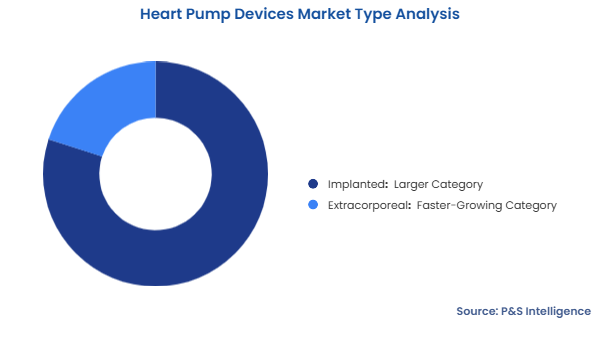
The implanted category held the larger market share, of 80%, in 2024, reflecting the predominance of durable mechanical circulatory support systems for long-term heart failure management. Implanted devices, particularly continuous-flow left ventricular assist devices, have demonstrated superior outcomes in both bridge-to-transplant and destination therapy applications. The development of fully implantable systems with transcutaneous energy transfer capabilities continues to advance, potentially eliminating the need for percutaneous drivelines and their associated infection risks.
The extracorporeal category will grow at the higher CAGR during the forecast period, driven by their critical role in providing temporary mechanical support during acute cardiac decompensation or high-risk procedures. The advantages of extracorporeal systems include rapid deployment capability, reversibility, and the ability to provide biventricular or cardiopulmonary support. Technological advances in circuit design, anticoagulation protocols, and cannulation techniques have improved the safety profile of extracorporeal support, expanding utilization in cardiac surgery and interventional cardiology settings.
The types analyzed here are:
Implanted (Larger Category)
Extracorporeal (Faster-Growing Category)
Therapy Analysis
The bridge-to-transplant category held the largest market share, of 65%, in 2024. This dominance is primarily due to the persistent gap between the number of patients requiring heart transplants and the availability of donor organs, which often results in prolonged waiting periods. BTT therapy provides critical circulatory support for patients with end-stage heart failure while they await transplantation, ensuring they remain stable enough to undergo the procedure when a donor heart becomes available.
The destination therapy category will grow at the highest CAGR during the forecast period. The rapid growth of DT is driven by an expanding patient pool, improvements in continuous-flow ventricular assist devices, and broader reimbursement coverage in many healthcare systems. The increasing clinical evidence demonstrating quality-of-life improvements and extended survival for non-transplant candidates is further accelerating the adoption of DT, making it the most dynamic segment in terms of market expansion.
The hospitals category held the largest market share, of 60%, in 2024.This is because most heart pump device implantations, particularly those involving ventricular assist devices and total artificial hearts, require advanced surgical facilities, intensive care units, and specialized cardiac teams—resources that are concentrated in tertiary care hospitals. These institutions also manage the majority of bridge-to-transplant and destination therapy patients, offering comprehensive pre-operative, surgical, and post-operative care under one roof. Their ability to handle high-risk procedures, provide continuous patient monitoring, and manage complications positions them as the primary centers for heart pump utilization.
The ambulatory surgical centers category will grow at the highest CAGR during the forecast period. Growth in this category is being fueled by the healthcare industry’s gradual shift toward outpatient cardiac care, supported by advancements in minimally invasive implantation techniques, shorter recovery times, and cost-efficiency advantages. ASCs are increasingly used for certain short-term mechanical circulatory support procedures and follow-up interventions that do not require prolonged hospital stays. As technology continues to reduce device size, improve ease of implantation, and lower complication rates, ASCs are expected to capture a growing share of select heart pump–related procedures, particularly in regions with strong reimbursement systems and an emphasis on lowering inpatient costs.
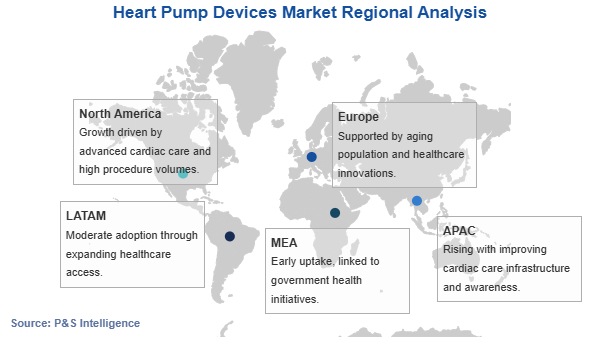
North America dominated the global heart pump devices market with a 40% share in 2024, driven by advanced healthcare infrastructure, favorable reimbursement policies, and high prevalence of cardiovascular diseases in the region. The presence of leading device manufacturers, coupled with robust clinical research programs and early adoption of innovative technologies, reinforces North America's market leadership. The region's well-established mechanical circulatory support programs, with over 200 centers offering ventricular assist device therapy, provide comprehensive coverage for the advanced heart failure population.
U.S. Heart Pump Devices Market
The U.S. represents the largest country market within North America, accounting for approximately 85% of regional revenue. According to the National Heart, Lung, and Blood Institute, heart failure affects approximately 6.7 million Americans, with annual healthcare expenditures exceeding USD 30 billion. The comprehensive Medicare coverage for both bridge-to-transplant and destination therapy indications has facilitated widespread adoption of heart pump devices across eligible patient populations. Furthermore, the presence of leading academic medical centers conducting pivotal clinical trials continues to drive innovation and establish treatment paradigms adopted globally.
Europe Heart Pump Devices Market Share
Europe represented the second-largest market, with a 30% share in 2024, supported by comprehensive national healthcare systems, aging demographics, and established cardiac surgery programs across major European countries. The region's emphasis on evidence-based medicine and stringent regulatory standards through CE marking ensures high-quality device adoption and patient safety. European clinical research initiatives, including multinational registries and randomized controlled trials, contribute significantly to the global evidence base supporting heart pump device utilization.
Asia-Pacific Heart Pump Devices Market Outlook
Asia-Pacific is projected to demonstrate the highest growth rate, of approx. 23.0%, during the forecast period, driven by rapidly developing healthcare infrastructure, increasing healthcare expenditure, and rising cardiovascular disease burden across the region. The expansion of cardiac surgery capabilities in emerging economies, combined with growing medical tourism for advanced cardiac procedures, creates substantial market opportunities. Government initiatives to improve cardiac care access and the establishment of specialized heart failure centers accelerate market growth across the region.
The regions and countries analyzed in this report are:
North America (Largest Regional Market)
U.S. (Larger Country Market)
Canada (Faster-Growing Country Market)
Europe
Germany (Largest Country Market)
U.K. (Fastest-Growing Country Market)
France
Italy
Spain
Rest of Europe
Asia-Pacific (Fastest-Growing Regional Market)
Japan
China (Largest Country Market)
India (Fastest-Growing Country Market)
South Korea
Australia
Rest of APAC
Latin America
Brazil (Largest Country Market)
Mexico (Fastest-Growing Country Market)
Rest of LATAM
Middle East and Africa
Saudi Arabia (Largest Country Market)
South Africa
U.A.E. (Fastest-Growing Country Market)
Rest of MEA
Heart Pump Devices Market Share Analysis
The heart pump devices market is consolidated in nature, with a small number of major players holding a significant share of global revenues. Companies such as Abbott Laboratories, Medtronic plc, and Abiomed (now part of Johnson & Johnson MedTech) dominate the space, particularly in the ventricular assist device segment, where technological barriers, stringent regulatory requirements, and high R&D costs limit the number of competitors. While there are niche and regional players in specialized extracorporeal and short-term support systems, the bulk of the market is concentrated among these few multinational manufacturers, making competitive dynamics more about innovation, product lifecycle management, and clinical trial leadership than price competition.
Key Heart Pump Devices Companies:
Abbott Laboratories
Medtronic plc
Getinge AB
Jarvik Heart Inc.
Fresenius Medical Care AG & Co. KGaA
Abiomed Inc.
Teleflex Incorporated
Terumo Corporation
Berlin Heart
SynCardia Systems LLC
BiVACOR Inc.
Picard Medical, Inc.
Heart Pump Devices Market News
In July 2025, CorWave SA announced the first implantation of its Left Ventricular Assist System (LVAS), which utilizes the wave membrane technology. The procedure was carried out by the medical team at St Vincent’s Hospital in Sydney, Australia.
In May 2025, the initial clinical trial to evaluate the safety and effectiveness of the BrioVAD System began in the U.S. This system incorporates fully magnetically levitated pump technology, aimed at minimizing complications and potentially enhancing the patient experience. The trial, known as Investigation of a Novel Magnetically Levitated VAD for the Treatment of Refractory Left Ventricular Heart Failure; NCT06310031 (INNOVATE), is conducting a safety assessment of the investigational device across eight centers, including the Cleveland Clinic, with both short- and long-term efficacy evaluations in comparison to HM3 expected to follow shortly.
In April 2025, Teleflex Incorporated announced the FDA 510(k) clearance for the AC3 Range intra-aortic balloon pump, a transport-ready IABP expanding its cardiac assist portfolio.
In November 2023, Abbott Laboratories announced the latest results from the randomized ARIES‑HM3 trial, showing that dropping aspirin from the standard antithrombotic regimen in HeartMate 3 patients reduced bleeding without compromising thrombotic outcomes.
Want a report tailored exactly to your business need?
Leading companies across industries trust us to deliver data-driven insights and innovative solutions for their most critical decisions. From data-driven strategies to actionable insights, we empower the decision-makers who shape industries and define the future. From Fortune 500 companies to innovative startups, we are proud to partner with organisations that drive progress in their industries.
Client Testimonials
Working with P&S Intelligence and their team was an absolute pleasure – their awareness of timelines and commitment to value greatly contributed to our project's success. Eagerly anticipating future collaborations.
McKinsey & Company
India
Unmatched Standards
Our insights into the minutest levels of the markets, including the latest trends and competitive landscape, give you all the answers you need to take your business to new heights
Complete Data Security
We take a cautious approach to protecting your personal and confidential information. Trust is the strongest bond that connects us and our clients, and trust we build by complying with all international and domestic data protection and privacy laws