This Report Provides In-Depth Analysis of the Garage Equipment Market Report Prepared by P&S Intelligence, Segmented by Function (Mechanical, Electronic), Based on Garage Type (OEM-Authorized Garages, Independent Garages), Equipment (Lifting, Diagnostic & Testing, Body Shop, Emission, Washing, Wheel & Tire), and Geographical Outlook for the Period of 2019 to 2032
Explore the market potential with our data-driven report
Garage Equipment Market Overview
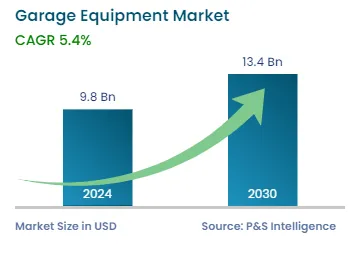
The global garage equipment market size was USD 9.8 billion in 2024, which is predicted to reach USD 14.8 billion by 2032, growing at a CAGR of 5.4% during 2025–2032.
This is due to the immense surge in the production and sale of vehicles, owing to technological advancements and the increasing population globally. Additionally, with their increasing price and taxes, people are buying pre-owned vehicles, which demand frequent maintenance, thus driving the demand for repair equipment. There has also been a surge in the sale of two-wheelers and lightweight vehicles, especially in emerging economies, which is further driving the market growth.
A garage is an allocated space, or a building attached to a house, where automobiles are kept and protected from the elements and burglaries. Its primary objective is to provide shelter for vehicles and serve as a workspace for maintenance & repairs. Garages differ significantly in size and design, from those meant for just one car to the commercial-grade ones, which can house multiple. Further, with the rise of electric vehicles, many garages these days have charging stations.
Further, many tools, machines, and devices are found in such places to perform maintenance, repairs, and servicing. The most prominent of these tools are vehicle lifts, tire changers, wheel balancers, battery chargers, and diagnostic tools. With the boom in the trend of owning cars, the demand for timely maintenance is rising, in order to prevent sudden breakdowns and long-term wear and tear. The need for timely service is especially high among those who drive their vehicles daily, majorly office-going people and those providing public/shared transportation services.
Moreover, people across the globe are demanding cars laden with advanced and premium features, including advanced driver assistance system and wireless smartphone connectivity. This has created the demand for qualified and experienced technical staff to provide high-quality repair and system replacement at reasonable prices. This leads to a surge in the usage of technologically advanced garage equipment around the world.
Additionally, the prominent players in the automotive industry are coming up with new solutions to enhance users’ vehicle servicing experiences. For instance, in June 2022, Renault Group purchased a startup, Fixter, in order to link retail and professional consumers to nearby vehicle servicing centers. Strategies like this make it easy for individuals to have their vehicles taken care of without much hassle, which ultimately increases the demand for garage equipment.
Garage Equipment Market Growth Factors
Integration of AI and Digital Technologies Is a Key Trend
AI-driven material modeling is enabling faster development of natural fiber composites by predicting fiber–matrix interactions, mechanical performance, and durability before physical prototyping.
Machine learning algorithms are being used to optimize processing parameters in injection molding, compression molding, and pultrusion, reducing defects and improving consistency.
Digital twins are helping manufacturers simulate real-world applications of NFCs in automotive and construction, allowing quicker validation of designs and reducing time-to-market.
AI-powered predictive maintenance in composite manufacturing equipment minimizes downtime and ensures stable production quality.
Computer vision and automated inspection systems are improving quality control by detecting fiber distribution irregularities, voids, or surface defects in NFC products.
Blockchain and digital traceability tools are being implemented to track fiber sourcing and ensure compliance with sustainability certifications.
Cloud-based collaboration platforms enable real-time data sharing among fiber suppliers, resin producers, and OEMs, accelerating innovation cycles.
AI-enabled lifecycle analysis tools help evaluate the environmental footprint of NFCs, strengthening their positioning as sustainable alternatives to conventional composites.
Rapid Adoption of Electric Vehicles Drives Market Growth
The global electric vehicle (EV) fleet reached approximately 58 million units by the end of 2024, with projections indicating continued double-digit growth through 2030.
The expansion of EVs is driving the demand for specialized testing and maintenance equipment, particularly for high-voltage battery systems, thermal management units, and insulation diagnostics.
BEVs, PHEVs, and HEVs operate on high-voltage electrical systems ranging from 400 to 1,000 Volts, according to the U.S. Department of Energy’s Alternative Fuels Data Center (AFDC).
These systems necessitate dedicated safety tools, insulation resistance testers, leakage current analyzers, and battery analyzers that are capable of meeting strict voltage thresholds and reliability standards.
Growth in EV manufacturing also increases the need for thermal imaging, battery health monitoring, and real-time diagnostic tools across production, servicing, and fleet maintenance ecosystems.
The shift toward electrified powertrains introduces new safety standards and equipment protocols, reshaping the demand for electrical insulation testing devices, calibration equipment, and protective maintenance kits.
Increasing EV penetration in public transportation, logistics, and commercial fleets further boosts the market for robust industrial diagnostic tools tailored to heavy-duty EV platforms.
Garage Equipment Market Segmentation Analysis
Function Analysis
The mechanical category held the larger share in the garage equipment market in 2024, of 85%, maintaining its relevance despite the electronic revolution. This growth is attributed to the continued need for traditional lifting equipment, tire changers, and mechanical tools, which remain essential for routine maintenance and repairs. The category benefits from the increasing average age of vehicles globally, as older vehicles require more frequent mechanical interventions. Additionally, the rise of electric vehicles, while reducing some mechanical maintenance needs, creates new demands for specialized mechanical equipment capable of handling heavier battery-equipped vehicles.
The electronic category is expected to witness the higher CAGR during the forecast period, driven by the increasing electronic complexity of modern vehicles and the growing need for sophisticated diagnostic capabilities. Electronic garage equipment encompasses diagnostic scanners, computerized wheel aligners, digital inspection systems, and electronic measuring tools that have become indispensable in modern automotive service centers. The dominance of this category reflects the fundamental shift in vehicle architecture from predominantly mechanical to heavily electronic systems, with modern vehicles containing dozens of electronic control units requiring specialized diagnostic interfaces.
These function types are covered:
Mechanical (Largest Category)
Electronic (Faster-Growing Category)
Garage Type Analysis
Independent garages dominated the market with a share of 70% in 2024, reflecting their widespread presence and accessibility across urban and rural markets. These establishments benefit from lower operational costs, flexibility in equipment selection, and the ability to serve multiple vehicle brands without manufacturer restrictions. The category's strength is reinforced by the aging vehicle fleet, as owners of older vehicles often prefer independent garages for cost-effective maintenance solutions. Independent garages are increasingly investing in advanced diagnostic equipment to compete with OEM-authorized facilities, particularly in serving the growing complexity of modern vehicles.
OEM-authorized garages are projected to grow at the higher CAGR during 2025–2032, driven by the increasing technical complexity of vehicles and manufacturer warranty requirements. These facilities benefit from direct access to manufacturer-specific diagnostic tools, technical support, and genuine parts. The growth is particularly pronounced in the electric vehicle category, where manufacturers often require specialized certification for service centers. OEM-authorized garages also leverage their brand association to attract customers seeking expertise in specific vehicle makes, especially for luxury and high-performance vehicles.
These garage types are covered:
OEM-Authorized Garages (Faster-Growing Category)
Independent Garages (Largest Category)
Equipment Type Analysis
The lifting category commanded the largest market share, of 35%, in 2024, establishing its position as the most fundamental category in garage operations. This category's dominance stems from the universal need for vehicle lifting solutions across all service types, from routine oil changes to complex undercarriage repairs. Modern lifting equipment incorporates advanced safety features, wireless controls, and increased weight capacities to accommodate the growing diversity of vehicle types, including heavy electric vehicles. The category benefits from the continuous innovation in lift design, including low-profile lifts for sports cars and specialized lifting points for battery electric vehicles.
The diagnostic & testing category is experiencing the fastest growth, during the forecast period. This rapid expansion is driven by the increasing electronic complexity of vehicles and the critical need for accurate fault identification. Modern diagnostic tools integrate artificial intelligence, cloud connectivity, and multi-brand compatibility, enabling technicians to diagnose issues across various vehicle systems efficiently. The category's growth is further accelerated by regulatory requirements for emissions testing and the need for ADAS calibration following routine maintenance procedures.
These equipment types are covered:
Lifting (Largest Category)
Diagnostic & Testing (Fastest-Growing Category)
Body Shop
Emission
Washing
Wheel & Tire
Drive strategic growth with comprehensive market analysis
Garage Equipment Market Geographical Analysis
Asia-Pacific Garage Equipment Market Share
Asia-Pacific held the largest share in the global garage equipment market in 2024, of 35%, primarily driven by the region's massive vehicle population and rapidly expanding automotive service infrastructure. China represents a significant portion of this market, with its dual dynamics of being both the world's largest automobile market and having an accelerating shift towards electric vehicles. The region benefits from strong manufacturing capabilities in garage equipment production, with numerous local manufacturers serving both domestic and export markets.
The rapid motorization in emerging economies, such as India and Southeast Asian nations, is creating substantial demand for garage equipment. These markets are characterized by a growing network of independent service centers catering to the increasing vehicle ownership rates. The region's growth is further supported by government initiatives promoting vehicle safety inspections and emissions testing, which require standardized garage equipment. Additionally, the presence of major automotive manufacturers in Japan and South Korea drives the demand for sophisticated diagnostic and testing equipment in their extensive dealer networks.
North America Garage Equipment Market Value
North America is projected to grow during 2025–2032, driven by the aging vehicle fleet and stringent safety regulations requiring regular vehicle inspections. The market benefits from high vehicle ownership rates, with 92% of American households owning at least one car, creating consistent demand for maintenance and repair services.
The region's growth is supported by technological advancement in garage equipment, with U.S.-based manufacturers leading innovation in smart diagnostic tools and connected service equipment. The proliferation of franchise service centers and the consolidation of independent repair shops into larger chains drive demand for standardized, high-quality garage equipment. Environmental regulations, particularly in states like California, mandate sophisticated emissions testing equipment, further boosting market growth. The increasing adoption of electric vehicles in North America, supported by federal incentives and infrastructure investments, is creating new opportunities for specialized EV service equipment.
Europe Garage Equipment Market Outlook
Europe represents the fastest-growing regional market, with a projected CAGR of approx. 5.5% during the forecast period, driven by stringent vehicle inspection regulations and the rapid transition to electric mobility. The region's growth is underpinned by mandatory periodic technical inspections (PTI) that require certified testing equipment, creating steady demand for diagnostic and emissions testing tools.
The European Union's aggressive emissions reduction targets and the push toward electrification are reshaping the garage equipment landscape. Service centers across Europe are investing heavily in EV-specific equipment to prepare for the growing electric vehicle fleet. The region also leads in the adoption of digital and connected garage equipment, with workshops increasingly implementing integrated management systems that connect diagnostic tools, customer databases, and parts ordering systems. Countries like Norway and the Netherlands, with high EV adoption rates, are pioneering the development of specialized EV service infrastructure.
The regions and countries analyzed in this report are:
North America
U.S. (Larger Country Market)
Canada (Faster-Growing Country Market)
Europe (Fastest-Growing Regional Market)
Germany (Largest Country Market)
U.K. (Fastest-Growing Country Market)
France
Italy
Spain
Rest of Europe
Asia-Pacific (Largest Regional Market)
Japan
China (Largest Country Market)
India (Fastest-Growing Country Market)
South Korea
Australia
Rest of APAC
Latin America
Brazil (Largest Country Market)
Mexico (Fastest-Growing Country Market)
Rest of LATAM
Middle East and Africa
Saudi Arabia (Largest Country Market)
South Africa
U.A.E. (Fastest-Growing Country Market)
Rest of MEA
Garage Equipment Market Share
The garage equipment market is fragmented, characterized by the presence of numerous global, regional, and local manufacturers offering a wide array of mechanical and electronic tools. This fragmentation stems from the market’s broad scope, which includes equipment for vehicle lifting, diagnostics, wheel and tire servicing, emission testing, and battery servicing. No single player holds a dominant global share, although some companies, such as Bosch, Snap-on, and MAHA, have strong brand recognition and wide product portfolios. Regional players often specialize in specific segments or cater to price-sensitive markets, especially in Asia and Latin America. Technological advancements, particularly in diagnostics and electric vehicle servicing tools, have created new opportunities for smaller entrants, further intensifying competition. Additionally, aftermarket demand from independent garages, service stations, and tire shops fuels ongoing diversification. As vehicle technologies evolve, especially with the rise of EVs and ADAS systems, the market remains dynamic and innovation-driven, reinforcing its fragmented and competitive nature.
Top Garage Equipment Manufacturers:
BorgWarner Inc.
Robert Bosch GmbH
Continental AG
Vehicle Service Group
VisiCon Automatisierungstechnik GmbH
Symach Srl
Otto Nussbaum GmbH & Co. KG
Sarveshwari Engineers
Boston Garage Equipment Ltd.
Gray Manufacturing Company Inc.
BendPak Inc.
Schaeffler Technologies AG & Co. KG
Garage Equipment Market News
In July 2025, Robert Bosch GmbH introduced FleetME, a cloud-based solution designed for fleet asset management rather than consumer service centers. It uses AI analytics for predictive maintenance, repair scheduling, and work order optimization.
In September 2024, Continental AG expanded its workshop aftermarket portfolio with new ADAS sensors, chassis and steering parts, Euro 7-compliant ATE New Original brake lines, and launched “Remote Support,” a live video assistance service for mechanics.
In June 2024, Robert Bosch GmbH showcased upgrades at the UK Garage & Bodyshop Event, including enhanced DAS 3000 ADAS calibration tools, an updated ESI Evolution diagnostic software with OEM repair access, and its Secure Diagnostic Access (SDA) solution for multi-brand vehicle systems.
In January 2024, Vehicle Service Group (VSG) announced the launch of new All-Vehicle (AV) lift arms. These patent-pending arms are designed to properly spot and lift nearly any vehicle—including next-generation electric vehicles (EVs)—using a single lift system.
In January 2024, VSG’s Rotary brand introduced its patent-pending All-Vehicle (AV) lift arms, a next-generation solution designed to enable workshops to efficiently spot and lift nearly any type of vehicle—including electric vehicles (EVs)—with a single lift system, enhancing safety, versatility, and productivity in garage operations.
Want a report tailored exactly to your business need?
Leading companies across industries trust us to deliver data-driven insights and innovative solutions for their most critical decisions. From data-driven strategies to actionable insights, we empower the decision-makers who shape industries and define the future. From Fortune 500 companies to innovative startups, we are proud to partner with organisations that drive progress in their industries.
Client Testimonials
Working with P&S Intelligence and their team was an absolute pleasure – their awareness of timelines and commitment to value greatly contributed to our project's success. Eagerly anticipating future collaborations.
McKinsey & Company
India
Unmatched Standards
Our insights into the minutest levels of the markets, including the latest trends and competitive landscape, give you all the answers you need to take your business to new heights
Complete Data Security
We take a cautious approach to protecting your personal and confidential information. Trust is the strongest bond that connects us and our clients, and trust we build by complying with all international and domestic data protection and privacy laws