European Injectable Drug Delivery Market Size & Share Analysis - Trends, Drivers, Competitive Landscape, and Forecasts (2026 - 2032)
This Report Provides In-Depth Analysis of the European Injectable Drug Delivery Market Report Prepared by P&S Intelligence, Segmented by Product Type (Prefilled Syringes, Smart Connected Injectors, Conventional Injection Devices, Injection Pens, Autoinjectors, Needle-Free Injectors, Wearable Injectors, Infusion Pumps, Microneedle Systems), Formulation Packaging (Ampoules, Ready-to-Use Containers, Vials, Cartridges, Bottles), Therapeutic Application (Diabetes, Oncology, Autoimmune Disorders, Cardiovascular Diseases, Infectious Diseases, Pain Management, Hormonal Disorders, Obesity), Route of Administration (Subcutaneous, Intravenous, Intramuscular, Intradermal), End User (Hospitals, Home Healthcare, Specialty Clinics, Ambulatory Care Centers, Long-Term Care Settings), and Geographical Outlook for the Period of 2021 to 2032
European Injectable Drug Delivery Market Size Forecast
Key Highlights
Study Period
2021 - 2032
Market Size in 2025
USD 166.9 Billion
Market Size in 2026
USD 180.8 Billion
Market Size by 2032
USD 306.5 Billion
Projected CAGR
9.1%
Largest Country
Germany
Fastest-Growing Country
Italy
Market Structure
Semi-Consolidated
Market Size
Explore the market potential with our data-driven report
European Injectable Drug Delivery Market Overview
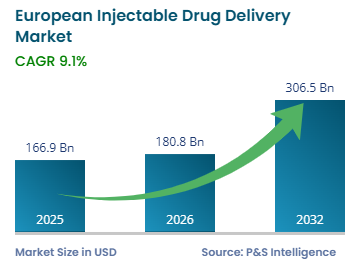
The European injectable drug delivery market size was USD 166.9 billion for 2025, and it will grow by 9.1% during 2026-2032, to reach USD 306.5 billion by 2032.
The European injectable drug delivery market is expanding as healthcare systems move toward safer, easier, and more patient-friendly treatment formats. Many of these therapies are effectively delivered through injectable routes, increasing the use of prefilled syringes, autoinjectors, wearable injectors, pen injectors, and other ready-to-administer formats across hospitals, specialty clinics, and home care settings.
The market is supported by the rising use of injectable therapies for chronic diseases, autoimmune disorders, cancer, diabetes, hormonal conditions, and immunisation programmes. Pharmaceutical and biotechnology companies are investing in delivery platforms that improve dose accuracy, reduce contamination risk, and support high-viscosity biologic formulations. According to the World Health Organisation and the United Nations Children’s Fund, about 109 million infants worldwide received three doses of the diphtheria, tetanus, and pertussis vaccine in 2024, showing the scale of injectable delivery used in routine immunisation. This volume supports demand for sterile, safe, and patient-compatible injectable systems across Europe.
Key Market Insights
Prefilled syringes are the largest product type, holding a market share of 25%, due to broad biologics, vaccine, and insulin use.
Smart connected injectors are the fastest-growing product type, registering a CAGR of approximately 9.8%, driven by dose tracking and home self-injection programs.
Diabetes is the largest therapeutic application, holding a market share of 25%, due to regular insulin use and repeated home dosing.
Germany is the largest country in the European injectable drug delivery market, holding a market share of 45% in 2025, driven by its strong pharmaceutical industry and advanced healthcare infrastructure.
Italy is the fastest-growing country, registering a CAGR of approximately 10.0%, driven by advanced hospitals and strong pharmaceutical manufacturing.
European Injectable Drug Delivery Market Trends and Drivers
Smart Self-Injectable and Wearable Devices Adoption Is a Major Trend
The European injectable drug delivery market is shifting toward smart self-injectable and wearable devices as patients increasingly manage long-term therapies outside hospitals. Autoinjectors, connected pens, wearable injectors, and prefilled syringe platforms are gaining use across Germany, France, the U.K., Italy, Spain, Denmark, Poland, the Netherlands, and the rest of the EU because biologics and chronic disease therapies require accurate dosing and simpler administration. Manufacturers are adding dose reminders, usage tracking, and app-linked monitoring to support adherence in home care settings. According to the International Telecommunication Union, four out of five people aged 10 years or older owned a mobile phone worldwide in 2024, and 5G coverage reached 51% of the world population in 2024. This digital base supports connected injection systems, remote monitoring, and patient-friendly treatment management.
Rising Demand for Biologic and Chronic Disease Treatments Drives Market
The European injectable drug delivery market is growing because chronic diseases and biologic-based therapies are increasing across Germany, France, the U.K., Italy, Spain, Denmark, Poland, the Netherlands, and the rest of the EU. Diabetes, cancer, autoimmune disorders, and hormonal conditions often require injectable medicines because many advanced therapies cannot be delivered effectively through oral routes. This is increasing demand for prefilled syringes, autoinjectors, pen injectors, and other devices that support accurate dosing and safer administration. According to the World Health Organisation, semaglutide, dulaglutide, liraglutide, and tirzepatide were added to the Essential Medicines List in 2025 for type 2 diabetes patients with defined high-risk conditions. This strengthens the role of injectable delivery systems in long-term chronic disease care.
High Cost of Advanced Injectable Devices and Sterile Manufacturing Limits Market Expansion
The European injectable drug delivery market faces restraints because advanced devices and sterile manufacturing systems require high investment, strict validation, and controlled production environments. Wearable injectors, smart autoinjectors, connected pens, and biologic-compatible containers need specialised materials, cleanroom operations, device testing, and packaging controls before commercial use. Smaller manufacturers face stronger pressure because compliance failures can delay product release and increase batch rejection risk. According to the World Health Organisation Vaccines Inspection Updates, the 2023/2024 vaccine inspection cycle covered 20 inspections and found 330 deficiencies; around 50% of critical and major deficiencies were related to GMP for sterile products. This also raises documentation, audit, and training costs for injectable drug delivery companies in Europe.
Expansion of Home-Based Biologic Therapy Creates New Growth Opportunities
The European injectable drug delivery market is creating new opportunities as healthcare systems expand home-based treatment for chronic and specialty diseases. Germany, France, the U.K., Italy, Spain, Denmark, Poland, the Netherlands, and the rest of the EU are using self-care models to reduce hospital pressure and make long-term therapy easier for patients. This shift supports demand for prefilled syringes, wearable injectors, dual-chamber systems, needle-safe devices, and other formats that can be used outside clinical settings. According to the World Health Organisation, around 50 countries had taken steps by 2024 to adapt their self-care guidelines and introduce or change policies supporting self-care interventions. This policy direction creates a stronger commercial scope for patient-friendly injectable platforms used in home-based biologic therapy.
European Injectable Drug Delivery Market Segmentation Analysis
Product Type Analysis
Prefilled syringes are the largest category, holding a market share of 25%, because they are widely used for biologics, vaccines, insulin, and other ready-to-administer injectable drugs. Hospitals, specialty clinics, and home care users prefer them because the dose is already filled, which reduces preparation steps and limits handling errors. According to the United Nations Children’s Fund, it delivered 2.787 billion vaccine doses to 99 countries in 2024. This supports strong demand for sterile injectable dose formats across immunisation, chronic therapy, and routine treatment settings in Europe.
Smart Connected Injectors are the fastest-growing category, registering a CAGR of approximately 9.8%, because European healthcare providers are moving toward devices that help patients take injections correctly outside hospitals. These injectors can support reminders, dose tracking, usage records, and better follow-up for long-term therapies. Demand is rising as biologic drugs, specialty medicines, and self-injection programs expand across Germany, France, the U.K., Italy, Spain, Denmark, Poland, the Netherlands, and the rest of the EU. Their growth is linked to digital health adoption and patient monitoring needs.
Ampoules are the largest category, holding a market share of 35%, because they remain a trusted and low-cost packaging format for many sterile injectable medicines used in European hospitals and clinics. They offer strong protection against contamination and are suitable for both small and large production batches. Their use is common for drugs that need stable, single-dose packaging. Across Germany, France, the U.K., Italy, Spain, Denmark, Poland, the Netherlands, and the rest of the EU, ampoules continue to support routine injectable medicine supply.
Ready-to-Use Containers are the fastest-growing category, registering a CAGR of approximately 9.5%, because pharmaceutical manufacturers are moving toward formats that reduce preparation time, contamination risk, and filling complexity. These containers support biologics, biosimilars, vaccines, and specialty injectables that require cleaner handling before administration. European manufacturers are also adopting more efficient sterile production systems as injectable formulations become more complex. According to the World Health Organisation, more than 1,700 health products were listed under its prequalification programme by the end of 2025. This shows rising quality-assurance requirements for sterile health products and supports demand for ready-to-use formats.
The formulation packaging analysed in this report are:
Diabetes is the largest category, because insulin and other injectable diabetes therapies are used regularly by a large patient base. Patients often need repeated dosing, which creates steady demand for pens, syringes, autoinjectors, and other easy-to-use delivery formats. The category is also supported by growing self-administration in home care settings across Germany, France, the U.K., Italy, Spain, Denmark, Poland, the Netherlands, and the rest of the EU. According to the International Diabetes Federation, approximately 589 million adults aged 20–79 lived with diabetes worldwide in 2024. This sustains recurring demand for injectable diabetes delivery systems.
Oncology is the fastest-growing category, registering a CAGR of approximately 9.7%, because cancer treatment in Europe is increasingly using biologics, immunotherapies, biosimilars, and supportive care drugs that often require injectable delivery. Hospitals and cancer centres need accurate delivery systems for complex therapies, while newer subcutaneous formulations are helping reduce treatment time. Growth is also supported by strong oncology research and product approvals. Across Germany, France, the U.K., Italy, Spain, Denmark, Poland, the Netherlands, and the rest of the EU, injectable cancer therapies are becoming more important.
The therapeutic applications analysed in this report are:
Diabetes (Largest Category)
Oncology (Fastest-Growing Category)
Autoimmune Disorders
Cardiovascular Diseases
Infectious Diseases
Pain Management
Hormonal Disorders
Obesity
Others
Route of Administration Analysis
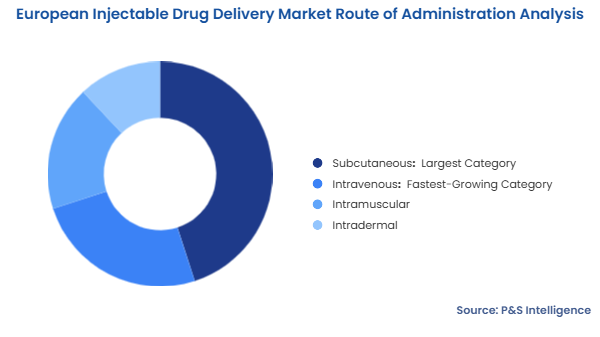
Subcutaneous is the largest category, holding a market share of 45%, because it is widely used for insulin, biologics, vaccines, autoimmune treatments, and several long-term therapies. This route is easier for patients compared with many clinic-based injection methods and supports self-administration at home. It also works well with prefilled syringes, pens, autoinjectors, and wearable injectors. Across Germany, France, the U.K., Italy, Spain, Denmark, Poland, the Netherlands, and the rest of the EU, subcutaneous delivery is strongly supported by chronic disease care.
Intravenous is the fastest-growing category, because oncology biologics, hospital-administered therapies, emergency medicines, and specialty treatments commonly require direct bloodstream delivery under medical supervision. European healthcare providers use this route when treatments require controlled infusion, rapid therapeutic action, and continuous patient monitoring. According to the World Health Organization Electronic Essential Medicines List, pembrolizumab was added in 2025 for four cancer indications and is available in three intravenous dosage presentations, including powder for injection, vial, and concentrate for solution for infusion. This supports broader use of intravenous administration across hospital oncology departments and specialty infusion services while strengthening demand for advanced injectable delivery systems.
The route of administrations analysed in this report are:
Subcutaneous (Largest Category)
Intravenous (Fastest-Growing Category)
Intramuscular
Intradermal
End User Analysis
Hospitals are the largest category, because many injectable drugs still require controlled administration by trained healthcare staff. Hospitals manage dose preparation, infusion, patient monitoring, emergency response, and sterile handling for complex biologics, oncology medicines, acute care drugs, and high-risk injectable therapies. They also remain key procurement centres for injectable products across Europe. According to the World Health Organisation, around 1 in 10 hospitalised patients experiences harm, with at least 50% of such harm considered preventable. This supports the need for monitored injectable administration in clinical settings.
Home Healthcare is the fastest-growing category, because more European patients are managing long-term conditions outside hospitals with self-injection devices and home support programs. This setting reduces hospital visits and makes regular treatment easier for patients with diabetes, autoimmune diseases, hormonal disorders, and other chronic conditions. Devices such as pens, prefilled syringes, autoinjectors, and connected injectors are helping this shift. Across Germany, France, the U.K., Italy, Spain, Denmark, Poland, the Netherlands, and the rest of the EU, home care adoption is rising.
The end users analysed in this report are:
Hospitals (Largest Category)
Home Healthcare (Fastest-Growing Category)
Specialty Clinics
Ambulatory Care Centers
Long-Term Care Settings
Others
Drive strategic growth with comprehensive market analysis
European Injectable Drug Delivery Market Regional Outlook
Germany European Injectable Drug Delivery Market Analysis
Germany is the largest country in the European injectable drug delivery market, supported by its advanced hospital network, strong pharmaceutical manufacturing base, and broad use of biologic medicines. The country creates sustained demand for prefilled syringes, autoinjectors, wearable injectors, and sterile injectable packaging across hospitals, specialty centers, and home-based treatment. German Federal Statistical Office data show that hospitals in Germany recorded 17.2 million full inpatient treatment cases in 2023. This hospital base supports injectable formats used in monitored care, biologic administration, oncology infusion, and sterile drug delivery, while Germany’s device and pharmaceutical ecosystem strengthens commercial use of patient-friendly injectable systems.
Italy European Injectable Drug Delivery Market Analysis
Italy is the fastest-growing country in the European injectable drug delivery market, supported by expanding biosimilar use, specialty treatment access, and wider adoption of self-administration formats. The country’s demand is linked to oncology, autoimmune diseases, diabetes care, and hospital-administered biologics, where prefilled syringes, pens, autoinjectors, and intravenous systems are commonly used. According to the Italian Medicines Agency, Italy ranked first in Europe for biosimilar medicine consumption, with 72.2% consumption incidence in 2024. This strengthens the use of injectable formats in hospital procurement, regional medicine programs, and outpatient treatment pathways, while supporting drug-device combinations designed for biologics and follow-on therapies.
The region and country analysed in this report are:
Germany (Largest Country)
Italy (Fastest-Growing Country)
U.K.
France
Spain
Rest of Europe
European Injectable Drug Delivery Market Share
The European injectable drug delivery market appears semi-consolidated, with leading multinational pharmaceutical and medical device companies competing alongside regional manufacturers and specialized device providers. Companies such as BD, Baxter International, Gerresheimer AG, SCHOTT Pharma, and West Pharmaceutical Services maintain a strong market presence through extensive product portfolios, advanced manufacturing capabilities, and well-established distribution networks across Europe. Continuous investments in research and development, strategic collaborations, acquisitions, and new product launches further strengthen their competitive positions. At the same time, several specialized companies focus on product categories such as prefilled syringes, autoinjectors, pen injectors, wearable injectors, and other advanced injectable delivery technologies. Growing demand for biologics, biosimilars, and self-administered therapies continues to encourage product innovation and expand competition across specialized segments, while established manufacturers retain a significant share of the overall market through their scale, expertise, and long-standing customer relationship.
Key Players in the European Injectable Drug Delivery Market:
Sanofi S.A.
Novartis AG
Roche Holding AG
Novo Nordisk A/S
GSK plc
Gerresheimer AG
SCHOTT Pharma AG & Co. KGaA
Ypsomed Holding AG
SHL Medical AG
Owen Mumford Limited
Stevanato Group S.p.A.
Vetter Pharma-Fertigung GmbH & Co. KG
Nemera S.A.
medmix AG
Becton, Dickinson and Company
Baxter International Inc.
West Pharmaceutical Services, Inc.
Datwyler Holding AG
European Injectable Drug Delivery Market News
In March 2026, Gerresheimer AG introduced Gx InMonit, a smart add-on for autoinjector-based home therapy. The device is placed on an autoinjector and records injection-use information during self-administration. The company positioned it with Gx AdheraLink, connecting the device data with patient-support messaging for injectable treatment routines.
In January 2026, SCHOTT Pharma AG & Co. KGaA launched EVERIC lyo and amber vials for light-sensitive injectable medicines. The product combines an amber glass vial with an inner coating used for lyophilised drugs. The launch targeted injectable oncology formulations that need protection from light during storage and fill-finish handling.
In January 2026, Dätwyler Holding Inc. launched a NeoFlex universal plunger for large-volume cartridges used in on-body drug delivery. The company added the product to its coated plunger range for injectable therapies. The launch focused on cartridge-based systems used with subcutaneous delivery devices for biologic treatments.
In October 2025, Owen Mumford Limited launched the EcoSafe safety syringe platform with a reusable autoinjector companion. The company extended its existing safety syringe system so the syringe can work inside the autoinjector. The launch addressed injectable drug delivery use cases where patients may need assisted self-administration.
In October 2025, Ypsomed AG launched YpsoLoop, an autoinjector platform designed around material separation after use. The product was introduced in two platform versions for prefilled autoinjector applications. The company stated that the design allows automated disassembly while keeping the device aligned with existing pharmaceutical production environments.
Frequently Asked Questions About This Report
What is driving demand in the European injectable drug delivery market?+
Demand is driven by biologics, biosimilars, chronic disease treatment, self administration, and patient centric delivery formats used across hospitals, clinics, and home care settings.
Which devices are commonly used for injectable medicines in Europe?+
Prefilled syringes, auto injectors, pen injectors, and wearable injectors are widely used because they support accurate dosing, convenience, safer handling, and easier administration.
Why are prefilled syringes important in injectable drug delivery?+
Prefilled syringes help reduce preparation steps, support dose accuracy, improve convenience for healthcare workers and patients, and lower medicine wastage during administration.
How do auto injectors support home based injectable treatment?+
Auto injectors make self administration easier by simplifying injection steps, improving confidence, and supporting patients who need regular treatment outside hospitals or clinics.
What role do biologics play in injectable drug delivery demand?+
Biologics often require injectable formats because of their complex structure, making reliable delivery systems important for immunology, oncology, metabolic, and other specialty therapies.
Want a report tailored exactly to your business need?
Leading companies across industries trust us to deliver data-driven insights and innovative solutions for their most critical decisions. From data-driven strategies to actionable insights, we empower the decision-makers who shape industries and define the future. From Fortune 500 companies to innovative startups, we are proud to partner with organisations that drive progress in their industries.
Client Testimonials
Working with P&S Intelligence and their team was an absolute pleasure – their awareness of timelines and commitment to value greatly contributed to our project's success. Eagerly anticipating future collaborations.
McKinsey & Company
India
Unmatched Standards
Our insights into the minutest levels of the markets, including the latest trends and competitive landscape, give you all the answers you need to take your business to new heights
Complete Data Security
We take a cautious approach to protecting your personal and confidential information. Trust is the strongest bond that connects us and our clients, and trust we build by complying with all international and domestic data protection and privacy laws