This Report Provides In-Depth Analysis of the RTF/RTU Vials Market Report Prepared by P&S Intelligence, Segmented by Packaging Type (Nest and Tub, Tray), Placing Method (Side-Up Inside, Down-Upside), Color (Clear, Amber), Filling Product (Liquid, Lyophilized), and Geographical Outlook for the Period of 2019 to 2030
Explore the market potential with our data-driven report
RTF/RTU Vials Market Key Insights
The nest and tub category holds the larger market share, of 85%, in 2025, and it will also witness the higher CAGR of 17.5%, due to superior compatibility with automated aseptic filling lines.
The side-up inside placing method dominates with 85% share, as it aligns with robotic filling systems and minimizes handling contamination risks.
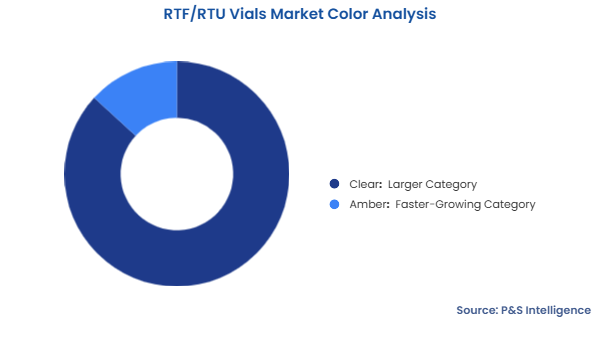
The clear vial segment holds the larger share, of 86.5%, due to widespread use in standard injectable formulations requiring visual inspection.
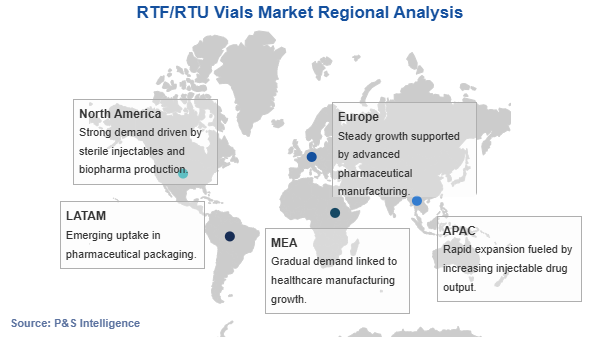
Europe holds the largest market share, of 40%, supported by a strong concentration of pharmaceutical manufacturers and glass packaging producers, enabling efficient supply chains and shorter lead times.
Asia-Pacific will register the highest CAGR, of 17.2%, driven by expanding pharmaceutical manufacturing capacity and government-led healthcare investments.
RTF/RTU Vials Market Future Outlook
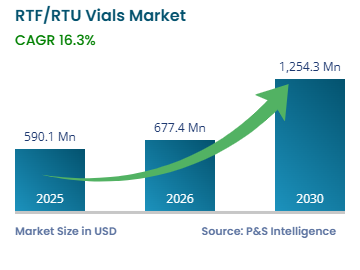
The global RTF/RTU vials market size was USD 590.1 million in 2025, and it is expected to grow at a CAGR of 16.3% during 2026–2030, to reach USD 1254.3 million by 2030. The growth is primarily driven by the increasing transition toward ready-to-use sterile packaging formats in aseptic pharmaceutical manufacturing, the rising global demand for injectable drugs and biologics, and the expansion of fill-finish outsourcing by biopharmaceutical companies. RTU/RTF vial systems eliminate washing, depyrogenation, and sterilization steps, thereby reducing contamination risks and improving operational efficiency in high-value sterile production lines. According to the International Agency for Research on Cancer, injectable therapies remain essential for managing chronic diseases, including diabetes and oncology, with cancer cases projected to reach 35 million globally by 2050. Additionally, the U.S. Food and Drug Administration reports that biologics and injectables account for a growing share of new drug approvals, reinforcing the adoption of pre-sterilized vial systems.
Furthermore, pharmaceutical manufacturing modernization programs across regions are accelerating adoption. The European Medicines Agency’s sterile manufacturing guidelines and the U.S. FDA’s aseptic processing recommendations emphasize contamination control and closed-system processing, directly supporting RTU vial adoption. These regulatory frameworks, combined with rising CDMO capacity expansions, are embedding RTU/RTF vial systems as a standard in advanced sterile manufacturing environments.
RTF/RTU Vials Market Trends and Drivers
Shift toward Nest-and-Tub Configurations in High-Value Sterile Operations Is Key Trend
A major structural trend in the RTF/RTU vials market is the transition from bulk packaging formats to nest-and-tub configurations, particularly in high-value biologics and sterile injectable manufacturing. Nest-and-tub systems enable direct integration into automated filling lines without intermediate processing, significantly reducing human intervention and contamination risk. These configurations are increasingly deployed in isolator-based and restricted access barrier systems (RABS), where sterility assurance is critical. This transition is further reinforced by industry developments such as the introduction of advanced nested closure systems, including innovations from Daikyo Seiko Ltd. in 2025, where PLASCAP RUV RTU closures were designed to support robotic, nested vial filling processes and seamless integration into automated vial filling processes.
Regulatory emphasis on contamination control is reinforcing this shift. The European Medicines Agency emphasizes advanced aseptic processing environments under EU GMP Annex 1, encouraging the use of pre-sterilized components. Similarly, the U.S. Food and Drug Administration emphasizes closed-system processing as a key strategy for sterility assurance. These frameworks are accelerating adoption of nest-and-tub vial formats across pharmaceutical manufacturing facilities, supported by industry initiatives such as the Alliance for RTU formed in 2024 by key players including SCHOTT Pharma, Gerresheimer AG, and Stevanato Group to promote standardized RTU adoption across sterile manufacturing ecosystems.
Growing Usage of Injectable Drugs Is Biggest Driver
The increasing global reliance on injectable therapeutics is the most significant driver for the RTF/RTU vials market. Injectable drugs are essential for biologics, vaccines, and emergency therapies, where rapid onset of action and precise dosing are required. The expansion of biologics pipelines, including monoclonal antibodies and cell & gene therapies, is structurally increasing demand for sterile packaging solutions. This growth is further supported by continuous product innovations from manufacturers such as SCHOTT Pharma, which introduced EVERIC freeze RTU vials designed for mRNA and gene therapies requiring ultra-low temperature storage.
According to the World Bank, global healthcare expenditure continues to rise, accounting for approximately 10% of global GDP, with a significant share allocated to advanced therapeutics. The global health data indicate a continuous rise in chronic disease prevalence, including diabetes, affecting over 537 million adults globally, necessitating long-term injectable treatments. This expanding therapeutic base directly increases demand for sterile fill-finish capacity and packaging formats that reduce processing complexity. RTU vial adoption is further strengthened by scalable platform technologies such as EZ-fill solutions commercialized by Stevanato Group, enabling efficient and high-throughput injectable drug manufacturing.
Cost Premium and Slower Payback in Price-Sensitive Portfolios Are Key Restraints
The higher cost of RTU/RTF vial systems compared to traditional bulk vials remains a key restraint, particularly for generic drug manufacturers and price-sensitive markets. RTU vials are pre-washed, depyrogenated, and sterilized at the supplier level in controlled environments, typically resulting in a 20%–40% price premium over conventional bulk formats, while eliminating these processing steps at the pharmaceutical manufacturer level.
Healthcare cost constraints in emerging economies further limit adoption. The Organisation for Economic Co-operation and Development indicates that cost containment remains a priority across public healthcare systems, especially in developing regions where pharmaceutical procurement is highly price-driven. This cost sensitivity affects return on investment calculations for manufacturers operating high-volume, low-margin portfolios. While RTU formats offer operational efficiencies, the payback period may be extended in such scenarios. Consequently, adoption remains concentrated in high-value biologics and regulated markets, resulting in slower adoption in high-volume generic injectable manufacturing.
Growing Need for Lyo-Compatible RTU Formats for Sensitive Injectables Is Key Opportunity
The increasing demand for lyophilized (freeze-dried) injectable drugs presents a significant growth opportunity for RTU vial manufacturers. Lyophilization is widely used for biologics and vaccines that require enhanced stability and extended shelf life. These formulations demand specialized vial designs compatible with freeze-drying processes, including uniform heat transfer and structural integrity. This is driving innovation in RTU vial engineering, including advancements in sterile packaging solutions showcased by DWK Life Sciences GmbH at global platforms such as CPHI, focusing on improving compatibility with sensitive injectable formulations and streamlined fill-finish processes. This opportunity is further strengthened by partnerships between Nipro Corporation and Corning Incorporated to enhance vial coating technologies and improve material performance in RTU systems.
The World Health Organization emphasizes the importance of stable vaccine formulations for global immunization programs, particularly in regions with limited cold-chain infrastructure. Additionally, government-led vaccination initiatives and pandemic preparedness programs are expanding demand for lyo-compatible packaging solutions. This creates a strong opportunity for manufacturers to develop advanced RTU vial formats optimized for lyophilization. Between 2012 and 2022, approximately 336 lyophilized drugs were approved, accounting for nearly 60% of total lyophilized drug approvals since 1954, reflecting the increasing reliance on lyophilization in modern pharmaceutical development.
RTF/RTU Vials Market Segmentation Analysis
Packaging Type Analysis
The nest and tub category holds the larger market share, of 85%, in 2025, and it will have the higher CAGR, of 17.5%, due to its compatibility with automated aseptic filling systems and reduced contamination risk. These systems eliminate manual handling and integrate seamlessly into isolator-based production environments, which are increasingly mandated by regulatory bodies. They also support standardized batch processing and reduce line changeover time, making them particularly suitable for multi-product facilities and small-batch biologics manufacturing.
The packaging types analyzed in this report are:
Nest and Tub (Larger & Faster-Growing Category)
Tray
Placing Method Analysis
The side-up inside method holds the larger market share, of 85%, in 2025, and it will have the higher CAGR, of 17.5%, as it ensures compatibility with automated filling lines and minimizes handling errors. This configuration supports high-speed filling operations and aligns with robotic systems used in modern sterile manufacturing. Regulatory emphasis on minimizing human intervention further supports this method. Advanced aseptic systems increasingly rely on standardized vial orientation, making side-up configurations the preferred choice across large-scale production facilities. This orientation also improves line efficiency by ensuring consistent vial positioning, which reduces machine stoppages and enhances overall throughput in high-speed fill-finish operations.
The placing methods analyzed in this report are:
Side-Up Inside (Larger & Faster-Growing Category)
Down-Upside
Color Analysis
The clear vials category holds the larger market share, of 86.5%, in 2025, due to their widespread use in injectable drugs requiring visual inspection for particulate contamination. Regulatory requirements for visual inspection in sterile products, as outlined by the U.S. Food and Drug Administration and the European Medicines Agency, reinforce their dominance.
The amber vials category will have the higher CAGR, of 17.2%, driven by increasing demand for light-sensitive biologics and vaccines. As biologic drug pipelines expand, the need for UV-protective packaging is rising significantly. Amber glass reduces ultraviolet and visible light transmission, protecting photosensitive drug formulations. The WHO recognizes the importance of photostability protection in pharmaceutical packaging, establishing light transmission specifications that distinguish clear from amber glass.
The colors analyzed in this report are:
Clear (Larger Category)
Amber (Faster-Growing Category)
Filling Product Analysis
The liquid category holds the larger market share, of 80%, in 2025, as the majority of injectable drugs are administered in liquid form. These formulations require standardized vial packaging compatible with high-throughput production lines. They also offer ease of administration and faster clinical deployment, making them the preferred choice for a wide range of therapeutic applications, including emergency and chronic care treatments.
The lyophilized category will have the higher CAGR, of 17.4%, supported by the increasing need for stable biologics and vaccines. These formulations also enable extended shelf life and improved stability during transportation, making them particularly suitable for global distribution and regions with limited cold-chain infrastructure.The expansion of global immunization programs and biologics pipelines is driving demand for freeze-dried formulations, with approvals of lyophilized injectable drugs having increased by over 300% since the 2000s.
The filling products analyzed in this report are:
Liquid (Larger Category)
Lyophilized (Faster-Growing Category)
Drive strategic growth with comprehensive market analysis
RTF/RTU Vials Market Geographical Analysis
Europe RTF/RTU Vials Market Size
Europe holds the largest market share in 2025, of 40%, driven by a high concentration of pharmaceutical manufacturers and leading glass packaging producers, which shortens lead times and sustains well-established supply relationships with regional pharmaceutical companies. The European Medicines Agency’s revised EU GMP Annex 1, effective from August 2023, introduced strengthened contamination control requirements and mandated closed-system aseptic processing across manufacturing operations, accelerating the transition toward RTU vials across European pharmaceutical facilities. Germany leads the region as both a primary production hub and a key consumption market for injectable biologics and oncology therapies, supported by Europe’s research-intensive pharmaceutical ecosystem that sustains demand for compliant sterile packaging solutions across the forecast period.
North America RTF/RTU Vials Market Size
North America holds the second-largest market share in 2025, driven by the region's deep biopharma manufacturing infrastructure, high volume of biologics approvals, and advanced aseptic fill-finish ecosystem. The United States leads within the region, where biologics represent a growing share of new drug approvals in the U.S. biopharmaceutical sector, typically accounting for around 30–40% and dominating in value and innovation intensity, thereby generating sustained demand for high-quality Type I borosilicate glass containers suited to sensitive biologic formulations. The U.S. Food and Drug Administration’s Aseptic Processing Current Good Manufacturing Practice guidance, periodically reinforced through updated process simulation requirements, mandates operational standards that favor pre-sterilized RTU systems, driving transitions away from conventional vial formats and toward closed-system aseptic processing across U.S. manufacturing sites. SCHOTT Pharma’s USD 371 million U.S. manufacturing investment reflects the scale of capacity build-out underway in the region and validates the structural shift toward RTF/RTU formats.
Asia-Pacific RTF/RTU Vials Market Size
Asia-Pacific will have the highest CAGR of 17.2%, driven by rapid scale-up in pharmaceutical manufacturing capacity, rising CDMO investment, and healthcare infrastructure build-out across China, India, Japan, and South Korea. The regional CDMO services market is expanding, with Asia-Pacific identified as the fastest-growing zone through 2030, with China, India, and South Korea as the primary contributors to this growth. China is recording an accelerating adoption of RTF/RTU vials, supported by a biopharmaceutical sector growing at a double-digit rate annually and increasing alignment with global sterility standards, which is expanding demand for compliant sterile packaging formats. The National Medical Products Administration is the primary regulatory body driving this alignment, progressively tightening sterility and contamination control requirements across Chinese pharmaceutical manufacturing operations.
India’s pharmaceutical production-linked incentive schemes have attracted cumulative investments of INR 41,943 crore (USD ~5.0 billion) as of 2025, stimulating sterile fill-finish capacity expansion that directly increases RTF/RTU vial consumption, along with the Make in India initiative accelerating sterile injectables capacity across the country. Indian CDMOs are scaling aseptic manufacturing suites for biologics, antibody-drug conjugates, and GLP-1 formulations, reinforcing domestic supply chains and broadening access to high-quality sterile packaging formats including RTF/RTU vials. The collaboration between Corning Incorporated and SGD Pharma to supply advanced pharmaceutical glass tubing in India reflects the depth of manufacturing investment consolidating across the region.
The regions and countries of the market are as follows:
North America
U.S. (Larger and Faster-Growing Country Market)
Canada
Europe (Largest Regional Market)
Germany (Largest and Fastest-Growing Country Market)
U.K.
France
Italy
Spain
Rest of Europe
Asia-Pacific (Fastest-Growing Regional Market)
China
India (Fastest-Growing Country Market)
Japan (Largest Country Market)
South Korea
Australia
Rest of APAC
Latin America
Brazil (Largest and Fastest-Growing Country Market)
Mexico
Rest of LATAM
Middle East and Africa
Saudi Arabia (Largest and Fastest-Growing Country Market)
South Africa
U.A.E.
Rest of MEA
RTF/RTU Vials Market Share Analysis
The market is semi-consolidated due to high entry barriers and strong dominance of established players. Capital-intensive manufacturing processes, including pharmaceutical-grade glass production, sterilization, and cleanroom operations, limit participation to companies with advanced technical capabilities. Strict regulatory requirements such as container-closure integrity validation, sterility assurance, and lengthy qualification cycles further reinforce supplier stickiness and switching costs. A small group of global leaders like SCHOTT Pharma, Gerresheimer AG, and Stevanato Group dominate high-value segments, resulting in limited competitive pressure in high-value RTU vial segments.
Top Companies in the RTF/RTU Vials Market:
SGD Pharma
Stevanato Group
SCHOTT AG
Gerresheimer AG
Corning Incorporated
Nipro Corporation
China Lemon Trading Co. Ltd.
Ningbo Zhengli Pharmaceutical Packaging Co. Ltd.
DWK Life Sciences GmbH
Four Star Glass
Origin Pharma Packaging
Dikyo Seiko Ltd.
RTF/RTU Vials Market News
In September 2025, Corning Incorporated and SGD Pharma inaugurated a pharmaceutical glass tubing facility in Telangana, India, expanding manufacturing capacity for injectable packaging, including RTU/RTF vials.
In December 2024, Gerresheimer AG completed the acquisition of Blitz LuxCo Sarl (Bormioli Pharma Group) for approximately EUR 800 million, strengthening its position in pharmaceutical primary packaging and expanding its glass and plastic containment portfolio.
In October 2024, Nipro Corporation launched direct-to-fill glass vials, developed using EZ-fill technology, offering RTU solutions for aseptic filling.
In January 2024, Stevanato Group launched the EZ-fill Kit, leveraging its ready-to-use portfolio of pre-sterilized vials, cartridges, and syringes, available for commercial use starting Q2 2024 to support efficient fill-finish operations.
Frequently Asked Questions About This Report
How do RTU vials improve fill-finish efficiency in pharmaceutical manufacturing?+
RTU vials eliminate washing, depyrogenation, and sterilization steps, enabling faster line setup, reducing downtime, and improving overall throughput in aseptic filling operations.
How does nest-and-tub packaging support automated vial filling?+
Nest-and-tub packaging holds vials in a pre-arranged sterile configuration, allowing direct loading into automated filling lines while minimizing manual handling and maintaining sterility.
How do RTU vials minimize contamination during drug manufacturing?+
RTU vials are processed in controlled sterile environments and supplied in sealed packaging, significantly reducing human intervention and exposure to contaminants during filling.
What sterilization technologies are used for RTU vials and how do they impact operations?+
RTU vials are sterilized using methods such as gamma irradiation, ethylene oxide, or steam, ensuring sterility assurance while enabling manufacturers to skip in-house sterilization processes.
What operational challenges are associated with RTU vial adoption?+
Key challenges include higher procurement costs, reliance on specialized suppliers, limited flexibility in customization, and the need for compatibility with specific automated filling systems.
Want a report tailored exactly to your business need?
Leading companies across industries trust us to deliver data-driven insights and innovative solutions for their most critical decisions. From data-driven strategies to actionable insights, we empower the decision-makers who shape industries and define the future. From Fortune 500 companies to innovative startups, we are proud to partner with organisations that drive progress in their industries.
Client Testimonials
Working with P&S Intelligence and their team was an absolute pleasure – their awareness of timelines and commitment to value greatly contributed to our project's success. Eagerly anticipating future collaborations.
McKinsey & Company
India
Unmatched Standards
Our insights into the minutest levels of the markets, including the latest trends and competitive landscape, give you all the answers you need to take your business to new heights
Complete Data Security
We take a cautious approach to protecting your personal and confidential information. Trust is the strongest bond that connects us and our clients, and trust we build by complying with all international and domestic data protection and privacy laws