This Report Provides In-Depth Analysis of the Empty Capsules Market Report Prepared by P&S Intelligence, Segmented by Type (Gelatin Capsules, Non-Gelatin Capsules), Functionality (Immediate-Release Capsules, Sustained-Release Capsules, Delayed-Release Capsules), Application (Antibiotic Drugs, Dietary Supplements, Antacid and Antiflatulent, Cardiovascular Therapy Drugs), End User (Pharmaceutical Industry, Nutraceutical Industry, Cosmetics Industry, Research Laboratories), and Geographical Outlook for the Period of 2021 to 2032
Explore the market potential with our data-driven report
Empty Capsules Market Future Outlook
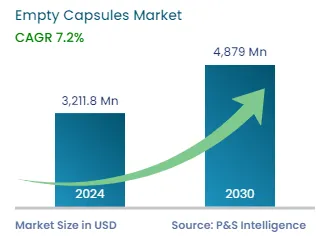
The empty capsules market size was USD 3.4 billion for 2025, and it will grow by 7.3% during 2026–2032, to reach USD 5.6 billion by 2032.
The market growth is driven by the rising demand for gelatin and non-gelatin capsule shells across pharmaceutical, nutraceutical, and cosmeceutical manufacturing. Manufacturers increasingly prefer hard capsules for their formulation flexibility, taste-masking capability, ease of swallowing, and compatibility with a wide range of active ingredients.
Expanding production of prescription medicines and dietary supplements worldwide is further strengthening demand. The World Health Organization projects that the global population aged 60 years and older will increase from 1 billion in 2020 to 1.4 billion by 2030, driving the need for chronic disease therapies and increasing the consumption of capsule-based oral medications. Additionally, the U.S. Centers for Disease Control and Prevention's National Center for Health Statistics reports that 60.2% of adults aged 20 years and older used a dietary supplement in the past 30 days during 2021–2023, reinforcing demand for empty capsules in nutraceutical manufacturing.
Key Market Insights
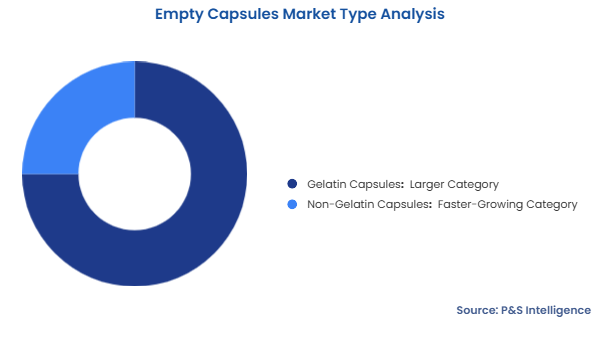
The gelatin capsules category holds the larger market share, of 75%, in 2025, due to their low cost, rapid dissolution, and widespread use in pharmaceutical formulations.
The dietary supplements category will have the highest CAGR, of approximately 7.7%, driven by growing consumer focus on preventive healthcare, wellness, and nutritional supplementation.
The pharmaceutical industry category holds the largest market share, of 40%, in 2025, owing to rising prescription drug demand and extensive capsule use.
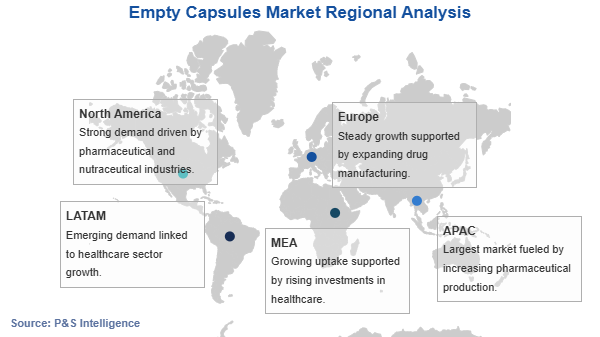
North America holds the largest market share, of 40%, in 2025, supported by a dense concentration of contract development and manufacturing organizations (CDMOs).
Asia-Pacific will have the highest CAGR, of approximately 8.2%, driven by expanding pharmaceutical manufacturing, rising nutraceutical production, and government support in China and India.
Empty Capsules Market Dynamics
Plant-Based Capsule Materials Is Key Trend
A material shift is underway as formulators move from animal-derived gelatin toward hydroxypropyl methylcellulose (HPMC) and other plant-based shells. Consumer demand for vegetarian, vegan, and religiously compliant products is driving this transition. This transformation is reshaping capsule manufacturing investment, as producers add HPMC production lines alongside traditional gelatin capacity to serve both conventional pharmaceutical customers and the fast-growing nutraceutical segment. In February 2025, ACG introduced vegan printed capsules made from plant-derived HPMC polymers, certified by Vegan Action and The Vegetarian Society. The certification supports ACG's positioning in the clean-label and plant-based capsule segment amid rising demand for animal-free pharmaceutical and nutraceutical formats. USDA's Agricultural Marketing Service reports that HPMC has been petitioned as a non-animal-based alternative to gelatin in hard capsule manufacturing, while the U.S. Food and Drug Administration (FDA) recognizes HPMC as a permitted food additive, supporting its use in capsule shell production.
The European Commission's Directive 2002/46/EC recognizes capsules among the standard dose forms permitted for food supplements marketed in the European Union. This recognition reflects the continued importance of capsule-based delivery systems in the expanding nutraceutical industry. As demand for clean-label, vegetarian, and plant-based formulations expands across the nutraceutical and pharmaceutical industries, the share of non-gelatin capsule shells is expected to continue increasing, prompting manufacturers to expand dual-format portfolios serving both conventional and plant-based markets.
Rising Chronic Disease Is Biggest Driver
Chronic disease prevalence is a structural driver of the empty capsules market. Pharmaceutical manufacturers are expanding production of oral medicines used to manage long-term conditions, including cardiovascular diseases and metabolic disorders. As noncommunicable diseases account for a growing share of global mortality, demand for maintenance medications continues to increase, while hard capsules remain widely used for formulations requiring taste masking, moisture protection, and formulation flexibility.
The World Health Organization reports that noncommunicable diseases caused at least 43 million deaths in 2021, accounting for 75% of non-pandemic-related deaths globally, with cardiovascular diseases and diabetes among the leading contributors. The growing burden of these conditions is driving sustained demand for oral pharmaceutical formulations. This growing demand for oral pharmaceutical formulations is directly supporting the long-term consumption of empty capsules. As health systems in emerging economies expand access to chronic disease treatment, demand for capsule-based medicines is expected to strengthen through 2032. This sustained demand is reinforcing the market's long-term growth trajectory.
Livestock Supply Contraction Is Key Restraint
Tightening global cattle supplies are constraining the price stability of bovine-derived gelatin, the dominant raw material for hard capsule shells. This constraint is creating cost pressure for manufacturers reliant on animal-based inputs, as herd sizes contract and the availability of hides and bones used for gelatin production becomes more constrained, contributing to higher raw material costs that can be passed through the capsule manufacturing value chain.
The U.S. Department of Agriculture's National Agricultural Statistics Service (NASS) reports that the U.S. cattle inventory fell to 86.7 million head as of January 2025, the lowest level since 1951, reflecting continued tightening in the supply of bovine raw materials used for gelatin production. These supply-side pressures are expected to persist in the near term because herd rebuilding requires multiple years, encouraging greater investment in HPMC and other non-animal-derived capsule materials to reduce exposure to gelatin price volatility.
Government Incentives Create Key Opportunities for Specialty Capsule Manufacturing
Government-backed pharmaceutical manufacturing initiatives are creating opportunities for empty capsule manufacturers. These initiatives encourage domestic production, strengthen pharmaceutical supply chains, support investment in high-value drug manufacturing, and are expected to increase demand for both gelatin and specialty non-gelatin capsules as pharmaceutical and nutraceutical production capacity expands across major manufacturing hubs. India's Department of Pharmaceuticals confirms that its Production Linked Incentive (PLI) Scheme carries a total incentive outlay of INR 15,000 crore. The scheme explicitly identifies special empty capsules such as HPMC, Pullulan, and enteric capsules as a Category 1 eligible product group alongside biopharmaceuticals and complex generics.
Similarly, the U.S. Food and Drug Administration (FDA) has launched the PreCheck Pilot Program to strengthen domestic pharmaceutical manufacturing by streamlining regulatory engagement for new manufacturing facilities, encouraging investment in drug production and supply chain resilience. Reflecting these favorable policy and investment conditions, ACG commenced operations at a new 175,000-square-meter capsule manufacturing facility in Rayong, Thailand, in December 2024, with an annual production capacity of 20 billion capsules. The investment expands regional manufacturing capacity and demonstrates how industry participants are capitalizing on growing opportunities created by expanding pharmaceutical production and resilient supply chain strategies. Together, these government initiatives and industry investments are expected to accelerate capacity expansion and technological advancement across the sector, creating long-term growth opportunities for the empty capsules market.
Empty Capsules Market Segmentation Analysis
Type Analysis
The gelatin capsules category holds the larger market share, of 75%, in 2025, driven by the cost-effective production and rapid, predictable dissolution characteristics, while long-established regulatory acceptance across pharmaceutical and nutraceutical applications, broad compatibility with active pharmaceutical ingredients (APIs), excellent machinability, and extensive use in oral solid dosage formulations have made gelatin capsules the preferred material for manufacturers worldwide. The U.S. Food and Drug Administration's (FDA) Inactive Ingredient Database lists gelatin as an approved excipient for oral capsule dosage forms. This listing reflects gelatin's longstanding regulatory acceptance across thousands of approved drug products.
The non-gelatin capsules category will have the higher CAGR, of approximately 7.6%, driven by increasing consumer demand for vegetarian and vegan products, rising preference for clean-label formulations, and expanding halal and other religious compliance requirements, which are broadening the addressable market for non-gelatin shells. Indonesia's Halal Product Assurance Organizing Agency (BPJPH) confirms that traditional medicines, health supplements, and quasi medicines must obtain mandatory halal certification by October 17, 2026, under Government Regulation No. 42/2024. This regulatory requirement is expected to encourage manufacturers serving Muslim-majority markets to increase the adoption of non-gelatin capsule materials that simplify halal compliance.
The types analyzed in this report are:
Gelatin Capsules (Larger Category)
Non-Gelatin Capsules (Faster-Growing Category)
Functionality Analysis
The immediate-release capsules category holds the largest market share, of 60%, in 2025, owing to their widespread use across conventional oral solid dosage formulations, rapid drug release characteristics, simple manufacturing process, and cost-effective production. Their broad applicability across prescription medicines, over-the-counter products, antibiotics, and dietary supplements has made them the preferred capsule format for pharmaceutical and nutraceutical manufacturers.
The delayed-release capsules category will have the highest CAGR, driven by the increasing use of probiotics, enzymes, and acid-sensitive drugs requiring intestinal release. Growing demand for targeted drug delivery and specialized oral formulations is further supporting adoption. The National Center for Complementary and Integrative Health (NCCIH) continues to support research on precision probiotic therapies, reflecting growing scientific interest in targeted probiotic delivery and microbiome-based interventions, which is expected to further increase demand for delayed-release empty capsules.
The antibiotic drugs category holds the largest market share, of 45%, in 2025, owing to the high global burden of bacterial infections, widespread use of oral antibiotics, and sustained generic pharmaceutical production. The Centers for Disease Control and Prevention (CDC) reports that U.S. healthcare providers issued 255.9 million oral antibiotic prescriptions in 2024, equivalent to 752 prescriptions per 1,000 persons, highlighting the sustained demand supporting this application segment.
The dietary supplements category will have the highest CAGR, driven by growing consumer focus on preventive healthcare, wellness, and nutritional supplementation. In this regard, the rising awareness of personal health and wellbeing is a key factor driving the demand for vitamins and other dietary supplements. Moreover, due to the busy schedules and evolving lifestyles, the working population worldwide struggles to meet its needs for daily nutrients. Hence, many of these people consume supplements in the form of capsules, which propels the demand for empty shells. A peer-reviewed NHANES trend analysis published through PubMed found that dietary supplement use among U.S. adults increased from 51.8% in 2011–2012 to 61.4% in 2021–2023, with particularly strong growth in fiber and probiotic products, supporting rising demand for capsule-based supplement formulations.
The applications analyzed in this report are:
Antibiotic Drugs (Largest Category)
Dietary Supplements (Fastest-Growing Category)
Antacid and Antiflatulent
Cardiovascular Therapy Drugs
End User Analysis
The pharmaceutical industry category holds the largest market share, in 2025, driven by sustained global prescription drug demand and the industry's reliance on capsules for both branded and generic oral solid dosage products. Large-scale pharmaceutical manufacturing accounts for the highest consumption of empty capsules owing to the extensive production of prescription and over-the-counter medicines. The Centers for Medicare & Medicaid Services (CMS) reports that U.S. retail prescription drug spending increased by 7.9% to USD 467.0 billion in 2024, underscoring the scale of pharmaceutical demand supporting this end-user segment.
The nutraceutical industry category will have the highest CAGR, of approximately 7.9%, as consumer demand for capsule-delivered vitamins, minerals, probiotics, and other functional ingredients continues to expand. According to the U.S. Centers for Disease Control and Prevention's National Center for Health Statistics (NCHS), 38.7% of U.S. adults aged 20 years and older used two or more dietary supplements during 2021–2023, with use increasing over time. This growing reliance on multiple dietary supplements reflects expanding consumer adoption of nutraceutical products and is expected to support increasing demand for empty capsules used in supplement formulations.
The end users analyzed in this report are:
Pharmaceutical Industry (Largest Category)
Nutraceutical Industry (Fastest-Growing Category)
Cosmetics Industry
Research Laboratories
Drive strategic growth with comprehensive market analysis
Empty Capsules Market Regional Outlook
North America Empty Capsules Market Size
North America holds the largest market share, of 40%, in 2025, supported by a dense concentration of contract development and manufacturing organizations (CDMOs). Well-established gelatin and HPMC capsule manufacturing facilities provide the region's production base, and a mature pharmaceutical industry with an extensive pipeline of generic and branded oral solid dosage formulations sustains ongoing demand for capsule inputs.
The region also benefits from high dietary supplement consumption and extensive nutraceutical manufacturing, driving demand for empty capsules across vitamins, minerals, probiotics, and herbal products. In fiscal year 2024, the U.S. Food and Drug Administration (FDA) approved 694 abbreviated new drug applications (ANDAs). This approval volume reflects sustained generic drug development and is reinforcing demand for capsule-based oral dosage manufacturing.
Canada Empty Capsules Market Size
Canada will show significant growth in the North American market over the forecast period. This growth can be attributed to increasing investments by key players in the manufacturing of pharmaceutical products and vitamin supplements, along with strategic initiatives such as acquisitions, capacity expansions, and product launches to strengthen their market presence. Moreover, the rising prevalence of chronic diseases and growing consumer awareness of preventive healthcare and nutritional supplementation are driving demand for pharmaceutical and nutraceutical products, supporting the growth of the empty capsules market in the country.
Asia-Pacific Empty Capsules Market Size
Asia-Pacific will have the highest CAGR, of approximately 8.2%, driven by the expanding pharmaceutical and nutraceutical manufacturing capacity in China and India, supported by government initiatives promoting domestic pharmaceutical production and exports, strengthening capsule manufacturing and formulation activities across the region. Comparatively lower production costs and increasing outsourcing of pharmaceutical manufacturing are accelerating capacity expansion across the region, while rising domestic demand for dietary supplements is broadening the end-use base. According to the Government of India, Department of Commerce, India's pharmaceutical exports reached USD 30.47 billion in FY2024–25, up 9.4% year on year. This export growth highlights the country's expanding role as a global pharmaceutical manufacturing hub and supports demand for empty capsules.
China Empty Capsules Market Size
China is the largest country market within Asia Pacific, driven by the extensive gelatin and HPMC capsule manufacturing capacity, supported by an established pharmaceutical production base and government-backed initiatives to strengthen the domestic pharmaceutical industry. The country's large-scale manufacturing ecosystem gives it substantial production scale. An integrated supply chain and cost-competitive production capabilities enable manufacturers to meet high domestic demand while supplying export markets across the Asia Pacific region. Nature Reviews Drug Discovery, citing China's National Medical Products Administration (NMPA), reported that the regulator approved 228 new drug applications in 2024. This approval volume reflects sustained growth in pharmaceutical innovation and is supporting demand for empty capsules used in oral solid dosage formulations.
Europe Empty Capsules Market Size
Europe is the second-largest market for empty capsules. This is owing to the rising prevalence of non-communicable diseases, such as cancer, diabetes, and cardiovascular diseases, which has increased demand for pharmaceutical therapies and preventive healthcare products. In this regard, the ever-increasing patient pool is a strong driving force for the European market. The demand for non-gelatin capsules in the region is rising with the growing desire for vegetable-origin capsules. In addition, the empty capsules are rising in demand in the European region due to the growing emphasis on superior pharmaceuticals, including generics. Moreover, companies are focusing on advancing their approaches for manufacturing the capsule shells. For instance, according to Eurostat, the European Union exported EURO 313.4 billion worth of medicinal and pharmaceutical products in 2024, a 13.5% increase from 2023, reflecting the region's strong pharmaceutical manufacturing base that continues to support demand for empty capsules.
The regions and countries analyzed in this report are:
North America (Largest Regional Market)
U.S. (Larger and Faster-Growing Country)
Canada
Europe
Germany (Largest Country)
U.K. (Fastest-Growing Country)
France
Italy
Spain
Rest of Europe
Asia-Pacific (Fastest-Growing Regional Market)
China (Largest Country)
India (Fastest-Growing Country)
Japan
South Korea
Australia
Rest of APAC
Latin America
Brazil (Largest Country)
Mexico (Fastest-Growing Country)
Rest of LATAM
Middle East and Africa
Saudi Arabia (Largest Country)
South Africa
U.A.E. (Fastest-Growing Country)
Rest of MEA
Empty Capsules Market Share Analysis
The market is consolidated due to the presence of a limited number of large manufacturers with extensive production capacity, established regulatory compliance, and long-standing relationships with pharmaceutical and nutraceutical companies. Producing pharmaceutical-grade empty capsules requires significant capital investment in specialized manufacturing equipment, stringent quality management systems, and compliance with regulatory standards such as GMP and pharmacopeial requirements, creating high barriers to entry for new participants. Leading companies also offer broad portfolios of gelatin and non-gelatin capsules, proprietary capsule technologies, and global distribution networks, enabling them to serve multinational customers consistently across regions. Additionally, their continuous investments in manufacturing expansion, product innovation, and strategic acquisitions further strengthen their competitive positions, while smaller regional manufacturers primarily compete in local markets or niche application segments rather than challenging the established global leaders.
Top Companies in the Empty Capsules Market:
ACG Group
Lonza Group AG
Qualicaps Co., Ltd.
Lyfe Group
Suheung Co., Ltd.
HealthCaps India Ltd.
Qingdao Yiqing Biotechnology Co., Ltd.
Comed Chemicals Limited
Bright Pharma Caps Inc.
Natural Capsules Limited
Saviour Caps Pvt. Ltd.
Shanxi Guangsheng Medicinal Capsule Co., Ltd.
Empty Capsules Market News
In March 2026, Lonza Group AG entered into an agreement to sell its Capsules & Health Ingredients (CHI) business to Lone Star Funds at an enterprise value of CHF 2.3 billion (approximately USD 3 billion), retaining a 40% stake in the business. The transaction completes Lonza's multi-year strategy to refocus on its core CDMO operations while divesting its capsule manufacturing unit.
In October 2025, ACG Group announced a USD 200 million phased investment to establish its first empty-capsule manufacturing operations in the United States, with an initial USD 100 million funding a hard-shell capsule facility in Atlanta, Georgia. The facility is expected to create more than 200 jobs and begin operations in early 2027. This expansion strengthens ACG's supply chain resilience for North American customers.
In October 2023, Roquette completed the acquisition of Qualicaps Co., Ltd. from Mitsubishi Chemical Group. The acquisition expanded Roquette's pharmaceutical excipients and hard capsule solutions portfolio, strengthening its position in the global empty capsules market.
Frequently Asked Questions About This Report
What is driving the growth of the empty capsules market?+
The market is growing due to rising demand for pharmaceutical products, dietary supplements, personalized medicines, and increasing preference for easy-to-swallow oral dosage forms.
Why is the demand for vegetarian capsules increasing?+
Demand is increasing because consumers prefer plant-based, clean-label, vegan, and halal/kosher-compatible products, particularly in nutraceuticals and specialty pharmaceuticals.
How are empty capsules used in dietary supplements?+
Empty capsules are widely used to encapsulate vitamins, minerals, herbal extracts, probiotics, and other nutraceutical ingredients, providing accurate dosing and convenient consumption.
What factors are influencing innovation in empty capsule manufacturing?+
Manufacturers are focusing on advanced capsule materials, printed capsules, improved dissolution performance, automation, and sustainable production technologies.
Which end-use industry is driving demand for empty capsules?+
The pharmaceutical industry is the primary demand driver, followed by the nutraceutical industry as global consumption of dietary supplements continues to increase.
What trends are shaping the future of the empty capsules market?+
Key trends include increasing adoption of vegetarian capsules, expansion of nutraceutical products, customized drug delivery solutions, and investments in high-capacity capsule manufacturing.
Want a report tailored exactly to your business need?
Leading companies across industries trust us to deliver data-driven insights and innovative solutions for their most critical decisions. From data-driven strategies to actionable insights, we empower the decision-makers who shape industries and define the future. From Fortune 500 companies to innovative startups, we are proud to partner with organisations that drive progress in their industries.
Client Testimonials
Working with P&S Intelligence and their team was an absolute pleasure – their awareness of timelines and commitment to value greatly contributed to our project's success. Eagerly anticipating future collaborations.
McKinsey & Company
India
Unmatched Standards
Our insights into the minutest levels of the markets, including the latest trends and competitive landscape, give you all the answers you need to take your business to new heights
Complete Data Security
We take a cautious approach to protecting your personal and confidential information. Trust is the strongest bond that connects us and our clients, and trust we build by complying with all international and domestic data protection and privacy laws