Electric Construction Equipment Market Size & Share Analysis - Trends, Drivers, Competitive Landscape, and Forecasts (2026 - 2032)
This Report Provides In-Depth Analysis of the Electric Construction Equipment Market Report Prepared by P&S Intelligence, Segmented by Equipment Type (Excavators, Loaders, Cranes, Bulldozers, Dump Trucks, Rollers, Graders), Battery Type (Lithium-Ion, Lead-Acid, Nickel-Metal Hydride), Battery Capacity (Less than 50 kWh, 50, 200, More than 500 kWh), Propulsion Type (Battery Electric Vehicle, Plug-in Hybrid Electric Vehicle, Fuel Cell Electric Vehicle), Application (Construction, Mining, Material Handling, Agriculture, Industrial), and Geographical Outlook for the Period of 2021 to 2032
Electric Construction Equipment Market Revenue Insights
Key Highlights
Study Period
2021 - 2032
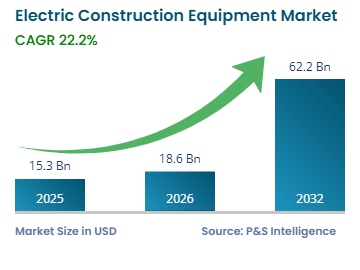
Market Size in 2025
USD 15.3 Billion
Market Size in 2026
USD 18.6 Billion
Market Size by 2032
USD 62.2 Billion
Projected CAGR
22.2%
Largest Region
Asia-Pacific
Fastest-Growing Region
Asia-Pacific
Market Structure
Semi-Consolidated
Market Size
Explore the market potential with our data-driven report
Electric Construction Equipment Market Future Outlook
The electric construction equipment market size was USD 15.3 billion for 2025, and it will grow by 22.2% during 2026–2032, to reach USD 62.2 billion by 2032.
The market growth is driven by the global transition toward low-emission construction practices, increasing electrification of heavy equipment, and rising government investments in sustainable infrastructure. Electric construction equipment eliminates tailpipe emissions, reduces noise levels, and improves energy efficiency, making it suitable for urban construction and environmentally sensitive zones. As regulatory pressure on diesel-powered equipment intensifies, electric alternatives are increasingly being adopted across construction activities and selectively in mining operations.
The International Energy Agency reports that the buildings and construction sector accounts for nearly 37% of global CO₂ emissions, including building operations and materials, underscoring the broader need for decarbonization across construction-related activities. Governments are implementing emission reduction policies, such as the European Union’s climate targets and emerging zero-emission construction zones in select urban regions, which are accelerating the adoption of electric equipment. Additionally, large-scale infrastructure investments, including the U.S. Infrastructure Investment and Jobs Act valued at USD 1.2 trillion, are driving demand for advanced and sustainable construction technologies.
Key Market Insights
The excavators category holds the largest market share, of 30%, in 2025, driven by their extensive deployment across infrastructure, urban development, and large-scale construction projects.
The lithium-ion category holds the largest market share, of 60%, in 2025, and it will have the highest CAGR, of approximately 22.9%, driven by its high energy density, longer lifespan, and faster charging capabilities.
The 50-200 kWh category holds the largest market share, of 45%, in 2025, driven by its suitability for mid-sized construction equipment such as excavators and loaders.
The mining category will have the highest CAGR, of approximately 22.4%, driven by increasing focus on sustainable mining operations and the reduction of carbon emissions.
Asia-Pacific holds the largest market share, of 40%, in 2025, and will have the highest CAGR, of approximately 23.1%, driven by large-scale infrastructure investment, emission reduction mandates, and expanding domestic lithium-ion battery supply chains.
Electric Construction Equipment Market Trends and Drivers
Rapid Decline in Lithium-Ion Battery Costs Is Key Trend
A defining trend transforming the commercial viability of electric construction equipment is the reduction in lithium-ion battery pack costs, which represent the largest single cost component of electric excavators and loaders. The International Energy Agency reported that lithium-ion battery pack prices fell by around 20% in 2024, marking one of the steepest annual declines in recent years. This cost reduction is structurally significant as it narrows upfront price differences and improves total cost of ownership competitiveness compared to diesel equipment.
As upfront cost differences narrow, contractors are increasingly shifting their evaluation toward lifetime operating economics, considering lower fuel and maintenance costs rather than focusing solely on initial capital expenditure. Continued innovation in battery chemistry and manufacturing processes is expected to sustain this downward cost trajectory through 2030. Government-backed incentive programs, including subsidies and tax credits under the European Green Deal, are further improving cost competitiveness and accelerating return on investment. OEMs are responding by developing modular and scalable battery architectures that allow a single platform to support multiple construction applications, improving fleet utilization and expanding the addressable market, particularly for rental operators.
Stringent Emission Regulations and Urban Zero-Emission Mandates Are Biggest Drivers
The most consequential force reshaping procurement across the global electric construction equipment market is the tightening of emission standards at both national and municipal levels, which is converting compliance from a long-term planning consideration into an immediate purchasing imperative. The European Commission Stage V Non-Road Mobile Machinery Regulation, fully enforced since 2020, establishes stringent pollutant limits across all power ranges of construction engines, covering excavators, loaders, bulldozers, and dump trucks, thereby restricting the use of higher-emission diesel equipment on urban European worksites. Beyond the EU-level framework, cities including London, Oslo, Copenhagen, and Amsterdam have introduced zero-emission construction requirements for selected public projects, creating a geographically targeted yet commercially significant layer of demand for battery-electric alternatives.
In North America, the United States Environmental Protection Agency Clean Trucks Plan Phase 3, effective from model year 2027, introduces stricter greenhouse gas standards that are expected to accelerate the adoption of zero-emission vocational vehicles through 2032. These multi-jurisdictional frameworks are compressing the viable commercial lifecycle of diesel equipment, forcing contractors and rental operators to accelerate fleet replacement timelines, while OEM capital allocation is increasingly shifting toward electric product development at scale.
High Initial Costs and Charging Infrastructure Limitations Are Key Restraints
The electric construction equipment market is constrained by the relatively higher upfront cost associated with electric machinery, which is higher than conventional diesel-powered equipment due to the integration of advanced battery systems and electric drivetrains. These cost differences create a cost consideration for contractors and construction companies, particularly in cost-sensitive markets where capital expenditure decisions are driven by short-term project economics rather than long-term operational savings. Many companies continue to rely on conventional equipment in the near term despite the long-term benefits of electrification.
In addition, the limited availability of high-capacity charging infrastructure at construction sites acts as a key operational consideration. Construction projects are often temporary and geographically dispersed, making it difficult to establish dedicated charging systems for heavy equipment. Remote and off-grid project locations further complicate deployment, as they may lack reliable access to electricity required for charging large machinery. The absence of standardized charging solutions and the need for high-power charging systems increase logistical complexity, slowing the adoption of electric construction equipment across multiple end-use applications.
Accelerating Electrification of Mining Operations Is Biggest Opportunity
The accelerating electrification of mining operations is emerging as a major opportunity for the electric construction equipment market, particularly for high-capacity machinery such as dump trucks, excavators, and loaders. Mining environments require continuous, high-power operations, making them increasingly suitable for selective deployment of electric equipment equipped with large battery systems. Electric machinery enables improvements in operational efficiency by reducing reliance on diesel fuel and lowering maintenance requirements. In underground mining operations, the use of electric equipment also reduces the need for ventilation systems, improving safety conditions and reducing overall energy consumption associated with air circulation.
Government and international institutions are actively supporting the transition toward sustainable mining. The International Energy Agency reports that demand for critical minerals is expected to increase substantially by 2040, with lithium demand projected to grow by up to 40 times, while cobalt and nickel demand are also expected to rise several-fold under accelerated energy transition scenarios. Additionally, the World Bank emphasizes that climate-aligned mining is essential to support the energy transition, with its Climate-Smart Mining initiative promoting sustainable extraction practices. The International Council on Mining and Metals has committed its member companies to achieve net-zero Scope 1 and 2 greenhouse gas emissions by 2050 or sooner, representing more than 650 mining and metals sites across over 50 countries, strengthening the industry’s focus on decarbonization and supporting the gradual adoption of zero-emission mining equipment. Countries such as Canada and Australia are also investing in zero-emission mining technologies and electrified equipment fleets. The development of high-capacity battery systems is enabling the electrification of heavy-duty mining equipment, expanding the addressable market for electric construction machinery.
Electric Construction Equipment Market Segmentation Analysis
Equipment Type Analysis
The excavators category holds the largest market share, of 30%, in 2025, driven by their extensive deployment across infrastructure, urban development, and large-scale construction projects. Excavators are the most widely used heavy equipment in earthmoving applications, including trenching, digging, and material handling. China’s Ministry of Transport of the People's Republic of China reported that transport fixed-asset investment is expected to reach approximately CNY 3.8 trillion (USD 521 billion) in 2024, supporting sustained demand for excavation equipment across road, railway, and logistics infrastructure projects.
The loaders category will have the highest CAGR, of approximately 22.7%, driven by increasing demand for efficient material handling in urban construction and mining environments. Loaders are widely used in applications requiring high-frequency loading and transportation of materials, particularly in confined or emission-sensitive environments. Electrification of loaders is being accelerated by stricter emission regulations in urban areas. The expansion of infrastructure and logistics networks is also supporting demand for equipment used in material handling operations.
The equipment types analyzed in this report are:
Excavators (Largest Category)
Loaders (Fastest-Growing Category)
Cranes
Bulldozers
Dump Trucks
Rollers
Graders
Others
Battery Type Analysis
The lithium-ion category holds the largest market share in 2025, and it will have the highest CAGR, of approximately 22.9%, driven by its superior energy density, longer lifecycle, and faster charging capabilities compared to alternative battery chemistries. Lithium-ion batteries support improved operational efficiency and extended operating durations, which are critical for construction equipment applications. The International Energy Agency reports that lithium-ion battery prices declined from approximately USD 1,400 per kilowatt-hour in 2010 to less than USD 140 per kilowatt-hour in 2023, making lithium-ion systems increasingly viable for heavy-duty electrification. Additionally, advancements in battery technology are improving performance and energy density, supporting the growing adoption of lithium-ion systems across heavy equipment.
The battery types analyzed in this report are:
Lithium-Ion (Largest and Fastest-Growing Category)
Lead-Acid
Nickel-Metal Hydride
Others
Battery Capacity Analysis
The 50-200 kWh category holds the largest market share, of 45%, in 2025, driven by its suitability for mid-sized construction equipment such as excavators and loaders. This capacity range provides a balanced combination of operational runtime and cost efficiency, supporting extended operating durations under typical duty cycles. Urban construction projects, where equipment operates in shifts, are increasingly adopting this capacity range to meet productivity requirements.
The 200-500 kWh category will have the highest CAGR, driven by the expanding electrification of heavier equipment platforms including large excavators, mining dump trucks, and high-capacity cranes. As OEMs introduce purpose-built electric equipment, such as models developed by Volvo Construction Equipment and Liebherr-International, the 200–500 kWh segment is transitioning from pilot applications toward broader commercial deployment. The International Council on Mining and Metals net-zero commitment, covering more than 650 mining and metals sites across over 50 countries, is supporting the adoption of high-capacity electric mining equipment, reinforcing growth in this segment.
The battery capacities analyzed in this report are:
Less than 50 kWh
50–200 kWh (Largest Category)
200–500 kWh (Fastest-Growing Category)
More than 500 kWh
Propulsion Type Analysis
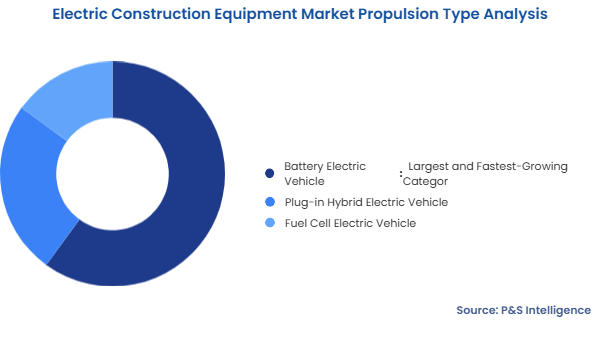
The battery electric vehicle category holds the largest market share, of 60%, in 2025, and it will have the highest CAGR, of approximately 22.5%, driven by its zero-emission operation and lower maintenance requirements compared to hybrid and fuel cell systems. BEVs eliminate the need for internal combustion engines, simplifying system architecture and reducing maintenance requirements while lowering dependence on fossil fuels. Governments worldwide are promoting BEV adoption through emission regulations and incentives. For instance, the Government of India is supporting electric mobility through initiatives such as the Faster Adoption and Manufacturing of Electric Vehicles (FAME) scheme, which provides financial incentives for electric vehicles and charging infrastructure development.
The propulsion types analyzed in this report are:
Battery Electric Vehicle (BEV) (Largest and Fastest-Growing Category)
Plug-in Hybrid Electric Vehicle (PHEV)
Fuel Cell Electric Vehicle (FCEV)
Application Analysis
The construction category holds the largest market share, of 35%, in 2025, driven by extensive use of heavy equipment across infrastructure, residential, and commercial projects. Governments globally are increasing investments in infrastructure development. The World Bank estimates that global infrastructure investment needs exceed USD 94 trillion by 2040, highlighting the scale of construction activities driving demand for electric equipment. This scale of infrastructure activity is driving sustained demand for construction equipment, supporting the adoption of electric machinery.
The mining category will have the highest CAGR, driven by increasing focus on sustainable mining operations and reduction of carbon emissions. Mining companies are adopting electric equipment to reduce operational costs and improve environmental performance. The International Energy Agency highlights the growing importance of sustainable mining practices to support the energy transition, including the extraction of critical minerals such as lithium and cobalt. Electrification of mining equipment is gaining momentum as companies aim to reduce emissions and improve energy efficiency.
The applications analyzed in this report are:
Construction (Largest Category)
Mining (Fastest-Growing Category)
Material Handling
Agriculture
Industrial
Others
Drive strategic growth with comprehensive market analysis
Electric Construction Equipment Market Geographical Analysis
Asia-Pacific Electric Construction Equipment Market Size
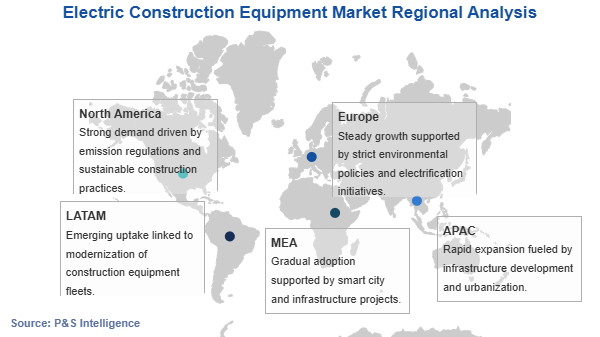
Asia-Pacific holds the largest market share, of 40%, in 2025, and will have the highest CAGR, of approximately 23.1%, supported by the scale and pace of infrastructure investment in China and India, government-mandated emission reduction targets across Japan, South Korea, and Australia, and the rapid development of domestic lithium-ion battery supply chains that are lowering equipment costs. China remains the largest country market, supported by strong infrastructure investment and urbanization trends, generating sustained demand for electric excavators, loaders, and dump trucks across smart city, transit, and industrial zone construction. The 14th Five-Year Plan’s emphasis on low-carbon infrastructure and digital integration has further supported the adoption of electric construction equipment across major projects.
India Electric Construction Equipment Market Size
India is the fastest-growing market within Asia-Pacific, driven by large-scale government-led infrastructure development. The Government of India National Infrastructure Pipeline committed USD 1.4 trillion to energy, roads, railways, and urban development between 2020 and 2025, while the Union Budget 2025–26 further raised capital investment outlay for infrastructure to USD 128.64 billion, equivalent to 3.1% of GDP. PM Gati Shakti, the national master plan unifying multiple ministries and states across large-scale infrastructure projects, is accelerating demand for construction machinery in road, metro rail, and renewable energy installation projects, creating a pipeline for electric equipment adoption aligned with India’s long-term emission reduction goals.
North America Electric Construction Equipment Market Size
North America holds a substantial share of the global electric construction equipment market and is among the most policy-driven regions for fleet electrification. The U.S. is the dominant and fastest-growing country market, driven by the U.S. Environmental Protection Agency's Clean Trucks Plan and the Inflation Reduction Act, which introduced tax credits and funding support for zero-emission heavy-duty vehicles, together forming the federal regulatory and financial architecture underpinning this position. At the state level, regulatory frameworks for zero-emission off-road equipment are becoming increasingly stringent across key regions, supporting the transition toward cleaner construction practices.
Large-scale federal investments under the Bipartisan Infrastructure Law and the CHIPS and Science Act are sustaining construction activity across transportation, energy, and semiconductor manufacturing sectors, generating demand for advanced construction equipment across these end-use verticals. Charging infrastructure for heavy equipment at construction sites remains an evolving challenge; however, ongoing grid expansion and electrification investments are expected to improve deployment feasibility over the forecast period. In December 2024, the U.S. Environmental Protection Agency announced approximately USD 735 million in funding under the Clean Heavy-Duty Vehicles Grant Program to support the deployment of zero-emission heavy-duty vehicles and associated charging infrastructure across multiple states and territories, reinforcing the region's transition toward low-emission equipment fleets
The regions and countries of the market are as follows:
North America
U.S. (Larger and Faster-Growing Country Market)
Canada
Europe
Germany (Largest Country Market)
U.K. (Fastest-Growing Country Market)
France
Italy
Spain
Rest of Europe
Asia-Pacific (Largest and Fastest-Growing Regional Market)
China (Largest Country Market)
India (Fastest-Growing Country Market)
Japan
South Korea
Australia
Rest of APAC
Latin America
Brazil (Largest Country Market)
Mexico (Fastest-Growing Country Market)
Rest of LATAM
Middle East & Africa
Saudi Arabia (Largest Country Market)
South Africa
U.A.E. (Fastest-Growing Country Market)
Rest of MEA
Electric Construction Equipment Market Share Analysis
The market is semi-consolidated, with leading OEMs such as Volvo Construction Equipment, Caterpillar Inc., Komatsu Ltd., SANY Heavy Industry Co., Ltd., and Xuzhou Construction Machinery Group Co., Ltd. collectively holding notable market positions. The structure is shaped by high capital requirements for electric powertrain development, battery integration, and charging compatibility, alongside strong dealer networks and brand trust built over decades. Entry barriers remain significant due to the need to prove operational reliability and cost efficiency in demanding environments. Competitive differentiation is increasingly driven by advancements in battery systems, telematics integration, and lifecycle service offerings rather than standalone equipment performance.
Key Players in the Electric Construction Equipment Market:
Caterpillar Inc.
Komatsu Ltd.
Volvo Construction Equipment AB
Hitachi Construction Machinery Co., Ltd.
J C Bamford Excavators Ltd.
Deere & Company
Liebherr-International AG
SANY Heavy Industry Co., Ltd.
XCMG Construction Machinery Co., Ltd.
HD Hyundai Construction Equipment Co., Ltd.
Wacker Neuson SE
Doosan Bobcat Inc.
Electric Construction Equipment Market News
In April 2025, SANY Heavy Industry Co., Ltd. showcased 11 electric-powered machines at Bauma 2025, marking a major expansion of its electric equipment portfolio in the European market. The lineup included models such as an electric crawler crane (SCC2000A-EV) and an electric road roller (STR50E), supporting its strategy to strengthen presence in zero-emission construction equipment.
In September 2024, Liebherr-International AG and Fortescue signed a USD 2.8 billion agreement at MINExpo 2024 for a zero-emission mining fleet.
The deal includes electric trucks, excavators, and dozers for large-scale deployment in Western Australia.
In September 2024, Hitachi Construction Machinery Co., Ltd. and Dimaag-AI announced a collaboration to develop a 1.7-tonne electric compact excavator.
The solution integrates swappable battery and electric drivetrain technology for urban and indoor applications.
In April 2024, Komatsu Ltd. launched new electric mini excavators at Intermat 2024, to strengthen its zero-emission compact equipment portfolio. The machines target urban construction with low-emission and compact operation capabilities.
Frequently Asked Questions About This Report
What is the market size of the electric construction equipment market?+
The electric construction equipment market was valued at USD 15.3 billion in 2025.
What is the growth rate of the electric construction equipment market?+
The market is growing at a CAGR of 22.2% during 2026-2032.
How does electric construction equipment reduce operating costs?+
Electric equipment reduces operating costs through lower fuel expenses, fewer moving parts leading to reduced maintenance, and improved energy efficiency.
What industries are adopting electric construction equipment the most?+
The construction industry leads adoption, followed by mining and industrial sectors, especially in regions with strict emission norms and urban development projects.
What are the environmental benefits of electric construction equipment?+
Electric construction equipment helps reduce greenhouse gas emissions, minimizes noise pollution, and supports cleaner and more sustainable construction operations.
Want a report tailored exactly to your business need?
Leading companies across industries trust us to deliver data-driven insights and innovative solutions for their most critical decisions. From data-driven strategies to actionable insights, we empower the decision-makers who shape industries and define the future. From Fortune 500 companies to innovative startups, we are proud to partner with organisations that drive progress in their industries.
Client Testimonials
Working with P&S Intelligence and their team was an absolute pleasure – their awareness of timelines and commitment to value greatly contributed to our project's success. Eagerly anticipating future collaborations.
McKinsey & Company
India
Unmatched Standards
Our insights into the minutest levels of the markets, including the latest trends and competitive landscape, give you all the answers you need to take your business to new heights
Complete Data Security
We take a cautious approach to protecting your personal and confidential information. Trust is the strongest bond that connects us and our clients, and trust we build by complying with all international and domestic data protection and privacy laws