Drug Discovery Informatics Market Size & Share Analysis - Trends, Drivers, Competitive Landscape, and Forecasts (2026 - 2032)
This Report Provides In-Depth Analysis of the Drug Discovery Informatics Market Report Prepared by P&S Intelligence, Segmented by Function (Sequencing and Target Data Analysis, Molecular Modelling, Molecular Docking, Library and Database Preparation, Data Mining and Predictive Analytics), Workflow (Discovery Informatics, Development Informatics), Mode (In-house, Outsourced), End User (Pharmaceutical Companies, Contract Research Organizations, Biotechnology Companies, Academic and Research Institutes), and Geographical Outlook for the Period of 2021 to 2032
Explore the market potential with our data-driven report
Drug Discovery Informatics Market Overview
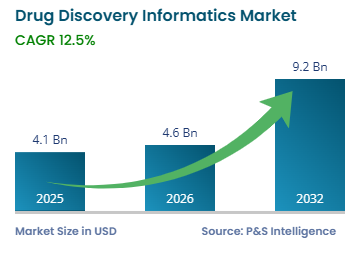
The drug discovery informatics market size was USD 4.1 billion in 2025, and it will grow by 12.5% during 2026-2032 to reach USD 9.2 billion by 2032.
The drug discovery informatics market is expanding as pharmaceutical and biotechnology companies increasingly depend on data-driven research to improve the efficiency, accuracy, and speed of drug development. Modern discovery programs generate large volumes of genomic, proteomic, molecular, and clinical data that are difficult to manage through conventional research approaches. Informatics platforms help researchers integrate diverse datasets, identify biological relationships, and support evidence-based decision-making across target identification, lead optimization, and candidate selection activities. The growing use of artificial intelligence, machine learning, molecular modeling, and predictive analytics is further increasing the importance of advanced informatics tools throughout discovery workflows.
Organizations are investing in cloud-based platforms that improve collaboration, data accessibility, and workflow management across geographically distributed research teams. Continuous advances in bioinformatics, computational biology, and multi-omics research are increasing the complexity of scientific datasets and creating demand for scalable informatics solutions. According to the European Molecular Biology Laboratory’s European Bioinformatics Institute (EMBL-EBI), its File Replication Archive reached 100 petabytes in 2024, highlighting the enormous volume of biological research data that organizations must store, manage, and analyze. Growing partnerships among pharmaceutical companies, biotechnology firms, technology providers, and research institutions are accelerating the adoption of advanced analytics platforms. These investments are strengthening data integration capabilities, supporting more efficient research workflows, and improving the ability of organizations to evaluate promising drug candidates across increasingly complex discovery programs.
Key Market Insights
Sequencing and Target Data Analysis is the largest function, holding a market share of 35.0%, due to its extensive use in processing genomic, transcriptomic, and molecular research datasets.
Molecular Modelling is the fastest-growing function, registering a CAGR of 12.8%, driven by increasing use of computational approaches for drug candidate evaluation and optimization.
Discovery Informatics is the largest workflow, holding a market share of 65.0%, due to its critical role in target identification, hit discovery, and lead optimization activities.
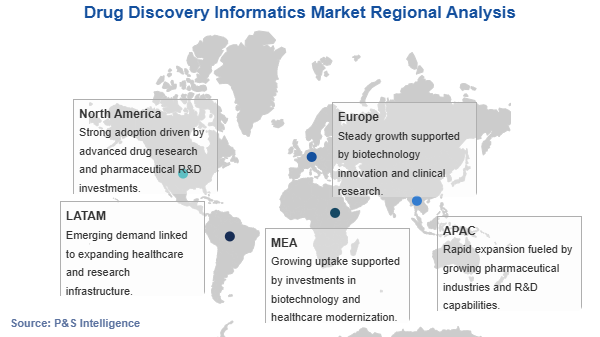
North America holds the largest share of 45.5%, due to the presence of major pharmaceutical companies, biotechnology innovators, and advanced drug research infrastructure.
Asia-Pacific is the fastest-growing region, registering a CAGR of 13.8%, driven by expanding pharmaceutical research capabilities, biotechnology investments, and digital healthcare infrastructure.
Drug Discovery Informatics Market Trends and Drivers
AI-Powered Drug Discovery Platforms and Integrated Research Ecosystems Are a Major Trend
A major trend in the drug discovery informatics market is the shift from standalone research software toward integrated AI-powered platforms that connect target identification, molecular design, predictive modeling, and experimental validation within a unified environment. Pharmaceutical and biotechnology companies are increasingly adopting solutions that combine bioinformatics, cheminformatics, machine learning, and cloud computing to improve collaboration and accelerate scientific decision-making across research programs. These capabilities are also supporting broader adoption of AI in drug discovery approaches that enhance target identification, molecular analysis, and candidate evaluation activities.
Recent product launches reflect this transition toward end-to-end digital discovery ecosystems. According to Eli Lilly and Company, TuneLab was launched in 2025 to provide biotechnology companies with access to AI and machine learning models trained on Lilly’s research data while protecting proprietary information through federated learning. According to Amazon Web Services, Amazon Bio Discovery was introduced in 2026 as an agentic AI application that connects computational drug design with wet-lab validation within a single workflow. These developments are expanding the role of informatics platforms beyond data management and positioning them as core systems for designing, evaluating, and advancing drug candidates across discovery programs.
Rising Complexity of Drug Research and Expanding Biological Data Volumes Drive Market
The growth of the drug discovery informatics market is driven by the increasing complexity of drug research and the rapid expansion of biological data generated throughout discovery and development activities. Pharmaceutical and biotechnology companies routinely work with datasets derived from genomics, proteomics, biomarker studies, high-throughput screening, and clinical research. Managing and interpreting this information requires advanced informatics platforms that can support target identification, lead optimization, and evidence-based decision-making.
The scale of modern research data continues to increase across both discovery and development workflows. According to the National Center for Biotechnology Information, GenBank Release 269.0 contained 49.73 trillion bases and 6.03 billion records in 2025, highlighting the volume of biological information used in discovery research. According to the World Health Organization International Clinical Trials Registry Platform, 115,753 clinical trials had an identified Phase II stage in 2025, demonstrating the substantial volume of research data generated during drug development. These expanding datasets are increasing reliance on informatics solutions that can integrate, analyze, and organize complex scientific information across multiple research stages.
High Implementation Costs and Data Integration Challenges Limit Market Expansion
The drug discovery informatics market faces challenges related to the integration, standardization, and management of increasingly diverse biological and research datasets. Pharmaceutical and biotechnology organizations often work with data generated from genomics, proteomics, molecular modelling, high-throughput screening, and other research platforms, which may use different formats, standards, and data-management environments. Integrating these heterogeneous datasets into a unified informatics environment can require significant technical resources, specialized expertise, and ongoing system maintenance. Research on biomedical data management has identified fragmented data systems, interoperability limitations, inconsistent standards, data-flow challenges, storage costs, and data security requirements as important barriers to efficient data integration and collaboration.
Expansion of Precision Medicine and Multi-Omics Research Creates New Growth Opportunities
A significant opportunity in the drug discovery informatics market is emerging from the expansion of precision medicine and multi-omics research. As organizations increasingly rely on precision medicine software to integrate genomic, clinical, and biomarker information, demand for advanced informatics platforms is expected to grow further. Pharmaceutical companies, healthcare organizations, and research institutions are increasingly combining genomic, transcriptomic, proteomic, and clinical data to identify disease mechanisms and develop targeted therapies. This approach requires advanced informatics platforms capable of integrating diverse datasets and generating actionable biological insights. According to the National Institutes of Health-maintained ClinVar database, more than 3 million human genetic variants from over 2,800 organizations were available in 2024, demonstrating the scale of data supporting precision medicine research. Growing use of variant-based analysis, biomarker discovery, and personalized treatment development is increasing demand for specialized informatics tools that support complex research workflows and translational research activities.
Drug Discovery Informatics Market Segmentation Analysis
Function Analysis
Sequencing and Target Data Analysis is the largest category, holding a market share of 35.0%, owing to its extensive use in processing and interpreting genomic, transcriptomic, and other biological datasets for target identification and validation. Drug discovery organizations increasingly rely on sequencing and target data analysis tools to identify disease-associated genes, characterize biological pathways, evaluate potential therapeutic targets, and integrate molecular information into early-stage research workflows. The increasing availability of large-scale genomic and multi-omics datasets is further strengthening the need for computational tools capable of organizing, analyzing, and interpreting complex biological information.
Molecular Modelling is the fastest-growing category, registering a CAGR of 12.8%, driven by increasing adoption of computational approaches for predicting molecular properties, evaluating drug-target interactions, and optimizing potential drug candidates. Molecular modelling enables researchers to assess molecular structures and interactions before extensive laboratory testing, supporting structure-based drug design and lead optimization activities. Advances in artificial intelligence, machine learning, molecular simulation, and computational chemistry are further expanding the capabilities of modelling platforms and improving their application across early-stage drug discovery workflows.
The functions analysed in this report are:
Sequencing and Target Data Analysis (Largest Category)
Molecular Modelling (Fastest-growing Category)
Molecular Docking
Library and Database Preparation
Data Mining and Predictive Analytics
Others
Workflow Analysis
Discovery Informatics is the largest category, holding a market share of 65.0%, due to its extensive application across target identification, target validation, hit discovery, lead identification, and lead optimization activities. Drug discovery organizations increasingly use informatics platforms during the early stages of research to integrate biological, chemical, genomic, and molecular datasets and support data-driven decision-making. The increasing adoption of computational approaches, artificial intelligence, machine learning, virtual screening, and predictive analytics is further strengthening the role of discovery informatics in identifying and evaluating potential drug candidates.
Development Informatics is the fastest-growing category, registering a CAGR of 13.0%, driven by increasing adoption of data-driven technologies across preclinical and clinical development activities. Development informatics solutions enable pharmaceutical and biotechnology organizations to integrate clinical, laboratory, biomarker, safety, and other development-related datasets to improve research coordination and decision-making. The increasing use of electronic data capture, advanced analytics, real-world evidence, and digital clinical research approaches is expanding the role of informatics beyond early discovery activities.
The workflow analysed in this report are:
Discovery Informatics (Largest Category)
Development Informatics (Fastest-growing Category)
Others
Mode Analysis
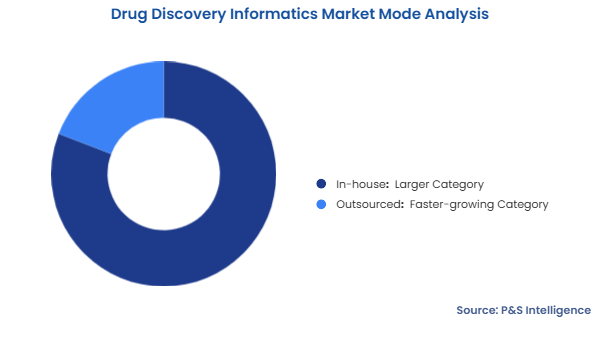
In-house is the larger category, holding a market share of 80.5%, because pharmaceutical and biotechnology companies prefer direct control over proprietary research data, analytical workflows, and intellectual property generated during drug discovery programs. Internal deployment allows organizations to customize informatics environments while maintaining data security and regulatory compliance standards. According to the World Intellectual Property Organization, the business sector filed nearly 264,100 Patent Cooperation Treaty applications in 2024, demonstrating the importance of protecting innovation and research assets. The strategic value of intellectual property and confidential scientific data continues to support investment in internally managed informatics infrastructure across large research organizations.
Outsourced is the faster-growing category, registering a CAGR of 13.5%, because organizations are increasingly seeking specialized expertise, flexible service models, and cost-efficient access to advanced informatics technologies. Outsourcing allows companies to leverage external capabilities in bioinformatics, computational biology, and data analytics without significant infrastructure investments. Growing collaboration between pharmaceutical firms and specialized service providers is supporting market expansion. As research complexity increases and development timelines become more demanding, outsourced informatics services are becoming an attractive option for improving operational efficiency and accelerating innovation.
The modes analysed in this report are:
In-house (Larger Category)
Outsourced (Faster-growing Category)
End User Analysis
Pharmaceutical companies are the largest category, holding a market share of 40.0%, due to their extensive drug discovery and development activities and continued investment in research and development. These organizations generate and manage large volumes of genomic, molecular, chemical, and biological data across target identification, lead discovery, molecular modelling, and candidate optimization workflows. Drug discovery informatics platforms enable pharmaceutical companies to integrate and analyze these datasets, support computational research, improve candidate selection, and enhance decision-making across research programs.
Contract Research Organizations are the fastest-growing category, registering a CAGR of 13.3%, driven by increasing outsourcing of specialized drug discovery and development activities by pharmaceutical and biotechnology companies. CROs provide access to specialized capabilities in areas such as bioinformatics, computational chemistry, molecular modelling, data analysis, and drug candidate evaluation, allowing sponsors to access advanced expertise and technologies without building all capabilities internally. The increasing complexity of drug discovery programs and the need to improve research efficiency are encouraging pharmaceutical companies to engage CROs for specialized and data-intensive research activities.
The End Users analysed in this report are:
Pharmaceutical Companies (Largest Category)
Contract Research Organizations (Fastest-growing Category)
Biotechnology Companies
Academic and Research Institutes
Others
Drive strategic growth with comprehensive market analysis
Drug Discovery Informatics Market Regional Analysis
North America Drug Discovery Informatics Market Analysis
North America holds the largest share, of 45.5%, due to the region’s highly developed pharmaceutical and biotechnology ecosystem, substantial research and development investments, and early adoption of advanced computational technologies. The region has a strong concentration of pharmaceutical companies, biotechnology firms, contract research organizations, academic research institutions, and technology providers that increasingly rely on informatics platforms to support data-driven drug discovery activities. The growing use of artificial intelligence, machine learning, molecular modelling, data analytics, and cloud-based research platforms is further strengthening demand for drug discovery informatics solutions across the region. According to the Pharmaceutical Research and Manufacturers of America, U.S. biopharmaceutical companies invested approximately USD 141 billion in research and development in 2022, with more than 80% of their global R&D conducted in the United States. This high concentration of pharmaceutical R&D activity strengthens the underlying demand for computational, data-management, and informatics technologies used across drug discovery workflows.
U.S. Drug Discovery Informatics Market Analysis
The United States is the largest country market in North America due to its concentration of pharmaceutical companies, biotechnology firms, academic medical centers, and specialized research organizations. The country remains a leader in artificial intelligence-enabled drug discovery, computational biology, and advanced bioinformatics research. According to the World Health Organization International Clinical Trials Registry Platform, the United States had 197,090 registered clinical trials in 2025, the highest total globally. This extensive research activity generates substantial volumes of biological and clinical data, encouraging widespread adoption of informatics platforms that support target discovery, data integration, predictive modeling, and development decision-making across research programs.
Asia-Pacific Drug Discovery Informatics Market Analysis
Asia-Pacific has the highest CAGR, of 13.8%, driven by the expansion of pharmaceutical and biotechnology research, increasing investments in drug development capabilities, and growing adoption of artificial intelligence, bioinformatics, and computational research technologies. Countries across the region are strengthening domestic pharmaceutical research ecosystems and increasing their participation in global drug discovery and development activities. The growing availability of genomic and molecular datasets, expansion of contract research capabilities, and increasing use of cloud-based research platforms are further supporting demand for informatics solutions. According to the OECD, Chinese firms accounted for about 17% of the research and development investments performed by the world’s top 2,500 corporate R&D investors, a level comparable with the European Union and demonstrating the increasing importance of Asian companies in global corporate research and innovation. The continued expansion of corporate R&D capabilities across major Asian economies is supporting greater adoption of computational tools for data integration, target identification, molecular analysis, and drug candidate evaluation.
China Drug Discovery Informatics Market Analysis
China is the largest country market in Asia-Pacific because of its expanding pharmaceutical research sector, growing biotechnology ecosystem, and increasing investment in computational drug discovery technologies. Companies across the country are strengthening research capabilities through artificial intelligence, machine learning, and advanced bioinformatics applications. According to the World Health Organization International Clinical Trials Registry Platform, China had 163,704 registered clinical trials in 2025, ranking second globally. The scale of research activity is increasing demand for informatics solutions that can manage complex datasets, support drug target identification, improve research efficiency, and enable data-driven decision-making across commercial and academic research environments.
Europe Drug Discovery Informatics Market Analysis
Europe holds a significant share of the drug discovery informatics market, supported by its established pharmaceutical and biotechnology industry, advanced biomedical research infrastructure, and strong collaboration between pharmaceutical companies, biotechnology firms, universities, research institutes, and technology providers. The region is increasingly adopting artificial intelligence, bioinformatics, molecular modelling, multi-omics analysis, and cloud-based research platforms to improve drug discovery efficiency and data-driven decision-making. Europe also benefits from a well-developed pharmaceutical manufacturing and research ecosystem, which generates substantial demand for technologies capable of managing and analyzing complex biological and molecular datasets. According to Eurostat, European Union exports of medicinal and pharmaceutical products increased by 13.5% in 2024 to reach €313.4 billion, while the region recorded a record pharmaceutical trade surplus of €193.6 billion. This strong pharmaceutical industry base supports continued investment in research technologies and creates a favorable environment for the adoption of drug discovery informatics solutions.
The regions and countries analysed in this report are:
North America (Largest Regional Market)
U.S. (Larger and Faster-Growing Country)
Canada
Europe
Germany (Largest Country)
U.K. (Fastest-Growing Country)
France
Italy
Spain
Rest of Europe
Asia-Pacific (Fastest-Growing Regional Market)
China (Largest and Fastest-Growing Country)
India
Japan
South Korea
Australia
Rest of APAC
Latin America
Brazil (Largest Country)
Mexico (Fastest-Growing Country)
Rest of LATAM
Middle East and Africa
Saudi Arabia (Largest Country)
U.A.E. (Fastest-Growing Country)
South Africa
Rest of MEA
Drug Discovery Informatics Market Competitive Landscape
The drug discovery informatics market is fragmented, with competition distributed across a diverse group of software developers, bioinformatics providers, cloud technology companies, specialized analytics vendors, and scientific research solution providers. The market continues to attract both established life sciences technology firms and emerging companies focused on artificial intelligence, computational biology, and data science applications. Product differentiation is largely based on analytical capabilities, integration with research workflows, data management efficiency, and the ability to support increasingly complex biological datasets. Continuous innovation has created a dynamic competitive environment where companies regularly expand platform functionalities, introduce new computational tools, and form strategic partnerships to strengthen their market position.
Leading Companies in the Drug Discovery Informatics Market:
Certara Incorporated
Dassault Systemes SE
Charles River Laboratories International, Inc.
Revvity, Inc.
Thermo Fisher Scientific Inc.
Eurofins Scientific SE
Schrodinger, Inc.
Collaborative Drug Discovery, Inc.
Infosys Limited
Jubilant Pharmova Limited
Selvita SA
Cadence Molecular Sciences
BioSolveIT GmbH
Drug Discovery Informatics Market Developments
In May 2026, Collaborative Drug Discovery partnered with Eli Lilly to integrate Lilly TuneLab into CDD Vault, enabling biotech companies to access selected Lilly AI/ML predictive models within their existing scientific workflows.
In April 2026, Revvity, Inc. launched Signals BioDesign through its Revvity Signals Software business. The cloud-native molecular cloning solution was released for biologics research workflows and connects with Signals One. The company said the release covered construct design, primer design, sequencing analysis, and protein translation in a single application used by biotech and pharmaceutical research teams.
In March 2026, Thermo Fisher Scientific completed its $8.875 billion acquisition of Clario, strengthening its digital clinical research and data capabilities. Clario integrates clinical-trial endpoint data from devices, sites, and patients, enabling digital collection, management, and analysis of clinical evidence across drug-development workflows.
In March 2025, Dassault Systemes expanded BIOVIA’s drug discovery capabilities through BIOVIA Reaction Planner on the 3DEXPERIENCE platform, using database exploration and machine learning to identify synthesis routes and support virtual drug design and synthesis planning.
Frequently Asked Questions About This Report
What does the drug discovery informatics market include for organizations?+
It includes informatics platforms for managing chemical, biological, genomic, screening, and experimental data across early drug research.
What factors are driving demand in the drug discovery informatics market?+
Growth is driven by complex research data, AI adoption, collaboration needs, target discovery, and pressure to improve pipeline decisions.
Why are organizations adopting drug discovery informatics solutions across operations?+
Pharma and biotech teams adopt these platforms to organize experiments, compare compounds, model properties, and support faster candidate selection.
How do drug discovery informatics solutions improve decision making and efficiency?+
These solutions improve research by connecting datasets, enabling analysis, reducing duplicated work, and supporting better decisions across discovery workflows.
What challenges affect adoption of drug discovery informatics solutions today?+
Adoption is affected by legacy data formats, data quality, scientific workflow complexity, integration with lab systems, and validation requirements.
Want a report tailored exactly to your business need?
Leading companies across industries trust us to deliver data-driven insights and innovative solutions for their most critical decisions. From data-driven strategies to actionable insights, we empower the decision-makers who shape industries and define the future. From Fortune 500 companies to innovative startups, we are proud to partner with organisations that drive progress in their industries.
Client Testimonials
Working with P&S Intelligence and their team was an absolute pleasure – their awareness of timelines and commitment to value greatly contributed to our project's success. Eagerly anticipating future collaborations.
McKinsey & Company
India
Unmatched Standards
Our insights into the minutest levels of the markets, including the latest trends and competitive landscape, give you all the answers you need to take your business to new heights
Complete Data Security
We take a cautious approach to protecting your personal and confidential information. Trust is the strongest bond that connects us and our clients, and trust we build by complying with all international and domestic data protection and privacy laws