AI in Drug Discovery Market Size & Share Analysis - Trends, Drivers, Competitive Landscape, and Forecasts (2026 - 2032)
This Report Provides In-Depth Analysis of the AI in Drug Discovery Market Report Prepared by P&S Intelligence, Segmented by Component (Solutions, Services), Clinical Specialty (Oncology, Neurology, Cardiovascular Diseases, Infectious Diseases, Metabolic and Endocrine Disorders), Drug Type (Small Molecule Drugs, Biologic Drugs), End User (Pharmaceutical Companies, Biotechnology Companies, Contract Research Organisations, Academic and Research Institutes), and Geographical Outlook for the Period of 2021 to 2032
Explore the market potential with our data-driven report
AI in Drug Discovery Market Future Prospects
AI in Drug Discovery Market Key Insights
Solutions represent the largest component with 70% share, as organizations utilize software platforms for biological data analysis.
Oncology forms the largest clinical speciality with 35% share, generating voluminous genomic data suitable for AI analysis.
Small molecule drugs are the larger drug type with 75% share, as pipelines focus on these therapeutics.
North America holds the largest regional share of 45%, supported by established biotech communities and robust R&D.
Asia-Pacific is the fastest-growing region with 22.1% CAGR, driven by increased AI investments from governments and pharma.
AI in Drug Discovery Market Future Outlook
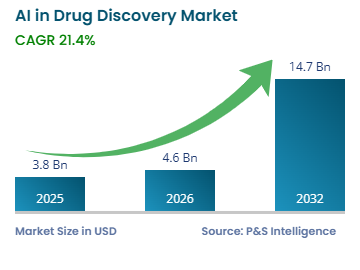
The AI in drug discovery market size was USD 3.8 billion for 2025, and it will grow by 21.4% during 2026–2032, to reach USD 14.7 billion by 2032.
The market is expanding because artificial intelligence algorithms rapidly identify drug targets and analyse complex biological data faster than standard laboratory techniques. Furthermore, according to the National Library of Medicine, the AlphaFold Protein Structure Database provided predictive structural coverage for over 214 million protein sequences globally in 2024. This unparalleled access to biological data highlights the growing adoption of such technologies among pharmaceutical and biotechnology companies, enabling more efficient preclinical development processes.
AI in Drug Discovery Market Trends & Drivers
Partnerships between AI Technology Firms and Drug Developers Are a Major Trend
The pharmaceutical industry is rapidly transitioning toward deep partnerships between drug researchers and artificial intelligence technology companies. Pharmaceutical firms actively collaborate with software developers to integrate complex predictive algorithms capable of analysing massive molecular datasets. The National Institutes of Health maintained over 119 million unique chemical compounds in its open-source database by 2024. Furthermore, data from the World Health Organization International Clinical Trials Registry Platform indicate that 596 clinical trials utilising artificial intelligence had been identified worldwide by 2025. Consequently, drug manufacturers shift from isolated experimental models to highly structured computational programs, accelerating the discovery of novel therapeutics and optimising clinical success rates.
Rising Cost and Time Pressure in Drug Development Drives The Market
The demand for artificial intelligence in drug discovery accelerates because conventional methods consume exceptional time and financial resources. Drug candidates frequently fail during late-stage testing, dramatically escalating financial risks worldwide. Researchers actively implement artificial intelligence to predict molecular behaviour and eliminate weak candidates before initiating expensive laboratory experiments. In 2025, the U.S. Food and Drug Administration published over 200 complete response letters issued between 2020 and 2024 as part of a transparency initiative. Furthermore, the European Medicines Agency issued 8 negative opinions for human medicine applications in 2024. Consequently, pharmaceutical companies aggressively adopt predictive algorithms to improve early-stage decision-making and decrease overall development timelines.
AI in Drug Discovery Market Segmentation Analysis
Component Analysis
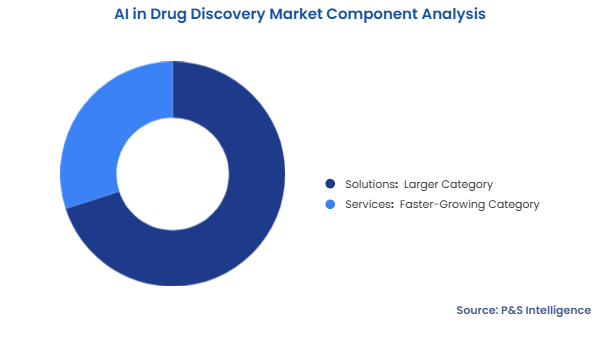
Solutions are the larger category holding a market share of 70% because pharmaceutical and biotech organisations actively use artificial intelligence platforms to analyse complex biological data. These comprehensive platforms allow researchers to evaluate massive molecular datasets rapidly during early-stage drug development. The National Institutes of Health maintained over 38.9 trillion base pairs of genomic sequence data in the GenBank database as of 2024. Consequently, laboratories overwhelmingly adopt complete software solutions to manage this immense biological information without disrupting their existing diagnostic workflows.
Services are the faster-growing category with a CAGR of 21.8% because many healthcare organisations lack the in-house technical expertise to build and deploy artificial intelligence systems independently. These institutions actively seek outside consulting to prepare massive datasets, develop predictive models and integrate complex computational tools into clinical networks. The European Molecular Biology Laboratory’s European Bioinformatics Institute reported that the ProteomeXchange consortium, led by its PRIDE database, reached over 50,000 proteomics datasets in 2024. To process these immense volumes of scientific information, pharmaceutical companies continuously outsource technical support and implementation tasks to specialised service providers.
The components analysed in this report are:
Solutions (Larger Category)
Drug target identification platforms
Molecular modelling and simulation tools
AI-driven compound screening platforms
Predictive analytics for drug candidate optimisation
Scientific data integration and knowledge discovery platforms
Services (Faster-Growing Category)
AI model development and algorithm training
Data preparation and annotation services
System integration and implementation services
Computational drug discovery consulting
Technical support and platform optimisation services
Clinical Speciality Analysis
Oncology is the largest category, because cancer research produces voluminous amounts of genomic data that artificial intelligence platforms efficiently analyse. Pharmaceutical companies continuously develop new targeted treatments to combat the rising burden of this complex disease worldwide. According to the U.S. Food and Drug Administration, the agency approved 17 novel anticancer therapeutics in 2024. Consequently, the global pharmaceutical industry accelerates its oncology pipelines by deploying artificial intelligence to rapidly discover novel molecules and improve survival rates for patients. Cancer is also the second-largest killer among chronic diseases, claiming around 10 million lives each year, as per the WHO.
Neurology is the fastest-growing category, registering a CAGR of 21.5%, because traditional discovery methods struggle to decode the complex biological pathways of the brain. Researchers increasingly utilise artificial intelligence tools to study vast patient datasets and understand diverse neurodegenerative disorders. According to a 2024 study published in Alzheimer’s & Dementia: Translational Research & Clinical Interventions, researchers identified 164 active clinical trials evaluating new Alzheimer’s disease therapies globally. As a result, biotechnology firms heavily invest in artificial intelligence to synthesise this complex trial data and accelerate the development of life-saving neurological treatments. As per a study published in the Lancet, over 3 billion people have some form of neurological conditions.
The clinical specialities analysed in this report are:
Oncology (Largest Category)
Neurology (Fastest-Growing Category)
Cardiovascular Diseases
Infectious Diseases
Metabolic and Endocrine Disorders
Others
Drug Type Analysis
Small molecule drugs are the larger category, because pharmaceutical companies maintain established discovery pathways and massive historical chemical databases for these traditional therapeutics. The U.S. Food and Drug Administration approved more than 30 small-molecule drugs in 2024. Researchers deploy artificial intelligence systems to screen these extensive chemical structures and identify promising lead compounds significantly faster than manual laboratory methods.
Biologic drugs are the faster-growing category, registering a CAGR of 21.7%, because the medical community increasingly prioritises complex therapeutics like monoclonal antibodies and recombinant proteins to target previously untreatable diseases. The European Medicines Agency recommended 28 new biosimilar medicines for marketing authorisation in 2024. As a result, biotechnology firms aggressively implement artificial intelligence algorithms to optimise complex biological interactions and predict patient responses to these advanced therapies. The global biopharmaceuticals market value is expected to reach USD 745.1 billion by 2030.
The drug types analysed in this report are:
Small Molecule Drugs (Larger Category)
Biologic Drugs (Faster-Growing Category)
End User Analysis
Pharmaceutical companies are the largest category, holding a market share of 45%, because these organisations heavily invest in expansive drug development pipelines and cutting-edge research technologies. They actively utilise artificial intelligence to evaluate vast amounts of biomedical data, identify viable drug targets, and enhance compound selection during early discovery phases. The U.S. Food and Drug Administration approved 50 novel drugs in 2024. To sustain this high regulatory output, massive pharmaceutical enterprises continuously deploy machine-learning algorithms to accelerate their research workflows and bring successful therapeutics to market faster.
Biotechnology companies are the fastest-growing category, registering a CAGR of 21.9% because emerging startups increasingly rely on artificial intelligence to build their foundational discovery models. These agile organisations aggressively implement machine learning systems to design novel biological compounds and secure vital partnerships with larger pharmaceutical firms. The European Patent Office received over 8,400 patent applications specifically in the biotechnology field in 2024. Consequently, biotechnology firms emphasise artificial intelligence technologies to rapidly navigate this competitive landscape of biomedical innovation and patent their complex molecular discoveries ahead of competitors.
Drive strategic growth with comprehensive market analysis
AI in Drug Discovery Market Regional Outlook
North America AI in Drug Discovery Market Analysis
North America holds the largest share of 45%, due to an established biotech community with high levels of investment in R&D and an advanced level of research-based infrastructure. In addition, major pharmaceutical organisations are investing heavily in the development of artificial intelligence to accelerate the early stages of drug discovery. There is collaboration among universities, medical research institutes, and technology companies with respect to biomedical research using AI. Federal government health agencies and various funding programs have provided support for innovation in computational biology. Due to the presence of leaders in the field of AI and large biomedical data sets, companies can conduct and implement AI-based drug discovery algorithms at a large scale across multiple therapeutic research programs.
U.S. AI in Drug Discovery Market Analysis
The United States leads artificial intelligence adoption in drug discovery because the robust domestic biotechnology sector heavily invests in cutting-edge computational research. Large pharmaceutical organisations continuously establish partnerships with technology startups to build predictive platforms for early-stage molecular screening. The U.S. Food and Drug Administration approved 26 novel therapies with an orphan drug designation and 18 biosimilars in 2024. Consequently, American research institutions leverage massive biomedical datasets to deploy predictive algorithms across multiple therapeutic programs, significantly accelerating the national drug development pipeline.
Canada AI in Drug Discovery Market Analysis
Canada is rapidly increasing its adoption of artificial intelligence in drug discovery because domestic universities actively develop advanced machine-learning models for biomedical studies. Government initiatives continuously promote digital health innovation to support the expanding national biotechnology ecosystem. Additionally, Canada's Drug Agency granted a time-limited reimbursement recommendation for 1 promising new oncology treatment in 2024. As a result, academic laboratories successfully partner with startup companies to translate complex computational research into practical clinical applications, pushing novel therapies to market faster.
Asia-Pacific AI in Drug Discovery Market Analysis
Asia-Pacific has the highest CAGR of 22.1%, due to increased investments from both government entities and pharmaceutical companies in artificial intelligence for biomedical research. Genomic databases, clinical research programs, and digital health systems are being developed by many countries within the region. Biotech firms in the region are working with tech companies to create AI-based drug discovery platforms. As a result, pharmaceutical manufacturers are using AI to accelerate compound screening and biological analysis processes. Additionally, an increase in research funding and growth of the life science ecosystem will encourage broader use of AI in drug development processes.
China AI in Drug Discovery Market Analysis
China rapidly expands its role in artificial intelligence drug development because the national government and local research organisations heavily invest in computational biology. Pharmaceutical manufacturers continuously build massive biomedical data systems to train algorithms for rapid drug target identification. The National Medical Products Administration approved 48 first-in-class innovative drugs in 2024. As a result, domestic biotechnology firms leverage these robust innovation pipelines to deploy advanced machine-learning tools, significantly shortening preclinical timelines and strengthening the national pharmaceutical sector.
India AI in Drug Discovery Market Analysis
India emerges as a rapidly growing centre for artificial intelligence in drug discovery because technology startups actively develop machine-learning tools for complex molecular analysis. The country leverages its massive pharmaceutical manufacturing base to support the expanding biotechnology ecosystem. Consequently, Indian research institutions and pharmaceutical companies increasingly collaborate to integrate artificial intelligence into early-stage discovery projects, accelerating the delivery of novel therapeutics.
Europe AI in Drug Discovery Market Analysis
Europe has a well-established pharmaceutical and life science research environment that supports the use of artificial intelligence in drug discovery. Many biotechnology firms and academic institutions in the region focus on computational biology and molecular modelling research. Collaborative research programs between universities, hospitals and pharmaceutical companies are common. Regulatory support for data sharing and scientific partnerships also helps companies develop AI models for biomedical applications. The presence of several global pharmaceutical companies continues to encourage the adoption of advanced technologies in early-stage drug development.
The regions and countries analysed in this report are:
North America (Largest Regional Market)
U.S. (Larger Country)
Canada (Faster-Growing Country)
Europe
Germany (Largest Country)
U.K. (Fastest-Growing Country)
France
Italy
Spain
Rest of Europe
Asia-Pacific (Fastest-Growing Regional Market)
China (Largest Country)
India (Fastest-Growing Country)
Japan
South Korea
Australia
Rest of APAC
Latin America
Brazil (Largest Country)
Mexico (Fastest-Growing Country)
Rest of LATAM
Middle East and Africa
Saudi Arabia (Largest Country)
South Africa
U.A.E. (Fastest-Growing Country)
Rest of MEA
AI in Drug Discovery Market Share
The market is fragmented, as many technology startups, AI platform providers, and specialised drug discovery firms are entering the field. Large pharmaceutical companies also collaborate with multiple technology partners rather than relying on a single provider. New firms continue to develop niche tools for target identification, molecule design, and data analysis. At the same time, research institutions and biotech companies are building their own AI capabilities. Because innovation is happening across many independent players, no single company dominates the overall landscape.
Key Players in the AI in Drug Discovery Market:
Schrodinger, Inc.
Insilico Medicine
BenevolentAI
Recursion Pharmaceuticals
Atomwise
Deep Genomics
BioSymetrics
XtalPi
Valence Discovery
Aria Pharmaceuticals, Inc.
Iktos
Healx
InSilicoTrials
Lantern Pharma, Inc.
Variant Bio, Inc.
Illumina, Inc.
Elix, Inc.
Owkin, Inc.
AI in Drug Discovery Market News
In January 2026, Variant Bio, Inc. launched an artificial intelligence platform called Inference designed to analyse genomic and biological datasets to identify potential drug candidates. It applies autonomous AI models to large genetic databases and supporting research collaborations with pharmaceutical partners.
In January 2026, Illumina, Inc. introduced the Billion Cell Atlas dataset to support artificial intelligence models used in drug discovery research. It maps cellular responses to genetic changes and enables pharmaceutical collaborators to accelerate disease mechanism studies and target identification.
In January 2026, Schrodinger, Inc. integrated an artificial intelligence drug discovery system developed by Eli Lilly into its LiveDesign research platform, allowing biotechnology researchers to access AI-driven compound design tools for early-stage drug development workflows.
In April 2025, Elix, Inc. and the Life Intelligence Consortium commercialised a federated learning-based artificial intelligence platform for drug discovery, enabling pharmaceutical companies to collaboratively train AI models on shared research data while maintaining the privacy of proprietary datasets.
Frequently Asked Questions About This Report
What are the primary factors driving the AI drug discovery market?+
Rising R&D costs, high clinical failure rates, and the urgent need to shorten preclinical timelines are the main drivers for adopting AI solutions.
How much time can AI save in the initial drug discovery phase?+
AI can reduce the time needed to identify new drug leads from several months down to just a few weeks through rapid simulations.
Which disease area is seeing the highest investment in AI-driven research?+
Oncology remains the leading segment, utilizing AI to analyze massive genomic datasets and identify highly specific biomarkers for personalized, targeted cancer therapies.
What are the biggest challenges to implementing AI in pharmaceutical research?+
Major hurdles include poor data quality, complex regulatory uncertainty, and the high cost of integrating AI platforms with legacy laboratory and clinical infrastructures.
How does generative AI contribute to the design of new molecules?+
Generative models predict optimal molecular structures and chemical properties, allowing researchers to explore vast chemical spaces and invent entirely new, effective drug candidates.
Want a report tailored exactly to your business need?
Leading companies across industries trust us to deliver data-driven insights and innovative solutions for their most critical decisions. From data-driven strategies to actionable insights, we empower the decision-makers who shape industries and define the future. From Fortune 500 companies to innovative startups, we are proud to partner with organisations that drive progress in their industries.
Client Testimonials
Working with P&S Intelligence and their team was an absolute pleasure – their awareness of timelines and commitment to value greatly contributed to our project's success. Eagerly anticipating future collaborations.
McKinsey & Company
India
Unmatched Standards
Our insights into the minutest levels of the markets, including the latest trends and competitive landscape, give you all the answers you need to take your business to new heights
Complete Data Security
We take a cautious approach to protecting your personal and confidential information. Trust is the strongest bond that connects us and our clients, and trust we build by complying with all international and domestic data protection and privacy laws