Precision Medicine Software Market Size & Share Analysis - Emerging Trends, Growth Opportunities, Competitive Landscape, and Forecasts (2026 - 2032)
This Report Provides In-Depth Analysis of the Precision Medicine Software Market Report Prepared by P&S Intelligence, Segmented by Component (Software, Services), Enterprise Size (Large Enterprises, Small & Medium Enterprises (SMEs)), Deployment (Cloud-based, On-premise, Hybrid), Application (Therapeutics, Diagnostics, Personalized Medical Care), Medical Specialty (Dermatology, Gynecology, Neurology, Cardiology, Orthopedics, Immunology / Autoimmune Diseases, Infectious Diseases), End User (Hospitals & Clinics, Pharmaceutical & Biotechnology Companies, Diagnostic Labs, Academic & Research Institutions), and Geographical Outlook for the Period of 2021 to 2032
Explore the market potential with our data-driven report
Precision Medicine Software Market Overview
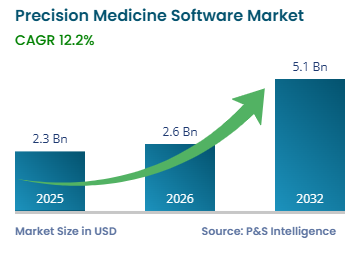
The precision medicine software market size was USD 2.3 billion in 2025, and it will grow by 12.2% during 2026 –2032, to reach USD 5.1 billion by 2032.
The market is growing due to a shift in healthcare delivery from the one-size-fits-all approach to personalised and data-driven treatments. Increasingly, there is a reliance upon genomic sequencing, electronic health records and real-world evidence among healthcare providers and drug developers to make informed treatment decisions. According to the World Health Organization (WHO), researchers globally registered over 6,500 clinical studies involving human genomic technologies by 2024. There is an increasing demand for solutions that enable the rapid analysis of large amounts of complex biological data.
Key Market Insights
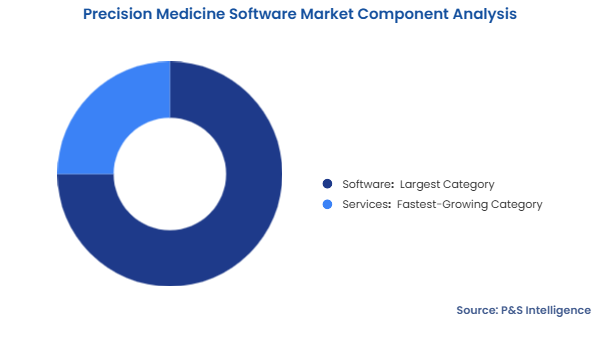
Software is the largest component with 75% share, as core platforms are essential to analyse complex genomic and clinical data.
Services are the fastest-growing component, with approx. 12.0% CAGR, driven by healthcare organisations outsourcing complex software integration, validation, and regulatory compliance support.
Cloud is the largest and fastest-growing deployment, with 65% share and 11.8% CAGR, providing high scalability to handle massive genomic data without local infrastructure.
Diagnostics is the largest application with 65% share, as genetic testing and molecular resistance profiling become daily clinical routines.
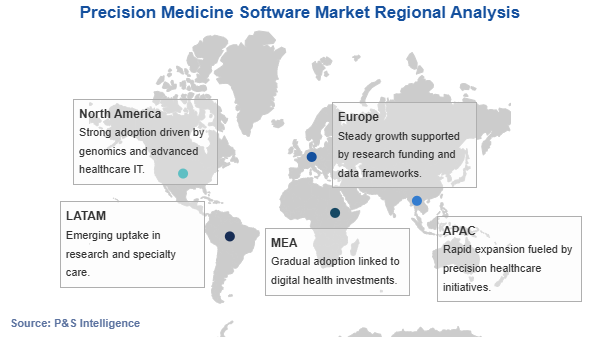
North America remains the largest regional market, with 45% share, while Asia-Pacific is the fastest-growing, with 12.5% CAGR, due to national genomics and digital health investments.
Precision Medicine Software Market Trends & Drivers
Growing Use of AI and Multi-Omics Approaches Is Major Trend
The healthcare industry is rapidly moving towards more-advanced forms of AI for handling huge amounts of complex medical data. Globally, 130 WHO member states had successfully completed official digital health maturity assessments by 2025 to evaluate their readiness for integrating interoperable AI platforms. According to the World Economic Forum, a typical global hospital generated approximately 50 petabytes of healthcare data in 2024. Companies are developing platforms that combine genomics, proteomics, imaging, and clinical records into one single system. The unprecedented volume of complex health information mandates the rapid deployment of interoperable, AI-powered analytical platforms.
Software is no longer simply storing medical data, it now identifies trends and provides actionable insights. Many vendors are forming alliances with sequencing technology and cloud providers to further enhance their analytic capabilities. At the same time, platforms are becoming more interoperable to enable hospitals using different systems and research databases to communicate through automated processes.
Rising Demand for Targeted and Cost-Effective TreatmentDrives Market
The market is growing because healthcare providers are looking for new ways to treat each patient more effectively than they have in the past. The WHO says that an estimated 20 million new cancer cases are diagnosed globally each year, actively driving the healthcare sector's rapid shift towards personalised software-driven oncology treatments. People with cancers and rare disorders do not always react the same way to standard treatment approaches. Rare diseases affected approximately 300 million people globally in 2024, creating a vast, genetically diverse patient population that urgently requires precision medicine software to replace trial-and-error prescribing.
As a result, doctors are seeking software tools that allow them to decide which drugs might be the most effective for an individual's specific genetic profile. Additionally, with the rising healthcare costs, precision medicine software is being used to eliminate the trial-and-error approach of prescribing and administering medications. In addition, drug manufacturers are utilising this software to identify the correct group of individuals who should participate in clinical trials. This results in a higher probability of successful clinical trials, resulting in faster product approval.
Precision Medicine Software Market Segmentation Analysis
Component Analysis
Software is the largest category, holding a market share of 75%, as precision medicine essentially depends on software to analyse genomic and clinical data. As per the National Human Genome Research Institute, global biomedical research and sequencing initiatives will generate an estimated 40 Exabytes of genomic data annually by 2025. This will create a massive structural requirement for software platforms capable of organising and analysing complex biological information. Therefore, hospitals and research institutions spend handsomely on software that can efficiently interpret large amounts of complex data.
Services are the fastest-growing category, because many healthcare organisations do not have the internal expertise to integrate and validate data on precision health applications and comply with regulations. In 2024, only 24% of the surveyed healthcare professionals received AI or advanced digital training. This highlights a significant internal skills gap, which drives clinical organisations to outsource complex software integration to specialised service providers. Therefore, once the application of the platform becomes more sophisticated, organisations often rely on third parties to deploy and maintain the technology.
The components analysed in this report are:
Software (Largest Category)
Core precision medicine platforms
Genomic data analysis tools
Clinical decision support systems
Bioinformatics & multi-omics integration
Patient data management software
Services (Fastest-Growing Category)
Implementation & integration support
Clinical interpretation & reporting
Validation & compliance support
Data curation & standardization
Consulting & training
Enterprise Size Analysis
Large enterprises are the larger category, holding a market share of 85%, due to their bigger budgets and established IT infrastructure. Researchers globally are conducting over 572,456 clinical studies across more than 220 countries in 2025. This underscores the sheer volume of complex medical data that drives large healthcare systems to deploy enterprise-wide precision software platforms.
Small & medium enterprises are the faster-growing category, primarily due to the increasing usage of cost-effective, cloud-based precision medicine technologies by smaller clinics and biotech firms. According to the World Bank, small and medium enterprises represent approximately 90% of all businesses worldwide. This highlights the massive underlying base of independent medical clinics that are increasingly leveraging subscription pricing models to deploy advanced analytics.
The enterprise sizes analysed in this report are:
Large Enterprises (Larger Category)
Small & Medium Enterprises (SMEs) (Faster-Growing Category)
Deployment Analysis
Cloud-based is the largest category, holding a market share of 65%, and also the fastest-growing category, registering a CAGR of 11.8%. This is because of its scalability and ability to handle large amounts of genomic data without significant onsite IT infrastructure. To support global collaboration, the National Institutes of Health (NIH) hosted over 339 Petabytes of complex genomic and clinical data on commercial cloud platforms in 2024, all accessible via the cloud.
For centralised access, ease of software upgrades and support for collaborative work across different sites, healthcare providers prefer cloud-based deployment of their NGS informatics applications. It provides a single point of entry for labs, hospitals and researchers to easily share the data that is generated during clinical studies and patient interactions. With many providers moving off legacy systems, cloud-based platforms have become the standard for managing precision medicine workflows and protecting sensitive patient information.
The deployments analysed in this report are:
Cloud-based (Largest and Fastest-Growing Category)
On-premise
Hybrid
Application Analysis
Diagnostics is the largest category, holding a market share of 65%, as genetic testing and biomarker-based screening are becoming part of daily clinical routines. Globally, an estimated 400,000 people developed multidrug-resistant or rifampicin-resistant tuberculosis (MDR/RR-TB) in 2023, according to the World Health Organization’s Global TB Report 2024.
Personalised medical care is the fastest-growing category, as treatment decisions are increasingly tailored to individual genetic profiles. The rising use of precision medicine software is driven by the rapid growth of genomic and molecular data, increasing prevalence of complex diseases and surging popularity of biomarker-guided therapies. These platforms integrate AI and clinical data to support accurate diagnoses, personalized treatment selection and improved patient outcomes. Additionally, cost-containment pressures, reduced incidence of adverse drug reactions and strong government support for data-driven healthcare accelerate adoption across modern healthcare systems.
The applications analysed in this report are:
Diagnostics (Largest Category)
Personalised Medical Care (Fastest-Growing Category)
Therapeutics
Medical Speciality Analysis
Cardiology is the largest category, holding a market share of 30%, as cardiovascular diseases are the leading cause of mortality globally, claiming an estimated 19.8 million lives each year. This drives the clinical demand for a wide variety of precision tools to screen for genetic mutations that may be contributing to the disease and to help plan therapy. Precision medicine is transforming cardiology by enabling risk prediction, early diagnosis, and personalized treatment based on genetic, biomarker, and lifestyle data.
Precision cardiology helps identify inherited cardiac conditions, tailor drug selection (such as anticoagulants) and guide interventional strategies. This way this approach improves outcomes, reduces adverse events and supports more proactive, preventive cardiovascular care. The global precision cardiology market size was USD 1,691.8 million in 2024, and it is forecast to reach USD 2,998.4 million by 2030.
Immunology/autoimmune diseases are the fastest-growing category, as many autoimmune disorders have complex biological pathways. Autoimmune diseases affected an estimated 10% of the global population in 2024, highlighting an immense patient base that requires advanced precision software for molecular profiling. As interest increases in the use of biologics and targeted therapies for autoimmune disorders, so will the demand for molecular profiling and other kinds of precision medicine software.
In rheumatoid arthritis, cytokine profiling helps select TNF or IL-6 inhibitors, while in systemic lupus erythematosus, interferon signatures and autoantibody panels guide B-cell or interferon-targeted therapies. For inflammatory bowel diseases, molecular and genetic markers inform biologic selection, and in multiple sclerosis, immune and MRI profiling supports early use of B-cell–depleting therapies. In severe asthma, blood eosinophil counts and IgE levels determine the most-effective biologic therapy.
The medical specialties analysed in this report are:
Hospitals & clinics are the largest category, holding a market share of 45%, as hospitals are the principal sites where patients receive their diagnoses and treatments. An estimated 1 in 10 patients worldwide experienced harm from adverse events whilst receiving healthcare in 2024, as per the WHO. This underscores the critical global need to integrate predictive precision software directly into clinical workflows, to improve safety.
Pharmaceutical & biotechnology companies are the fastest-growing category, registering a CAGR of 12.4%, because drug developers rely on genomic insights to design targeted therapies and select patient groups for clinical trials. According to the OECD, pharmaceutical R&D spending increased by nearly 76% between 2010 and 2025. This reflects the massive investments drug developers make in precision genomic platforms to improve success rates and reduce development risks.
Drive strategic growth with comprehensive market analysis
Precision Medicine Software Market Regional Outlook
North America Precision Medicine Software Market Analysis
North America is the largest market globally with 45% share, because many healthcare systems here have already incorporated genomic testing into their standard clinical pathways. Advanced electronic health records allow for more-seamless integration with precision-based software platforms. Additionally, research institutions and biotech companies collaborate on the development and validation of precision software platforms across this region. The Regulatory pathways for companion diagnostics and targeted therapy, as well as reimbursement mechanisms for genetic testing, are more developed in North America than anywhere else. As a result, hospitals and clinics on this continent are more likely to invest in precision medicine tools.
U.S. Precision Medicine Software Market Analysis
The United States dominates the regional market, as it is home to an advanced biotech industry and was one of the first countries to develop commercially viable genomic sequencing technologies. The federal All of Us Research Program had engaged more than 865,000 participants by 2025, generating a massive national dataset to advance precision medicine. In addition, many large hospital systems are utilising precision medicine tools for cancer treatment and rare disease programs.
The U.S. Food and Drug Administration (FDA) had approved 170 companion diagnostics in 2024, establishing a robust regulatory foundation for hospitals to deploy targeted therapies based on genetic profiles. Numerous companies are developing software for precision medicine in the U.S., while private equity and strategic partnerships drive innovation in precision software development and clinical adoption.
Canada Precision Medicine Software Market Analysis
The usage of genomic screening is rising across the provinces of Canada. Genome Canada, a national precision health initiative launched in 2024, aims to sequence the genomes of at least 100,000 Canadians to fuel AI-powered research. Research at a national level supports data sharing between publicly funded hospitals and academic centres. As per the Canadian Rare Disease Network, rare diseases affected an estimated 3 million Canadians in 2024. This underscores the critical need for regional health organisations to implement software platforms capable of diagnosing complex genetic conditions. Additionally, Canada focuses on population health and identifying rare diseases. Further, the government-backed funding for digital health allows smaller, regional health organisations to develop and implement precision medicine platforms.
Asia-Pacific Precision Medicine Software Market Analysis
Asia-Pacific is the fastest-growing region in the market, with approx. 12.5% CAGR, due to the significant investment in national genomics programs and digital health. Many countries are creating large genomic databases for the study of diseases. Access to healthcare is increasing as private hospital chains are utilising new diagnostic technologies. The regional biotechnology industry is expanding, and the number of clinical trials is rising. The growing disease burden due to the rapid urbanisation propels the need for personalised treatment options in both public and private healthcare systems.
China Precision Medicine Software Market Analysis
The Chinese biotechnology industry is developing quickly as a result of large-scale national genomics initiatives, as well as through the direct government encouragement of biotechnology innovation. A total of 4,900 clinical trials were registered in China in 2024, representing a 13.9% increase driven by expansions in precision oncology. Companies that specialise in domestic sequencing are increasing their operational capacity, which propels the demand for analysis software. Public hospitals in major metropolitan areas are implementing molecular diagnostics protocols rapidly. China approved 48 first-in-class innovative drugs and 55 rare disease medications in 2024, demonstrating strong national policy support for the development of targeted precision therapies.
India Precision Medicine Software Market Analysis
India is experiencing rapid expansion as large private hospital chains now provide genomic testing services within major urban markets. The genomic data of 10,000 sequenced individuals was made publicly accessible in 2025 through the Genome India Project, establishing a foundational genetic reference database for the Indian population. India has become an increasingly popular site for clinical research and bioinformatics service provision.
The growing public awareness of hereditary diseases and decreasing costs of sequencing are driving adoption. The government is taking several initiatives to improve the use of data for healthcare delivery. Over 79.91 crore Ayushman Bharat Health Accounts (ABHAs) were created, and 67.19 crore electronic health records were linked by 2025.
Europe Market Analysis
Europe is another significant market as a result of its well-established public health infrastructure, which supports national healthcare systems and coordinated, cross-border research initiatives. Most European countries have developed or are developing genomic medicine strategies based on large academic hospital systems. The regulatory framework for protecting patient data influences the way it is collected, used and shared and, in turn, the precision medicine software design and deployment. A strong emphasis is placed on the ethical use of genetic data, as well as the development of standardised clinical practice guidelines. The adoption of genomics technologies continues to be driven by collaborative research networks and publicly funded innovation programs.
The regions and countries analysed in this report are:
North America (Largest Regional Market)
U.S. (Larger Country)
Canada (Faster-Growing Country)
Europe
Germany (Largest Country)
U.K. (Fastest-Growing Country)
France
Italy
Spain
Rest of Europe
Asia-Pacific (Fastest-Growing Regional Market)
China (Largest Country)
India (Fastest-Growing Country)
Japan
South Korea
Australia
Rest of APAC
Latin America
Brazil (Largest Country)
Mexico (Fastest-Growing Country)
Rest of LATAM
Middle East and Africa
Saudi Arabia (Largest Country)
U.A.E. (Fastest-Growing Country)
South Africa
Rest of MEA
Precision Medicine Software Market Share Analysis
The market is fragmented because of the presence of large global health IT vendors, small bioinformatics vendors that specialise in certain areas, and startups developing new technologies for precision medicine. As such, no one vendor dominates the entire industry, as most have specific expertise, including genomic analytics, clinical decision support systems (CDS), and data integration services. While many larger technology vendors compete in the same space as smaller innovation-based vendors, they partner, acquire each other and expand their platforms. Because new competitors can enter the market quickly through continuous innovation and rapid changes in technology, the market will continue to have a fragmented nature.
Key Precision Medicine Software Companies:
Illumina, Inc.
Thermo Fisher Scientific Inc.
IBM Watson Health
SAS Institute Inc.
Oracle Corporation (Oracle Health Sciences)
SAP SE (SAP Health)
Microsoft Corporation (Microsoft Cloud for Healthcare / Azure Genomics)
Google Cloud (Healthcare & Life Sciences)
Q2 Solutions (IQVIA)
Veeva Systems
DNAnexus, Inc.
Color Health, Inc.
Fabric Genomics (a Roche company)
Tempus Labs, Inc.
Epic Systems Corporation
Precision Medicine Software Market News
In January 2026, Tempus AI launched Paige Predict, an AI-powered biomarker prediction solution that analyses digital pathology slide images to support clinical decision-making workflows.
In November 2025, Gene Solutions introduced its SPOT-MAS multi-cancer early detection platform in Taiwan. This way, the company expanded its AI-integrated precision screening technology, which combines multi-omics and advanced cell-free DNA analysis for earlier cancer detection.
In October 2025, IBM Watson Health expanded its precision medicine software with enhanced genomics analytics capabilities, partnering with hospitals to improve rare disease diagnostics and clinical data interpretation workflows.
Frequently Asked Questions About This Report
What factors are driving the growth of the precision medicine software market?+
Growth is heavily driven by the rising demand for personalized healthcare, rapid advancements in genomic sequencing technologies, and increasing investments in AI-powered medical solutions.
What are the major challenges facing the precision medicine software market?+
High implementation costs, complex data interoperability issues, and strict data privacy regulations regarding sensitive genomic information remain the biggest hurdles for widespread global adoption.
Which application segment holds the largest share of this global market?+
The oncology segment dominates the market due to the high global prevalence of cancer and the increasing use of genomics to develop highly personalized therapies.
How is artificial intelligence transforming precision medicine software solutions today?+
Artificial intelligence accelerates the interpretation of complex genomic datasets, enables predictive modeling for early disease detection, and significantly speeds up the personalized drug discovery process.
Which end-user segment currently leads the adoption of precision medicine software?+
Healthcare providers account for the largest share, as they increasingly utilize these advanced platforms to deliver tailored clinical treatments and improve overall patient health outcomes.
Want a report tailored exactly to your business need?
Leading companies across industries trust us to deliver data-driven insights and innovative solutions for their most critical decisions. From data-driven strategies to actionable insights, we empower the decision-makers who shape industries and define the future. From Fortune 500 companies to innovative startups, we are proud to partner with organisations that drive progress in their industries.
Client Testimonials
Working with P&S Intelligence and their team was an absolute pleasure – their awareness of timelines and commitment to value greatly contributed to our project's success. Eagerly anticipating future collaborations.
McKinsey & Company
India
Unmatched Standards
Our insights into the minutest levels of the markets, including the latest trends and competitive landscape, give you all the answers you need to take your business to new heights
Complete Data Security
We take a cautious approach to protecting your personal and confidential information. Trust is the strongest bond that connects us and our clients, and trust we build by complying with all international and domestic data protection and privacy laws