Dental Digital X-Ray Market Size & Share Analysis - Trends, Drivers, Competitive Landscape, and Forecasts (2026 - 2032)
This Report Provides In-Depth Analysis of the Dental Digital X-Ray Market Report Prepared by P&S Intelligence, Segmented by Product Type (Intraoral X-Ray Systems, Extraoral X-Ray Systems, Hybrid/Multi-Function Imaging Systems), Portability (Wall-Mounted Systems, Portable/Handheld Systems), End User (Dental Hospitals and Clinics, Dental Diagnostic Imaging Centres, Dental Academic and Research Institutes, Forensic Laboratories), Technology (Direct Radiography, Computed Radiography), and Geographical Outlook for the Period of 2021 to 2032
Explore the market potential with our data-driven report
Dental Digital X-Ray Market Future Outlook
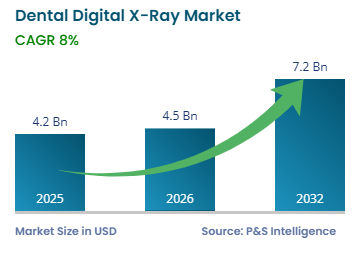
The dental digital X-Ray market size was USD 4.2 billion for 2025, and it will grow by 8.0% during 2026-2032, to reach USD 7.2 billion by 2032.
The market is expanding because dental clinics and hospitals are replacing conventional film-based imaging systems with digital X-ray technologies that provide faster image processing, clearer diagnostic visibility, and simplified patient record management. Dental professionals increasingly use digital imaging systems for implant planning, orthodontic assessment, oral surgery, and endodontic procedures, where accurate visualisation improves treatment precision and workflow efficiency. Growing awareness regarding preventive oral healthcare and rising demand for cosmetic and restorative dental procedures are also supporting adoption across developed and emerging healthcare markets. Patients increasingly prefer quicker diagnosis and minimally invasive treatment approaches, which is encouraging clinics to modernise diagnostic infrastructure with advanced digital imaging platforms.
The market is also benefiting from continuous improvements in cone beam computed tomography systems, artificial intelligence-enabled diagnostics, cloud-connected imaging software, and low-radiation digital radiography solutions. Dental clinics are integrating AI-supported imaging platforms to improve abnormality detection, automate image interpretation, and support treatment planning with greater accuracy. The growing use of 3D imaging in implantology, orthodontics, and maxillofacial applications is further increasing demand for advanced dental digital X-ray systems. According to the World Health Organization, an estimated 2 billion people had caries in permanent teeth and approximately 510 million children had caries in primary teeth in 2025. Expanding private dental networks and rising healthcare spending in Asia-Pacific countries are also strengthening demand for connected imaging ecosystems that combine diagnostics, patient records, and treatment planning within a single platform.
Key Market Insights
Intraoral X-ray systems are the largest product type, holding a market share of 45%, due to routine use in cavity detection and chairside diagnosis.
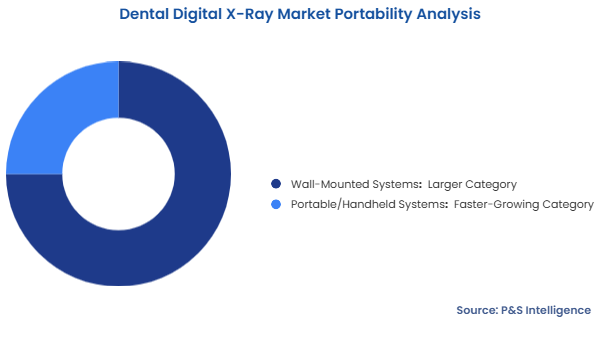
Portable/handheld systems are the faster-growing portability type, registering a CAGR of approximately 8.3%, driven by demand for movable imaging in flexible clinical workflows.
Dental hospitals and clinics are the largest end user, holding a market share of 40%, due to direct imaging use during diagnosis, treatment planning, and follow-ups.
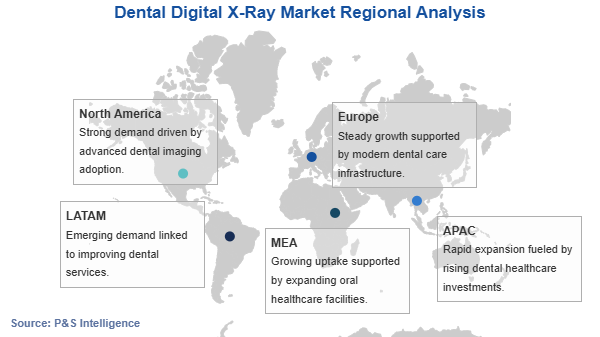
North America holds the largest regional share of 40%, due to advanced dental technology adoption, strong clinic networks, and preventive oral care demand.
Asia-Pacific is the fastest-growing region, registering a CAGR of approximately 8.9%, driven by private dental clinic expansion and rising access to specialised oral healthcare.
Dental Digital X-Ray Market Trends and Drivers
AI-Integrated 3D Dental Imaging Platforms Are a Major Trend
Dental imaging companies are increasingly integrating artificial intelligence with 3D digital X-ray systems to improve diagnostic accuracy and automate treatment planning workflows. Clinics are adopting imaging platforms that support implant positioning, orthodontic analysis, nerve mapping, and real-time image interpretation with reduced manual intervention. Compact cone beam computed tomography systems and low-dose 3D scanners are also becoming more common in smaller dental facilities seeking advanced imaging without large equipment installations. According to the Organization for Economic Co-operation and Development, 72% of surveyed medical associations across North America, South America, Asia-Pacific, Europe, the Middle East, North Africa, and Sub-Saharan Africa stated in 2024 that the benefits of artificial intelligence in healthcare outweigh the risks. According to the International Telecommunication Union, 6 billion people, equal to 74% of the global population, used the internet in 2025, supporting wider adoption of cloud-connected imaging platforms and digital patient management systems. This transition is encouraging dental providers to adopt integrated imaging ecosystems that improve workflow coordination, support chairside consultations, and enable faster communication between dentists, specialists, and laboratories.
Rising Demand for Early Dental Disease Detection Drives Market
The market is growing because dentists and patients are placing greater emphasis on early diagnosis of oral conditions before extensive restorative procedures become necessary. Dental digital X-ray systems support accurate identification of cavities, periodontal disease, bone loss, tooth infections, and impacted teeth, allowing clinicians to develop precise treatment plans for orthodontics, implantology, endodontics, and cosmetic dentistry. Furthermore, digital imaging improves workflow by providing immediate image availability, streamlined record management, and efficient collaboration between dental specialists and laboratories. According to the World Health Organization, severe periodontal diseases are estimated to affect more than 1 billion cases worldwide. Additionally, the World Health Organization estimates that the global prevalence of complete tooth loss is 23% among people aged 60 years or older. These oral health indicators are increasing the use of digital radiography, panoramic imaging, and cone beam computed tomography across dental practices. Clinics are continuing to modernize diagnostic infrastructure with connected imaging platforms that support detailed clinical evaluation, improve treatment planning accuracy, strengthen patient communication, and integrate efficiently with digital dental workflows.
High Equipment and Installation Costs Restraining Adoption across Small Dental Practices
The market faces challenges because advanced dental digital X-ray systems require a high initial investment, particularly for small clinics and independent dental practices operating with limited financial resources. Equipment such as cone beam computed tomography systems, digital sensors, integrated imaging software, and specialised workstations can involve high purchase, installation, and maintenance costs. Many clinics must also spend on software upgrades, staff training, system calibration, cybersecurity protection, and digital storage infrastructure after implementation. In developing regions, smaller dental facilities often continue using conventional imaging methods because replacing existing systems increases operational pressure and raises long-term technology management costs. According to the World Health Organization, oral diseases affected nearly 3.7 billion people globally in 2025, while prevention and treatment services remained expensive and were commonly excluded from national universal health coverage benefit packages. These financial limitations slow the adoption of advanced imaging technologies in price-sensitive healthcare markets and delay digital modernisation among smaller dental providers that cannot support continuous technology-related expenditure.
Expansion of Dental Care Infrastructure in Emerging Economies Creating Significant Market Opportunities
The market has strong growth opportunities as dental healthcare infrastructure expands across developing countries and private dental clinic networks continue increasing in urban and semi-urban areas. Healthcare providers are investing in modern facilities equipped with digital imaging systems for diagnosis, implant planning, restorative dentistry, and orthodontic procedures. Furthermore, rising dental tourism is encouraging clinics to adopt advanced digital X-ray technologies that support efficient diagnosis and integrated treatment workflows. According to the World Bank DataBank, the global population aged 65 years and above reached approximately 831 million in 2024, representing about 10.2% of the world's population. This expanding older population is increasing demand for restorative dental care, periodontal treatment, implant procedures, and digital diagnostic imaging, encouraging providers to strengthen imaging capabilities and modernize clinical infrastructure across emerging healthcare markets.
Dental Digital X-Ray Market Segmentation Analysis
Product Type Analysis
Intraoral X-ray systems are the largest category, holding a market share of 45%, because they are widely used for cavity detection, periodontal assessment, root canal planning, and routine dental examinations. These systems are common in general dental clinics because they are compact, easier to install, and suitable for daily chairside imaging procedures. Digital sensors and phosphor storage plates also support clinics replacing conventional film-based workflows with faster digital imaging processes. According to a peer-reviewed review of digital intraoral radiography systems, 150 intraoral digital radiography systems from 55 companies were identified in 2025, highlighting the broad product availability supporting routine chairside dental imaging. This wide commercial availability continues to strengthen adoption across both independent clinics and larger dental care networks.
Extraoral X-Ray Systems are the fastest-growing category, registering a CAGR of approximately 8.7%, because dentists are using wider-view imaging for implants, orthodontics, jaw assessment, and complex treatment planning. CBCT, panoramic, and cephalometric systems help capture structures that intraoral images cannot show clearly. Demand is rising as dental clinics handle more implant procedures and cosmetic treatments that need full-mouth or three-dimensional views before treatment starts. This makes extraoral systems more important for advanced dental practices and diagnostic imaging centres.
The product types analysed in this report are:
Intraoral X-Ray Systems (Largest Category)
Digital Sensors
Photostimulable Phosphor (PSP) Systems
Extraoral X-Ray Systems (Fastest-Growing Category)
Panoramic Systems
Cephalometric Systems
Cone Beam Computed Tomography (CBCT) Systems
Hybrid/Multi-Function Imaging Systems
Others
Portability Analysis
Wall-Mounted Systems are the larger category, holding a market share of 75%, because most dental clinics still prefer fixed X-ray units for regular patient imaging. These systems are stable, easy to position inside treatment rooms, and suitable for repeated daily use. Clinics also trust wall-mounted equipment because it fits normal dental workflows and supports consistent image capture by trained staff. Their long operating life and wide availability through dental equipment suppliers keep them the main choice for established practices.
Portable and handheld systems are the faster-growing category, because dental clinics increasingly prefer compact imaging solutions that support chairside diagnosis and flexible patient positioning. These systems are widely used in mobile dental services, community outreach programs, and smaller clinics where space optimization is important. According to the World Health Organization, approximately 1.3 billion people, representing 16% of the global population, are persons with disabilities. This supports wider adoption of portable dental X-ray systems that improve imaging accessibility for patients with mobility limitations while helping providers deliver efficient diagnostic services across diverse clinical settings.
The portabilities analysed in this report are:
Wall-Mounted Systems (Larger Category)
Portable/Handheld Systems (Faster-Growing Category)
End User Analysis
Dental hospitals and clinics are the largest category, holding a market share of 40%, because most dental imaging procedures are performed where diagnosis and treatment are delivered. General dentists, orthodontists, implant specialists, and oral surgeons rely on digital X-ray systems for treatment planning, follow-up evaluations, and restorative procedures. Clinics also invest in imaging equipment to maintain integrated clinical workflows and improve patient management within a single facility. According to the FDI World Dental Federation Membership Liaison and Support Committee Report, the organization included 188 member associations across 132 countries and territories in 2024. This broad professional network reflects continued expansion of dental services and supports sustained adoption of digital imaging systems across clinical settings.
Dental Diagnostic Imaging Centres are the fastest-growing category, registering a CAGR of approximately 8.5%, because many dental practices refer complex cases to specialised imaging centres for panoramic, cephalometric, and CBCT scans. These centres serve multiple clinics, so they often invest in higher-end imaging systems with better scan options and reporting workflows. Growth is also supported by rising demand for implant planning, orthodontic assessment, and maxillofacial evaluation, where dentists need detailed images but may not own advanced equipment in-house.
Direct Radiography (DR) is the larger category, because it provides instant digital images without a separate plate-scanning step. Dentists prefer DR for busy clinic workflows where faster diagnosis and quick image sharing are important. The technology also reduces manual handling, simplifies storage, and connects more easily with dental practice software. As clinics replace film and older systems, DR is often selected because it improves daily imaging speed and supports chairside decision-making.
Computed radiography is the faster-growing category, because it provides clinics with a gradual transition from film-based imaging to digital diagnostic workflows. Many smaller dental practices prefer computed radiography systems because phosphor storage plates remain familiar, flexible, and easier to position during imaging procedures. These systems also reduce the immediate investment burden associated with full sensor-based digital imaging platforms. According to a peer-reviewed review of digital intraoral radiography systems, 45 phosphor storage plate-based systems were identified in 2025, supporting the continued availability of computed radiography workflows in dental imaging. Continued preference for cost-effective digital conversion strategies is supporting adoption among smaller and budget-sensitive dental facilities.
Drive strategic growth with comprehensive market analysis
Dental Digital X-Ray Market Regional Outlook
North America Dental Digital X-Ray Market Analysis
North America holds the largest share, of 40%, because the region has a highly developed dental care ecosystem with strong adoption of advanced diagnostic technologies across private clinics, dental service organisations, and hospital-based dental facilities. Dental professionals in the region widely use cone beam computed tomography systems, digital radiography platforms, and AI-supported imaging software for implantology, orthodontics, and cosmetic dentistry procedures. The presence of large dental imaging manufacturers and established reimbursement systems also supports faster technology integration in clinical practice. In addition, patients in the region show high awareness regarding preventive oral healthcare and routine dental examinations, which increases the demand for digital diagnostic imaging. The market is also supported by continuous product innovation, rapid replacement of older imaging systems, and increasing preference for connected digital workflows in dental practices.
U.S. Dental Digital X-Ray Market Analysis
The U.S. market is driven by widespread adoption of advanced imaging technologies across dental service organisations, specialised clinics, and multi-location dental groups. Dentists in the country extensively use digital X-ray systems for implant procedures, cosmetic dentistry, orthodontics, and oral surgery planning to improve treatment precision and workflow efficiency. AI-supported imaging software and cloud-based dental management platforms are also becoming more common in modern dental practices. According to the ADA Health Policy Institute, more than 1 in 4 U.S. dentists within 10 years of dental-school graduation were affiliated with a dental support organization in 2024. Expanding organised dental networks and continued investment in advanced diagnostic technologies are strengthening demand for digital dental imaging systems across the country.
Canada Dental Digital X-Ray Market Analysis
Canada is witnessing steady growth in dental digital X-ray adoption due to increasing emphasis on preventive oral healthcare and continued modernization of community dental clinics. Healthcare providers are replacing film-based systems with digital imaging platforms that improve image storage, clinical workflow, and diagnostic efficiency. Portable radiography systems are also expanding access to dental imaging in remote communities and smaller practice settings. According to Statistics Canada, approximately 72% of Canadians aged 12 years and older reported during November 2023 to March 2024 that they had visited an oral health professional in the previous 12 months. Higher participation in routine dental care continues to encourage investments in digital imaging equipment across Canadian dental practices.
Asia-Pacific Dental Digital X-Ray Market Analysis
Asia-Pacific has the highest CAGR, of approximately 8.9%, because the region is experiencing rapid expansion of private dental clinics, rising dental tourism activity, and growing investment in healthcare infrastructure across developing economies. Countries in the region are seeing stronger demand for modern dental imaging systems as urban populations gain better access to specialised oral healthcare services. Many dental centres are adopting digital X-ray platforms to improve treatment planning efficiency and reduce patient waiting time during diagnosis. The region is also benefiting from increasing awareness of cosmetic dentistry, orthodontic care, and preventive dental treatments among younger populations. In several countries, local distributors and international manufacturers are expanding their sales and service networks, making advanced imaging systems more accessible to mid-sized clinics and newly established dental facilities.
China Dental Digital X-Ray Market Analysis
China is expanding rapidly in the market due to the fast growth of private dental chains, rising middle-class healthcare spending, and increasing demand for cosmetic dental procedures. Urban dental clinics are investing heavily in advanced imaging systems to support implantology, orthodontics, and high-volume patient management. Domestic manufacturers are also introducing cost-competitive digital imaging equipment for regional clinics and smaller healthcare providers. According to the National Bureau of Statistics of China, the country had 943.50 million urban permanent residents in 2024, representing 67.0% of the total population. Rising urbanisation and expanding private healthcare infrastructure are increasing demand for modern dental diagnostic technologies across large metropolitan and developing urban markets.
Japan Dental Digital X-Ray Market Analysis
Japan is witnessing growing demand for advanced dental imaging systems due to its ageing population and strong focus on precision-based dental care. Dental clinics widely use high-resolution imaging technologies for restorative dentistry, periodontal treatment, implant procedures, and long-term oral health management. The market also benefits from a strong preference for technologically advanced healthcare equipment and compact diagnostic systems suitable for space-efficient clinical settings. According to the Statistics Bureau of Japan, the population aged 65 years and above reached 36.243 million in 2024, accounting for 29.3% of the country’s total population. Increasing elderly dental care requirements and rising focus on preventive treatment planning continue to support the adoption of digital radiography and 3D imaging systems across the country.
Europe Dental Digital X-Ray Market Analysis
Europe has a stable position in the market due to its well-established dental healthcare systems, strong regulatory standards, and consistent use of digital diagnostic technologies in clinical practice. Dental clinics across the region continue to modernise imaging infrastructure to improve diagnostic precision and workflow efficiency. The market is supported by growing demand for minimally invasive dental procedures, implant treatments, and orthodontic care among ageing populations. Several countries in the region also emphasise preventive oral healthcare, which increases the use of routine dental imaging during patient examinations. In addition, universities, dental research institutes, and specialised training centres across Europe actively support the adoption of advanced imaging technologies for education, research, and clinical applications.
The regions and countries analysed in this report are:
North America (Largest Regional Market)
U.S. (Larger Country)
Canada (Faster-Growing Country)
Europe
Germany (Largest Country)
U.K. (Fastest-Growing Country)
France
Italy
Spain
Rest of Europe
Asia-Pacific (Fastest-Growing Regional Market)
China (Largest Country)
India
Japan (Fastest-Growing Country)
South Korea
Australia
Rest of APAC
Latin America
Brazil (Largest Country)
Mexico (Fastest-Growing Country)
Rest of LATAM
Middle East and Africa
Saudi Arabia (Largest Country)
U.A.E. (Fastest-Growing Country)
South Africa
Rest of MEA
Dental Digital X-Ray Market Share Analysis
The market appears semi-consolidated, with established dental imaging companies holding strong positions in cone beam computed tomography, intraoral sensors, panoramic systems, and integrated imaging software. Competition is shaped by product quality, imaging clarity, radiation dose management, software connectivity, and after-sales service support. Additionally, regional manufacturers and specialized dental technology providers continue to participate through portable units, chairside imaging systems, and cost-efficient solutions for small and mid-sized clinics. Large companies are strengthening their portfolios through digital workflow integration, cloud-based image management, artificial intelligence-supported diagnostics, and distribution partnerships. Similarly, local distributors play an important role in emerging markets by supporting installation, training, and equipment servicing. This structure gives the market a balanced competitive profile, where global brands lead advanced imaging segments while regional suppliers support wider adoption across developing dental care settings.
Top Companies in the Dental Digital X-Ray Market:
Envista Holdings Corporation
Dentsply Sirona Inc.
Planmeca Oy
Vatech Co., Ltd.
Varex Imaging Corporation
Carestream Dental LLC
Durr Dental SE
Cefla Societa Cooperativa
Acteon Group
The Yoshida Dental Mfg. Co., Ltd.
Midmark Corporation
J. MORITA MFG. CORP.
Genoray Co., Ltd.
Asahi Roentgen Ind. Co., Ltd.
Villa Sistemi Medicali S.p.A.
Dental Digital X-Ray Market News
In February 2026, DEXIS, LLC introduced an update to its DTX Studio platform for dental imaging workflows. The release added AI-supported indicators for intraoral radiographs, expanded planning tools, and a cloud sync option for multi-site practices. The update focused on connecting imaging records, diagnostics, and case data inside one platform.
In October 2025, Carestream Dental LLC launched CS 3D Imaging Premium, a software add-on for CBCT-based implant planning and case sharing. The launch added AI-supported planning steps and online case-sharing tools to its imaging software environment. The release was tied to dental imaging workflows rather than a general practice-management update.
In September 2025, Pearl Inc. launched Imagecheck, a dental X-ray quality assurance platform for radiograph review at the point of capture. The product checks image quality during the imaging process and flags common capture issues. The release was focused on dental radiographs, not general patient management or clinic operations.
In June 2025, Planmeca Oy made Romexis 7 available for purchase as the latest version of its dental imaging software. The release added AI-supported tools for CBCT image review, implant planning, and intraoral scan alignment. The product update was positioned around imaging data handling and treatment-planning workflows.
Frequently Asked Questions About This Report
What is the Dental Digital X-Ray market mainly about?+
The Dental Digital X-Ray market includes digital imaging systems used by dental professionals to capture detailed images of teeth, gums, jaws, and surrounding bone structures for diagnosis, treatment planning, and patient monitoring.
Which product types are included in the Dental Digital X Ray market?+
The market includes intraoral X-Ray systems, extraoral X ray systems, cone beam computed tomography systems, phosphor plate systems, digital sensors, and imaging software used across dental practices.
Why are dental clinics adopting digital X-Ray systems more rapidly?+
Dental clinics are adopting digital X-Ray systems because they provide faster image acquisition, lower radiation exposure, easier image storage, improved workflow efficiency, and enhanced diagnostic accuracy.
What applications are driving demand for Dental Digital X-Ray systems?+
Demand is driven by cavity detection, periodontal disease assessment, bone loss evaluation, implant planning, orthodontic treatment, oral surgery, and routine preventive dental examinations.
How does artificial intelligence improve Dental Digital X-Ray imaging?+
Artificial intelligence improves Dental Digital X-Ray imaging by supporting image analysis, detecting dental abnormalities, assisting treatment planning, reducing interpretation errors, and improving overall clinical efficiency.
Want a report tailored exactly to your business need?
Leading companies across industries trust us to deliver data-driven insights and innovative solutions for their most critical decisions. From data-driven strategies to actionable insights, we empower the decision-makers who shape industries and define the future. From Fortune 500 companies to innovative startups, we are proud to partner with organisations that drive progress in their industries.
Client Testimonials
Working with P&S Intelligence and their team was an absolute pleasure – their awareness of timelines and commitment to value greatly contributed to our project's success. Eagerly anticipating future collaborations.
McKinsey & Company
India
Unmatched Standards
Our insights into the minutest levels of the markets, including the latest trends and competitive landscape, give you all the answers you need to take your business to new heights
Complete Data Security
We take a cautious approach to protecting your personal and confidential information. Trust is the strongest bond that connects us and our clients, and trust we build by complying with all international and domestic data protection and privacy laws