This Report Provides In-Depth Analysis of the Decarbonization Market Report Prepared by P&S Intelligence, Segmented by Solution (Renewable Energy Technologies, Electric Vehicles & Charging Infrastructure, Energy Efficiency Solutions, Carbon Capture, Utilization, and Storage, Grid Modernization & Smart Grid Technologies, Energy Storage Systems, Green Hydrogen, Low-Carbon Fuels), Service (Consulting & Advisory Services, Carbon Accounting & Reporting Services, Carbon Offsetting & Trading Services, Project Implementation & Integration Services, Operation & Maintenance Services), Deployment Mode (On-premises, Cloud), End User (Oil & Gas, Power Generation & Utilities, Automotive & Transportation, Manufacturing & Heavy Industries, IT & Telecommunications, Aerospace & Defense, Buildings & Construction, Government & Public Sector), and Geographical Outlook for the Period of 2021 to 2032
Explore the market potential with our data-driven report
Decarbonization Market Overview
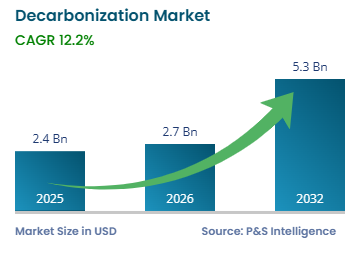
The decarbonization market size was USD 2.4 billion for 2025, and it will grow by 12.2% during 2026-2032, to reach USD 5.3 billion by 2032.
The market is expanding because governments, industrial operators, and energy providers are accelerating efforts to reduce carbon emissions while maintaining long-term energy security and operational efficiency. Companies across manufacturing, transportation, utilities, construction, and heavy industries are investing in cleaner production technologies as climate regulations become stricter and corporate sustainability targets increasingly influence long-term business strategy. The transition away from fossil fuel dependence is strengthening investments in renewable energy systems, energy-efficient infrastructure, carbon capture technologies, green hydrogen, electric mobility, and low-carbon industrial processes. Organisations are also adopting digital monitoring platforms to improve emissions tracking, optimise energy consumption, and strengthen transparency across industrial operations and supply chains.
The market is also gaining momentum because decarbonisation is increasingly associated with industrial modernisation, cost optimisation, and energy resilience rather than only environmental compliance. Businesses are focusing on reducing exposure to fuel price volatility, improving operational efficiency, and strengthening long-term competitiveness through cleaner infrastructure investments. Public and private sector funding is supporting grid modernisation, battery storage deployment, sustainable fuel development, and clean transportation networks across developed and emerging economies. According to the International Energy Agency, global energy-related CO₂ emissions reached 37.8 Gt CO₂ in 2024, highlighting the continuing pressure on governments and industries to accelerate decarbonisation initiatives across power generation, transportation, and industrial production systems. Financial institutions and investors are also prioritising companies with credible emission reduction strategies, which is increasing the adoption of carbon management technologies, low-emission industrial systems, and cleaner energy infrastructure across multiple sectors.
Key Market Insights
Renewable Energy Technologies is the largest category, holding a market share of 25.0%, due to accelerating renewable capacity expansion and rising industrial electrification investments globally.
Carbon Accounting & Reporting Services is the fastest-growing category, registering a CAGR of 12.8%, driven by stricter emissions disclosure requirements and increasing sustainability compliance activities.
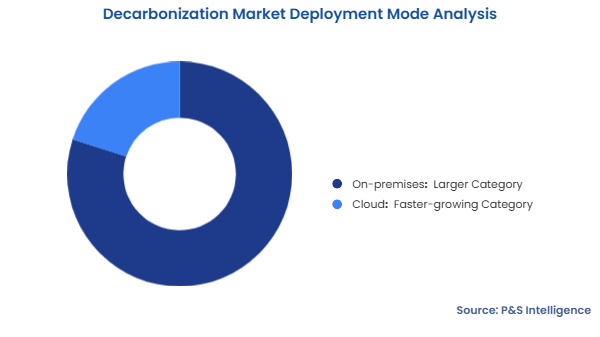
On-premises is the larger category, holding a market share of 80.0%, due to rising enterprise focus on operational security and industrial infrastructure control.
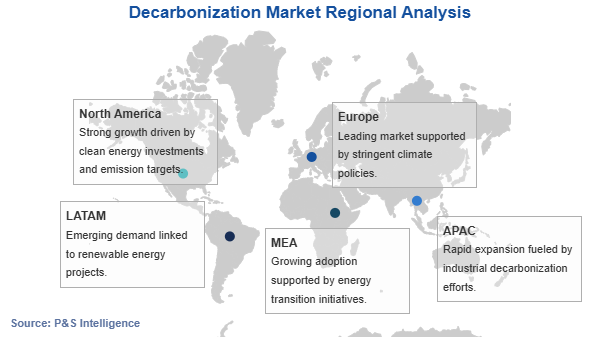
North America holds the largest share of 45.0%, due to strong clean energy investments and advanced industrial decarbonisation infrastructure deployment.
Asia-Pacific is the fastest-growing region, registering a CAGR of 13.5%, driven by expanding renewable energy capacity and accelerating industrial transition programmes.
Decarbonization Market Trends and Drivers
Integration of Green Hydrogen and Carbon Capture Technologies Is a Major Trend
The market is witnessing a strong shift toward integrated decarbonisation projects that combine green hydrogen, carbon capture, renewable energy, and industrial electrification within connected industrial ecosystems. Companies across steel, chemicals, refining, cement, and transportation are increasingly prioritising multi-technology deployment strategies to reduce emissions in sectors where direct electrification remains difficult. Partnerships between industrial manufacturers, utilities, and technology developers are also expanding to improve project scalability and commercial feasibility. China and Germany are strengthening industrial transition programmes through hydrogen integration and carbon capture deployment across heavy industries. According to the International Energy Agency, global operating CO₂ capture and storage capacity stood at just over 50 Mt CO₂ in 2025. According to the International Energy Agency, global hydrogen demand reached almost 100 Mt in 2024, while low-emissions hydrogen production remained on track to reach 1 Mt in 2025. These developments are increasing investment activity across hydrogen infrastructure, low-carbon fuels, industrial electrification systems, and carbon management technologies.
Government Net-Zero Policies and Industrial Emission Regulations Drive Market
The market is growing steadily because governments and regulatory authorities are tightening emission standards across power generation, manufacturing, transportation, construction, and industrial operations. National net-zero commitments and carbon disclosure requirements are pushing companies to adopt cleaner production technologies, improve energy efficiency, and reduce dependence on fossil fuel-based systems. Regulatory pressure is becoming particularly significant in carbon-intensive industries where compliance increasingly affects financing access, procurement eligibility, and long-term commercial positioning. Governments across North America, Europe, and the Asia Pacific are also expanding incentives for renewable energy deployment, industrial decarbonisation, and clean mobility infrastructure. According to the United Nations Framework Convention on Climate Change, 168 nationally determined contributions represented 195 Parties to the Paris Agreement in 2024. According to the International Energy Agency, the global energy policy database covered over 5,000 energy policies across more than 60 countries in 2024. These policy frameworks are increasing commercial adoption of carbon management systems, renewable integration technologies, and low-emission industrial infrastructure across global industries.
High Capital Requirements and Infrastructure Transition Challenges Limiting Market Expansion
The market faces restraints because large-scale decarbonisation projects require substantial capital investment, long deployment timelines, and major infrastructure upgrades across industrial operations. Carbon capture systems, hydrogen production facilities, renewable integration projects, and grid modernisation programmes often involve complex engineering adjustments that increase financial and operational risks for industrial operators. These challenges are more significant in heavy industries and developing economies where existing infrastructure remains highly dependent on fossil fuel-based systems. Infrastructure bottlenecks are also slowing project execution across utilities and transportation sectors. According to the International Energy Agency, total wind, solar PV, and hydropower capacity waiting for grid connections reached 1,650 GW in 2024. Grid connection delays, limited hydrogen transport infrastructure, and shortages of specialised technical expertise are affecting deployment schedules and reducing implementation efficiency for advanced decarbonisation technologies across multiple industries.
Expansion of Industrial Green Hydrogen and Sustainable Fuel Ecosystems Creating New Growth Opportunities
The market is creating opportunities through expanding investments in green hydrogen, sustainable aviation fuel, renewable natural gas, and other low-carbon fuel ecosystems. Heavy industries and transportation sectors are increasingly exploring alternative fuels in operations where direct electrification remains technically difficult or commercially impractical. This is increasing demand for hydrogen-ready industrial systems, carbon-neutral logistics infrastructure, and specialised fuel storage and distribution technologies across aviation, shipping, chemicals, and steel manufacturing. Emerging economies are also attracting investment as governments support industrial transition projects through clean energy policies and public-private partnerships. According to the International Energy Agency, global installed water electrolysis capacity reached 2 GW in 2024. Growing electrolyser deployment is supporting commercial activity across hydrogen production infrastructure, low-carbon fuel integration systems, and industrial decarbonisation projects that require cleaner energy inputs and long-term emissions reduction capabilities.
Decarbonization Market Segmentation Analysis
Solution Analysis
Renewable Energy Technologies is the largest category, holding a market share of 25.0%, because governments, utilities, and industrial operators continue increasing investments in solar, wind, hydro, and other clean power infrastructure to reduce carbon emissions and strengthen long-term energy security. According to the International Renewable Energy Agency, global renewable power capacity increased by 585 GW in 2024. Expanding renewable deployment is increasing commercial activity across energy storage integration, transmission infrastructure upgrades, industrial electrification projects, and low-carbon power systems supporting long-term decarbonisation investments.
Electric Vehicles (EVs) & Charging Infrastructure is the fastest-growing category, registering a CAGR of 12.6%, due to rising adoption of electric mobility solutions across passenger transportation, commercial fleets, and public transit systems. Governments are expanding emission reduction policies while automakers continue increasing investments in battery technologies, charging networks, and vehicle electrification platforms. Growing consumer preference for low-emission transportation and the development of fast-charging infrastructure are also accelerating market expansion.
The solutions analysed in this report are:
Renewable Energy Technologies (Largest Category)
Electric Vehicles (EVs) & Charging Infrastructure (Fastest-growing Category)
Consulting & Advisory Services are the largest category, holding a market share of 35.0%, because organisations across industries require strategic guidance to develop emission reduction roadmaps, comply with environmental regulations, and manage complex decarbonization initiatives. Businesses are increasingly relying on advisory firms for sustainability planning, carbon management frameworks, climate risk assessment, and clean energy transition strategies. Demand remains strong among industrial operators, utilities, transportation providers, and public sector organisations seeking support for technology selection, regulatory alignment, and long-term sustainability implementation across operations and supply chains.
Carbon Accounting & Reporting Services are the fastest-growing category, registering a CAGR of 12.8%, because regulatory authorities and investors are increasing pressure for transparent emissions disclosure and sustainability reporting across industrial operations and supply chains. Companies are adopting advanced carbon tracking platforms and reporting frameworks to monitor direct and indirect emissions, improve compliance management, and strengthen long-term decarbonisation planning. Organisations are also prioritising real-time emissions visibility to support cleaner production strategies, energy optimisation, and sustainability governance across manufacturing, utilities, transportation, and industrial sectors. According to CDP, over 22,100 companies disclosed environmental data in 2025.
On-premises is the larger category, holding a market share of 80.0%, because industrial enterprises and energy operators continue prioritising localised infrastructure for managing operational, environmental, and energy consumption data within highly regulated industrial environments. Organisations across oil and gas, utilities, manufacturing, and government sectors prefer on-premises deployment to maintain stronger control over cybersecurity, system integration, and operational monitoring capabilities. According to IBM, 40% of breaches recorded in 2024 involved data spread across public cloud, private cloud, and on-premises systems.
Cloud is the faster-growing category, registering a CAGR of 12.3%, due to rising demand for scalable and centralised platforms that support emissions monitoring, sustainability reporting, and energy optimisation across geographically distributed operations. Businesses are increasingly adopting cloud-based decarbonization solutions to improve data accessibility, enable remote management, and integrate real-time analytics into sustainability strategies.
The deployment modes analysed in this report are:
On-premises (Larger Category)
Cloud (Faster-growing Category)
End User Analysis
Oil & Gas is the largest category, holding a market share of 25.0%, because the industry faces significant pressure to reduce emissions across exploration, production, refining, and transportation activities. Companies are investing heavily in carbon capture technologies, methane reduction systems, renewable energy integration, and operational efficiency improvements to meet evolving environmental regulations and corporate sustainability commitments. The sector’s high carbon intensity and large-scale infrastructure requirements continue driving substantial spending on decarbonization initiatives.
Power Generation & Utilities are the fastest-growing category, registering a CAGR of 13.1%, because utilities are accelerating investments in renewable electricity generation, grid modernization, and digital energy infrastructure to support rising electrification demand and long-term decarbonization targets. Energy providers are deploying smart grid technologies, energy storage systems, and distributed energy resources to improve grid stability and integrate larger volumes of low-carbon electricity. According to the International Energy Agency, global electricity generation increased by more than 1,200 TWh in 2024, while renewables and nuclear accounted for over 80% of this growth.
The end users analysed in this report are:
Oil & Gas (Largest Category)
Power Generation & Utilities (Fastest-growing Category)
Automotive & Transportation
Manufacturing & Heavy Industries
IT & Telecommunications
Aerospace & Defense
Buildings & Construction
Government & Public Sector
Others
Drive strategic growth with comprehensive market analysis
Decarbonization Market Regional Outlook
North America Decarbonization Market Analysis
North America holds the largest share, of 45.0%, because the region has an established clean energy ecosystem supported by strong corporate sustainability commitments, advanced industrial infrastructure, and large-scale investments in low-carbon technologies. Major energy companies, utilities, and industrial operators across the U.S. and Canada are actively deploying carbon capture systems, renewable power projects, battery storage infrastructure, and grid modernisation technologies to reduce operational emissions. The region also benefits from supportive climate policies, tax incentives, and growing private-sector participation in decarbonization initiatives. Demand remains strong across oil and gas, manufacturing, transportation, and power generation sectors, where companies are accelerating energy transition strategies to meet emission reduction targets. In addition, North America has a mature innovation environment with significant activity in hydrogen development, industrial electrification, and carbon management software deployment, further strengthening regional market expansion.
U.S. Decarbonization Market Analysis
The U.S. maintains a strong position in the market due to large-scale investments in renewable energy deployment, carbon capture projects, clean fuel development, and industrial emission reduction technologies. Federal incentives supporting hydrogen production, electric vehicle infrastructure, and clean energy manufacturing are accelerating adoption across transportation, utilities, and industrial operations. Major industrial companies are also modernising facilities through electrification and advanced sustainability management systems. According to the U.S. Energy Information Administration, wind and utility-scale solar generated 760,000 GWh of electricity in 2025, increasing by 88,000 GWh from 2024. Rising renewable electricity generation is strengthening investments in grid infrastructure, energy storage systems, industrial electrification, and large-scale decarbonisation technologies across the country.
Asia-Pacific Decarbonization Market Analysis
Asia-Pacific has the highest CAGR, of 13.5%, as governments across China, India, Japan, South Korea, and Southeast Asia continue accelerating investments in renewable energy capacity, electric mobility, green manufacturing, and energy transition infrastructure. Rapid industrialisation and rising energy demand are increasing pressure on regional economies to reduce dependence on carbon-intensive systems while maintaining long-term economic growth. Countries across the region are expanding domestic clean energy production, battery manufacturing, smart grid deployment, and sustainable transportation projects to strengthen energy security and reduce industrial emissions. Asia-Pacific also benefits from strong manufacturing capabilities and large-scale supply chains supporting solar panels, batteries, electric vehicles, and hydrogen technologies. In addition, increasing urbanisation and public infrastructure modernisation programs are creating long-term demand for energy-efficient systems and low-carbon industrial operations across regional economies.
China Decarbonization Market Analysis
China continues to lead regional decarbonisation activity through aggressive expansion of renewable energy generation, electric vehicle manufacturing, battery production, and industrial transition programmes. The country is investing heavily in solar, wind, hydrogen, and smart grid infrastructure to reduce coal dependence while supporting industrial growth and energy security objectives. Government-backed clean energy initiatives and strong domestic manufacturing capabilities are accelerating deployment across utilities, transportation, and heavy industries. According to the Government of China, the country added more than 430 million kW of solar and wind power capacity in 2025, increasing cumulative grid-connected wind and solar capacity to 1.84 billion kW. Expanding renewable infrastructure is increasing investments in energy storage systems, grid modernisation technologies, and low-carbon industrial operations.
South Korea Decarbonization Market Analysis
South Korea is experiencing rapid market growth due to government support for hydrogen economy development, clean mobility expansion, and advanced industrial decarbonisation programmes. The country is strengthening investments in fuel cell technologies, battery innovation, and smart energy infrastructure to support long-term energy transition goals across industrial sectors. Manufacturing companies are also increasing the adoption of low-carbon production systems and sustainable supply chain operations, particularly within the automotive, electronics, and shipbuilding industries. According to South Korea’s e-Nara Index, based on Ministry of Land, Infrastructure and Transport vehicle registration data, South Korea had 2.746 million registered eco-friendly vehicles in 2024, including 2.024 million hybrid vehicles, 684,000 electric vehicles, and 38,000 hydrogen vehicles. Expanding clean mobility adoption is supporting investments in hydrogen infrastructure, battery technologies, charging networks, and low-emission transportation systems across the country.
The regions and countries analysed in this report are:
North America (Largest Regional Market)
U.S. (Larger and Faster-Growing Country)
Canada
Europe
Germany (Largest Country)
U.K.
France (Fastest-Growing Country)
Italy
Spain
Rest of Europe
Asia-Pacific (Fastest-Growing Regional Market)
China (Largest Country)
India
Japan
South Korea (Fastest-Growing Country)
Australia
Rest of APAC
Latin America
Brazil (Largest and Fastest-Growing Country)
Mexico
Rest of LATAM
Middle East and Africa
Saudi Arabia (Largest Country)
U.A.E. (Fastest-Growing Country)
South Africa
Rest of MEA
Decarbonization Market Share Analysis
The market is fragmented because decarbonization covers a wide range of technologies, project types, and end-use industries rather than a single solution category. Global energy companies mainly compete in large-scale renewable power, low-carbon fuels, carbon capture, and industrial transition projects, while industrial technology providers focus on electrification equipment, automation, energy efficiency systems, and process optimization. Renewable energy developers lead project execution for solar, wind, and storage assets, whereas carbon management firms and software vendors support emissions tracking, carbon accounting, and sustainability reporting. Engineering service providers remain important in feasibility studies, plant upgrades, infrastructure design, and project implementation.
Leading Companies in the Decarbonization Market:
Accenture plc
Deloitte Touche Tohmatsu Limited
IBM Corporation
Siemens AG
Schneider Electric SE
Honeywell International Inc.
Atos SE
Infosys Limited
Air Liquide SA
Linde plc
Mitsubishi Heavy Industries, Ltd.
ABB Ltd.
Johnson Controls International plc
DNV AS
General Electric Company
Decarbonization Market News
In November 2025, Schneider Electric SE unveiled the first phase of a three-phase industrial decarbonization study at COP30, developed in collaboration with Brazil's Ministry of Development, Industry, Trade and Services (MDIC).
In June 2025, Honeywell International Inc. signed a memorandum of understanding with NTPC Green to explore sustainable aviation fuel (SAF) production in India using Honeywell's eFining technology. The collaboration will utilize captured carbon dioxide (CO₂) and green hydrogen to produce SAF, supporting the decarbonization of the aviation sector and advancing India's energy transition.
In May 2024, Mitsubishi Heavy Industries, Ltd., in collaboration with ArcelorMittal, BHP, and Mitsubishi Development Pty Ltd., commissioned a pilot carbon capture plant at ArcelorMittal's Gent steelworks in Belgium. The facility uses MHI's proprietary KM CDR Process technology to capture CO₂ emissions from blast furnace gas, supporting the evaluation of large-scale carbon capture for industrial decarbonization.
Frequently Asked Questions About This Report
What does the decarbonization market include for organizations?+
It includes solutions that reduce emissions through efficiency, electrification, renewable energy, carbon management, process changes, and cleaner fuels.
What factors are driving demand in the decarbonization market?+
Growth is driven by climate commitments, investor expectations, regulations, energy cost concerns, and demand for lower emission products.
Why are organizations adopting decarbonization solutions across operations?+
Organizations adopt decarbonization solutions to cut emissions, improve energy performance, meet customer requirements, and prepare for climate reporting.
How do decarbonization solutions improve decision making and efficiency?+
These solutions improve operations by identifying emission sources, prioritizing actions, tracking progress, and connecting energy strategy with business planning.
What challenges affect adoption of decarbonization solutions today?+
Adoption is affected by capital needs, technology readiness, data availability, policy uncertainty, operational disruption, and difficulty measuring results.
Want a report tailored exactly to your business need?
Leading companies across industries trust us to deliver data-driven insights and innovative solutions for their most critical decisions. From data-driven strategies to actionable insights, we empower the decision-makers who shape industries and define the future. From Fortune 500 companies to innovative startups, we are proud to partner with organisations that drive progress in their industries.
Client Testimonials
Working with P&S Intelligence and their team was an absolute pleasure – their awareness of timelines and commitment to value greatly contributed to our project's success. Eagerly anticipating future collaborations.
McKinsey & Company
India
Unmatched Standards
Our insights into the minutest levels of the markets, including the latest trends and competitive landscape, give you all the answers you need to take your business to new heights
Complete Data Security
We take a cautious approach to protecting your personal and confidential information. Trust is the strongest bond that connects us and our clients, and trust we build by complying with all international and domestic data protection and privacy laws