This Report Provides In-Depth Analysis of the Corporate Telephony Market Report Prepared by P&S Intelligence, Segmented by Technology (Internet Protocol, Key Telephone System, Wireless Private Branch Exchange), Industry (Information Technology (IT), BFSI, Government, Retail, Healthcare, Manufacturing), and Geographical Outlook for the Period of 2021 to 2032
Explore the market potential with our data-driven report
Corporate Telephony Market Overview
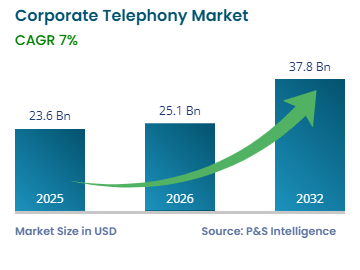
The corporate telephony market size was USD 23.6 billion in 2025, and it will grow by 7.0% during 2026–2032, to reach USD 37.8 billion by 2032.
The market is driven by the accelerating enterprise transition from legacy circuit-switched and hardware-centric private branch exchange systems to Internet Protocol-based architectures, which is the primary structural force reshaping corporate communication infrastructure. IP-PBX and cloud-hosted platforms are extending voice, collaboration, and integrated data management capabilities to distributed organizational structures that legacy hardware-dependent systems could not support. Corporate telephony is converging with unified communications platforms and AI-powered call management tools, a shift that is redefining communication infrastructure investment strategies across IT, BFSI, healthcare, retail, and manufacturing sectors. Additionally, the expanding global internet user base, with approximately 6 billion people connected in 2025, representing nearly three-quarters of the global population, is strengthening the underlying digital infrastructure supporting the deployment of corporate telephony solutions across enterprise environments worldwide.
Mid-sized and large enterprises are transitioning from on-premise hardware to subscription-based IP telephony services at an accelerating rate. Capital expenditure reduction and support for a hybrid workforce are the primary drivers. AI-driven analytics and automated routing capabilities provide additional commercial justification, with real-time transcription functionality enabling enterprises to extract value for compliance and productivity directly from communication infrastructure.
Key Market Insights
The IP-PBX category holds the largest market share, of 40%, in 2025, and it will have the highest CAGR, of 7.2%, driven by enterprise-wide migration from legacy circuit-switched systems to IP-based communication infrastructure.
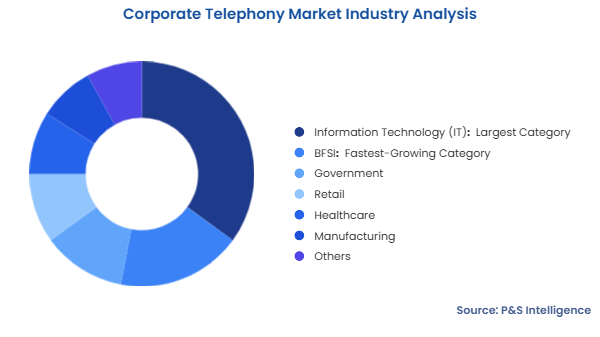
The IT category holds the largest market share, of 35%, in 2025, driven by high communication volumes generated through customer support operations and internal help desk functions.
The BFSI category will have the highest CAGR, of 7.1%, driven by regulatory requirements for compliant call recording and expanding digital banking infrastructure.
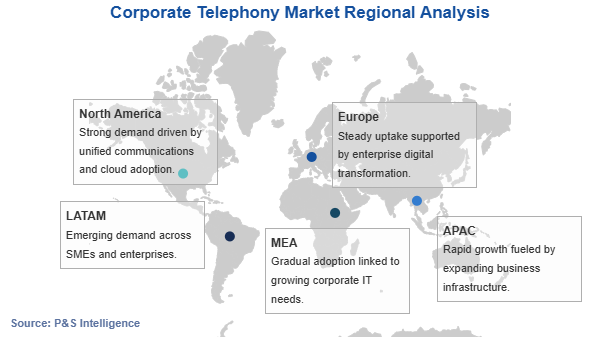
North America holds the largest market share, of 40%, in 2025, driven by advanced broadband infrastructure and high enterprise cloud adoption rates.
Asia-Pacific will have the highest CAGR, of 7.2%, driven by enterprise digitalization that is accelerating the transition away from fragmented legacy telephony systems toward scalable IP-PBX and cloud-hosted platforms.
Corporate Telephony Market Trends & Drivers
AI-Powered Voice Analytics & UC Integration Are Key Trends
The convergence of IP-PBX infrastructure with AI-driven voice analytics is reshaping the corporate telephony market. Natural language processing capabilities are deepening this convergence, and unified communication platform integration is extending its commercial scope beyond voice management into a broader enterprise architecture. Enterprises are transitioning from telephony systems that exclusively manage voice routing toward integrated communication platforms hosted in unified cloud environments. IP voice, video conferencing, and messaging are consolidating within these platforms alongside CRM data synchronization and real-time transcription capabilities. Demand for telephony deployments that generate actionable business intelligence is driving this evolution, with sentiment analysis, automated call summarization, keyword detection, and predictive routing transforming how organizations manage customer interactions and communication workflows at scale. Technology vendors are embedding AI natively into IP-PBX platforms rather than offering it as a standalone overlay, reducing integration complexity and consolidating communication toolsets within a single platform architecture.
Additionally, expanding 5G network coverage, reaching approximately 55% of the global population and supporting a growing share of mobile broadband subscriptions, is enabling the low-latency and high-bandwidth connectivity required for real-time AI-driven voice processing and enterprise communication analytics at scale. This trend continues to intensify as AI capabilities become standard differentiators among corporate telephony platforms competing for enterprise contracts.
Hybrid Workforce Expansion and Enterprise Digitalization Are Biggest Drivers
The structural entrenchment of hybrid and remote work models across global enterprise environments is compelling organizations to overhaul communication infrastructure. Legacy on-premise PBX hardware is being displaced in favor of IP-based and cloud-hosted telephony platforms as a direct consequence of this shift. As hybrid arrangements become standard operating models rather than temporary accommodations, enterprises require telephony systems capable of bridging mobile and softphone connections with desk endpoints across geographically dispersed teams. Additionally, the growing prevalence of remote and hybrid work, with approximately 35% of employed individuals working from home on at least some days, is reinforcing enterprise demand for cloud telephony systems capable of supporting distributed workforces without performance degradation.
Procurement decisions are shifting away from capital-intensive hardware toward subscription-based IP telephony services. Per-seat pricing and scalable capacity structures make these platforms economically accessible across enterprise sizes. Mobile-integrated communication workflows extend telephony functionality to distributed workforces without additional hardware investment. Eurostat indicates that 45% of enterprises in the European Union purchased cloud computing services in 2023, highlighting the growing shift toward subscription-based digital infrastructure, including communication platforms. As hybrid work policies formalize across enterprise segments globally, demand for IP-PBX systems offering seamless endpoint portability continues to expand. Integrated collaboration features and AI-assisted call management capabilities are now standard procurement requirements.
SME Digitalization and Emerging Market Enterprise is Biggest Opportunity
Enterprise telephony modernization remains in early stages across small and medium-sized enterprise segments in developed economies, while rapidly digitalizing businesses across the Asia Pacific, Latin America, and MEA represent a second concentration of underpenetrated demand. SMEs historically underinvested in enterprise telephony infrastructure due to high capital expenditure requirements for on-premise PBX deployment. Cloud-hosted IP telephony platforms with affordable per-user subscription models have lowered the barriers to adoption that previously confined enterprise-grade telephony to large organizations. Mobile extension functionality is extending enterprise telephony reach to field-based and remote workforces that fixed-line systems could not serve.
Additionally, the World Bank estimates that small and medium-sized enterprises represent over 90% of businesses and more than 50% of employment worldwide. As cloud telephony pricing continues declining and regional data center infrastructure matures across emerging economies, the SME and emerging market opportunity is contributing to corporate telephony market expansion at an accelerating rate.
Security Vulnerabilities and Legacy Infrastructure Complexity Are Key Restraints
Security threats targeting IP communication systems and the complexity of migrating legacy PBX infrastructure present material barriers to corporate telephony deployment velocity. VoIP-based systems introduce attack surfaces that legacy circuit-switched networks did not expose, with toll fraud and SIP denial-of-service attacks representing the most operationally disruptive threat vectors. Additionally, Cybersecurity and Infrastructure Security Agency (CISA) Known Exploited Vulnerabilities (KEV) Catalog data indicates that the catalog expanded to approximately 1,484 vulnerabilities by the end of 2025, reflecting nearly 20% year-over-year growth, reinforcing enterprise concerns regarding cybersecurity risks in IP telephony deployment.
Enterprises with long-established on-premise telephony deployments face migration complexity that procurement assessments routinely underestimate, as integration with existing CRM and ERP systems introduces coordination dependencies. Additionally, the European Union Agency for Cybersecurity reports that Voice over IP (VoIP) systems are increasingly targeted by cyber threats such as eavesdropping, denial-of-service attacks, and service disruption, reinforcing the need for enhanced security architectures in enterprise communication networks. Security challenges are compelling enterprises in BFSI, healthcare, and government sectors to extend legacy infrastructure lifecycles beyond economic justification due to stringent regulatory and compliance requirements.
Corporate Telephony Market Segmentation Analysis
Technology Analysis
The IP-PBX category holds the largest market share, of 40%, in 2025, and it will have the highest CAGR, of 7.2%, driven by enterprise-wide migration from legacy circuit-switched systems to IP-based communication infrastructure. Cost efficiency and scalability advantages over legacy hardware make IP-based architecture commercially compelling across enterprise size tiers, while integration with cloud and unified communication platforms extends IP-PBX value beyond voice routing into broader enterprise workflow and collaboration architecture.
Additionally, the U.K. Department for Science, Innovation, and Technology (DSIT) reports that all PSTN-based services are scheduled to be switched off by January 2027, with over two-thirds of landlines already migrated to IP-based alternatives, accelerating enterprise migration toward IP-based telephony systems.
The technologies analyzed in this report are:
Internet Protocol–Private Branch Exchange (IP-PBX) (Largest and Fastest-Growing Category)
Key Telephone System
Wireless Private Branch Exchange
Others
Industry Analysis
The IT category holds the largest market share, of 35%, in 2025, driven by high communication volumes generated through customer support operations and internal help desk functions. Business process outsourcing operations require scalable telephony infrastructure capable of managing high-volume call flows across global delivery centers. IT organizations and BPO providers are major users of IP-PBX systems, with cloud-hosted and on-premise platforms as the primary deployment formats. Capacity for large-scale communication workloads and multi-site routing are the primary platform selection criteria, while advanced routing, call recording, and CRM integration are standard requirements connecting telephony directly to customer engagement workflows. IT departments function as primary technology procurement decision-makers across industries.
The BFSI category will have the highest CAGR, of 7.1%, driven by regulatory requirements for compliant call recording and expanding digital banking infrastructure. AI-driven call analytics, fraud detection capabilities, and voice authentication are transforming telephony platforms into integrated security and intelligence systems beyond traditional voice routing. Additionally, the Organisation for Economic Co-operation and Development (OECD) data indicates increasing financial sector investment in digital transformation across member economies, supporting communication system modernization and accelerating enterprise telephony adoption within BFSI organizations.
The industries analyzed in this report are:
Information Technology (IT) (Largest Category)
BFSI (Fastest-Growing Category)
Government
Retail
Healthcare
Manufacturing
Others
Drive strategic growth with comprehensive market analysis
Corporate Telephony Market Regional Outlook
North America Corporate Telephony Market Size
North America holds the largest market share, of 40%, in 2025, driven by advanced broadband infrastructure and high enterprise cloud adoption rates. Major IP telephony platform vendors are concentrated within the region, reinforcing the supply-side depth that sustains North America's market leadership. The region's leadership reflects sustained enterprise investment in IP-PBX modernization, with organizations across financial services, IT, healthcare, and government deploying cloud-hosted telephony integrated with unified communication tools and AI-driven voice analytics. U.S. and Canadian enterprises are actively replacing legacy hardware with subscription-based IP voice platforms that support hybrid workforces. Real-time routing and CRM integration are standard capabilities of these platforms, and mobile-accessible telephony removes the capital-intensive infrastructure commitments that on-premise systems required.
Additionally, Federal Communications Commission (FCC) data indicates that approximately 110 million homes and small businesses, representing 95%, have access to high-speed terrestrial fixed broadband (100 Mbps download and 20 Mbps upload), supported by nearly USD 65 billion in federal investment under the Infrastructure Investment and Jobs Act, strengthening the high-capacity connectivity foundation required for enterprise cloud telephony deployment at scale.
Asia-Pacific Corporate Telephony Market Size
Asia-Pacific will have the highest CAGR, of 7.2%, driven by rapid enterprise digitalization, expanding broadband and 5G infrastructure, and growing adoption of cloud-based IP telephony solutions. Government-led digital transformation initiatives in China, India, Japan, and South Korea are strengthening connectivity and enterprise readiness for IP telephony adoption. Demand from e-commerce, fintech, IT services, and manufacturing sectors is reinforcing enterprise communication upgrade cycles across both developed and emerging Asia Pacific economies. China's Digital Economy Development Plan and India's Digital India programme are accelerating connectivity infrastructure investment and enterprise transformation across their respective markets. Cloud-based communication and IP telephony adoption are advancing in both countries due to this policy-driven infrastructure build-out.
Additionally, country-level digital maturity further reinforces regional growth, with Japan reporting enterprise cloud adoption of approximately 70%, Australia indicating approximately 50% business cloud usage, and South Korea demonstrating leadership in high-speed connectivity and 5G deployment, collectively supporting accelerated enterprise telephony modernization.
India Corporate Telephony Market Size
India is a rapidly growing country market within Asia Pacific for corporate telephony, driven by the government's Digital India programme, which is accelerating enterprise broadband adoption across the country and building the connectivity foundation required for cloud telephony platforms. A rapidly expanding SME sector is deploying affordable cloud telephony solutions as an alternative to legacy hardware, with cost and scalability requirements driving this transition. Major enterprise IT hubs in Bengaluru, Hyderabad, Mumbai, and Delhi are generating sustained demand for scalable IP communication infrastructure across large distributed workforces. Domestic demand for cloud-hosted IP-PBX systems with CRM integration and AI analytics capabilities is being reinforced by India's IT services firms and growing startup ecosystem. A large, digitally connected enterprise workforce supports large-scale adoption of cloud telephony, while competitive cloud service pricing is accelerating platform adoption among cost-sensitive mid-market enterprises.
Additionally, Government of India data indicates that broadband subscribers increased from 25 crore in 2014–15 to over 103 crore in 2024–25, representing nearly 400% growth and strengthening the digital infrastructure required for enterprise cloud telephony deployment across Indian markets. Mobile-first IP voice applications are bypassing legacy landline infrastructure limitations, extending enterprise telephony reach into mobile-native workforce segments. Enterprise cloud migration is further expanding adoption beyond major metro centres into Tier 2 and Tier 3 cities, supported by BPO and IT services sector growth and continued government investment in communication infrastructure, which is enabling new addressable markets for cloud telephony vendors across India's secondary urban tier.
The regions and countries of the market are as follows:
North America (Largest Regional Market)
U.S. (Larger Country Market)
Canada (Faster-Growing Market)
Europe
Germany (Largest Country Market)
U.K. (Fastest-Growing Country Market)
France
Italy
Spain
Rest of Europe
Asia-Pacific (Fastest-Growing Regional Market)
China (Largest Country Market)
India (Fastest-Growing Country Market)
Japan
South Korea
Australia
Rest of APAC
Latin America
Brazil (Largest Country Market)
Mexico (Fastest-Growing Country Market)
Rest of LATAM
Middle East and Africa
Saudi Arabia (Largest Country Market)
South Africa
U.A.E. (Fastest-Growing Country Market)
Rest of MEA
Corporate Telephony Market Competitive Landscape
The market is fragmented, as enterprise requirements vary across organization sizes and industry verticals, preventing any single platform architecture from serving all segments uniformly. IP-PBX, cloud-based, and hybrid deployment models coexist across the market, each carrying distinct technical and commercial requirements that sustain segmentation at the provider level. Cloud-native communication platform adoption is intensifying competition among established and emerging telephony vendors. Integration with enterprise productivity ecosystems is extending this competitive pressure beyond core voice functionality into collaboration, workflow, and data synchronization segments, while ongoing innovation in pricing models is reshaping enterprise procurement dynamics.
Key Players in the Corporate Telephony Market:
Cisco Systems, Inc.
Microsoft Corporation
Huawei Technologies Co., Ltd.
Mitel Networks Corporation
NEC Corporation
Avaya Inc.
RingCentral, Inc.
8x8, Inc.
Zoom Video Communications, Inc.
Vonage Holdings Corp.
Alcatel-Lucent Enterprise
Telefonaktiebolaget LM Ericsson
Corporate Telephony Market News
In March 2025, Cisco Systems, Inc. launched the Webex AI Agent alongside Webex Calling Customer Assist at Enterprise Connect 2025, enabling AI-driven customer interaction and intelligent call routing.
In October 2024, Zoom Video Communications, Inc. introduced Zoom Phone in India, enabling enterprises to deploy cloud telephony with native phone numbers.
In May 2024, Avaya Inc. and RingCentral, Inc. expanded their partnership, introducing hybrid cloud PBX integration and enhanced connectivity with Microsoft Teams.
In March 2024, Cisco Systems, Inc. launched the Cisco Desk Phone 9800 Series and Cisco Board Pro G2 at Enterprise Connect 2024, introducing AI-enabled enterprise communication devices for hybrid work environments.
Frequently Asked Questions About This Report
What are the key drivers of the corporate telephony market?+
The market is driven by increasing enterprise communication needs, expansion of distributed workforces, demand for cost-efficient voice systems, and integration with business communication platforms.
What are the major challenges in the corporate telephony market?+
Key challenges include legacy system migration, data security concerns, interoperability issues, and maintaining consistent communication quality across locations.
What trends are shaping the corporate telephony market?+
Major trends include transition toward IP-based systems, integration with collaboration tools, mobility enablement, and increased focus on scalable communication infrastructure.
How is digital transformation impacting corporate telephony systems?+
Digital transformation is modernizing enterprise communication by enabling flexible deployment models, enhancing system integration, and improving operational efficiency.
How is enterprise mobility influencing corporate telephony adoption?+
Enterprise mobility is increasing demand for flexible communication systems that support remote access, mobile integration, and seamless connectivity across multiple devices and locations.
Want a report tailored exactly to your business need?
Leading companies across industries trust us to deliver data-driven insights and innovative solutions for their most critical decisions. From data-driven strategies to actionable insights, we empower the decision-makers who shape industries and define the future. From Fortune 500 companies to innovative startups, we are proud to partner with organisations that drive progress in their industries.
Client Testimonials
Working with P&S Intelligence and their team was an absolute pleasure – their awareness of timelines and commitment to value greatly contributed to our project's success. Eagerly anticipating future collaborations.
McKinsey & Company
India
Unmatched Standards
Our insights into the minutest levels of the markets, including the latest trends and competitive landscape, give you all the answers you need to take your business to new heights
Complete Data Security
We take a cautious approach to protecting your personal and confidential information. Trust is the strongest bond that connects us and our clients, and trust we build by complying with all international and domestic data protection and privacy laws