Unified Communication and Collaboration Market Size & Share Analysis - Emerging Trends, Growth Opportunities, Competitive Landscape, and Forecasts (2026 - 2032)
This Report Provides In-Depth Analysis of the Unified Communication and Collaboration Market Report Prepared by P&S Intelligence, Segmented by Offering (Solutions, Services, Hardware), Deployment Mode (Cloud, On-Premises), Organization Size (Large Enterprises, Small and Medium-Sized Enterprises), Vertical (IT and Telecommunications, Healthcare, BFSI, Retail and Consumer Goods, Public Sector and Utilities, Logistics and Transportation, Travel and Hospitality), and Geographical Outlook for the Period of 2021 to 2032
Unified Communication & Collaboration Market Size Forecast
Key Highlights
Study Period
2021 - 2032
Market Size in 2025
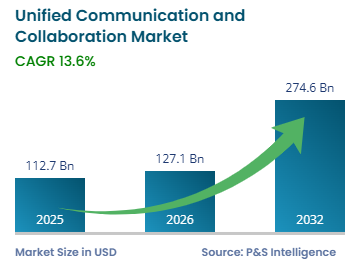
USD 112.7 Billion
Market Size in 2026
USD 127.1 Billion
Market Size by 2032
USD 274.6 Billion
Projected CAGR
13.6%
Largest Region
North America
Fastest-Growing Region
Asia-Pacific
Market Structure
Fragmented
Largest Vertical Category
IT and Telecommunications
Market Size
Explore the market potential with our data-driven report
Unified Communication and Collaboration Market Analysis
The unified communication and collaboration market size was USD 112.7 billion for 2025, and it will grow by 13.6% during 2026–2032, to reach USD 274.6 billion by 2032.
The market is expanding because businesses require integrated platforms for messaging, video, and file sharing to support decentralised teams. Cloud integration and mobile access enable organisations to deploy these solutions quickly across multiple locations. According to the International Telecommunication Union, mobile broadband networks covered 96% of the global population in 2024. Consequently, this widespread connectivity allows companies to maintain seamless operations across distributed workforces, driving continuous demand for collaboration tools.
Key Market Insights
Services is the largest offering, holding a market share of 60%, because enterprises require continuous support for integration, maintenance, and system management
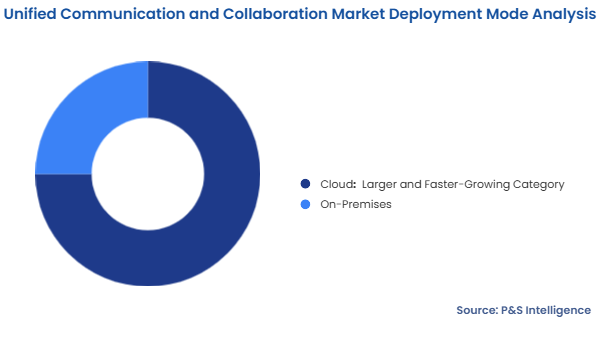
Cloud is the fastest-growing deployment, registering a CAGR of 13.8%, because businesses adopt scalable solutions that reduce infrastructure costs and support distributed workforces
IT and telecommunications is the largest vertical, holding a market share of 35%, because the sector requires real-time data exchange across highly distributed digital networks
North America is the largest region, holding a market share of 40%, because enterprises rely on advanced communication tools and established digital ecosystems
Asia-Pacific is the fastest-growing region, registering a CAGR of approximately 14.5%, because businesses rapidly adopt advanced platforms and expand operations across multiple cities and countries
Unified Communication and Collaboration Market Trends & Drivers
Shift towards AI-Driven and Integrated Communication Platforms Is Major Trend
The market is shifting toward integrated platforms that combine messaging, video, and workflows into a unified system. Companies increasingly demand intelligent solutions that extend beyond basic communication to include automation and AI-driven capabilities. Vendors are embedding generative artificial intelligence into collaboration tools to enhance productivity and streamline decision-making. According to the World Bank, leading generative AI tools attracted nearly 3 billion global visits per month in 2024. According to the International Telecommunication Union, 5.5 billion people used the Internet globally in 2024. Consequently, this widespread digital engagement drives demand for advanced, all-in-one communication platforms.
Rising Need for Seamless Remote and Hybrid Work Connectivity Drives Market
The market is growing because companies must keep employees seamlessly connected across different geographical locations. Remote and hybrid work models now define daily operations and require a reliable digital communication infrastructure. According to the International Telecommunication Union, global fixed-broadband subscriptions reached 20.1 per 100 people in 2025. According to the International Telecommunication Union, over 75% of the global population maintained an active mobile broadband subscription in 2024. Consequently, this widespread connectivity enables businesses to invest in unified collaboration solutions that support continuous, secure, and low-latency interaction across distributed teams.
Data Security Risks and Integration Complexity Limiting Adoption
The market faces adoption challenges because organisations struggle to secure and integrate unified communication platforms across complex IT environments. These systems centralise sensitive voice, messaging, and data workflows, increasing exposure to cybersecurity risks if vulnerabilities exist. In addition, integrating modern collaboration tools with legacy enterprise infrastructure requires significant technical expertise, time, and system customisation. According to Microsoft, customers faced more than 600 million cyberattacks globally each day in 2024. Consequently, these persistent security threats and integration complexities force enterprises to delay deployment and limit large-scale investments in unified communication solutions.
Expansion Potential in Emerging Markets and Untapped Small Businesses
The market presents strong expansion opportunities as small businesses and emerging regions accelerate digital adoption. These organisations often bypass legacy systems and directly deploy cloud-based communication platforms to modernise operations. Expanding high-speed connectivity further enables sectors such as retail, healthcare, and education to adopt reliable collaboration tools. According to the International Telecommunication Union, 5G networks covered 51% of the global population in 2024. Consequently, this expanding digital infrastructure supports scalable, cost-efficient collaboration solutions for new users globally.
Unified Communication and Collaboration (UCC) Market Segmentation Analysis
Offering Analysis
Services is the largest and fastest-growing category, holding a market share of 60% and registering a CAGR of approximately 14.0%, because organisations require continuous support to manage complex communication systems. As unified platforms evolve with advanced features, companies often lack the in-house technical expertise to operate and maintain them effectively. According to Microsoft, 55% of global business leaders reported a shortage of internal talent to fill critical technical roles in 2024. Consequently, enterprises increasingly rely on specialised service providers to ensure seamless integration, perform ongoing system maintenance, and maintain secure and efficient collaboration environments.
The offerings analysed in this report are:
Solutions
Unified communication platforms
Telephony solutions
Video conferencing solutions
Collaboration solutions
Messaging solutions
Contact center solutions
Services (Largest and Fastest-Growing Category)
Implementation and integration services
Managed services
Training and consulting services
Support and maintenance services
Hardware
VoIP phones
Video conferencing equipment
Unified communication appliances
Gateways and controllers
Collaboration endpoints
Deployment Mode Analysis
Cloud is the largest and fastest-growing category, holding a market share of 75% and registering a CAGR of approximately 13.8%, because organisations increasingly adopt scalable solutions without investing in heavy physical infrastructure. These platforms enable businesses to support distributed workforces while reducing upfront hardware and maintenance costs. According to the International Energy Agency, global data centres consumed over 400 Terawatt-hours of electricity in 2024. Consequently, this large-scale centralised computing infrastructure enables enterprises to manage system updates efficiently and maintain continuous, high-performance communication and collaboration operations.
The deployment modes analysed in this report are:
Cloud (Larger and Faster-Growing Category)
Public
Private
On-Premises
Organisation Size Analysis
Large enterprises are the larger category, holding a market share of 70%, because they have complex communication needs across multiple locations and departments. These organisations handle high volumes of data and require reliable systems to maintain coordination. They also have the budget to invest in advanced platforms and services. Strong focus on productivity and internal efficiency further pushes them to adopt unified communication solutions at a wider scale.
Small and medium-sized enterprises (SMEs) are the fastest-growing category, because these organisations rapidly adopt digital communication tools to support business expansion. SMEs prefer cloud-based integrated platforms as they eliminate the need for heavy upfront infrastructure investments and enable flexible scaling. According to the World Bank, approximately 400 million formal SMEs operated across the global economy in 2024. Consequently, this large and expanding business base continuously drives demand for cost-effective, scalable, and easy-to-deploy collaboration solutions.
The organisation sizes analysed in this report are:
Large Enterprises (Larger Category)
Small and Medium-Sized Enterprises (SMEs) (Faster-Growing Category)
Vertical Analysis
IT and telecommunications is the largest category, because this sector requires real-time data exchange across highly distributed digital networks. Companies in this industry prioritise early adoption of advanced communication platforms to manage operations efficiently. The large-scale network activity drives demand for highly reliable and integrated collaboration tools to support continuous internal communication.
Healthcare is the fastest-growing category, registering a CAGR of approximately 14.3%, because there is a rising need for better coordination between medical staff, patients, and administrative teams. Communication tools help in remote consultations, patient monitoring, and quick decision-making. Hospitals and clinics are adopting these systems to improve service quality and reduce delays. Growing focus on digital healthcare and remote services is accelerating adoption in this sector.
The verticals analysed in this report are:
IT and Telecommunications (Largest Category)
Healthcare (Fastest-Growing Category)
BFSI
Retail and Consumer Goods
Public Sector and Utilities
Logistics and Transportation
Travel and Hospitality
Drive strategic growth with comprehensive market analysis
Unified Communication and Collaboration Market Regional Analysis
North America Unified Communication and Collaboration Market Analysis
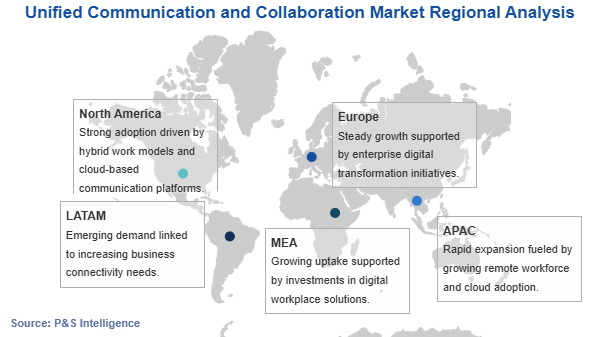
North America holds the largest share, of 40%, because enterprises in this region have already built strong digital ecosystems and rely heavily on advanced communication tools. Companies here focus on improving employee productivity and customer experience, which increases demand for integrated platforms. There is also early adoption of new features like AI-enabled communication and workflow automation. Strict data policies and enterprise-grade requirements push firms to invest in secure and reliable solutions, making the region a key revenue contributor.
U.S. Unified Communication and Collaboration Market Analysis
The United States generates strong demand for unified communication solutions as companies manage highly distributed workforces across industries. Businesses deploy integrated platforms to connect employees and maintain efficient daily operations. Over 35 million professionals engaged in remote or hybrid work models across the United States in 2024. According to IBM, 42% of U.S. enterprises actively deployed artificial intelligence in 2023, indicating deeper integration into core operations. Consequently, organisations increasingly implement AI-enabled collaboration tools to support real-time communication, workflow automation, and efficient enterprise coordination.
Asia-Pacific Unified Communication and Collaboration Market Analysis
Asia-Pacific has the highest CAGR, of approximately 14.5%, because businesses in this region are rapidly moving from basic tools to advanced communication platforms. Many companies are expanding across cities and countries, which creates a strong need for better coordination. Governments are also supporting digital programs, encouraging companies to upgrade their systems. The presence of a large number of small businesses entering digital workflows further drives demand for scalable and easy-to-use collaboration tools.
China Unified Communication and Collaboration Market Analysis
China demonstrates strong adoption of unified communication solutions as businesses rely on integrated digital ecosystems to manage multiple corporate functions. Companies deploy centralised platforms to streamline messaging, workflows, and daily operational services across large organisations. China operated over 4 million commercial 5G base stations in 2024. Consequently, this extensive digital infrastructure supports high-speed, reliable communication across urban and industrial networks. Furthermore, strict regulatory frameworks encourage the development and adoption of domestic collaboration platforms, reinforcing the use of region-specific solutions for enterprise communication.
India Unified Communication and Collaboration Market Analysis
India is seeing rapid adoption as businesses move toward organised digital communication systems. Many companies are expanding into smaller cities, which increases the need for remote coordination tools. Cloud-based platforms are popular because they are affordable and easy to use. The growth of startups and IT services firms is also driving demand, as these businesses depend on fast and flexible communication to manage daily operations.
Europe Unified Communication and Collaboration Market Analysis
Europe shows steady growth as businesses focus on structured and compliant communication systems. Organisations here pay close attention to data privacy rules, which shape how solutions are designed and deployed. Many firms prefer region-specific hosting and secure platforms to meet regulatory needs. Cross-border operations also increase the need for standardised communication tools. Industries such as manufacturing and finance are actively adopting these systems to manage distributed teams and maintain operational control.
The regions and countries analysed in this report are:
North America (Largest Regional Market)
U.S. (Larger and Faster-growing Country)
Canada
Europe
Germany (Largest Country)
U.K. (Fastest-Growing Country)
France
Italy
Spain
Rest of Europe
Asia-Pacific (Fastest-Growing Regional Market)
China (Largest Country)
India (Fastest-Growing Country)
Japan
South Korea
Australia
Rest of APAC
Latin America
Brazil (Largest and Fastest-growing Country)
Mexico
Rest of LATAM
Middle East and Africa
Saudi Arabia (Largest Country)
South Africa
U.A.E. (Fastest-Growing Country)
Rest of MEA
Unified Communication and Collaboration (UCC) Market Share Analysis
The market is fragmented because many global and regional players offer similar communication and collaboration solutions. Large technology companies compete with smaller firms that provide niche or specialised services. New entrants can also enter easily, especially with cloud-based models that reduce setup barriers. This creates a wide range of options for customers. At the same time, businesses often use multiple vendors instead of relying on a single provider. Continuous product updates and innovation further increase competition, making it difficult for one company to dominate the market fully.
Major Unified Communication and Collaboration Service Providers:
Google LLC
Amazon Web Services Inc
Verizon Communications Inc
AT&T Inc.
Deutsche Telekom AG
Orange S.A.
NTT Communications Corporation
Tata Communications Limited
Vodafone Group Plc
Twilio Inc
Sangoma Technologies Corporation
Nextiva Inc.
Dialpad Inc.
GoTo Group Inc.
Poly Inc.
Unified Communication and Collaboration Market News
In January 2026, Cisco Systems, Inc. released security patches for its unified communications products. The update applied to multiple communication and collaboration tools used in enterprise environments.
In November 2025, Zoom Communications, Inc. deployed updates to its collaboration platform that expanded integrated workspace features, combining messaging and content sharing within a single environment used by enterprise teams.
In April 2025, RingCentral, Inc. launched updates to its unified communication platform, adding deeper integration with enterprise applications to support centralised communication workflows across business operations.
Frequently Asked Questions About This Report
what is unified communication and collaboration market and why it is important+
Unified communication and collaboration market refers to integrated platforms combining messaging video and file sharing enabling businesses to improve productivity streamline communication and support remote and hybrid work environments
what factors are driving growth of unified communication and collaboration market+
Growth is driven by rising remote work adoption increasing demand for cloud based solutions improved internet connectivity and the need for seamless communication across distributed teams globally
which industries use unified communication and collaboration solutions the most+
Industries such as information technology telecommunications healthcare banking retail and public sector widely use these solutions to enhance internal communication customer engagement and operational efficiency
how cloud technology impacts unified communication and collaboration adoption+
Cloud technology enables flexible scalable and cost efficient deployment allowing organisations to access communication tools from anywhere while reducing infrastructure costs and improving system reliability
what role does artificial intelligence play in unified communication platforms+
Artificial intelligence enhances collaboration tools through automation smart scheduling real time transcription virtual assistants and analytics helping businesses improve decision making and overall communication efficiency
Want a report tailored exactly to your business need?
Leading companies across industries trust us to deliver data-driven insights and innovative solutions for their most critical decisions. From data-driven strategies to actionable insights, we empower the decision-makers who shape industries and define the future. From Fortune 500 companies to innovative startups, we are proud to partner with organisations that drive progress in their industries.
Client Testimonials
Working with P&S Intelligence and their team was an absolute pleasure – their awareness of timelines and commitment to value greatly contributed to our project's success. Eagerly anticipating future collaborations.
McKinsey & Company
India
Unmatched Standards
Our insights into the minutest levels of the markets, including the latest trends and competitive landscape, give you all the answers you need to take your business to new heights
Complete Data Security
We take a cautious approach to protecting your personal and confidential information. Trust is the strongest bond that connects us and our clients, and trust we build by complying with all international and domestic data protection and privacy laws