This Report Provides In-Depth Analysis of the Conversational Intelligence Software Market Report Prepared by P&S Intelligence, Segmented by Component (Software, Services), Deployment Model (Cloud-based, On-premises), Organization Size (Small & Medium-sized Enterprises, Large Enterprises), Technology (Natural Language Processing, Machine Learning, Speech Recognition, Sentiment & Emotion Analysis), Use Case (Sales Performance Optimization, Sales Coaching & Training, Deal Intelligence, Customer Support & Engagement, Call Center Analytics, Quality Assurance, Marketing Attribution, Compliance Monitoring, Market Research), Interaction Channel (Voice Calls, Video Meetings, Chat Messages, Email Threads, SMS), By Industry Vertical (Banking, Financial Services & Insurance, Healthcare, Retail & E-commerce, Information Technology, Telecommunications, Manufacturing, Education), and Geographical Outlook for the Period of 2021 to 2032
Explore the market potential with our data-driven report
Conversational Intelligence Software Market Future Outlook
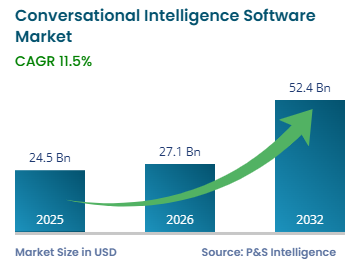
The conversational intelligence software market size was USD 24.5 billion for 2025, and it will grow by 11.5% during 2026–2032, to reach USD 52.4 billion by 2032.
The market is being driven by the growing adoption of artificial intelligence (AI), natural language processing (NLP), speech recognition, machine learning, and generative AI for analyzing business conversations and converting conversational data into actionable insights. Organizations are increasingly using conversational intelligence across sales, customer service, contact centers, and meetings to automate transcription and summarization, identify customer sentiment and intent, monitor interactions, and improve decision-making. For example, Google Cloud's Customer Experience Insights uses machine learning to analyze conversations for sentiment, entities, call topics, and interaction patterns, highlighting the increasing use of AI-based technologies to extract business insights from conversational data.
The market is further supported by the increasing focus on sales productivity, customer experience, operational efficiency, and data-driven decision-making. According to Salesforce, 81% of sales teams were investing in AI in 2024, while 83% of sales teams using AI reported revenue growth, compared with 66% of teams without AI. As businesses increasingly seek to understand customer interactions, improve employee performance, reduce manual analysis, and generate actionable insights from conversations, demand for conversational intelligence software is expected to strengthen.
Key Market Insights
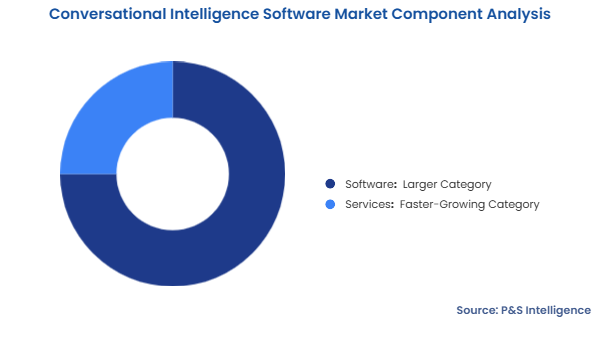
The software category holds the larger market share, of 75%, in 2025, driven by its core analytical capabilities.
The on-premises category will have the higher CAGR, of approximately 11.9%, driven by data control, security, sovereignty, and regulatory compliance.
The customer support & engagement category will have the highest CAGR, of approximately 12.2%, driven by AI-powered conversation analysis and improved customer experiences.
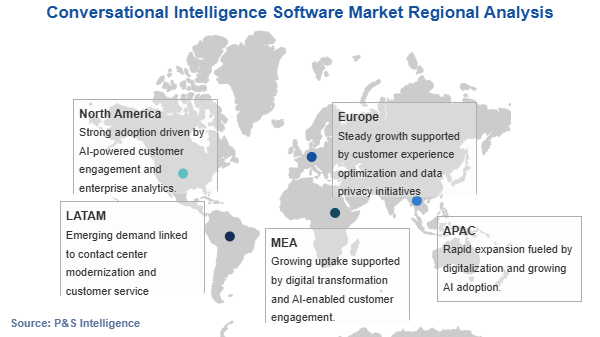
North America holds the largest market share, of 40%, in 2025, driven by early AI adoption and strong enterprise technology spending.
Asia-Pacific will have the highest CAGR, of approximately 12.4%, driven by rapid digital transformation and increasing AI and cloud adoption.
Conversational Intelligence Software Market Trends and Drivers
Rapid Integration of Generative AI Is Key Trend
The rapid integration of generative AI is becoming a significant trend in the Conversational Intelligence Software Market, as vendors increasingly incorporate large language models (LLMs) and generative AI capabilities into platforms that analyze business conversations. Instead of limiting conversational intelligence to transcription, keyword detection, or basic sentiment analysis, these platforms can now generate automated summaries, key discussion points, follow-up actions, conversation insights, and recommendations from sales calls, customer-service interactions, and meetings. This is expanding the role of conversational intelligence from a monitoring tool into an AI-driven decision-support solution.
The trend is being reinforced by the rapid adoption of generative AI across business functions. IBM reported that 77% of surveyed executives considered generative AI to be market-ready in 2024, compared with 36% in 2023. As generative AI becomes more embedded in enterprise workflows, conversational intelligence providers are increasingly integrating these capabilities to automate the interpretation of unstructured conversational data, accelerate access to insights, and support more personalized customer and sales interactions. This integration is therefore expected to increase the functionality and business value of conversational intelligence software.
Growing Importance of Employee Coaching and Training Is Biggest Driver
The growing importance of employee coaching and training is driving the adoption of conversational intelligence software as organizations increasingly seek continuous and measurable ways to improve employee performance. Traditional coaching often depends on managers reviewing a limited number of calls and providing feedback based on individual observations. Conversational intelligence platforms can analyze a much larger volume of interactions to identify communication gaps, objection-handling patterns, customer sentiment, talk-to-listen ratios, and behaviors associated with stronger performance. This allows managers to identify specific coaching opportunities, provide feedback based on actual customer interactions, and use successful conversations as training material for other employees.
The driver is also supported by the development of AI-enabled coaching capabilities across the industry. For example, Zoom introduced its Virtual Coach within Revenue Accelerator to simulate customer conversations and provide objective performance assessments for sales employees, while Gong uses AI to identify coachable moments and automatically score calls against defined criteria. Gong also reports that its customer Diligent achieved a 7.4% increase in close rates on calls reviewed in Gong and reduced new-representative ramp time by three weeks. These developments reflect the growing shift toward continuous, AI-supported coaching and training, which is expanding the role of conversational intelligence software beyond conversation analysis toward employee development and performance improvement.
Data Privacy and Security Concerns Are Key Restraints
Data privacy and security concerns are a significant restraint for the Conversational Intelligence Software Market because these solutions process recorded conversations, transcripts, customer information, employee data, and other sensitive business information. Collecting, storing, and analyzing this information increases the risk of unauthorized access, data breaches, misuse, and inappropriate data retention. Different data-protection requirements across countries and industries also require organizations to implement appropriate consent, access controls, data-minimization, and data-retention practices.
These requirements increase the cost and complexity of adopting conversational intelligence solutions. Organizations must carefully assess how conversation data is collected, stored, accessed, transferred, and processed by third-party AI systems. Compliance requirements can therefore extend implementation timelines and increase investments in security and governance, making some organizations more cautious about adopting or expanding conversational intelligence platforms.
Industry-Specific Conversational Intelligence Solutions Is Biggest Opportunity
Industry-specific conversational intelligence solutions represent an opportunity because businesses in different sectors have distinct terminology, customer interactions, workflows, compliance requirements, and performance metrics. Solutions tailored to healthcare, financial services, insurance, retail, and telecommunications can provide more relevant analysis than generic platforms by focusing on industry-specific conversations, customer intent, and use cases. This specialization can improve the relevance of insights, support compliance requirements, strengthen integration with existing workflows, and help vendors differentiate their offerings.
The opportunity is supported by the increasing adoption of AI across individual industries. For example, 76% of surveyed insurance executives reported that their organizations had already implemented generative AI in at least one business function, while 75% of leading healthcare companies were experimenting with or planning to scale generative AI. As organizations increase their use of AI within specific industry workflows, demand can expand for conversational intelligence solutions designed around those environments, creating opportunities for vendors to develop specialized products and expand into new industry verticals.
The software category holds the larger market share, of 75%, in 2025, as software platforms form the core of conversational intelligence solutions and provide capabilities such as transcription, conversation analysis, sentiment detection, automated summaries, coaching, and real-time insights. The scale of software adoption is reflected in the capabilities offered by leading platforms; for instance, CallMiner's platform captures and analyzes 100% of customer interactions across voice, chat, email, SMS, surveys, and other digital channels. This broad functionality makes software platforms the primary component through which organizations derive value from conversational intelligence.
The services category will have the higher CAGR, of approximately 11.7%, driven by the growing need for implementation, integration, customization, managed operations, training, and ongoing technical support as organizations deploy conversational intelligence across existing CRM, contact-center, communication, and analytics systems. As these deployments become more complex, businesses increasingly require specialized services to connect platforms, configure workflows, maintain performance, and support employee adoption, making services an increasingly important part of conversational intelligence deployments.
The components analyzed in this report are:
Software (Larger Category)
Services (Faster-Growing Category)
Managed Services
Integration Services
Training & Support Services
Deployment Model Analysis
The cloud-based category holds the larger market share, of 80%, in 2025, as cloud deployment enables organizations to implement conversational intelligence without maintaining extensive on-premises infrastructure. Cloud-based platforms offer scalability, faster deployment, lower upfront infrastructure requirements, automatic updates, and flexible access, making them suitable for organizations processing growing volumes of customer and employee conversations. The increasing availability of enterprise-grade security and data controls is also supporting cloud adoption.
The on-premises category will have the higher CAGR, of approximately 11.9%, driven by the growing need for greater control over sensitive conversation data, data sovereignty, security, and regulatory compliance. Organizations in highly regulated sectors increasingly require AI systems to operate within controlled infrastructure, particularly when conversations contain confidential customer, financial, healthcare, or employee information. The OECD notes that on-premises AI solutions provide greater control, customization, and security and can be suitable for applications subject to data-localization requirements. This demand is further supported by the tightening focus on AI governance and data protection. India's Digital Personal Data Protection Act and 2025 AI governance framework emphasize data protection, consent, security, and responsible AI deployment, increasing the importance of deployment models that give organizations greater control over how sensitive data is processed.
The deployment models analyzed in this report are:
Cloud-based (Larger Category)
On-premises (Faster-Growing Category)
Organization Size Analysis
The large enterprises category holds the larger market share, of 70%, in 2025, because large organizations have greater technology budgets, higher volumes of customer and employee interactions, and more complex sales and customer-service operations that benefit from conversational intelligence. They are also more likely to deploy these solutions across multiple departments and geographic markets. Meta and Bain & Company found that 70% of surveyed large enterprises in India were already engaging with more than half of their customer base through conversational platforms, highlighting the strong adoption of conversational technologies among large businesses.
The small & medium-sized enterprises category will have the higher CAGR, driven by the increasing accessibility of cloud-based AI solutions, subscription-based pricing, and ready-to-deploy conversational intelligence platforms. These developments reduce the need for large upfront technology investments and specialized IT infrastructure, making advanced conversation analytics increasingly accessible to smaller businesses. The U.S. Small Business Administration reports that small businesses account for 43.5% of U.S. economic activity, demonstrating the substantial economic base represented by SMEs and the potential addressable market for scalable AI-based business solutions.
The organization sizes analyzed in this report are:
Small & Medium-sized Enterprises (SMEs) (Faster-Growing Category)
Large Enterprises (Larger Category)
Technology Analysis
The natural language processing category holds the largest market share, of 45%, in 2025, driven by its fundamental role in enabling conversational intelligence platforms to understand and interpret human language from calls, meetings, chats, and other interactions. NLP supports intent recognition, topic identification, entity extraction, conversation summarization, and automated insights, making it a core technology across conversational intelligence applications.
The sentiment & emotion analysis category will have the highest CAGR, driven by the growing need to understand customer satisfaction, emotional responses, engagement, and dissatisfaction during interactions. Organizations are increasingly using sentiment and emotion analysis to identify negative experiences, improve customer service, support sales conversations, and enable more personalized interactions. Google Cloud's Contact Center AI provides sentiment analysis across customer conversations, reflecting the increasing integration of emotional intelligence capabilities into conversational analytics.
The technologies analyzed in this report are:
Natural Language Processing (NLP) (Largest Category)
The sales performance optimization category holds the largest market share in 2025, driven by the widespread use of conversational intelligence to analyze sales interactions, identify customer needs and objections, evaluate seller performance, and improve conversion opportunities. Sales teams can use conversation data to identify successful behaviors, monitor pipeline interactions, and generate actionable insights from customer conversations, making sales optimization one of the most established applications of conversational intelligence. For instance, in July 2026, Zoom announced an agreement to acquire Common Room, an AI-native go-to-market intelligence platform, to add buyer intelligence and AI-powered revenue capabilities to Zoom Revenue Accelerator, which captures and analyzes sales conversations to provide deal intelligence, coaching, and forecasting.
The customer support & engagement category will have the highest CAGR, of approximately 12.2%, driven by the increasing use of AI-powered conversation analysis to improve customer experience, personalize interactions, identify customer sentiment, and resolve issues more efficiently. Organizations are increasingly analyzing customer conversations across voice, chat, email, and digital channels to understand customer needs and improve service quality. The expansion of omnichannel customer-service operations is therefore creating significant opportunities for conversational intelligence in customer support and engagement.
The use cases analyzed in this report are:
Sales Performance Optimization (Largest Category)
Sales Coaching & Training
Deal Intelligence
Customer Support & Engagement (Fastest-Growing Category)
Call Center Analytics
Quality Assurance
Marketing Attribution
Compliance Monitoring
Market Research
Interaction Channel Analysis
The voice calls category holds the largest market share in 2025, driven by the continued importance of voice-based customer and sales interactions across contact centers, sales teams, financial services, healthcare, and other business functions. Voice conversations provide rich information on customer intent, sentiment, objections, and employee performance, making them a major source of data for conversational intelligence platforms. The availability of advanced speech recognition and automated transcription also enables organizations to analyze large volumes of voice interactions at scale.
The chat messages category will have the highest CAGR, of approximately 12.0%, driven by the rapid expansion of digital customer engagement and real-time messaging across websites, mobile applications, social platforms, and business messaging services. Chat-based interactions generate large volumes of text data that can be analyzed for customer intent, sentiment, frequently asked questions, and service issues. The increasing use of AI-powered chatbots and digital customer-service channels is further expanding the volume of conversations available for analysis
The interaction channels analyzed in this report are:
Voice Calls (Largest Category)
Video Meetings
Chat Messages (Fastest-Growing Category)
Email Threads
SMS
Industry Vertical Analysis
The BFSI category holds the largest market share, of 35%, in 2025, driven by the high volume of customer interactions across banking, insurance, lending, wealth management, and financial advisory services. Conversational intelligence helps financial institutions analyze customer conversations, identify customer needs, monitor service quality, improve sales interactions, and support compliance processes. According to the Bank of England and Financial Conduct Authority, 75% of UK financial firms surveyed were already using AI in 2024, indicating the strong adoption of AI technologies across the financial-services industry.
The healthcare category will have the highest CAGR, driven by increasing adoption of AI-enabled technologies for patient engagement, virtual care, administrative support, contact-center operations, and analysis of patient interactions. Healthcare organizations are increasingly seeking technologies that can analyze conversations while improving service quality and operational efficiency. The growing use of AI across healthcare workflows and the need to manage increasingly complex patient interactions are creating greater opportunities for conversational intelligence solutions.
The industry verticals analyzed in this report are:
North America Conversational Intelligence Software Market Size
North America holds the largest market share, of 40%, in 2025, driven by the region's early adoption of AI and cloud technologies, strong enterprise spending on customer-experience and sales technologies, advanced digital infrastructure, and the presence of major conversational intelligence and AI technology providers. The region also has a mature ecosystem of enterprises using AI for customer service, sales analytics, contact centers, and employee performance management, creating strong demand for conversational intelligence solutions.
Within North America, Canada is the faster-growing market, supported by increasing business adoption of AI, NLP, virtual agents, and speech technologies. According to Statistics Canada, 19.2% of Canadian businesses used AI to produce goods or deliver services in the 12 months preceding Q2 2026, up from 6.1% in Q2 2024. Among AI-using businesses, 27.0% used natural language processing, 28.2% used virtual agents or chatbots, and 20.6% used speech or voice recognition—technologies directly relevant to conversational intelligence.
U.S. Conversational Intelligence Software Market Size
The United States is the largest market for conversational intelligence software in North America, driven by its large enterprise base, high AI adoption, advanced cloud infrastructure, mature contact-center ecosystem, and strong spending on sales and customer-experience technologies. The country also has a strong concentration of AI and enterprise software providers, supporting widespread adoption across sales, customer service, financial services, healthcare, and technology. According to the U.S. Census Bureau, overall AI usage among U.S. businesses was between 17% and 20% from December 2025 to May 2026, with 37% of firms having 250 or more employees using AI. This high level of enterprise AI adoption supports the country's leading position in conversational intelligence software.
Asia-Pacific will have the highest CAGR, of approximately 12.4%, driven by rapid digital transformation, increasing enterprise AI adoption, expanding cloud infrastructure, and the growing use of digital customer-service and communication channels across the region. The region's large customer base and expanding sales and contact-center operations are creating strong demand for conversational intelligence solutions. According to India's Ministry of Information and Broadcasting, 87% of Indian enterprises were actively using AI solutions as of December 2025.
AI adoption is also increasing across other major economies in the region. Japan's government has been actively promoting AI adoption through its AI Promotion Act and national AI strategy, supporting greater integration of AI technologies across businesses and industries. Rising AI adoption, expanding digital interactions, and increasing enterprise investment in AI are creating significant growth opportunities for conversational intelligence software across Asia-Pacific.
China Conversational Intelligence Software Market Size
China market is the largest country in the Asia-Pacific market, driven by its large enterprise and consumer base, extensive digital ecosystem, strong AI infrastructure, and significant government and corporate investment in artificial intelligence. AI adoption is expanding across telecommunications, manufacturing, financial services, customer service, and other sectors, creating a broad base for conversational intelligence applications. According to China's Ministry of Industry and Information Technology, the country's AI industry exceeded 1.2 trillion yuan in 2025, growing 40% year over year, while China had more than 6,600 AI companies as of June 2026.
The regions and countries analyzed in this report are:
The market is fragmented, with competition spread across a large number of global technology companies, specialized conversational intelligence providers, enterprise software companies, and emerging AI startups. No single group of vendors controls the overall market, as companies continuously compete through AI capabilities, speech and language analysis, automated insights, real-time analytics, and generative AI features. The rapid advancement of AI is also lowering barriers for new technology providers to develop and launch conversational intelligence solutions, increasing competitive activity. Established companies are expanding their capabilities through product development, partnerships, and acquisitions, while smaller vendors compete through specialized technologies and innovation. This creates high competition and continuous product development, with established providers and new entrants competing to strengthen their positions.
Leading Companies in the Conversational Intelligence Software Market:
In July 2026, Gong.io, Inc. partnered with Microsoft Corporation to make Gong available through Microsoft Marketplace and connect its Revenue Graph and real-time customer insights with Microsoft's enterprise tools and workflows.
In January 2025, HubSpot, Inc.completed the acquisition ofFrame AI, Inc., integrating its conversation-intelligence capabilities into HubSpot's Breeze AI platform. The acquisition strengthened HubSpot's ability to analyze unstructured customer conversations and generate actionable insights from customer interactions.
In May 2024, Avaya Holdings Corp. partnered with LivePerson, Inc. to integrate LivePerson's Conversational Cloud and conversational intelligence capabilities into Avaya's customer-experience platform, including digital channels and unified conversation insights.
In May 2024, LivePerson, Inc. launched new AI capabilities, partnerships, and integrations to connect and orchestrate customer conversations across voice and messaging channels using AI, LLMs, and human agents.
In March 2024, NICE Ltd. launched Enlighten XM, an AI-powered CX solution using large language models and customer-data memory to deliver more contextualized and personalized customer interactions.
Frequently Asked Questions About This Report
How does conversational intelligence work?+
AI records, transcribes, and analyzes conversations to identify intent, sentiment, topics, patterns, and actionable insights.
What are the benefits of conversational intelligence?+
Key benefits include better sales performance, customer experience, employee coaching, productivity, and quality monitoring.
How is conversational intelligence used in sales?+
Sales teams use conversation intelligence to analyze calls, identify buyer intent and objections, improve follow-ups, and strengthen coaching.
How does conversational intelligence improve customer experience?+
Conversation analysis identifies customer sentiment, recurring issues, service gaps, and opportunities for more personalized interactions.
What features are included in conversational intelligence software?+
Common features include transcription, sentiment analysis, conversation summaries, topic detection, AI insights, coaching, and CRM integration.
Want a report tailored exactly to your business need?
Leading companies across industries trust us to deliver data-driven insights and innovative solutions for their most critical decisions. From data-driven strategies to actionable insights, we empower the decision-makers who shape industries and define the future. From Fortune 500 companies to innovative startups, we are proud to partner with organisations that drive progress in their industries.
Client Testimonials
Working with P&S Intelligence and their team was an absolute pleasure – their awareness of timelines and commitment to value greatly contributed to our project's success. Eagerly anticipating future collaborations.
McKinsey & Company
India
Unmatched Standards
Our insights into the minutest levels of the markets, including the latest trends and competitive landscape, give you all the answers you need to take your business to new heights
Complete Data Security
We take a cautious approach to protecting your personal and confidential information. Trust is the strongest bond that connects us and our clients, and trust we build by complying with all international and domestic data protection and privacy laws