This Report Provides In-Depth Analysis of the Emotion Analytics Market Report Prepared by P&S Intelligence, Segmented by Type (Facial Analytics, Speech Analytics, Text Analytics, Video Analytics), Enterprise Size (Large Enterprise, Small and Medium-Sized Enterprise), Application (Customer Experience Management, Public Safety & Law Enforcement, Sales and Marketing Management, Workforce Management, Competitive Intelligence), Industry (BFSI, Healthcare, Information Technology & Telecom, Media & Entertainment, Automotive, Government, Retail), and Geographical Outlook for the Period of 2021 to 2032
Explore the market potential with our data-driven report
Emotion Analytics Market Future Prospects
Emotion Analytics Key Market Insights
The facial analytics category holds the largest market share, of 40%, in 2025, driven by widespread camera-based deployments enabling passive emotion detection across multiple industries.
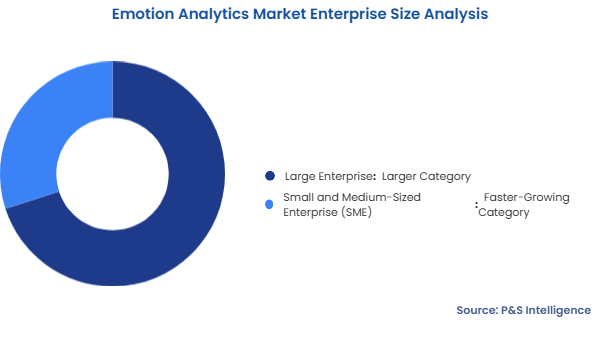
The large enterprise category holds the largest market share, of 70%, in 2025, driven by high integration costs and complex AI deployments, favoring organizations with strong technical resources.
The public safety & law enforcement category will have the highest CAGR, of 16.7%, driven by rising government investment in AI-based security, surveillance, and behavioral analytics systems.
The BFSI category holds the largest market share of 25% in 2025, driven by high investment in customer interaction analytics, fraud detection, and compliance monitoring.
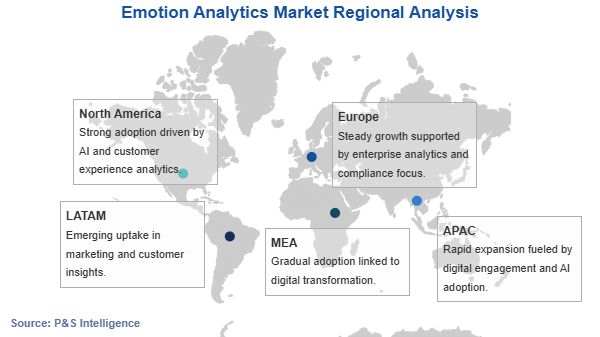
North America holds the largest market share, of 40%, in 2025, driven by strong enterprise adoption and advanced cloud infrastructure enabling scalable emotion analytics deployment.
Emotion Analytics Market Future Outlook
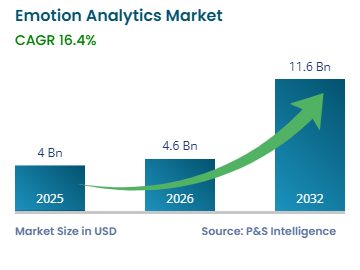
The emotion analytics market size was USD 4.0 billion for 2025, and it will grow by 16.4% during 2026–2032, to reach USD 11.6 billion by 2032.
The market is driven by accelerating integration of artificial intelligence, machine learning, and natural language processing across customer experience management, healthcare diagnostics, and public safety verticals, reflecting a sustained institutional shift toward emotionally intelligent enterprise systems. Emotion analytics platforms analyze human affective states through multimodal inputs, including facial expressions, speech patterns, text sentiment, video behavior, and physiological signals such as electroencephalography and galvanic skin response, enabling organizations to quantify and act on emotional data at scale while supporting more adaptive and context-aware decision-making frameworks.
BFSI institutions deploy these systems to optimize real-time customer interactions and detect behavioral anomalies, while automotive manufacturers embed affective computing modules into driver monitoring and in-cabin safety platforms. According to the International Data Corporation, global spending on artificial intelligence is expected to surpass USD 300 billion by 2026, reflecting accelerating enterprise investment in AI-driven analytics technologies.
Emotion Analytics Market Trends & Drivers
Multimodal AI System Convergence Is Key Trend
The emotion analytics market is undergoing a structural transition away from single-modality systems toward integrated multimodal platforms. Multimodal platforms process facial cues, vocal tone, textual sentiment, video behavioral sequences, and physiological signals such as electroencephalography and galvanic skin response. Measurable accuracy limitations of unimodal approaches are driving this architectural shift, as facial-only analysis is compromised by occlusion and cultural expression variance, while speech-only systems underperform in high-noise or multilingual environments. By fusing complementary data channels, multimodal architectures reduce false-positive emotion classifications and deliver higher-confidence outputs that enterprise customers in BFSI, healthcare, and automotive verticals require for production-grade deployment.
The National Institute of Standards and Technology has emphasized multimodal AI and biometric evaluation frameworks to improve system reliability and reduce classification bias in real-world deployments. Platform vendors are responding through aggressive R&D consolidation, with previously separate analytic engines being integrated into unified SDKs and cloud APIs that allow enterprise developers to access multiple modalities through a single integration layer. For instance, in 2024, Amazon Web Services, Inc. continued expanding Amazon Bedrock with enhanced generative AI capabilities, supporting enterprise adoption of multimodal AI applications relevant to sentiment and emotion analytics. As edge computing infrastructure matures across North America and Asia-Pacific, multimodal inference is becoming feasible at the device level, with real-time applications such as automotive driver monitoring and clinical diagnostics emerging as key beneficiaries. China’s national AI development strategy promotes integration of computer vision, speech recognition, and natural language processing into unified AI systems, with companies like Baidu Inc. and Tencent Holdings advancing multimodal AI platforms across both consumer and enterprise applications.
Escalating Enterprise Investment in Behavioral Customer Intelligence Is Biggest Driver
The primary external force accelerating commercial adoption of emotion analytics is the intensifying enterprise focus on behavioral and emotional dimensions of customer interaction as a measurable driver of revenue retention and lifetime value. Organizations across banking, retail, telecommunications, and hospitality sectors are transitioning from satisfaction surveys and net promoter scores toward real-time affective intelligence. These tools capture retrospective, declared preferences rather than live emotional states. Affective intelligence platforms reveal emotional states during live interactions and enable immediate service personalization and escalation decisions.
Voice emotion detection deployed within contact centers quantifies emotional stress, frustration, or satisfaction at the utterance level, with automated routing and supervisor alerts responding in real time and dynamic script adjustment adapting agent responses to shifting customer sentiment, collectively improving first-contact resolution and overall customer engagement outcomes. Companies such as Cogito Corporation have deployed real-time voice emotion AI solutions in contact centers that provide live coaching to agents based on detected customer sentiment. The Organisation for Economic Co-operation and Development estimates that AI adoption across services industries, including customer-facing analytics, will contribute up to USD 15.7 trillion to global GDP by 2030.
Expanding Mental Wellness and Clinical Diagnostics Applications Are Key Opportunities
The growing global burden of psychological disorders exceeds the capacity of traditional diagnostic and therapeutic infrastructure, creating a structural opportunity at the intersection of emotion analytics and clinical mental health monitoring. The World Health Organization estimates that one in eight people worldwide currently lives with a mental disorder, highlighting the urgent need for scalable, technology-assisted mental health monitoring solutions across healthcare systems.
Telehealth platforms are integrating voice and facial emotion analysis to enable practitioners to assess patient affect during digital consultations. Pharmaceutical companies, health systems, and digital therapeutics developers are funding pilot programs that apply longitudinal emotion analytics to measure treatment efficacy for depression, anxiety, and post-traumatic stress disorder. For instance, in November 2024, Sentiance NV announced the acquisition of DRVR to enhance its capabilities in driver state analytics and behavioral intelligence, reflecting the growing cross-industry applicability of emotion-aware technologies.
Regulatory pathways for Software as a Medical Device (SaMD) are evolving across the United States and European Union, with frameworks from the U.S. Food and Drug Administration and European regulators guiding the approval and deployment of AI-based medical technologies, including emotion-aware tools, supporting compliant integration into clinical workflows and accelerating commercialization across regulated healthcare environments. This vertical represents a high-growth pathway that diversifies emotion analytics revenue beyond its current concentration in customer experience and marketing research applications.
Biometric Data Governance Fragmentation and Consent Requirements Are Biggest Restraints
The jurisdiction-specific nature of biometric and behavioral data governance increases compliance complexity, raising deployment costs and slowing enterprise adoption of emotion analytics. Facial expression analysis and voice biometric processing each capture sensitive personal data categories subject to heightened protection obligations in major regulatory frameworks, with physiological signal collection carrying equivalent requirements. The UNESCO Recommendation on the Ethics of Artificial Intelligence, adopted by 193 member states, establishes principles mandating transparency, informed consent, non-discrimination, and human oversight for AI systems processing behavioral and emotional data, translating into increased compliance and governance requirements for commercial emotion analytics vendors operating across multiple jurisdictions.
Enterprises deploying emotion analytics in consumer-facing environments must navigate concurrent obligations under GDPR in the European Union and the Illinois Biometric Information Privacy Act in the United States. Equivalent frameworks are emerging in Canada, Brazil, India, and Australia, with differing consent, data localization, and retention requirements creating additional operational complexity for cross-border deployments. Italy's data protection authority fined Clearview AI EURO 20 million for unlawful biometric data processing under GDPR, highlighting how such regulatory actions delay enterprise adoption timelines and increase vendor compliance overhead. Smaller specialized firms bear a disproportionate burden relative to large platform operators that maintain established legal and data governance teams capable of sustaining multi-jurisdictional compliance at scale.
Emotion Analytics Market Segmentation Analysis
Type Analysis
The facial analytics category holds the largest market share, of 40%, in 2025, driven by the widespread deployment of camera-based systems across retail, automotive, healthcare, and consumer device applications, enabling passive emotion detection without requiring active user participation. Advances in deep learning have improved micro-expression recognition accuracy, allowing more nuanced emotional states to be identified within production-grade systems. The National Institute of Standards and Technology has reported that leading facial recognition systems achieve false match rates below 1% under controlled conditions.
The speech analytics category will have the highest CAGR, of 16.6%, driven by expanding volumes of real-time audio data generated through voice-enabled AI and contact center platforms. Conversational interfaces are broadening the range of deployment environments where voice emotion detection operates. Transformer-based speech models enable emotion detection through tonal and prosodic analysis. The Institute of Electrical and Electronics Engineers reports that such systems achieve emotion recognition accuracy in the range of 70–85%, with performance varying significantly depending on dataset quality and real-world environmental conditions.
The types analyzed in this report are:
Facial Analytics (Largest Category)
Speech Analytics (Fastest-Growing Category)
Text Analytics
Video Analytics
Others
Enterprise Size Analysis
The large enterprise category holds the larger market share, of 70%, in 2025, driven by high integration costs and complex AI deployment workflows that favor organizations with dedicated technical resources and established vendor relationships. Data governance requirements add a further layer of compliance capability that large enterprises sustain through internal legal and AI operations teams. These organizations leverage large proprietary datasets and dedicated AI teams to enhance model accuracy and operational performance. The World Economic Forum reported in its Future of Jobs Report 2023 that around 75% of large enterprises are adopting AI-driven analytics. This adoption rate confirms their leadership position within the emotion analytics segment.
The SMEs category will have the highest CAGR, of 16.8%, driven by cloud-based, subscription-driven emotion analytics solutions that reduce infrastructure and cost barriers to adoption. Growing digital transformation initiatives are broadening uptake among SMEs across regions. The European Commission reported in 2023 that AI and digital analytics tools are becoming key investment priorities for SMEs, with accelerated post-pandemic digital adoption further reinforcing this trend.
The enterprise sizes analyzed in this report are:
Large Enterprise (Larger Category)
Small and Medium-Sized Enterprise (SME) (Faster-Growing Category)
Application Analysis
The customer experience management category holds the largest market share, of 35%, in 2025, driven by high adoption across BFSI, retail, and telecommunications sectors, which rely on emotion analytics to analyze customer interactions and improve satisfaction and retention outcomes. Organizations deploy real-time sentiment analysis in contact centers to optimize routing and monitor agent performance. Reduced customer churn is a measurable downstream outcome of these deployments. The Consumer Financial Protection Bureau highlights that complaint resolution quality and speed are key factors influencing consumer trust. This positions emotion-aware solutions as a direct response to a documented consumer expectation.
The public safety & law enforcement category will have the highest CAGR, of 16.7%, driven by increasing government investment in AI-based security, surveillance, and threat detection systems, along with emotion and behavioral analytics for screening and risk assessment across critical infrastructure and transportation environments. The U.S. Department of Homeland Security is actively funding research into AI-driven behavioral analysis for security applications.
The applications analyzed in this report are:
Customer Experience Management (Largest Category)
Public Safety & Law Enforcement (Fastest-Growing Category)
Sales and Marketing Management
Workforce Management
Competitive Intelligence
Others
Industry Analysis
The BFSI category holds the largest market share in 2025, driven by customer interaction analytics accounting for the highest investment volumes within the sector. Financial institutions also direct spending toward fraud detection and compliance monitoring capabilities. Voice emotion analysis is deployed in contact centers to identify customer distress signals, while behavioral fraud indicators are embedded into transaction monitoring workflows to support risk management. The Bank for International Settlements reports that AI adoption in financial services is accelerating. Behavioral analytics is emerging as a key tool for risk assessment within this environment.
The healthcare category will have the highest CAGR, driven by emotion recognition being integrated into telehealth and clinical decision support platforms. Digital therapeutics developers are embedding affective monitoring into mental health applications. These tools enable remote assessment and tracking of patient emotional states. The National Institutes of Health has reported that AI-based emotion recognition shows validated potential in identifying symptoms of depression and anxiety, supporting broader adoption across healthcare environments.
The industries analyzed in this report are:
BFSI (Largest Category)
Healthcare (Fastest-Growing Category)
Information Technology (IT) & Telecom
Media & Entertainment
Automotive
Government
Retail
Others
Drive strategic growth with comprehensive market analysis
Emotion Analytics Market Geographical Outlook
North America Emotion Analytics Market Size
North America holds the largest market share, of 40%, in 2025, driven by a dense concentration of enterprise technology adopters across banking, retail, and healthcare verticals, along with mature cloud computing infrastructure that enables scalable, real-time deployment of AI-driven emotion sensing platforms. Enterprises across the United States and Canada have moved from pilot-stage evaluations toward full production integration of voice and facial analytics within contact centers, digital banking channels, and clinical decision-support environments, with the customer experience management vertical accounting for the highest volume of commercial adoption as organizations prioritize personalized and data-driven engagement strategies. Large-scale BFSI and telecommunications operators deploy sentiment analysis systems to reduce customer churn and enhance first-contact resolution.
North American technology firms occupy both vendor and early adopter roles within this market, creating a self-accelerating innovation ecosystem that strengthens regional leadership and continuously advances enterprise-scale emotion analytics deployment. The National Science Foundation supports human-centered AI and affective computing research through dedicated grant programs, which advance foundational capabilities in emotion recognition and feed into commercial platform development. Additionally, the National Institute of Standards and Technology released the AI Risk Management Framework in January 2023, establishing voluntary governance standards that influence enterprise procurement decisions and promote responsible deployment of emotion-aware AI systems across North America.
U.S. Emotion Analytics Market Size
The United States is the largest individual country market within North America. Its position reflects the country's role as the primary global hub for enterprise AI commercialization and home to leading emotion analytics vendors including IBM Corporation, Microsoft Corporation, Google LLC, Amazon Web Services, and Cogito Corporation. Federal policy engagement has reduced enterprise procurement uncertainty. The White House Executive Order on the Safe, Secure, and Trustworthy Development and Use of Artificial Intelligence, issued in October 2023, established transparency, safety, accountability, and equity requirements for AI systems, thereby shaping enterprise deployment strategies and governance frameworks for emotion-aware technologies across regulated industries.
Asia-Pacific Emotion Analytics Market Size
Asia-Pacific will have the highest CAGR, of 16.5%, driven by government AI investment programs that are expanding at scale across the region, and rapid smartphone and IoT device penetration is broadening the sensor infrastructure available to emotion analytics platforms. Enterprise demand for customer engagement and healthcare monitoring solutions is accelerating commercial adoption across China, India, Japan, South Korea, and Australia. Regional governments have embedded AI strategy frameworks into national development plans. Public funding is directed toward affective computing research and deployment across healthcare, education, and smart city verticals.
Japan's AI Strategy under its Society 5.0 framework emphasizes human-centered AI and robotics. National R&D programs support human–machine interaction technologies applicable to emotion recognition systems. Japan and South Korea contribute to regional expansion through automotive and consumer electronics integrations, where emotion-aware human-computer interaction systems have become a standard product investment among leading manufacturers. South Korea's government has committed to becoming a top global AI economy by 2030. National strategies promote AI adoption in smart mobility and consumer electronics, including driver monitoring systems and personalized user interfaces incorporating emotion recognition, with government digital health programs supporting this expansion and accelerating adoption across patient care environments.
India Emotion Analytics Market Size
India is the fastest-growing individual country market within Asia-Pacific, supported by its rapidly expanding business process outsourcing sector, which houses one of the world's largest concentrations of voice-based customer interaction. NITI Aayog's National Strategy for Artificial Intelligence identified healthcare, financial services, and customer service as priority AI deployment sectors, establishing a policy framework that supports broader adoption of behavioral analytics across national development initiatives.
The strategy directed government and enterprise focus toward AI deployment across telehealth, BFSI, and retail verticals. According to the National Payments Corporation of India, India processes over 12 billion UPI transactions monthly as of 2024–2025. This transaction volume defines the scale of digital financial interactions. India's fintech ecosystem is deploying voice emotion detection to personalize digital banking interactions and embed behavioral fraud signals into transaction monitoring workflows. The Government of India's Digital India initiative and the Ayushman Bharat Digital Mission are expanding nationwide digital healthcare infrastructure. This expansion enables integration of AI-based tools, including emotion and mental health monitoring solutions, across telemedicine platforms. The country's growing digital health startup sector is accelerating clinical adoption of emotional monitoring tools, with mental wellness applications targeting underserved rural and semi-urban populations emerging as a primary growth area within the broader digital health ecosystem.
The regions and countries analyzed in this report are:
North America (Largest Regional Market)
U.S. (Larger Country)
Canada (Faster-Growing Country)
Europe
Germany (Largest Country)
U.K. (Fastest-Growing Country)
France
Italy
Spain
Rest of Europe
Asia-Pacific (Fastest-Growing Regional Market)
China (Largest Country)
India (Fastest-Growing Country)
Japan
South Korea
Australia
Rest of APAC
Latin America
Brazil (Largest Country)
Mexico (Fastest-Growing Country)
Rest of LATAM
Middle East and Africa
Saudi Arabia (Largest Country)
U.A.E. (Fastest-Growing Country)
South Africa
Rest of MEA
Emotion Analytics Market Competitive Landscape
The market is fragmented across a two-tier competitive structure. Large enterprise platform providers occupy the upper tier, while a broad base of specialized vendors forms the lower tier. Major technology providers hold a moderate share through strong infrastructure and enterprise integration capabilities. Niche players compete by offering specialized solutions across distinct modalities and application areas. These vendors target specific use cases in healthcare, automotive, and customer experience through domain expertise that generalist platforms do not replicate. The absence of dominant market control sustains a competitive, innovation-driven market environment.
Leading Companies in the Emotion Analytics Market:
IBM Corporation
Microsoft Corporation
Google LLC
Amazon Web Services, Inc.
Realeyes
NVISO SA
Cogito Corporation
Uniphore Technologies Inc.
SoftBank Corporation
Sentiance NV
Clarifai Inc.
Entropik Technologies Pvt Ltd
Emotion Analytics Market Developments
In November 2024, Uniphore Technologies Inc. announced a strategic alliance with Konecta to deliver AI-powered emotion detection and sentiment analysis solutions across multilingual contact center environments.
In June 2024, SoftBank Corporation announced the development of an AI-based voice modulation technology designed to reduce emotional intensity in customer calls and improve agent well-being.
In December 2023, Google LLC launched its Gemini multimodal AI models capable of processing text, audio, image, and video inputs and supporting advanced sentiment and behavioral analytics applications.
In November 2023, Microsoft Corporation announced multimodal advancements in Azure OpenAI Service at Microsoft Ignite, including GPT-4 Turbo with Vision and DALL·E 3 integration.
Frequently Asked Questions About This Report
How does emotion analytics work?+
Emotion analytics uses artificial intelligence, machine learning, and natural language processing to analyze human emotions through facial expressions, voice tone, text sentiment, and behavioral patterns.
What technologies are used in emotion analytics?+
Emotion analytics relies on technologies such as computer vision, speech recognition, natural language processing, and deep learning algorithms to detect and interpret emotional signals.
How is emotion analytics used in healthcare?+
Emotion analytics is used in healthcare for mental health monitoring, telehealth consultations, and clinical decision support by analyzing patient emotions through voice and facial cues.
What are the key challenges in emotion analytics adoption?+
Key challenges include data privacy regulations, high implementation costs, and accuracy limitations due to cultural and contextual variations in emotional expression.
How is emotion analytics used in customer experience management?+
Emotion analytics is used to analyze real-time customer interactions in contact centers, enabling personalized responses, improved service quality, and reduced customer churn.
Want a report tailored exactly to your business need?
Leading companies across industries trust us to deliver data-driven insights and innovative solutions for their most critical decisions. From data-driven strategies to actionable insights, we empower the decision-makers who shape industries and define the future. From Fortune 500 companies to innovative startups, we are proud to partner with organisations that drive progress in their industries.
Client Testimonials
Working with P&S Intelligence and their team was an absolute pleasure – their awareness of timelines and commitment to value greatly contributed to our project's success. Eagerly anticipating future collaborations.
McKinsey & Company
India
Unmatched Standards
Our insights into the minutest levels of the markets, including the latest trends and competitive landscape, give you all the answers you need to take your business to new heights
Complete Data Security
We take a cautious approach to protecting your personal and confidential information. Trust is the strongest bond that connects us and our clients, and trust we build by complying with all international and domestic data protection and privacy laws