Key Highlights
| Study Period | 2019 - 2032 |
| Market Size in 2024 | USD 3.9 Billion |
| Market Size in 2025 | USD 4.4 Billion |
| Market Size by 2032 | USD 10.1 Billion |
| Projected CAGR | 12.8% |
| Largest Region | West |
| Fastest Growing Region | South |
| Market Structure | Fragmented |

| Study Period | 2019 - 2032 |
| Market Size in 2024 | USD 3.9 Billion |
| Market Size in 2025 | USD 4.4 Billion |
| Market Size by 2032 | USD 10.1 Billion |
| Projected CAGR | 12.8% |
| Largest Region | West |
| Fastest Growing Region | South |
| Market Structure | Fragmented |
|
Explore the market potential with our data-driven report
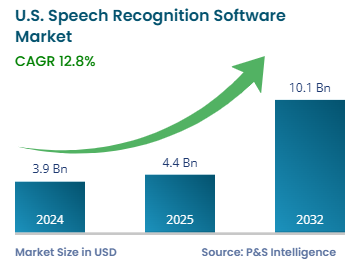
The U.S. speech recognition software market size stood at USD 3.9 billion in 2024, and it is expected to grow at a CAGR of 12.8% during 2025–2032, to reach USD 10.1 billion by 2032.
This growth occurs because the users are adopting digital technologies on a regular basis while seeking hands-free interaction methods. This growth is due to artificial intelligence, voice-capable virtual assistant, and speech recognition enhancements. As per studies, in 2024, over 120 million smart speakers were bought by U.S. households.
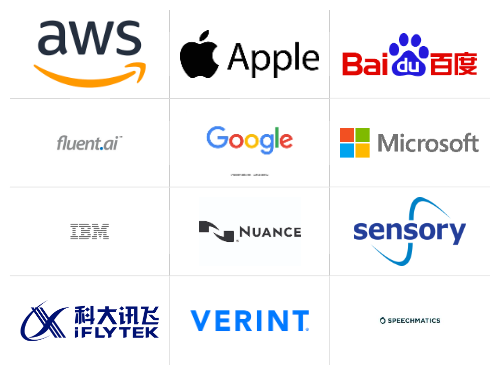
The market benefits from multinational tech leaders, such as Amazon, Google, and Microsoft, which invest heavily in speech recognition development to enhance their capabilities. The market adoption of smart devices and virtual assistants continues to boost because customers want to manage their daily routines using voice-operated commands. The market experiences growth because accurate and secure speech recognition solutions meet the health industry's need to fulfill strict regulatory and compliance needs.
Through constant advancements in AI and ML, professionals achieve better efficiency as well as enhanced accuracy when using speech recognition systems that become more accessible to users. The market expands substantially because of the integration between voice recognition systems with smart devices and IoT technology. Home automation systems and all connected devices now use voice-enabled devices as their primary control system.
The healthcare domain accepts speech recognition solutions at a rising rate because professionals utilize this technology to document clinical notes and perform patient support initiatives and paperwork duties. Roughly 72,000 healthcare providers in the U.S. had deployed voice-enabled electronic health record systems by 2024.
On-premises is the larger category, with 60% value share in 2024. Speech recognition systems that operate under the on-premise deployment mode allow an organization to run their programs locally from their physical servers located within their infrastructure. The deployment method offers privacy multipliers and performance capabilities in handling sensitive information, thus assisting organizations with regulatory adherence. The systems function with or without internet access making them appropriate for real-time operations even when networks lose connectivity during outages. Specific business needs allow on-premise solutions to integrate organizational exclusive vocabulary and jargon. An on-premise system requires a higher initial investment but provides permanent control of data management together with affordable maintenance expenses rather than cloud-based payment structures.
These are the deployment modes analyzed here:
The voice-driven navigation systems category dominates the market with a revenue share of 75% in 2024. This is because people widely use them in vehicle navigation systems and mobile technology platforms. The majority of applications feature these systems because they allow hands-free access to navigation and information retrieval. Among all mentioned function types, voice-driven navigation systems stand as the largest due to their extensive use throughout automotive production and consumption electronics manufacturing.
The functions covered in this report are:
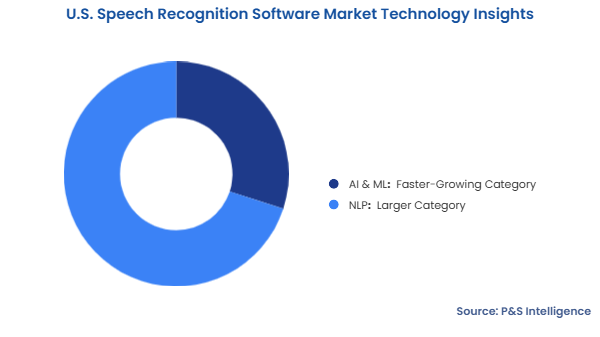
NLP is the dominant category, with a share of 70%. Natural language processing serves as an essential key function for computers to decode human speech making it vital for speech recognition system operation. The extensive usefulness of NLP throughout healthcare and finance alongside retail operations makes it the leading technology in current market conditions. Enhanced efficiencies meet better decision-making abilities while professional workers can effectively access corporate data because of this technology.
These are the technologies that were analyzed:
Healthcare accounted for the largest revenue share, of around 40%, in 2024, and this category is further expected to maintain its position during the forecast period. Healthcare institutions use speech recognition technology extensively for multiple functions such as medical documentation and patient care as well as administrative duties. The healthcare industry adopts speech recognition systems to create efficient data entry processes that release healthcare workers for patient care activities. Healthcare professionals use speech recognition software to optimize processes through accurate documentation and achieve better productivity in their facilities. The management of electronic health records (EHR) by healthcare providers becomes more effective through voice-enabled systems, which support proper and timely documentation of patient information. The technology enables telemedicine and virtual consultation, which provides healthcare professionals with a smooth and convenient method to interact with their patients.
Here are the end users type covered in the report:
Drive strategic growth with comprehensive market analysis
The Western region has the largest share, of 25%. Significant advancements in speech recognition technology are primarily developed within major technology hubs located in the West region together with Silicon Valley. High-tech companies together with research facilities and technology-forward populations promote extensive adoption of speech recognition software throughout healthcare sectors and automotive sectors as well as consumer electronic domains. Continuous advancement of speech recognition capabilities happens within the West region's innovation ecosystem.
These regions were analyzed:
Want a report tailored exactly to your business need?
Request CustomizationLeading companies across industries trust us to deliver data-driven insights and innovative solutions for their most critical decisions. From data-driven strategies to actionable insights, we empower the decision-makers who shape industries and define the future. From Fortune 500 companies to innovative startups, we are proud to partner with organisations that drive progress in their industries.

Working with P&S Intelligence and their team was an absolute pleasure – their awareness of timelines and commitment to value greatly contributed to our project's success. Eagerly anticipating future collaborations.
McKinsey & Company
India
Our insights into the minutest levels of the markets, including the latest trends and competitive landscape, give you all the answers you need to take your business to new heights

We take a cautious approach to protecting your personal and confidential information. Trust is the strongest bond that connects us and our clients, and trust we build by complying with all international and domestic data protection and privacy laws


Customize the Report to Align with Your Business Objectives

Request the Free Sample Pages