This Report Provides In-Depth Analysis of the Cloud Migration Services Market Report Prepared by P&S Intelligence, Segmented by Service Type (Managed Services, Data Migration and Management Services, Assessment and Planning Services, Migration and Deployment Services, Integration and Customization Services, Security and Compliance Services, Support and Maintenance Services), Migration Type (Application Migration, Infrastructure Migration, Platform Migration, Database Migration, Storage Migration), Deployment Model (Public Cloud, Hybrid Cloud, Private Cloud, Multi-Cloud), Enterprise Size (Large Enterprises, Small and Medium Enterprises), End User (Banking, Financial Services, and Insurance, Healthcare and Life Sciences, IT and Telecommunications, Government and Public Sector, Manufacturing, Retail and Consumer Goods, Media and Entertainment, Automotive, Travel and Hospitality), and Geographical Outlook for the Period of 2021 to 2032
Explore the market potential with our data-driven report
Cloud Migration Services Market Overview
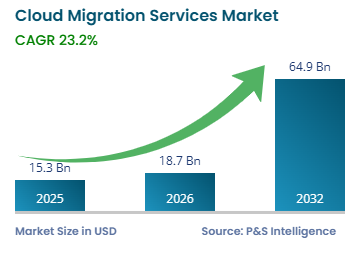
The cloud migration services market size was USD 15.3 billion in 2025, and it will grow by 23.2% during 2026-2032, to reach USD 64.9 billion by 2032.
The cloud migration services market is expanding as enterprises move applications, data, and workloads from legacy infrastructure to cloud environments to improve scalability, operational flexibility, and technology agility. Organisations increasingly operate business-critical systems across hybrid and multi-cloud architectures, making migration projects more complex and increasing the need for specialised services covering assessment, planning, integration, security alignment, workload transfer, and post-migration optimisation. Businesses are also seeking faster deployment cycles, improved application performance, and more efficient technology spending, positioning cloud migration as a central component of broader digital transformation and infrastructure modernisation strategies rather than a standalone technology upgrade.
The market is also benefiting from growing demand for cloud-native development, artificial intelligence readiness, advanced analytics, and automation-driven operating models. Enterprises are modernising older applications while seeking migration partners that can reduce downtime, manage data movement, identify application dependencies, and align workloads with suitable public, private, or hybrid cloud environments. According to the International Telecommunication Union, 5.8 billion people used the Internet in 2024, representing 71% of the global population, highlighting the continued expansion of digital services, online transactions, connected applications, and data-intensive business operations. This growth is increasing the volume of digital workloads that organisations must support while strengthening demand for scalable cloud infrastructure, governance frameworks, managed support services, performance optimisation capabilities, and long-term migration strategies that help enterprises maintain operational resilience, regulatory compliance, and technology competitiveness across increasingly distributed IT environments.
Key Market Insights
Managed Services is the largest service type, holding a market share of 30.0%, due to rising multi-cloud adoption requiring continuous governance, monitoring, and optimisation.
Database Migration and Management Services is the fastest-growing service type, registering a CAGR of 23.5%, driven by increasing cloud-hosted database adoption for analytics and AI workloads.
Public Cloud is the largest deployment mode, holding a market share of 45.5%, due to widespread enterprise adoption of cloud computing services.
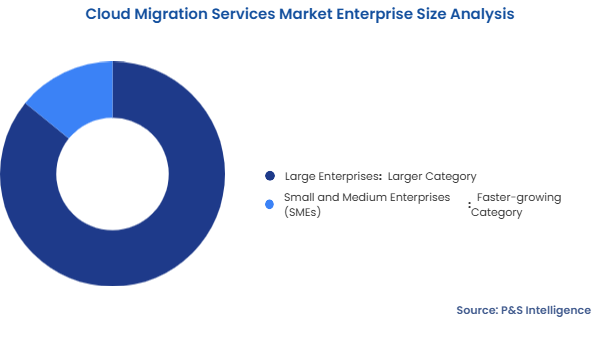
Large Enterprises is the larger category, holding a market share of 85.5%, because these organisations operate extensive IT infrastructures, large application portfolios, and complex data environments.
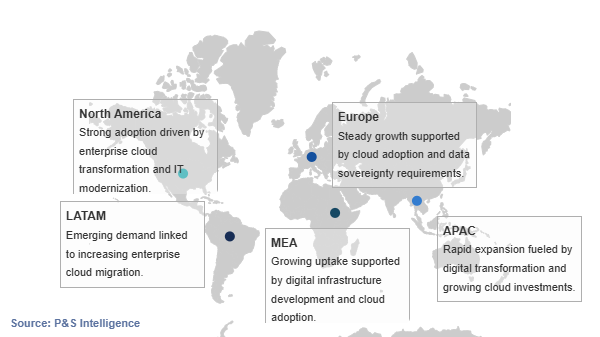
North America holds the largest share of 45.5% because the region has a highly mature cloud ecosystem.
Asia-Pacific has the highest CAGR, of 25.0%, because enterprises across the region are rapidly modernising technology environments and expanding cloud-based operations.
Cloud Migration Services Market Trends and Drivers
AI-Driven Migration Automation and Application Modernisation Is a Major Trend
The cloud migration services market is witnessing a shift towards AI-enabled migration and application modernisation strategies. Organisations are increasingly using intelligent tools to automate workload assessment, dependency mapping, code analysis, testing, and migration planning while preparing applications for cloud-native architectures, analytics, and AI-driven operations. In 2025, Google Cloud launched AI-based mainframe modernisation solutions using Gemini models and partner technologies to support migration and transformation of legacy workloads. In 2025, Amazon Web Services expanded AWS Transform for mainframe with AI-powered analysis, automated testing, and modernisation capabilities for COBOL, CICS, DB2, and VSAM environments. These developments are changing how migration projects are delivered, helping enterprises reduce complexity, improve migration accuracy, accelerate deployment timelines, and support long-term cloud transformation programmes across increasingly complex hybrid and multi-cloud environments.
Growing Need to Replace Legacy IT Infrastructure Drives Market
The need to modernise ageing technology environments is a major driver for the cloud migration services market. Many organisations continue to operate legacy infrastructure that limits scalability, increases maintenance costs, and creates operational risks, making cloud migration a practical route towards infrastructure modernisation and improved business agility. According to the United States Government Accountability Office, eight of the 11 most critical U.S. federal legacy IT systems used outdated programming languages in 2025, four relied on unsupported hardware or software, and seven operated with known cybersecurity vulnerabilities. According to Kyndryl's 2025 mainframe modernisation survey, 99% of surveyed enterprises operated in hybrid environments, while 80% reported that their modernisation strategy had changed during the previous year. These conditions are increasing demand for migration services that support technology renewal, workload transformation, and long-term operational flexibility.
Data Security, Compliance, and Migration Risk Challenges Limit Market Expansion
Data security, regulatory compliance, and operational risk concerns continue to restrain cloud migration projects across many industries. Organisations handling sensitive financial, healthcare, government, and customer information often face strict governance requirements covering data residency, access controls, audit obligations, and cybersecurity standards. Migration programmes can also introduce concerns related to service disruption, application compatibility, and data loss, particularly when highly customised legacy systems are involved. According to the International Telecommunication Union, 105 countries remained in Tier 3 or Tier 4 for cybersecurity in 2024. This indicates that many economies are still strengthening cybersecurity readiness and governance frameworks, leading organisations to adopt phased migration approaches, conduct more extensive risk assessments, and extend project timelines before moving critical workloads into cloud environments.
Rising Demand for Industry-Specific Cloud Transformation Services Creates Growth Opportunities
An important opportunity for cloud migration service providers is the growing demand for industry-specific cloud transformation programmes. Organisations across healthcare, financial services, manufacturing, retail, telecommunications, and government increasingly require migration strategies tailored to their operational, security, compliance, and workload requirements. Service providers can capture this opportunity by offering sector-specific capabilities across application modernisation, data migration, cloud governance, security, workload optimisation, analytics integration, and post-migration support. According to Eurostat, 82.92% of enterprises in the information and communication sector in the European Union used paid cloud computing services in 2025. The electricity, gas, steam, and air-conditioning supply sector recorded the highest increase in cloud adoption, rising by 10.56 percentage points from 2023 to 2025. The increasing adoption of cloud technologies across different industries is creating opportunities for migration service providers to develop specialised solutions that address sector-specific technology, compliance, and operational requirements.
Managed Services is the largest category, holding a market share of 30.0%, because enterprises increasingly require ongoing governance, monitoring, optimisation, security management, and operational support after migration projects are completed. Multi-cloud environments create additional management complexity that many organisations cannot handle internally. According to Kyndryl, 84% of cloud leaders intentionally used multiple clouds in 2025. This is increasing demand for managed service providers that can maintain performance, control costs, enforce governance policies, and support workloads operating across public cloud, private cloud, and hybrid infrastructure environments.
Data Migration and Management Services is the fastest-growing category, registering a CAGR of 23.5%, as enterprises move growing volumes of structured and unstructured data to cloud environments while maintaining accessibility, integrity, and regulatory compliance. Organisations are placing greater emphasis on data-driven decision-making, advanced analytics, and artificial intelligence initiatives that require scalable cloud-based data architectures. The increasing complexity of transferring business-critical information across diverse environments is driving demand for specialised migration expertise.
The service type analysed in this report are:
Managed Services (Largest Category)
Data Migration and Management Services (Fastest-growing Category)
Assessment and Planning Services
Migration and Deployment Services
Integration and Customisation Services
Security and Compliance Services
Support and Maintenance Services
Migration Type Analysis
Application Migration is the largest category, holding a market share of 40.5%, due to the widespread need to modernise business applications and improve operational flexibility. Enterprises are increasingly migrating core applications to cloud environments to support scalability, enhance user experiences, and accelerate software deployment cycles. The growing adoption of cloud-native technologies, microservices architectures, and software modernisation programs further strengthens demand for application migration services across both mature and emerging industries.
Database Migration is the fastest-growing category, registering a CAGR of 23.9%, because organisations are modernising data infrastructure to support analytics, artificial intelligence applications, and cloud-native business operations. Legacy databases often limit scalability, integration, and accessibility across distributed environments. According to the European Commission Eurostat, 45.52% of EU enterprises using paid cloud services hosted their enterprise database on the cloud in 2025. Growing adoption of cloud-hosted databases is encouraging enterprises to migrate data assets, modernise database architectures, and improve access to business-critical information across cloud platforms.
The migration type analysed in this report are:
Application Migration (Largest Category)
Database Migration (Fastest-growing Category)
Infrastructure Migration
Platform Migration
Storage Migration
Deployment Model Analysis
Public Cloud is the largest category, holding a market share of 45.5%, because it provides scalable infrastructure, broad service availability, and easier deployment than traditional on-premises environments. Many database migration and managed service projects are also being directed towards public cloud platforms due to their extensive computing and storage capabilities. According to the European Commission Eurostat, 52.74% of EU enterprises used paid cloud computing services in 2025. Widespread enterprise cloud adoption is strengthening demand for migration services that help organisations move applications, workloads, and data into public cloud environments.
Hybrid Cloud is the fastest-growing category, registering a CAGR of 24.9%, as organisations increasingly seek to balance flexibility, security, and operational control across multiple computing environments. Many enterprises prefer maintaining certain workloads in private infrastructure while leveraging public cloud resources for scalability and innovation. Hybrid architectures enable businesses to meet regulatory requirements, optimise workload placement, and support gradual migration strategies without disrupting existing operations.
The deployment model analysed in this report are:
Public Cloud (Largest Category)
Hybrid Cloud (Fastest-growing Category)
Private Cloud
Multi-Cloud
Enterprise Size Analysis
Large Enterprises is the larger category, holding a market share of 85.5%, because these organisations operate extensive IT infrastructures, large application portfolios, and complex data environments that require specialised migration expertise. Large enterprises often manage global operations and must modernise legacy systems while maintaining business continuity and regulatory compliance. Their substantial technology budgets allow them to undertake large-scale migration and modernisation initiatives.
Small and Medium Enterprises (SMEs) are the faster-growing category, registering a CAGR of 23.8%, because smaller organisations are adopting cloud technologies to improve operational efficiency without large infrastructure investments. Affordable migration services, managed support, and cloud-based business applications are making cloud adoption more accessible. According to the European Commission Eurostat, 49.3% of small EU businesses used paid cloud computing services in 2025. Rising cloud usage among SMEs is increasing demand for migration projects that simplify infrastructure management, improve scalability, and support digital business expansion.
The enterprise size analysed in this report are:
Large Enterprises (Larger Category)
Small and Medium Enterprises (SMEs) (Faster-growing Category)
End User Analysis
Banking, Financial Services, and Insurance (BFSI) is the largest category, holding a market share of 25.5%, because financial institutions are increasingly modernising legacy IT infrastructure to support digital banking, payment platforms, risk management systems, customer-facing applications, and data-intensive operations. These organisations require secure, scalable, and highly available cloud environments to manage large transaction volumes and meet stringent regulatory requirements.
Healthcare and Life Sciences is the fastest-growing category, registering a CAGR of 24.5%, as healthcare organisations increasingly adopt digital technologies that require scalable and secure data infrastructure. The growing use of electronic health records, telemedicine, artificial intelligence, medical analytics, and connected healthcare services is increasing demand for cloud-based environments. According to the OECD, the average availability of online digital health services across OECD countries reached 82% in 2024, up from 79% in 2023 among countries with comparable data.
The end user analysed in this report are:
BFSI (Largest Category)
Healthcare and Life Sciences (Fastest-growing Category)
IT and Telecommunications
Government and Public Sector
Manufacturing
Retail and Consumer Goods
Media and Entertainment
Automotive
Travel and Hospitality
Others
Drive strategic growth with comprehensive market analysis
Cloud Migration Services Market Geographical Outlook
North America Cloud Migration Services Market Analysis
North America holds the largest share of 45.5% because the region has a highly mature cloud ecosystem, strong enterprise technology spending, and a large installed base of legacy systems requiring modernisation. Many organisations across financial services, healthcare, retail, and public sector operations are undertaking large-scale workload migration projects to improve operational flexibility and support digital business models. The region also benefits from the presence of major cloud platform providers, global system integrators, and specialised migration service firms that offer advanced consulting, migration, and managed service capabilities. Enterprises in the region are increasingly focused on hybrid and multi-cloud strategies, creating sustained demand for complex migration engagements. In addition, stringent security, governance, and compliance requirements encourage organisations to work with experienced migration partners, supporting continued market expansion across both private and public sector environments.
U.S. Cloud Migration Services Market Analysis
The United States is the largest country market, because enterprises are modernising large and complex IT estates across hybrid and multi-cloud environments. Financial institutions, healthcare providers, retailers, and government agencies are migrating critical workloads to improve scalability, resilience, and operational agility. According to the Federal Risk and Authorisation Management Program, 144 cloud service authorisations were completed in 2025. The growing availability of authorised cloud services is supporting migration projects across regulated sectors while increasing demand for consulting, workload transformation, integration, and cloud governance services.
Canada Cloud Migration Services Market Analysis
Canada is the fastest-growing country market, because organisations are increasing cloud adoption to strengthen cybersecurity, improve service delivery, and modernise legacy infrastructure. Businesses are also expanding the use of hybrid cloud environments to support distributed operations and digital transformation programmes. According to Statistics Canada, 25.7% of businesses using artificial intelligence purchased cloud services or cloud storage after implementing AI in 2025. Growing links between AI deployment and cloud adoption are increasing demand for migration services that help organisations move workloads, applications, and data into scalable cloud environments.
Asia-Pacific has the highest CAGR of 25.0%, driven by rapid enterprise digitalisation, increasing cloud adoption, and the modernisation of legacy IT infrastructure across the region. Organisations are increasingly migrating applications, workloads, and data to cloud environments to improve scalability, operational flexibility, digital service delivery, and technology efficiency. According to the Asian Development Bank, cloud computing contributed between 0.25% and 2.23% of GDP in selected Asia-Pacific economies in 2023, highlighting the growing economic importance of cloud technologies across the region. The expansion of e-commerce, mobile-based services, artificial intelligence, analytics, and digital business models is further increasing demand for cloud infrastructure and migration capabilities. Government-led digital transformation programmes, investments in cloud infrastructure, and the development of data centres are also supporting cloud adoption across the region. The growing adoption of hybrid and multi-cloud environments is creating additional demand for migration, integration, security, governance, and post-migration optimisation services.
China Cloud Migration Services Market Analysis
China is the largest country market, because enterprises are accelerating digital transformation across manufacturing, telecommunications, financial services, and digital commerce. Organisations are modernising applications and infrastructure to support automation, artificial intelligence, and data-intensive operations. According to the National Data Administration of China, the country's total computing power reached 280 EFLOPS in 2024. Expanding computing infrastructure is creating stronger demand for migration services that help enterprises modernise workloads, optimise resource utilisation, and support increasingly complex cloud-based operating environments.
India Cloud Migration Services Market Analysis
India is the fastest-growing country market, because businesses are rapidly shifting towards cloud-based operating models to improve scalability, deployment speed, and technology flexibility. Demand is growing across technology companies, financial institutions, telecommunications providers, and digital commerce platforms seeking modern infrastructure. According to the Press Information Bureau of India, more than 300 government departments used NIC National Cloud Services in 2024. Wider adoption of government cloud infrastructure is encouraging cloud modernisation initiatives and increasing demand for migration services that support workload transformation, integration, and long-term cloud management.
Europe Cloud Migration Services Market Analysis
Europe is an important market for cloud migration services, supported by enterprise technology modernisation, increasing adoption of cloud and advanced digital technologies, and strong regulatory focus on data governance and technological sovereignty. Organisations across the region are increasingly migrating applications, data, and workloads to cloud environments to improve scalability, modernise legacy infrastructure, and support digital transformation initiatives. Germany is the largest country market due to its large industrial base, extensive enterprise IT infrastructure, and continued investment in digital transformation across manufacturing, automotive, financial services, and business services. According to the European Commission, EU Member States included 1,910 digital transformation measures worth EUR 288.6 billion in their National Digital Decade Roadmaps in 2025. These investments cover areas such as secure cloud and data infrastructure, artificial intelligence, cybersecurity, digital connectivity, and business digitalisation.
The regions and countries analysed in this report are:
North America (Largest Regional Market)
U.S. (Larger Country)
Canada (Faster-Growing Country)
Europe
Germany (Largest Country)
U.K.
France (Fastest-Growing Country)
Italy
Spain
Rest of Europe
Asia-Pacific (Fastest-Growing Regional Market)
China (Largest Country)
India (Fastest-Growing Country)
Japan
South Korea
Australia
Rest of APAC
Latin America
Brazil (Largest Country)
Mexico (Fastest-Growing Country)
Rest of LATAM
Middle East and Africa
Saudi Arabia (Largest Country)
U.A.E.
South Africa (Fastest-Growing Country)
Rest of MEA
Cloud Migration Services Market Share Analysis
The cloud migration services market is moderately fragmented, with competition distributed across global technology companies, cloud service providers, system integrators, consulting firms, managed service providers, and specialised migration vendors. The market includes providers with different service capabilities, industry expertise, cloud partnerships, and geographic coverage, which limits the dominance of a single provider across the overall market. The diverse requirements of enterprises across application migration, database migration, infrastructure modernisation, security, compliance, and hybrid and multi-cloud environments allow multiple providers to compete across different customer segments and service areas. Competition is driven by technical expertise, application modernisation capabilities, cloud migration experience, security and compliance support, industry knowledge, and post-migration optimisation services.
Top Companies in the Cloud Migration Services Market:
IBM Corporation
Amazon Web Services, Inc.
Alphabet Inc.
Microsoft Corporation
Oracle Corporation
SAP SE
Cisco Systems, Inc.
NTT DATA Group Corporation
Accenture plc
Infosys Limited
DXC Technology Company
Hewlett Packard Enterprise Company
HCL Technologies Limited
Cloud Migration Services Market Developments
In May 2025, HCL Technologies Limited and Microsoft launched an AI-enabled solution to accelerate RISE with SAP S/4HANA migrations on the Microsoft Cloud. The offering combines HCLTech AI Force, Microsoft Cloud and AI tools, and the HCLTech SAP Migration+ model to streamline SAP estate modernisation and cloud migration while reducing transformation complexity and risk.
In May 2025, DXC Technology collaborated with SAP and Microsoft to introduce DXC Complete with SAP and Microsoft, providing enterprises with an accelerated path to modernization and migration to SAP S/4HANA Cloud on Microsoft Azure.
In April 2026, Amazon Web Services, Inc. announced the availability of AWS Transform in Kiro and Visual Studio Code (VS Code), enabling developers to access AWS Transform custom transformations directly within their development environments.
In March 2024, Accenture Federal Services partnered with Microsoft to launch a Cloud Modernization and Migration Factory on Microsoft Azure Government. The solution was designed to accelerate secure migration and modernisation of federal workloads and included generative AI-enabled migration tools.
Frequently Asked Questions About This Report
What does the cloud migration services market include for organizations?+
It includes consulting, assessment, planning, modernization, transfer, testing, and managed services that move workloads to cloud platforms.
What factors are driving demand in the cloud migration services market?+
Growth is driven by digital transformation, scalability needs, cost optimization, application modernization, remote access, and demand for agile infrastructure.
Why are organizations adopting cloud migration services solutions across operations?+
Organizations adopt migration services to plan moves safely, reduce disruption, modernize applications, and align cloud choices with business needs.
How do cloud migration services solutions improve decision making and efficiency?+
These services improve operations by assessing dependencies, designing migration paths, automating transfers, and validating application performance after movement.
What challenges affect adoption of cloud migration services solutions today?+
Adoption is affected by legacy applications, data security, downtime risk, cost uncertainty, skill shortages, and complex compliance requirements.
Want a report tailored exactly to your business need?
Leading companies across industries trust us to deliver data-driven insights and innovative solutions for their most critical decisions. From data-driven strategies to actionable insights, we empower the decision-makers who shape industries and define the future. From Fortune 500 companies to innovative startups, we are proud to partner with organisations that drive progress in their industries.
Client Testimonials
Working with P&S Intelligence and their team was an absolute pleasure – their awareness of timelines and commitment to value greatly contributed to our project's success. Eagerly anticipating future collaborations.
McKinsey & Company
India
Unmatched Standards
Our insights into the minutest levels of the markets, including the latest trends and competitive landscape, give you all the answers you need to take your business to new heights
Complete Data Security
We take a cautious approach to protecting your personal and confidential information. Trust is the strongest bond that connects us and our clients, and trust we build by complying with all international and domestic data protection and privacy laws