This Report Provides In-Depth Analysis of the Circuit Monitoring Market Report Prepared by P&S Intelligence, Segmented by Type (Modular Circuit, Branch Circuit & Multi Circuit), End User (Industrial, Commercial, Residential), and Geographical Outlook for the Period of 2019 to 2032
Explore the market potential with our data-driven report
Circuit Monitoring Market Outlook
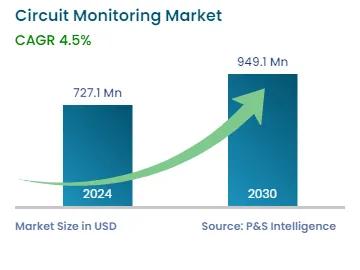
The global circuit monitoring market was valued at USD 727.1million in 2024, and it is projected to grow at a CAGR of 4.5% during 2025–2032, reaching USD 1,022 million by 2032. The market growth is primarily driven by increasing demand for energy-efficient monitoring systems, rising data center investments, and growing emphasis on electrical safety standards across industrial and commercial sectors. According to the International Energy Agency, global energy investment is set to exceed USD 3 trillion in 2024, with USD 2 trillion allocated to clean energy technologies and infrastructure. The emphasis on energy efficiency and sustainability is compelling organizations to deploy advanced monitoring systems that can track and optimize electrical consumption at the circuit level.
The growing focus on industrial automation and smart building technologies is creating substantial opportunities for circuit monitoring solutions. Modern facilities increasingly require sophisticated power monitoring capabilities to optimize energy usage, prevent equipment failures, and comply with stringent safety regulations. The integration of Internet of Things technologies and artificial intelligence into circuit monitoring systems is enabling predictive maintenance capabilities, helping organizations reduce operational costs and minimize unplanned downtime.
Regulatory compliance requirements are becoming increasingly stringent across multiple jurisdictions, particularly in relation to electrical safety standards and energy efficiency mandates. The U.S. Energy Information Administration reports that utility spending on distribution infrastructure reached USD 50.9 billion in 2023, with more than one-fifth of the increase occurring between 2022 and 2023 as utilities replaced aging equipment and installed new lines to withstand extreme weather events. This infrastructure modernization is creating substantial demand for advanced monitoring solutions capable of providing real-time operational insights and predictive maintenance capabilities.
Circuit Monitoring Market Emerging Trends
Smart Building and Industrial Automation Adoption Is Key Trend
The rapid adoption of smart building technologies is creating significant opportunities for circuit monitoring solutions. This growth is primarily driven by increasing demand for energy-efficient solutions and integration of IoT technologies across commercial and industrial properties.
Industrial automation is experiencing widespread adoption, with 80% of businesses having deployed AI and machine learning technologies for automation purposes. The U.S. Bureau of Labor Statistics projects an 18% increase in industrial automation investments, driving demand for connected power monitoring solutions. Circuit monitoring systems enable manufacturers to implement predictive maintenance strategies, optimize energy usage, and ensure compliance with safety standards.
The integration of IoT devices and edge computing capabilities into building management systems is revolutionizing how facility managers approach energy optimization. Modern circuit monitoring solutions offer cloud-based analytics platforms that can process vast amounts of real-time data to identify consumption patterns, predict equipment failures, and automatically adjust power distribution to maximize efficiency. This technological evolution is particularly relevant for large commercial facilities and industrial complexes where energy costs represent a significant operational expense.
Rising Data Center Investments Are Driving Market Growth
The exponential growth of data centers globally represents a primary driver for the circuit monitoring market. The artificial intelligence boom is fundamentally transforming data center requirements, driving unprecedented demand for power-intensive infrastructure. McKinsey reports that AI servers consume significantly more energy than traditional servers, often requiring liquid cooling systems for power densities exceeding 50 kW per rack. This increased power density necessitates advanced circuit monitoring solutions to ensure safe and efficient operations.
According to the International Energy Agency and Visual Capitalist, the global installed data center capacity has surged from 21.4 GW in 2005 to approximately 114 GW in 2025. Moreover, about 66 gigawatts of data center capacity are currently under development globally—of which around 12.5 GW is actively under construction.
Data center operators are increasingly focused on optimizing power usage effectiveness and reducing energy consumption to meet sustainability targets. The hyperscale data center category, which accounts for the majority of new capacity additions, requires sophisticated monitoring solutions to manage the complex power distribution architectures typical of these facilities. Circuit monitoring systems enable operators to identify inefficiencies, prevent costly downtime, and optimize power distribution across thousands of server racks and supporting infrastructure components.
Cybersecurity Concerns and Data Privacy Issues Restrain Market Expansion
The increasing connectivity of circuit monitoring systems creates cybersecurity vulnerabilities that concern many potential users. Connected monitoring devices can serve as entry points for cyberattacks targeting critical infrastructure, making security a paramount consideration for system design and deployment. Organizations in sensitive sectors such as healthcare, finance, and government are particularly cautious about implementing connected monitoring solutions due to potential security risks.
Data privacy regulations such as GDPR and CCPA create additional compliance requirements for organizations deploying comprehensive monitoring systems. The collection and storage of detailed energy consumption data may be subject to regulatory oversight, particularly when the data can be used to infer occupancy patterns or operational schedules. These compliance requirements can increase implementation costs and complexity, potentially deterring adoption in some market segments.
The rapid evolution of cybersecurity threats requires ongoing investment in security updates and system maintenance, adding to the total cost of ownership for circuit monitoring solutions. Organizations must balance the operational benefits of connected monitoring with the ongoing costs and risks associated with maintaining secure systems in an increasingly hostile cyber environment.
Circuit Monitoring Market Segmentation Analysis
Type Analysis
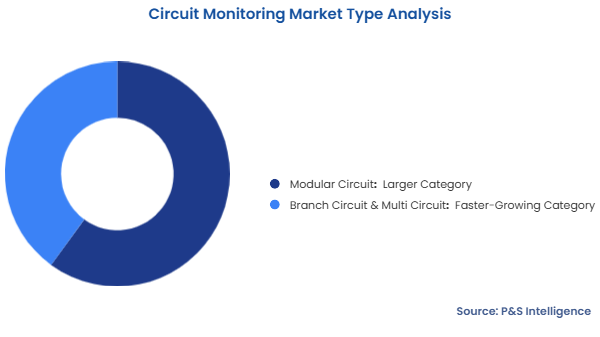
The modular circuit monitoring category held the larger share of 60% in 2024, attributed to the simplified installation process, enhanced connectivity features, and instant access to data in user-friendly formats. Modular circuit monitoring systems offer the ability to sense voltages using customized voltage field detection systems, enabling the determination of circuit breaker status even under no-load conditions. This capability helps identify failed circuits that conventional monitoring systems might miss.
Modular systems provide exceptional flexibility for facility managers and electrical contractors, allowing for incremental deployment and easy system expansion. The modular architecture enables organizations to start with basic monitoring capabilities and progressively add advanced features, such as power quality analysis, harmonic distortion monitoring, and predictive maintenance algorithms. This scalability is particularly valuable for growing businesses that need to expand their monitoring infrastructure over time without requiring a complete system replacement.
They are also easy to integrate with existing building management systems and industrial automation platforms. These systems can seamlessly interface with SCADA systems, building automation controllers, and cloud-based analytics platforms, providing comprehensive integration that enhances operational efficiency. The standardized communication protocols supported by modern modular systems enable interoperability with equipment from multiple vendors, reducing deployment complexity and long-term maintenance costs.
The branch circuit & multi-circuit category is projected to register the higher CAGR, of 4.6%, during 2025–2032, due technological enhancements and compact designs, unlike traditional single-circuit energy meters.
Branch circuits prove optimal for high-density applications, while multi-circuit submeters excel at monitoring multiple single-phase or three-phase circuits simultaneously. The growing adoption of these systems in data centers, which consumed 7.4 Gigawatts of power in 2023, representing a 55% increase from 2022, is driving significant demand for space-efficient monitoring solutions. The ability to monitor multiple circuits from a single device significantly reduces installation costs and panel space requirements, making these solutions particularly attractive for retrofit applications in existing facilities.
Advanced branch circuit monitoring systems now incorporate wireless communication capabilities, enabling remote monitoring and configuration without the need for extensive wiring modifications. This wireless capability is particularly valuable for historical buildings and facilities where traditional wiring installation would be disruptive or prohibitively expensive. The integration of edge computing capabilities into these devices allows for local data processing and real-time decision making, reducing the dependence on central monitoring systems and improving overall system reliability.
These types are covered:
Modular Circuit (Larger Category)
Branch Circuit & Multi Circuit (Faster-Growing Category)
End User Analysis
The industrial category captured the largest market share, of 65%, in 2024, driven by extensive adoption of circuit monitoring systems across manufacturing facilities, processing plants, and heavy industrial operations. Industrial facilities require sophisticated power monitoring capabilities to ensure operational continuity, optimize energy consumption, and comply with safety regulations. The category benefits from the increasing focus on industrial automation, with 80% of businesses deploying AI and machine learning technologies for enhanced operational efficiency.
Manufacturing facilities are increasingly implementing Industry 4.0 initiatives, for which circuit monitoring systems are fundamental, providing granular power consumption data to optimize production processes, identify equipment inefficiencies, and perform predictive maintenance. The integration of circuit monitoring with manufacturing execution systems enables real-time visibility into the relationship between power consumption and production output, facilitating data-driven optimization decisions.
Energy-intensive industries, such as steel production, chemical processing, and mining, are particularly focused on circuit monitoring solutions due to the significant impact of electricity costs on operational profitability. These industries require monitoring systems capable of handling high-voltage, high-current applications and providing accurate measurements under challenging environmental conditions. Advanced industrial circuit monitoring systems incorporate protective features and robust designs specifically engineered for harsh industrial environments.
The commercial category will exhibit the highest growth rate, of 4.7%, during 2025–2032, fueled by the rapid expansion of commercial data centers and office buildings. The growing emphasis on energy efficiency, smart technologies, and sustainability in commercial real estate is driving the adoption of advanced circuit monitoring solutions.
Commercial buildings are now required to meet stringent energy efficiency standards and sustainability certifications, such as LEED, BREEAM, and Energy Star. These certification programs often mandate comprehensive energy monitoring and reporting capabilities that can only be achieved through detailed circuit-level monitoring. The ability to demonstrate measurable energy savings and environmental impact reductions has become a competitive advantage for commercial property owners and managers seeking to attract environmentally conscious tenants.
The rise of flexible workspace concepts and hybrid work models is creating new challenges for commercial building operators who need to optimize energy consumption based on variable occupancy patterns. Circuit monitoring systems enable dynamic load management and space utilization optimization, allowing building operators to adjust lighting, HVAC, and other systems based on real-time occupancy data. This capability is particularly valuable for reducing energy waste in partially occupied buildings and optimizing operational costs.
These end user categories are covered:
Industrial (Largest Category)
Commercial (Fastest-Growing Category)
Residential
Drive strategic growth with comprehensive market analysis
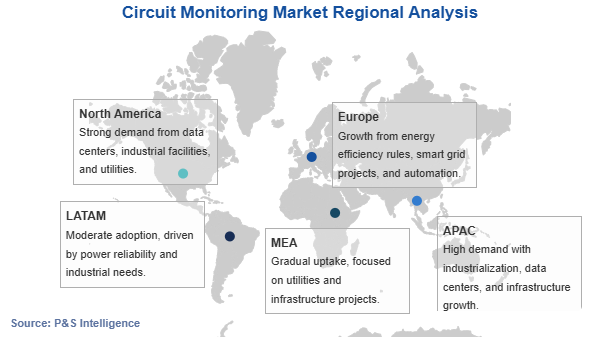
North America held the largest market share, of 45%, in 2024, attributed to the substantial data center investments, robust industrial infrastructure, and stringent energy efficiency regulations. The region benefits from established technology companies, comprehensive regulatory frameworks, and early adoption of smart grid technologies. The U.S. Energy Information Administration reports that utilities spent USD 17.4 billion on overhead infrastructure in 2023, an 11% increase from 2022, driving demand for advanced monitoring solutions to manage these investments effectively.
U.S. Circuit Monitoring Market Size
The U.S. represents the largest country market within North America, driven by massive data center expansion and industrial automation initiatives. Amazon's acquisition of a nuclear-powered data center for USD 650 million exemplifies the scale of infrastructure investments requiring advanced circuit monitoring solutions. The Stargate joint venture's commitment of USD 100 billion for AI infrastructure over four years, including 20 advanced AI-enabled data centers, will significantly boost demand for circuit monitoring systems.
In the U.S. alone, the number of leased data centers has grown 17 times over the past five years, with 5,000 Megawatts of new capacity added in 2024, equivalent to 1% of the nation's total power consumption. This massive infrastructure expansion directly translates to increased demand for circuit monitoring systems capable of managing complex power distribution networks.
Asia-Pacific Circuit Monitoring Market Forecast
Asia-Pacific is projected to be the fastest-growing region with a CAGR of 4.8% during 2025–2032. The region's rapid industrialization, urbanization, and increasing data center investments are primary growth drivers.
China represents the largest country market in the region, driven by massive infrastructure investments and industrial expansion. The country's commitment to achieving carbon neutrality goals is accelerating the adoption of energy-efficient monitoring systems across various sectors. Shanghai announced a 100 billion Yuan investment to enhance biomedicine, integrated circuits, and artificial intelligence industries, creating substantial opportunities for circuit monitoring solutions.
India Circuit Monitoring Market Forecast
India emerges as the fastest-growing country market, supported by rapid industrialization and increasing foreign direct investment. India's private final consumption expenditure share of GDP reached the highest level since FY 2015, with FDI increasing to USD 21.3 billion (approximately INR 1.76 lakh crore) in FY 2022. The growing emphasis on manufacturing and smart city initiatives is driving demand for advanced power monitoring infrastructure.
Based on geography, the market has the following categories:
North America (Largest Regional Market)
U.S. (Larger-Country Market)
Canada (Faster-Growing Country Market)
Europe
Germany (Largest Country Market)
U.K. (Fastest-Country Market)
France
Italy
Spain
Rest of Europe
Asia-Pacific (Fastest-Growing Regional Market)
Japan
China (Largest Country Market)
India (Fastest-Growing Country Market)
South Korea
Australia
Rest of APAC
Latin America
Brazil (Largest Country Market)
Mexico (Fastest-Growing Country Market)
Rest of LATAM
Middle East and Africa
Saudi Arabia (Largest Country Market)
South Africa
U.A.E. (Fastest-Growing Country Market)
Rest of MEA
Circuit Monitoring Market Share
The global circuit monitoring market exhibits a moderately fragmented competitive landscape, characterized by the presence of several established international players alongside numerous smaller regional companies. The market concentration is relatively low, with the top 10 players collectively accounting for approximately 40% of the total market share, indicating significant opportunities for both established and emerging companies to capture market presence.
Leading market players are focusing on product innovation, strategic partnerships, and geographical expansion to strengthen their competitive positions. The market is witnessing increased investment in research and development activities, particularly in areas such as IoT integration, artificial intelligence capabilities, and cloud-based monitoring solutions. Companies are also emphasizing the development of industry-specific solutions to address the unique requirements of different end-use industries.
ABB, Schneider Electric, and Eaton collectively held an estimated 25.0% market share in 2024, leveraging their extensive global presence, comprehensive product portfolios, and strong distribution networks. These companies benefit from their established relationships with industrial customers and their ability to provide integrated solutions combining circuit monitoring with broader automation and power management systems. Their competitive advantage stems from decades of experience in power management technologies and substantial investments in research and development capabilities.
The competitive dynamics are increasingly influenced by technological advancement capabilities, with companies investing heavily in smart monitoring solutions that incorporate predictive analytics and remote diagnostic features. The growing demand for cybersecurity-enabled monitoring systems is also shaping competitive strategies, as companies seek to address the security concerns associated with connected monitoring infrastructure. Market leaders are establishing dedicated cybersecurity teams and partnering with specialized security solution providers to enhance their product offerings.
Market participants are actively pursuing strategic acquisitions and partnerships to expand their technological capabilities and market reach. The trend toward platform-based solutions that integrate circuit monitoring with broader building and industrial automation systems is creating opportunities for companies with comprehensive technology portfolios. Companies are also investing in edge computing capabilities and artificial intelligence algorithms to differentiate their monitoring solutions and provide advanced analytics capabilities.
Emerging companies and startups are focusing on niche applications and innovative technologies such as wireless monitoring, energy harvesting sensors, and advanced analytics platforms. These companies often target specific market categories or applications where they can differentiate themselves through specialized expertise or innovative approaches. The competitive environment provides opportunities for companies that can develop cost-effective solutions for small and medium-sized enterprises or specialized applications.
Regional players maintain competitive positions through deep local market knowledge, established customer relationships, and ability to provide specialized support and customization. These companies often focus on specific geographical markets or industry verticals where they can leverage their expertise and relationships to compete effectively against larger international players.
Key Circuit Monitoring Companies:
ABB Ltd.
Schneider Electric SE
Eaton Corporation plc
Toshiba International Corporation
Accuenergy Inc.
CircuitMeter Inc.
OMRON Corporation
Daxten
ELMEASURE
Legrand SA
Siemens AG,
Circuit Monitoring Market News
In December 2024, Delta Electronics Inc. launched Delta Intelligent Building Technologies in North America, integrating its subsidiaries to offer unified smart building solutions that enhance energy efficiency, security, automation, and occupant comfort across commercial properties through advanced circuit monitoring capabilities.
In September 2024, ABB Ltd. launched ABB freehome in India, a comprehensive wireless Smart Home Automation System with enhanced interoperability, offering comfort, energy efficiency, and security for residential segments through integrated circuit monitoring features.
In September 2024, Johnson Controls International plc announced updates to its building automation system, Metasys, to fulfill the needs of commercial, institutional, and residential buildings with enhanced circuit monitoring and energy management capabilities.
In July 2024, WAGO GmbH & Co. KG launched compact and space-efficient multi-channel electronic circuit breakers designed for modern commercial and industrial applications, providing advanced monitoring capabilities and significant space savings while fulfilling the requirements of contemporary automation systems.
In March 2024, Siemens AG introduced its new SENTRON ECPD circuit protection device, featuring electronic switch technology that automatically switches off circuits in case of faults while mechanically isolating downstream contacts for enhanced safety and maximized electrical planning efficiency.
In January 2024, Omnion Power Inc. launched its secondary DC-distribution cabinet Intelligent Distribution Bay, featuring individual branch circuit monitoring capabilities for up to 160 circuits, expanding the company's battery distribution product portfolio and enhancing data center power management solutions.
Want a report tailored exactly to your business need?
Leading companies across industries trust us to deliver data-driven insights and innovative solutions for their most critical decisions. From data-driven strategies to actionable insights, we empower the decision-makers who shape industries and define the future. From Fortune 500 companies to innovative startups, we are proud to partner with organisations that drive progress in their industries.
Client Testimonials
Working with P&S Intelligence and their team was an absolute pleasure – their awareness of timelines and commitment to value greatly contributed to our project's success. Eagerly anticipating future collaborations.
McKinsey & Company
India
Unmatched Standards
Our insights into the minutest levels of the markets, including the latest trends and competitive landscape, give you all the answers you need to take your business to new heights
Complete Data Security
We take a cautious approach to protecting your personal and confidential information. Trust is the strongest bond that connects us and our clients, and trust we build by complying with all international and domestic data protection and privacy laws