This Report Provides In-Depth Analysis of the Behaviour Analytics Market Report Prepared by P&S Intelligence, Segmented by Component (Software, Services), Deployment Mode (Cloud, On-Premises), Organization Size (Large Enterprises, Small & Medium Enterprises), Application (Fraud Detection, Cybersecurity and Threat Intelligence, Insider Threat Detection, Risk Management, Access Management, Customer Experience Management), End User (Banking, financial services and insurance, Healthcare, IT & Telecom, Manufacturing, Retail & E-Commerce, Government & Defense, Education), and Geographical Outlook for the Period of 2021 to 2032
Explore the market potential with our data-driven report
Behaviour Analytics Market Overview
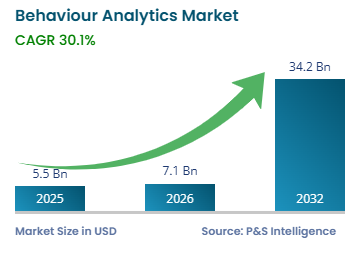
The behaviour analytics market size was USD 5.5 billion in 2025, and it will grow by 30.1% during 2026-2032, to reach USD 34.2 billion by 2032.
The behaviour analytics market is expanding as organisations seek greater visibility into how users, accounts, devices, applications, and other digital entities interact across increasingly complex IT environments. Traditional rule-based security systems struggle to identify credential misuse, insider threats, account takeover attempts, data exfiltration, and other suspicious activities that may initially appear consistent with legitimate behaviour. Security teams are also managing growing volumes of activity data as enterprises expand cloud adoption, support hybrid workforces, and operate across multiple business applications and connected environments. According to the International Telecommunication Union, fixed-broadband networks carried 7.3 zettabytes of end-user Internet traffic globally in 2025, while mobile broadband networks carried a further 1.5 zettabytes. This growing volume of digital activity is increasing the need for technologies that can establish normal behavioural patterns, identify anomalies, and distinguish legitimate activity from emerging security risks.
Financial institutions use behavioural analytics to identify suspicious account activity and transaction anomalies, while enterprises apply it to detect insider threats, credential misuse, unusual access patterns, and other identity-related risks. Organisations are increasingly integrating behavioural insights into identity protection, access governance, fraud prevention, and security operations workflows. Machine learning and real-time anomaly detection enable security teams to establish dynamic behavioural baselines, identify deviations from expected activity, and prioritise higher-risk events for investigation.
Key Market Insights
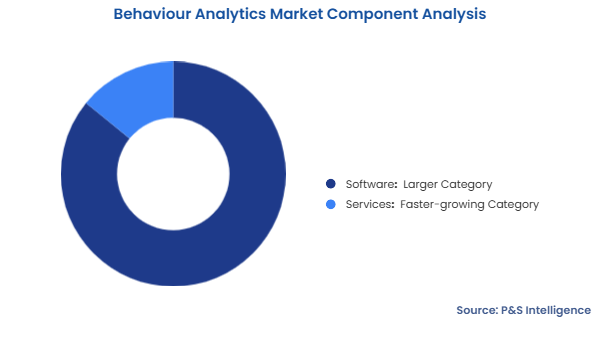
Software is the larger category, holding a market share of 85.5%, due to its central role in behavioural monitoring, anomaly detection, risk assessment, and security investigations.
On-Premises is the faster-growing category, registering a CAGR of 30.5%, driven by increasing requirements for data sovereignty, privacy compliance, and direct control over security infrastructure.
Large Enterprises are the larger category, holding a market share of 80.0%, due to complex IT environments, extensive cybersecurity investments, and greater exposure to identity-related threats.
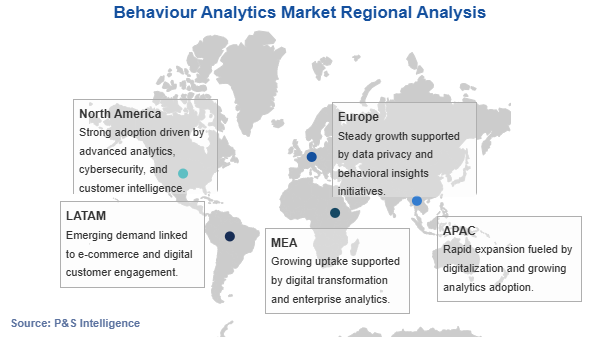
North America holds the largest share of 40.5%, due to widespread deployment of advanced security operations, identity protection, and threat intelligence solutions.
Asia-Pacific is the fastest-growing region, registering a CAGR of 32.5%, driven by large-scale digital transformation and rising demand for proactive threat detection across expanding digital ecosystems.
Behaviour Analytics Market Trends and Drivers
AI-Based Behavioural Detection for Human and Non-Human Identities Is a Major Trend
Behaviour analytics is evolving from user-focused monitoring towards broader behavioural detection across users, devices, service accounts, applications, and AI agents. Organisations increasingly require visibility across every identity interacting with enterprise systems, particularly as digital environments become more distributed and automated. Vendors are responding by introducing machine learning models that establish dynamic behavioural baselines, correlate activity across sessions, and prioritise risks using contextual signals rather than static rules. According to the International Telecommunication Union, mobile broadband reached 99 subscriptions per 100 inhabitants globally in 2025 and accounted for 89% of all mobile subscriptions. The growing number of connected users and devices is expanding the volume of behavioural data that security teams must analyse.
The trend is also being shaped by the emergence of non-human identities. According to Rubrik Zero Labs, 89% of organisations had fully or partly integrated AI agents into their identity infrastructure in 2025. Security teams are therefore extending behavioural monitoring beyond employees and customers to include autonomous and semi-autonomous agents that access systems, data, and applications. This is increasing demand for behavioural intelligence capabilities that can evaluate risk across both human and machine-driven activity within modern security operations environments.
Rising Insider Threats and Credential Misuse Drive Market
The market is growing because organisations need to identify threats that increasingly resemble legitimate user activity. Attackers frequently rely on stolen credentials, trusted accounts, remote access tools, and approved business applications instead of deploying easily detectable malware. Traditional rule-based monitoring often struggles to recognise these activities because they appear consistent with normal system usage. Behaviour analytics addresses this challenge by comparing current actions against established behavioural patterns and highlighting unusual activity linked to users, devices, and identities.
According to Microsoft, identity-based attacks increased by 32% during 2025, while more than 97% of identity attacks involved passwords. The growing use of identity-focused attack methods is increasing demand for behavioural detection that can identify abnormal access patterns before compromise escalates. According to IBM X-Force, valid account credentials were involved in 30% of incident response engagements in 2024. This highlights how frequently attackers gain access through trusted identities rather than exploiting technical vulnerabilities, encouraging organisations to strengthen behavioural monitoring across cloud environments, hybrid workforces, and identity-driven access frameworks.
Data Integration and Alert Accuracy Challenges Restrain Market Growth
A major restraint for the behaviour analytics market is the difficulty of integrating and analysing behavioural data across fragmented and complex IT environments. Behaviour analytics platforms depend on continuous inputs from identity systems, endpoints, cloud environments, applications, and network infrastructure to establish accurate behavioural baselines and identify anomalies. However, organisations often operate multiple security tools with different data formats, architectures, and monitoring capabilities, making it challenging to consolidate information and generate consistent behavioural insights. Incomplete data visibility, inconsistent activity records, and limited interoperability can reduce detection accuracy, increase false positives, and require additional time and resources for data integration and model optimisation.
Privacy and data governance requirements further increase the complexity of deploying behaviour analytics solutions. These platforms process detailed information about user activities, access patterns, devices, and interactions, requiring organisations to establish appropriate controls over how behavioural data is collected, stored, analysed, and shared. According to the United Nations Conference on Trade and Development, 79% of countries had data protection and privacy legislation in place in 2024. The continued expansion of privacy regulations increases compliance and governance requirements for organisations using behavioural monitoring technologies.
Expansion of Identity-Centric Security Platforms Creates Opportunity
A significant opportunity for the behaviour analytics market is the growing adoption of identity-centric cybersecurity strategies. Organisations are implementing zero trust frameworks, cloud-native access models, and continuous authentication approaches that require greater visibility into user and entity behaviour after access is granted. This is increasing demand for behavioural intelligence that supports adaptive access controls, identity protection, and risk-based decision-making. According to the World Economic Forum, 42% of organisations experienced a successful social-engineering attack during 2025. The prevalence of identity-focused attacks is encouraging organisations to strengthen monitoring around user activity and access behaviour.
Vendors are expanding opportunities by integrating behavioural analytics with identity governance, privileged access management, cloud security, and security operations platforms. Managed security services and cloud-delivered security offerings are also making advanced behavioural capabilities accessible to organisations that previously lacked dedicated security resources. This broader accessibility is helping organisations apply behavioural intelligence across a wider range of security functions, creating stronger demand for integrated and context-driven threat visibility.
Behaviour Analytics Market Segmentation Analysis
Component Analysis
Software is the larger category, holding a market share of 85.5%, because it serves as the core layer for behavioural monitoring, anomaly detection, risk scoring, and security investigations across enterprise environments. Organisations prioritise software platforms to gain continuous visibility into user activity, identities, and access patterns across cloud, hybrid, and on-premises infrastructure. According to Splunk, 59% of security professionals reported that adopting a unified platform accelerated incident response in 2025. This highlights the growing preference for software solutions that centralise behavioural analytics, investigation workflows, and threat detection capabilities, helping security teams respond more efficiently while managing increasing volumes of security data.
Services are the faster-growing category, registering a CAGR of 30.7%, as organisations increasingly require specialised expertise to deploy, integrate, optimise, and manage behaviour analytics platforms. Many enterprises lack in-house resources to handle complex security configurations, behavioural model tuning, and continuous monitoring requirements. Service providers help improve operational efficiency, accelerate implementation, and support evolving cybersecurity strategies. Growing adoption among mid-sized organisations and rising demand for managed security offerings are further contributing to the expansion of behaviour analytics-related services.
The components analysed in this report are:
Software (Larger Category)
Services (Faster-growing Category)
Deployment Mode Analysis
Cloud is the larger category, holding a market share of 80.5%, because organisations are increasingly adopting cloud-based behaviour analytics solutions to support scalability, centralised visibility, flexible deployment, and continuous monitoring across distributed IT environments. Cloud deployment enables security teams to analyse behavioural data from users, applications, devices, and other digital entities across multiple locations without requiring extensive on-premises infrastructure.
On-Premises is the faster-growing category, registering a CAGR of 30.5%, as organisations in highly regulated and security-sensitive sectors increasingly seek greater control over data, infrastructure, and security operations. Financial institutions, healthcare organisations, government entities, and other enterprises handling sensitive information may prefer locally controlled deployments to meet internal governance, data management, and security requirements. According to the Organisation for Economic Co-operation and Development, 124 measures affecting cross-border flows of non-personal data were identified in 2025, with 39% prohibiting such flows.
The deployment modes analysed in this report are:
Cloud (Larger Category)
On-Premises (Faster-growing Category)
Organisation Size Analysis
Large Enterprises are the larger category, holding a market share of 80.0%, due to extensive cybersecurity investments, complex digital environments, and higher exposure to identity-related threats, fraud, and insider risks. These organisations manage large volumes of users, applications, devices, and business data, creating strong demand for advanced behavioural monitoring capabilities. According to the World Economic Forum, only 7% of large organisations considered themselves underprepared for cyber risks in 2025, compared with 35% of small organisations. This stronger cyber maturity reflects greater investment in advanced security technologies, dedicated security teams, and enterprise-wide monitoring programmes, supporting wider adoption of behaviour analytics platforms.
Small & Medium Enterprises are the faster-growing category, registering a CAGR of 30.2%, as affordable cloud-based security solutions and managed services are making advanced behaviour analytics more accessible. Smaller organisations are becoming increasingly aware of identity-related threats, account compromise risks, and fraud incidents that can disrupt operations. As cybersecurity requirements expand and digital transformation accelerates, many businesses are adopting behaviour analytics to strengthen security visibility without maintaining large internal security teams, driving faster growth across the segment.
The organisation sizes analysed in this report are:
Large Enterprises (Larger Category)
Small & Medium Enterprises (Faster-growing Category)
Application Analysis
Fraud detection is the largest category, holding a market share of 35.5%, as behaviour analytics is increasingly used to identify unusual transaction patterns, account activity, payment behaviour, and other deviations that may indicate fraudulent activity. Financial institutions, e-commerce platforms, and digital service providers use behavioural intelligence to distinguish legitimate user activity from suspicious behaviour and identify potential fraud in real time.
Cybersecurity and threat intelligence is the fastest-growing category, registering a CAGR of 32.0%, as organisations increasingly use behavioural analytics to detect anomalous activity, compromised accounts, insider threats, lateral movement, and other emerging security risks. Behaviour analytics enables security teams to establish behavioural baselines for users, devices, applications, and other entities and identify deviations that may indicate potential threats. Modern User and Entity Behavior Analytics (UEBA) solutions use machine learning to analyse behavioural patterns and support the detection and investigation of suspicious activities across enterprise environments.
The applications analysed in this report are:
Fraud Detection (Largest Category)
Cybersecurity and Threat Intelligence (Fastest-growing Category)
Banking, Financial Services and Insurance is the largest category, holding a market share of 30.0%, due to the sector’s extensive use of digital banking, online payments, and financial applications, which generate large volumes of customer, transaction, and access data. Financial institutions use behaviour analytics to identify unusual account activity, suspicious transactions, credential misuse, fraud attempts, and other deviations from established behavioural patterns.
Healthcare is the fastest-growing category, registering a CAGR of 31.3%, as healthcare organisations accelerate digital transformation and increasingly rely on electronic health records, connected medical systems, digital patient services, and cloud-based applications. These environments generate large volumes of sensitive user and patient activity data, increasing the need to identify abnormal access patterns, unauthorised activity, insider risks, and potential security incidents.
The end users analysed in this report are:
Banking, financial services and insurance (Largest Category)
Healthcare (Fastest-growing Category)
IT & Telecom
Manufacturing
Retail & E-Commerce
Government & Defense
Education
Others
Drive strategic growth with comprehensive market analysis
Behaviour Analytics Market Regional Analysis
North America Behaviour Analytics Market Analysis
North America holds the largest share, of 40.5%, supported by the region’s mature digital infrastructure, high adoption of advanced analytics technologies, and strong focus on cybersecurity, fraud prevention, identity protection, and customer intelligence. Organisations across the region increasingly use behaviour analytics to analyse user, customer, employee, device, and transaction activity and identify unusual patterns across digital environments. According to the Cybersecurity and Infrastructure Security Agency, the United States has an estimated 294 million smartphone users, highlighting the extensive scale of connected users and digital activity across the country. The growing number of connected devices and digitally active users is generating large volumes of behavioural data that organisations can analyse to identify anomalies, assess risks, and improve security and fraud detection capabilities. The presence of large enterprises, financial institutions, technology companies, and highly digitised businesses further supports demand for behaviour analytics solutions.
U.S. Behaviour Analytics Market Analysis
The U.S. market benefits from a mature cybersecurity ecosystem and widespread adoption of advanced security operations technologies. Financial institutions, healthcare organisations, technology companies, and government agencies increasingly deploy behaviour analytics to strengthen identity protection and detect sophisticated threats. According to the Federal Bureau of Investigation Internet Crime Complaint Centre, 859,532 suspected internet crime complaints were recorded in 2024. The scale of reported cybercrime highlights the need for continuous monitoring of user activity, access behaviour, and account usage. Organisations are therefore investing in behavioural analytics platforms that provide earlier detection of credential abuse, insider threats, and suspicious activity across large and complex digital environments.
Canada Behaviour Analytics Market Analysis
Canada is experiencing growing adoption of behaviour analytics as organisations strengthen digital security, fraud prevention, and risk management capabilities across increasingly connected business environments. Financial institutions, public-sector organisations, healthcare providers, and critical infrastructure operators are increasing their focus on identifying unusual user activity, suspicious access patterns, and emerging security risks. According to the Canadian Centre for Cyber Security, ransomware incidents affecting Canadian organisations increased by an average of 26% year-over-year between 2021 and 2024. The continued rise in cyber threats is encouraging organisations to strengthen continuous monitoring and behavioural detection capabilities to identify abnormal activity and reduce the potential impact of security incidents.
Asia-Pacific Behaviour Analytics Market Analysis
Asia-Pacific has the highest CAGR, of 32.5%, driven by rapid digital transformation, expanding cloud adoption, increasing use of connected devices, and growing demand for fraud prevention, cybersecurity, and data-driven risk management solutions. According to the International Telecommunication Union, Asia and the Pacific recorded 101 active mobile-broadband subscriptions per 100 people in 2025, while 5G networks covered 70.4% of the region’s population. The high level of mobile connectivity is expanding the volume of digital interactions, user activity, and connected-device data generated across the region, increasing the need for behavioural analytics to identify abnormal patterns, assess risks, and improve security and fraud detection. The region is also experiencing increasing adoption of artificial intelligence, cloud computing, digital financial services, and e-commerce, creating additional opportunities for behaviour analytics across financial, technology, retail, healthcare, and other industries.
China Behaviour Analytics Market Analysis
China's market is supported by large-scale digital transformation across enterprise, industrial, financial, and public-sector environments. Organisations are placing greater emphasis on proactive threat detection as digital services, cloud adoption, and business applications continue to expand. According to the State Council of the People's Republic of China, the country had 1.1 billion internet users in 2024. This extensive digital ecosystem creates a large volume of user interactions, access events, and online activity that require effective security monitoring. Behaviour analytics platforms are increasingly being adopted to improve visibility into user behaviour, identify suspicious activity patterns, and strengthen protection across interconnected digital environments.
India Behaviour Analytics Market Analysis
India market is driven by rapid digital transformation, increasing cybersecurity requirements, and growing adoption of advanced security and analytics technologies. According to IBM, the average cost of a data breach in India reached INR 220 million in 2025, increasing 13% from INR 195 million in 2024. The rising financial impact of security incidents is encouraging organisations to strengthen continuous monitoring, anomaly detection, and risk assessment capabilities to identify suspicious behaviour before incidents escalate. Financial institutions, technology companies, e-commerce platforms, and large enterprises are increasingly adopting cloud-based applications and digital services, creating greater demand for monitoring user, identity, device, and transaction behaviour. The growing adoption of artificial intelligence and machine learning is also enabling organisations to improve behavioural modelling and automate the identification of unusual activity.
Europe Behaviour Analytics Market Analysis
Europe represents a significant behaviour analytics market, supported by widespread digital adoption, strong data-protection requirements, and increasing demand for fraud prevention, cybersecurity, identity management, and data-driven risk management. Organisations across the region are increasingly using behaviour analytics to monitor user, customer, employee, device, and transaction activity and identify unusual patterns across digital environments. According to Eurostat, 93% of EU enterprises used at least one information and communication technology security measure in 2024, highlighting the widespread adoption of cybersecurity practices across European businesses. This strong focus on digital security is supporting demand for advanced technologies that can identify anomalous behaviour and strengthen risk detection.
The regions and countries analysed in this report are:
North America (Largest Regional Market)
U.S. (Larger Country)
Canada (Faster-Growing Country)
Europe
Germany (Fastest-Growing Country)
U.K. (Largest Country)
France
Italy
Spain
Rest of Europe
Asia-Pacific (Fastest-Growing Regional Market)
China (Largest Country)
India (Fastest-Growing Country)
Japan
South Korea
Australia
Rest of APAC
Latin America
Brazil (Largest Country)
Mexico (Fastest-Growing Country)
Rest of LATAM
Middle East and Africa
Saudi Arabia (Largest Country)
U.A.E. (Fastest-Growing Country)
South Africa
Rest of MEA
Behaviour Analytics Market Competitive Landscape
The market is fragmented, with competition distributed across cybersecurity platform providers, identity security vendors, security analytics specialists, fraud detection companies, and dedicated behaviour analytics providers. Organisations select solutions based on specific requirements such as insider threat detection, identity protection, fraud prevention, security operations, and cloud security monitoring, creating room for a broad range of vendors to compete. The market continues to attract innovation as companies develop advanced behavioural modelling, risk scoring, anomaly detection, and machine learning capabilities to differentiate their offerings. Vendor competition is further intensified by growing demand for integrated security ecosystems that combine behaviour analytics with identity management, threat detection, and security orchestration tools.
Leading Companies in the Behaviour Analytics Market:
Cisco Systems, Inc.
IBM Corporation
Microsoft Corporation
Varonis Systems, Inc.
Google LLC
NTT DATA Group Corporation
SAP SE
Exabeam, Inc.
Oracle Corporation
Securonix, Inc.
Rapid7, Inc.
Gurucul Solutions, LLC
DTEX Systems, Inc.
Cynet Security Ltd.
Behaviour Analytics Market Developments
In May 2026, Securonix, Inc. launched the Securonix Threat Research Agent and ThreatWatch for ThreatQ, enabling organisations to connect threat intelligence with security operations workflows. The solution allows security teams to research emerging threats, validate exposure against historical telemetry, and generate documented findings for analysts and security leaders, strengthening threat investigation and response capabilities.
In January 2026, Exabeam, Inc. expanded its New-Scale platform with Agent Behaviour Analytics (ABA), introducing advanced behavioural detections for AI-driven activity and extending visibility into non-human identities across enterprise environments. The update enabled security teams to monitor AI agent behaviour, support investigation workflows, and strengthen threat detection by adding behaviour-based context to security operations.
In April 2025, Gurucul announced a Self-Driving SIEM powered by agentic AI and generative AI, introducing multi-agent workflows for threat detection, investigation, threat hunting, and response within its REVEAL platform. The development strengthened its AI-driven security analytics capabilities by automating detection and response while leveraging user behaviour and contextual security intelligence.
In September 2024, Oracle announced plans to deliver Oracle Intelligent Data Lake as a foundational component of the Oracle Data Intelligence Platform, enabling organisations to unify data from diverse sources and integrate data warehousing, analytics, and AI within a governed and secure environment.
Frequently Asked Questions About This Report
What does the behavior analytics market include for organizations?+
It includes analytics that study user, device, customer, or entity behavior to detect patterns, risks, intent, and anomalies.
What factors are driving demand in the behavior analytics market?+
Growth is driven by fraud risk, insider threats, customer personalization, digital activity data, and need for anomaly detection.
Why are organizations adopting behavior analytics solutions across operations?+
Organizations adopt behavior analytics to identify unusual actions, understand journeys, reduce risk, and deliver more relevant experiences.
How do behavior analytics solutions improve decision making and efficiency?+
These tools improve decisions by comparing current behavior with normal patterns and flagging changes that need action.
What challenges affect adoption of behavior analytics solutions today?+
Adoption is affected by privacy expectations, data quality, false positives, model tuning, cross system visibility, and ethical use concerns.
Want a report tailored exactly to your business need?
Leading companies across industries trust us to deliver data-driven insights and innovative solutions for their most critical decisions. From data-driven strategies to actionable insights, we empower the decision-makers who shape industries and define the future. From Fortune 500 companies to innovative startups, we are proud to partner with organisations that drive progress in their industries.
Client Testimonials
Working with P&S Intelligence and their team was an absolute pleasure – their awareness of timelines and commitment to value greatly contributed to our project's success. Eagerly anticipating future collaborations.
McKinsey & Company
India
Unmatched Standards
Our insights into the minutest levels of the markets, including the latest trends and competitive landscape, give you all the answers you need to take your business to new heights
Complete Data Security
We take a cautious approach to protecting your personal and confidential information. Trust is the strongest bond that connects us and our clients, and trust we build by complying with all international and domestic data protection and privacy laws