This Report Provides In-Depth Analysis of the Automatic Content Recognition Market Report Prepared by P&S Intelligence, Segmented by Component (Solutions, Services), Technology (Audio and Video Fingerprinting, Audio and Video Watermarking, Optical Character Recognition, Speech Recognition), Platform (Linear TV, Conncted TV, OTT), Deployment Mode (Cloud, On-Premises), Organization Type (Small & Medium Enterprises, Large Enterprises), Application (Advertisement Targeting & Pricing, Audience Segmentation & Measurement, Broadcast Monitoring, Content Filtering), End User (Automotive, BFSI, Consumer Electronics, Education, Government & Defense, Healthcare, IT & Telecommunications, Media & Entertainment, Retail & E-Commerce), and Geographical Outlook for the Period of 2019 to 2032
Explore the market potential with our data-driven report
Automatic Content Recognition Market Overview
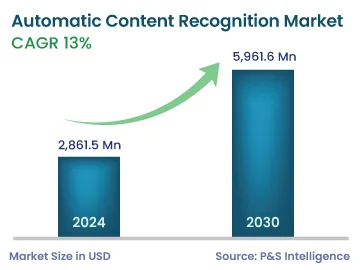
The automatic content recognition market size will be an estimated USD 3.2 billion for 2025, and it will grow by 13.0% during 2026–2032, to reach USD 7.5 billion by 2032.
The market growth is primarily driven by the increasing demand for enhanced viewer analytics, the proliferation of smart devices with integrated ACR capabilities, and the rising need for effective content monetization strategies across digital platforms. This technology helps users achieve the seamless synchronization of data from multiple devices, by sharing information on the content being played. This further helps content creators and advertisers analyze viewers' engagement and deliver the relevant content, which ultimately improves viewers' experiences.
Moreover, the increasing demand for personalized and targeted advertising techniques due to the rise in the consumption of digital media further creates a demand for ACR solutions. This technology helps advertisers know their target customers better and optimize their advertising campaigns, which further boosts customer engagement and increases conversion rates. In addition, this technology generates enormous amounts of important analytical data related to users' consumption patterns, viewing behaviors, and demography, which further helps broadcasters and content providers make data-driven decisions on their advertising strategies.
Automatic Content Recognition Market Dynamics
Rising Adoption of Connected TV and OTT Platforms Is Key Trend
The exponential growth of connected TV and over-the-top (OTT) streaming services is a key trend in the market.
The proliferation of streaming platforms has fragmented the viewing landscape, making ACR technology essential for understanding cross-platform content consumption and enabling unified measurement across the entire media ecosystem.
The shift towards streaming has also driven innovation in ACR applications, particularly in content discovery, automatic content recognition for live sports and events, and interactive advertising experiences.
Major streaming platforms are leveraging ACR to enable features like automatic highlight generation, real-time sports statistics overlay, and shoppable video content.
The technology also facilitates compliance with content licensing agreements by tracking content usage across different territories and platforms, ensuring proper royalty distribution and preventing unauthorized content distribution.
The integration of this technology into the content streaming applications running on smart TVs, smartphones, laptops, and PCs, including YouTube, Disney+, Amazon Prime Video, Netflix, Hulu, and Peacock, is helping users engage more easily.
These solutions identify and recognize stuff people have watched or heard earlier and then, recommend similar content.
The increasing use of AI and ML algorithms in ACR-enabled platforms is allowing streaming services to provide personalized content recommendations, predictive suggestions, and adaptive advertising.
All this ultimately enhances content discovery and boosts viewer engagement and retention.
Real-time analytics enabled by ACR is becoming critical for advertisers to measure ad exposure, engagement, and effectiveness across multiple platforms, improving ROI and programmatic advertising strategies.
The expansion of ACR technology to mobile devices, tablets, and multi-screen ecosystems is reflecting a shift toward multi-device content consumption, ensuring seamless recognition and analytics across devices.
The global adoption of OTT platforms is accelerating in Europe, Asia-Pacific, and Latin America, which is driving ACR deployment beyond traditional markets, such as the U.S.
Government Initiatives for Digital Infrastructure ModernizationAre Biggest Drivers
Government-led digital transformation initiatives and infrastructure investments represent a fundamental driver accelerating automatic content recognition market growth across multiple sectors.
National governments are actively modernizing their broadcasting infrastructure, implementing digital switchovers, and establishing standards for next-generation television services that incorporate ACR capabilities as core components.
The Federal Communications Commission's ATSC 3.0 deployment initiative in the United States, which enables advanced features including targeted advertising and enhanced emergency alerting through ACR technology, has catalyzed significant industry investment.
The strategic government investments in smart city infrastructure are creating new applications for ACR technology beyond traditional media contexts.
These initiatives are driving ACR adoption in government agencies for applications such as automated content archiving, real-time translation services for public broadcasts, and accessibility features for citizens with disabilities.
Defense and intelligence agencies worldwide are increasingly adopting ACR technology for security applications, including broadcast monitoring, open-source intelligence gathering, and content verification.
The government-driven demand is spurring innovation in specialized ACR solutions capable of operating in secure environments while processing content in multiple languages and formats.
Educational institutions, supported by government digitalization grants, are emerging as significant ACR adopters for applications ranging from automated lecture transcription to content-based learning analytics.
In August 2025, the Government of Brazil officially adopted DTV+, a next-generation digital TV format based on ATSC 3.0.
The experimental DTV+ broadcasts start in Rio and São Paulo, with full rollout before the 2026 FIFA World Cup.
This move highlights how government-led broadcasting modernization is creating fertile ground for ACR-enabled services, such as targeted advertising, content measurement, and interactive applications.
India’s ongoing Smart Cities Mission, where over 90% of projects are near completion, is deploying advanced integrated command and control centers with AI, analytics, and digital infrastructure.
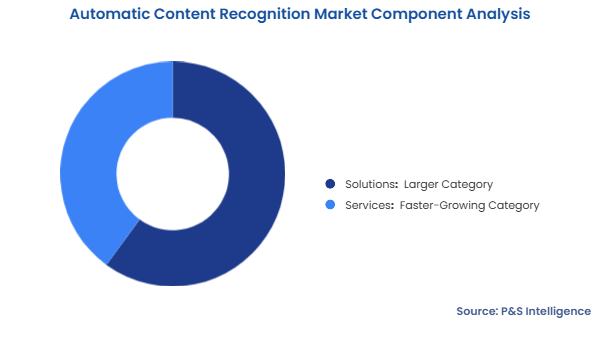
The solutions category holds the larger market share, of 60%, in 2025, because of the rising adoption of internet-connected video and audio streaming platforms. ACR solutions gather and analyze data from smartphones, computers, laptops, and smart TVs, which capture audio, video, text, and image content. The associated software uses applications based on AI algorithms and ML models to extract meaningful information, by analyzing the insightful data, and store it in secure repositories. The advancements in Al & ML have led to improvements in the accuracy and efficiency of ACR systems, allowing them to understand and recognize the content better.
The services category will have the higher CAGR, of 13.3%, because of the rising need for experts to obtain managed and professional services. As they possess the expertise to provide valuable insights by analyzing data on consumer and industry trends, businesses are able to make data-driven decisions to improve content offerings, find target customers, and improve user experiences, by tracking and monitoring content.
The rapid evolution of content formats, streaming protocols, and device ecosystems necessitates continuous professional services support for system configuration, customization, and performance tuning. Additionally, managed services are gaining traction as organizations seek to outsource the operational aspects of ACR systems, including monitoring, maintenance, and regular updates to recognition algorithms and content databases.
The components analyzed in this report are:
Solutions (Larger Category)
Services (Faster-Growing Category)
Technology Analysis
The speech recognition category holds the largest market share in 2025, and it will have the highest CAGR during the forecast period, driven by the rising adoption of smart devices around the world to simplify tasks, get easier access to content, and remotely control a range of home appliances. The speech recognition technology enables automatic content recognition systems to categorize content, improve user experiences, personalize recommendations, and offer multilingual support and real-time processing capabilities. These solutions also automate the devices, by integrating voice-activated functionalities into them.
The technologies analyzed in this report are:
Audio and Video Fingerprinting
Audio and Video Watermarking
Optical Character Recognition
Speech Recognition (Largest and Fastest-Growing Category)
Others
Platform Analysis
The linear TV category holds the largest market share in 2025, reflecting the continued importance of traditional broadcast television in many markets and the substantial investments made by broadcasters in ACR infrastructure. Despite the growth of streaming services, linear TV remains a significant platform for live events, news, and premium content, necessitating advanced ACR solutions for audience measurement, ad verification, and content protection.
The OTT category will have the highest CAGR, of 13.1%, driven by the explosive growth in streaming subscriptions and the launch of numerous direct-to-consumer services. The Federal Communications Commission (FCC) reports that the number of OTT video subscriptions in the U.S. surpassed that of traditional pay TV subscriptions for the first time in 2023. This shift is compelling content providers and advertisers to invest heavily in ACR technologies that can track and analyze viewing behavior across fragmented OTT ecosystems.
The platforms analyzed in this report are:
Linear TV (Larger Category)
Connected TV
OTT (Faster-Growing Category)
Deployment Mode Analysis
The cloud category holds the largest market share, of 65%, in 2025, and it will have the higher CAGR, of 13.5%, as it offers scalability, which allows automatic content recognition solutions to handle large amounts of data. Further, it provides flexibility, which improves remote access and collaboration. Cloud-based content recognition solutions are also cost-effective, as this mode overcomes the need for expensive IT infrastructure. The powerful processing capabilities of cloud-based ACR software offer improved accuracy and speed of automatic content recognition.
In addition, the collaboration of different cloud-based service providers, such as AWS, Azure, and Google Cloud, with ACR solution developers improves the performance of these solutions across different industries, including media & entertainment, BFSI, consumer electronics, retail & e-commerce, education, automotive, IT & telecommunications, healthcare, government & defense, and aerospace & aviation.
The deployment modes analyzed in this report are:
Cloud (Larger and Faster-Growing Category)
On-Premises
Organization Type Analysis
The large enterprises category holds the larger market share, of 75%, in 2025, driven by the rising investments in advanced technologies to reduce human error, such as automatic content recognition solutions & services, by large enterprises. They are also increasingly applying ACR with advanced algorithms for research to identify opportunities to boost revenue.
Additionally, these enterprises have large facilities and resources, and, further, they invest in testing and validation practices for their ACR solutions. They can also afford to have multiple high-value partnerships and collaborations with content providers, broadcasters, and streaming platforms to integrate ACR capabilities into their offerings. For instance, in May 2023, Samsung announced that it is going to make two significant investments in its data analysis capabilities, to track the number of people that view streaming advertisements on its TV Plus, which supports free ads. The other investment is in a research study that would allow advertisers to place their promotions on both linear and streaming platforms.
The small & medium enterprises category will have the higher CAGR, of 13.6%, due to the burgeoning broadcasting and advertisement industry. As the global demand for consumer electronics, media & entertainment, education, and retail & e-commerce services rises rapidly, SMEs are making concrete efforts to improve their IT infrastructure. Their specialized solutions and services cater to the specific needs of their targeted customers, which makes them accessible to a wide range of organizations, such as education, consumer electronics, and retail & e-commerce.
The organization types analyzed in this report are:
Small & Medium Enterprises (Faster-Growing Category)
Large Enterprises (Larger Category)
Application Analysis
The audience segmentation & measurement category holds the largest market share, of 35%, in 2025, because this application has become essential for several businesses for knowing their customers, since it offers targeted advertising, content optimization, performance monitoring, monetization choices, and improved user experiences. Further, the demand for ACR solutions has been increasing as a result of their ability to help platforms, advertisers, and content creators take data-driven decisions on improving their content delivery techniques.
The advertisement targeting & pricing category will have the highest CAGR during the forecast period, as advertisers increasingly demand precise targeting capabilities and verifiable ad exposure metrics. ACR technology enables dynamic ad insertion, contextual advertising, and cross-platform campaign measurement, providing advertisers with unprecedented control over their media investments. By applying ACR technologies for targeted advertisements and pricing, companies can improve their audience segmentation by analyzing viewer experiences based on their preferences and behaviors. This ultimately allows them to reach the right audience with personalized ads or offer the best pricing deal.
The media & entertainment category holds the largest market share, of 40%, in 2025, reflecting the sector's fundamental reliance on content identification, tracking, and monetization. Broadcasters, streaming services, content studios, and digital platforms utilize ACR technology across the entire content lifecycle, from production and distribution to consumption analytics and rights management. The industry's need for cross-platform audience measurement, dynamic ad insertion, and content recommendation systems drives continuous investment in advanced ACR capabilities.
The consumer electronics category will have the highest CAGR, of 13.4%, due to the growing usage of smart devices, such as smartphones, smart TVs, and wearables, as well as the rising popularity of streaming services. By offering tailored suggestions and enabling smooth content synchronization across platforms, the ACR technology improves the user experience. In addition, it makes interactive features possible, such as the ability to get real-time data on the content being viewed. Moreover, it enables targeted advertising and gathers insightful user preference data, thus helping marketers and content producers customize their offerings.
The end users analyzed in this report are:
Automotive
BFSI
Consumer Electronics (Fastest-Growing Category)
Education
Government & Defense
Healthcare
IT & Telecommunications
Media & Entertainment (Largest Category)
Retail & E-Commerce
Others
Drive strategic growth with comprehensive market analysis
Automatic Content Recognition Market Regional Outlook
North America Automatic Content Recognition Market Size
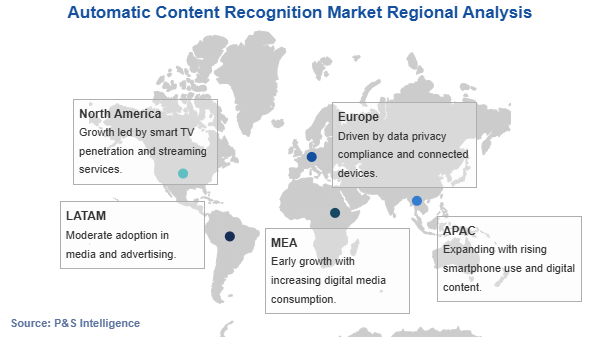
North America holds the largest market share, of 35%, in 2025. This is primarily attributed to the growing adoption of automatic content recognition solutions & services by several industries in the region, with the increasing investments in advanced technologies, such as AI/ML, IoT, and big data analytics. In addition, the presence of a highly developed media & entertainment industry, content creators, leading streaming platforms, broadcasters, and global players fuels the market's growth. Further, smart gadgets have witnessed high sales in the region of late, which ultimately drives the market by allowing companies to use ACR solutions to gather data on content consumption for analysis.
U.S. Automatic Content Recognition Market Size
The U.S. dominates the North American ACR market, driven by the presence of global players, such as Google and Apple, who are utilizing big data to cater to the market and go beyond the competition. Further, the U.S. FTC's regulations support innovations in the ACR domain. The country's advanced advertising technology sector, centered in hubs like New York and Silicon Valley, continues to drive innovation in ACR applications, particularly in programmatic advertising and cross-platform measurement solutions.
Furthermore, regulatory developments in the region are shaping ACR adoption patterns. The California Consumer Privacy Act (CCPA) and similar state-level privacy regulations have prompted ACR technology providers to develop more transparent and privacy-compliant solutions. This has led to innovations in privacy-preserving ACR techniques, such as on-device processing and differential privacy methods, which are gaining traction among privacy-conscious consumers while still enabling valuable audience insights for content providers and advertisers.
Asia-Pacific will have the highest CAGR, of 13.2%, due to the growing adoption of process automation in various sectors, such as media & entertainment, BFSI, consumer electronics, retail & e-commerce, education, automotive, IT & telecommunication, and government & defense. In addition, India, Japan, South Korea, and China have a huge potential to propel the market due to the presence of global consumer electronics players, such as Samsung and LG, who have already adopted TV advertising strategies to boost their revenue.
China Automatic Content Recognition Market Size
China represents the largest market within Asia-Pacific, with its massive digital ecosystem and advanced technology infrastructure. In December 2023, China had 1.067 billion online video users. This enormous user base, combined with the country's emphasis on content regulation and intellectual property protection, drives significant demand for ACR solutions capable of monitoring and managing content across numerous platforms and formats.
India Automatic Content Recognition Market Size
India is emerging as a high-growth market for ACR technology, fueled by the rapid adoption of connected TVs and the proliferation of regional language content. The country's linguistic diversity, with content produced in over 20 languages, presents both challenges and opportunities for ACR providers to develop multilingual recognition capabilities and cater to diverse audience segments.
Europe Automatic Content Recognition Market Size
Europe has a significant market for automatic content recognition technology, driven by stringent data protection regulations, advanced broadcasting infrastructure, and the region's focus on preserving cultural content diversity. The implementation of the General Data Protection Regulation has significantly influenced how ACR technology is deployed, leading to innovations in privacy-preserving content recognition methods that comply with strict data protection requirements while still delivering valuable insights.
Germany leads the European market, benefiting from its strong technology sector and advanced media landscape. The country's emphasis on engineering excellence and data privacy has positioned it as a hub for developing next-generation ACR solutions that balance functionality with privacy protection, setting standards for ACR deployment across the European Union.
The geographical breakdown of the market is as follows:
North America (Largest Regional Market)
U.S. (Larger and Faster-Growing Country)
Canada
Europe
Germany (Largest Country)
U.K. (Fastest-Growing Country)
France
Italy
Spain
Rest of Europe
Asia-Pacific (Fastest-Growing Regional Market
China (Largest Country)
India (Fastest-Growing Country)
Japan
South Korea
Australia
Rest of APAC
Latin America
Brazil (Largest Country)
Mexico (Fastest-Growing Country)
Rest of LATAM
Middle East and Africa
Saudi Arabia (Largest Country)
South Africa (Fastest-Growing Country)
U.A.E.
Rest of MEA
Automatic Content Recognition Market Share
The automatic content recognition market is currently fragmented, with a wide range of vendors offering specialized solutions across audio, video, and metadata recognition. No single player dominates the market, and adoption varies by industry and application. While some larger firms are expanding their offerings and signs of consolidation exist, the market remains competitive and diverse. Fragmentation is driven by varying technological approaches, niche use cases, and evolving integration demands from sectors like media, advertising, and consumer electronics.
Key Automatic Content Recognition Companies:
Apple Inc.
Beatgrid Media B.V.
Google Inc.
IBM Corporation
Kudelski S.A.
Microsoft Corporation
mufin GmbH
Nuance Communications Inc.
Samba TV Inc.
Samsung Electronics Co. Ltd.
Gracenote, Inc.
Audible Magic Corporation
Automatic Content Recognition Market News
In June 2025, Samba TV Inc. expanded its global partnership with Acxiom LLC to extend advanced audience activation capabilities powered by ACR data. The collaboration focused on combining Samba’s real-time viewership insights with Acxiom’s identity solutions, enabling advertisers to execute more effective and privacy-compliant campaigns across multiple international markets.
In April 2025, Vobile Group Co. Ltd. announced the acquisition of Pex, a digital rights technology company specializing in audio and video fingerprinting. Vobile enhanced its ACR-driven content protection and monitoring solutions, empowering media companies to better detect copyright infringements and optimize monetization strategies across digital platforms.
In October 2024, Samba TV Inc. announced the acquisition of Semasio GmbH, aimed at strengthening Samba TV’s automatic content recognition ecosystem by combining its proprietary TV viewership data with Semasio’s semantic targeting and identity capabilities.
Want a report tailored exactly to your business need?
Leading companies across industries trust us to deliver data-driven insights and innovative solutions for their most critical decisions. From data-driven strategies to actionable insights, we empower the decision-makers who shape industries and define the future. From Fortune 500 companies to innovative startups, we are proud to partner with organisations that drive progress in their industries.
Client Testimonials
Working with P&S Intelligence and their team was an absolute pleasure – their awareness of timelines and commitment to value greatly contributed to our project's success. Eagerly anticipating future collaborations.
McKinsey & Company
India
Unmatched Standards
Our insights into the minutest levels of the markets, including the latest trends and competitive landscape, give you all the answers you need to take your business to new heights
Complete Data Security
We take a cautious approach to protecting your personal and confidential information. Trust is the strongest bond that connects us and our clients, and trust we build by complying with all international and domestic data protection and privacy laws