Application Platform as a Service Market Size & Share Analysis - Emerging Trends, Growth Opportunities, Competitive Landscape, and Forecasts (2026 - 2032)
This Report Provides In-Depth Analysis of the Application Platform as a Service Market Report Prepared by P&S Intelligence, Segmented by Deployment Mode (Public Cloud, Private Cloud, Hybrid Cloud), Enterprise Size (Large Enterprises, Small and Medium-Sized Enterprises (SMEs)), Service (Implementation & Integration, Consulting, Maintenance), and Geographical Outlook for the Period of 2021 to 2032
Application Platform as a Service Market Size Estimation
Key Highlights
Study Period
2021 - 2032
Market Size in 2025
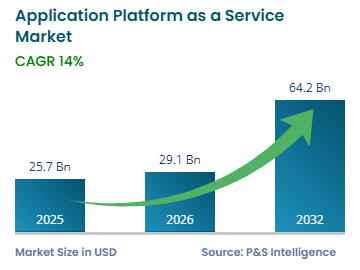
USD 25.7 Billion
Market Size in 2026
USD 29.1 Billion
Market Size by 2032
USD 64.2 Billion
Projected CAGR
14%
Largest Region
North America
Fastest-Growing Region
Asia-Pacific
Market Structure
Consolidated
Market Size
Explore the market potential with our data-driven report
Application Platform as a Service Market Analysis
The application platform as a service market size was USD 25.7 billion for 2025, and it will grow by 14.0% during 2026–2032, to reach USD 64.2 billion by 2032.
This growth is driven by accelerating enterprise adoption of cloud-native architectures, low-code and no-code application development frameworks, and AI-integrated application delivery pipelines across sectors ranging from banking and financial services to healthcare and manufacturing. Organizations worldwide are migrating away from monolithic legacy systems toward microservices-based environments, positioning aPaaS platforms as foundational infrastructure for digital transformation, DevOps enablement, and continuous application delivery.
Strengthening data protection and cybersecurity regulations is also contributing to market expansion. The European Union’s General Data Protection Regulation has imposed cumulative fines exceeding EUR 4 billion, encouraging enterprises to deploy governed cloud application environments with built-in compliance and data-residency controls.
Key Market Insights
The public category holds the largest market share, of 60%, in 2025, driven by the structural appeal of public cloud environments for application development and delivery.
The hybrid category will have the highest CAGR, of 14.2%, driven by the growing imperative to balance public cloud agility with private cloud governance.
The implementation and integration services category holds the largest market share, of 55%, in 2025, driven by the operational complexity inherent in deploying aPaaS platforms within existing enterprise IT environments.
The consulting category will have the highest CAGR, of 14.1%, driven by enterprise demand for strategic advisory services that guide aPaaS platform selection, architecture design, AI integration roadmaps, and change management programs.
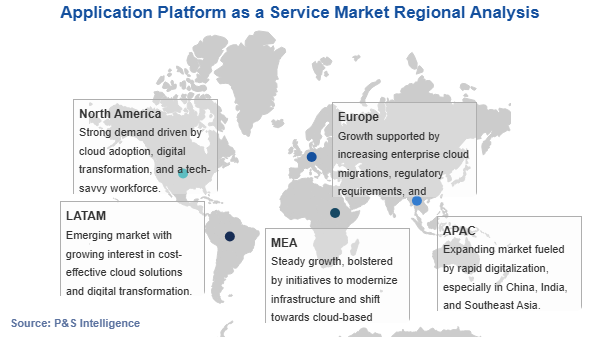
North America holds the largest share of the Application Platform as a Service (aPaaS) market, while Asia-Pacific is projected to be the fastest-growing region during the forecast period.
Application Platform as a Service Market Emerging Trends
Low-Code and No-Code Application Development Are Key Trends
The widespread adoption of low-code and no-code (LCNC) development frameworks is fundamentally reshaping how enterprises conceive, build, and deploy applications, directly expanding the addressable demand for aPaaS platforms. Low-code architectures eliminate a substantial share of manual programming requirements by providing visual development environments, pre-built connectors, and drag-and-drop workflow designers, enabling both professional developers and non-technical citizen developers to build production-grade applications significantly faster than conventional methods. Enterprises are deploying LCNC tools in an accelerating range of use cases, from internal process automation and customer-facing portals to compliance reporting and ERP extensions.
As organizations embed LCNC capabilities within broader aPaaS environments, leveraging integrated DevOps toolchains, CI/CD pipelines, and microservices orchestration, platforms evolve from standalone development tools into enterprise application lifecycle management systems. This shift structurally deepens customer dependency on aPaaS vendors and raises average contract values, reinforcing revenue growth across the forecast period.
In Latin America, governments are also advancing digital development initiatives that support cloud and platform adoption; for instance, Brazil’s Brazilian Digital Transformation Strategy (E‑Digital) promotes the expansion of digital infrastructure and digital innovation ecosystems across the country to accelerate enterprise digitalization. According to Eurostat, 57.5% of enterprises in the European Union that attempted to recruit ICT specialists reported difficulties filling those vacancies, highlighting persistent digital skills shortages across the region. The OECD confirms that talent shortages in the technology sector pose significant challenges for firms, workers, and governments, hindering productivity and innovation, a structural pressure compelling enterprises to adopt platform-based development approaches that reduce reliance on scarce specialist engineering talent.
Global Developer Talent Shortages and Rising IT Labor Costs Are Biggest Drivers
A persistent and deepening global deficit of qualified software developers is functioning as a structural demand driver for the aPaaS market, compelling organizations to platform-based application delivery as an operational necessity rather than a discretionary investment. Across OECD economies, technology sector vacancies continue to outpace supply; Germany currently has approximately 149,000 IT positions unfilled, the United States is projected to face a software developer shortage exceeding 1.2 million professionals by 2026, Japan is projected to face a shortage of approximately 790,000 IT professionals by 2030, and more than half of EU companies that attempted to recruit ICT talent in 2023 reported significant difficulties filling roles. These conditions translate directly into aPaaS adoption because platform-based environments enable organizations to deliver application projects with fewer specialized developers, compressing timelines, reducing dependency on external contracting, and enabling existing staff to contribute more meaningfully to complex build cycles. As global talent constraints show no signs of abating, aPaaS platforms are increasingly embedded as permanent infrastructure rather than transitional tools.
Underserved SME Application Development Is Biggest Opportunity
The global small and medium-sized enterprise segment represents a substantial and structurally underserved demand base for aPaaS platforms, with an expanding runway driven by falling platform costs, cloud-native delivery models, and the proliferation of usage-based pricing structures that remove traditional capital expenditure barriers. Historically, enterprise-grade application development infrastructure was economically inaccessible to organizations below a certain revenue or IT headcount threshold—requiring significant upfront investment in licensed software, implementation services, and ongoing engineering maintenance. aPaaS platforms delivered on consumption-based, subscription pricing models dissolve these barriers by enabling SMEs to access the same development environments, integration ecosystems, and DevOps toolchains previously reserved for large-enterprise deployments. The European Commission's Digital Decade Policy Programme mandates that at least 75% of EU enterprises adopt cloud computing, big data, or AI technologies by 2030, with specific provisions directing support toward SME digitization, creating a policy-activated demand signal that aPaaS vendors can target through compliant, cost-accessible platform offerings.
Application Platform as a Service Market Segmentation Analysis
Deployment Mode Analysis
The public category holds the largest market share, of 60%, in 2025, driven by the structural appeal of public cloud environments for application development and delivery. Public cloud eliminates upfront capital expenditure through consumption-based pricing, provides globally distributed hyperscaler infrastructure with built-in redundancy and low-latency access, and offers pre-integrated developer toolchains spanning CI/CD pipelines, Kubernetes-managed containerization, and serverless compute, enabling enterprises to accelerate delivery without managing underlying infrastructure. Enterprises operating across multiple geographies particularly favor public cloud aPaaS for its ability to deploy applications consistently across regions without managing disparate data center configurations.
The hybrid category will have the highest CAGR, of 14.2%, driven by the growing imperative to balance public cloud agility with private cloud governance. BFSI, healthcare, and government enterprises, collectively representing the aPaaS market's most regulated and highest-value buyer segments, are systematically adopting hybrid configurations that keep sensitive workloads within controlled environments while leveraging public cloud capacity for customer-facing and non-sensitive application layers.
The deployment modes analyzed in this report are:
Public Cloud (Largest Category)
Private Cloud
Hybrid Cloud (Fastest-Growing Category)
Enterprise Size Analysis
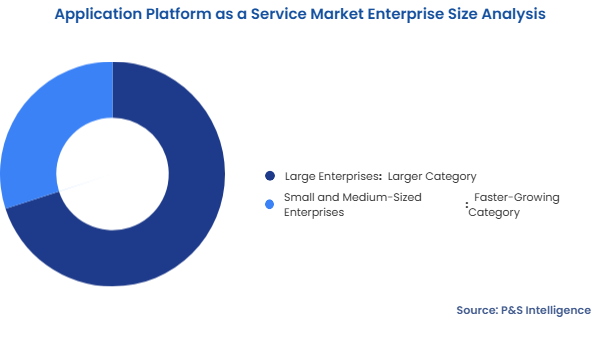
The large enterprises category holds the larger market share, of 70%, in 2025, driven by large IT modernization budgets, complex legacy application environments across BFSI, manufacturing, and public sector organizations, and the need for structured migration to cloud-native architectures. Large enterprises also operate under the most demanding regulatory compliance requirements, spanning SOC 2, HIPAA, GDPR, and sector-specific mandates, which favor comprehensive aPaaS platforms offering built-in governance tooling, audit trail capabilities, and configurable data residency controls.
The SMEs category will have the higher CAGR, of 14.3%, driven by the democratization of application development through low-code and no-code aPaaS tooling, usage-based subscription pricing that eliminates capital barriers, and government-mandated digitization programs in Europe, Asia Pacific, and Latin America directing structural support toward SME technology adoption. The European Commission's Digital Decade Policy Programme targets that at least 90% of EU SMEs achieve at least a basic level of digital intensity by 2030, creating a policy-activated demand signal that aligns directly with the cost-accessible, scalability-oriented aPaaS value proposition for the SME segment.
The enterprise sizes analyzed in this report are:
Large Enterprises (Larger Category)
Small and Medium-Sized Enterprises (SMEs) (Faster-Growing Category)
Service Analysis
The implementation and integration services category holds the largest market share, of 55%, in 2025, driven by the operational complexity inherent in deploying aPaaS platforms within existing enterprise IT environments. Organizations with complex hybrid environments require implementation services that span cloud platform configuration, existing system integration mapping, security posture alignment, and user training, services that sustain high-value, recurring revenue for aPaaS vendors and their implementation partners. Eurostat data confirms that 28.18% of EU enterprises purchasing paid cloud services used computing platforms for running their own business software, reflecting measurable organizational investment in platform-level deployments that require structured implementation and integration support.
The consulting category will have the highest CAGR, of 14.1%, driven by enterprise demand for strategic advisory services that guide aPaaS platform selection, architecture design, AI integration roadmaps, and change management programs. As aPaaS platforms evolve in capability complexity, incorporating generative AI tooling, multi-cloud orchestration, and agentic application architectures, organizations increasingly require expert consulting engagements to navigate platform decision-making and deployment strategy. Industry estimates indicate that nearly 70% of enterprises adopting advanced cloud application platforms engage external consulting partners during the early implementation phases, reinforcing the demand for specialized advisory services.
The services analyzed in this report are:
Implementation & Integration (Largest Category)
Consulting (Fastest-Growing Category)
Maintenance
Drive strategic growth with comprehensive market analysis
Application Platform as a Service Market Geographical Analysis
North America Application Platform as a Service Market Size
North America holds the largest market share, of 40%, in 2025, driven by a hyperscaler infrastructure ecosystem anchored by Microsoft Azure, Amazon Web Services, and Google Cloud; a mature DevOps and agile software development culture embedded across enterprise IT organizations; and sustained demand from BFSI, healthcare, and federal government sectors requiring regulated, compliance-ready cloud application environments. The region's structured cloud procurement frameworks, particularly the U.S. Federal Risk and Authorization Management Program (FedRAMP), create verified pathways for aPaaS adoption at institutional scale, enabling both agencies and regulated enterprises to deploy cloud-native applications within defined security boundaries.
According to the U.S. Bureau of Labor Statistics, employment of software developers in the United States is projected to grow by 17% between 2023 and 2033, significantly faster than the average for all occupations, reflecting strong and sustained demand for cloud-based application development platforms such as aPaaS.
U.S. Application Platform as a Service Market Size
The U.S. represents the largest country market within the North America aPaaS market, driven by strong enterprise IT modernization spending, a large cloud developer ecosystem, and federal cloud adoption initiatives led by the Office of Management and Budget through the Cloud First policy and the Cloud Smart strategy. The transition from owned data center infrastructure to consumption-based application platforms has been measurable: Federal data center optimization initiatives led by the U.S. Office of Management and Budget generated over USD 6.6 billion in cumulative cost savings and avoidances between 2012 and 2021, according to the U.S. Government Accountability Office, with agencies continuing to close data centers and report additional savings under ongoing optimization programs. The U.S. also benefits from a mature independent software vendor (ISV) ecosystem supplying purpose-built aPaaS tools for healthcare compliance, financial services integration, and public sector application delivery, sectors collectively driving above-average platform investment cycles.
The U.S. Government Accountability Office reports that 26 U.S. federal agencies planned approximately USD 95 billion in IT spending across about 6,700 investments in FY 2024, with the majority allocated to operating and maintaining existing systems and the remainder directed toward modernization and development initiatives.
Asia-Pacific Application Platform as a Service Market Size
Asia-Pacific will have the highest CAGR, of 14.4%, driven by large-scale government digitalization initiatives across China, India, and South Korea, alongside rapid growth in mobile-first application usage across Southeast Asia and the expansion of cloud-native startups seeking agile development platforms. Increasing data center investments by hyperscalers are further strengthening the regional cloud ecosystem. China represents the largest national market in the region, supported by domestic technology companies such as Alibaba Cloud, Huawei Cloud, and Tencent Cloud, which provide integrated aPaaS capabilities aligned with national digital economy strategies.
Enterprise modernization and government-led digital programs are also expanding platform adoption across the region. In Japan, the establishment of the Digital Agency of Japan in 2021 aims to accelerate nationwide digital transformation across public institutions and enterprises. Meanwhile, South Korea’s Digital New Deal includes KRW 58.2 trillion in planned investment, with KRW 44.8 trillion from the national treasury between 2020 and 2025 to strengthen digital infrastructure and integrate data, networks, and artificial intelligence. According to the International Telecommunication Union, global internet users reached 5.4 billion in 2023 (67% of the world’s population), while internet penetration in Asia-Pacific stood at about 64%, reflecting the expanding digital connectivity that supports cloud platform and application development adoption across the region.
India Application Platform as a Service Market Size
India represents the fastest-growing national aPaaS market within Asia Pacific, distinguished by the scale and velocity of government-led digital infrastructure investment alongside a rapidly maturing enterprise cloud adoption curve. The Ministry of Electronics and Information Technology (MeitY) has embedded cloud computing at the center of India's national digital strategy through the GI Cloud initiative, known as MeghRaj, which currently hosts applications from over 2,170 central and state government ministries and departments on a standardized, MeitY-audited cloud platform. This government-first cloud model has created a structured procurement pathway that accelerates aPaaS adoption across public administration and progressively draws regulated private sector enterprises into compliant cloud environments.
India's digital economy contributed 11.74% to national income in 2022–23 and is projected to reach 13.42% by 2024–25, reflecting the broad economic foundation driving enterprise technology investment and cloud application demand. The Government of India, Press Information Bureau (PIB), reports that India's digital economy is expected to approach 20% of GDP by 2030, signaling a deepening structural dependency on cloud-native platforms. India’s digital innovation ecosystem is being strengthened through initiatives such as the IndiaAI Mission, which was approved by the Government of India with a budget allocation of INR 10,371.92 crore for implementation over five years to develop AI computing infrastructure, datasets, and innovation platforms supporting startups, researchers, and enterprises.
The regions and countries of the market are as follows:
North America (Largest Regional Market)
U.S. (Larger Country Market)
Canada (Faster-Growing Market)
Europe
Germany (Fastest-Growing Country Market)
U.K. (Largest Country Market)
France
Italy
Spain
Rest of Europe
Asia-Pacific (Fastest-Growing Regional Market)
China (Largest Country Market)
India (Fastest-Growing Country Market)
Japan
South Korea
Australia
Rest of APAC
Latin America
Brazil (Largest Country Market)
Mexico (Fastest-Growing Country Market)
Rest of LATAM
Middle East and Africa
Saudi Arabia (Fastest-Growing Country Market)
South Africa
U.A.E. (Largest Country Market)
Rest of MEA
Application Platform as a Service Market Share
The market is consolidated because a small group of hyperscale cloud providers dominates platform adoption through their integrated infrastructure, developer ecosystems, and global enterprise relationships. Companies such as Microsoft, Amazon Web Services, and Google Cloud operate large-scale cloud infrastructure that directly supports their application development platforms, enabling seamless integration with identity management, data services, analytics, and AI tools. Additionally, these providers benefit from strong network effects, where enterprises already using their cloud environments prefer to build applications within the same ecosystem. Extensive regulatory compliance certifications and continuous platform innovation further raise entry barriers, reinforcing the dominance of these established vendors.
Application Platform as a Service Providers:
Microsoft Corporation
Amazon Web Services, Inc.
Alphabet Inc.
Salesforce, Inc.
International Business Machines Corporation
Oracle Corporation
SAP SE
ServiceNow, Inc.
Red Hat, Inc.
Mendix Technology B.V.
Appian Corporation
Progress Software Corporation
Zoho Corporation Pvt. Ltd.
Software AG
Alibaba Group Holding Limited
Shanghai Wanqi Mingdao Software Co. Ltd.
Shenzhen Aozhe Network Technology Co. Ltd.
OutSystems, Inc.
Application Platform as a Service Market News & Updates
In December 2025, ServiceNow, Inc. signed a definitive agreement to acquire Armis for USD 7.75 billion, aiming to expand its security and risk management capabilities by integrating Armis’s real-time asset visibility and threat detection into the Now Platform.
In November 2025, Appian Corporation launched Agent Studio as a generally available capability within the Appian Platform, enabling organizations to deploy AI agents that can reason, handle unexpected process conditions, and act autonomously on enterprise data.
In May 2025, Salesforce, Inc. signed a definitive agreement to acquire Informatica, an enterprise cloud data management company, for approximately USD 8.0 billion in equity value.
In March 2025, ServiceNow, Inc. announced the acquisition of Moveworks for USD 2.85 billion to enhance conversational AI, enterprise search, and automated employee support across the Now Platform.
Frequently Asked Questions About This Report
What factors are driving the growth of the application platform as a service (aPaaS) market?+
The market growth is driven by increasing demand for rapid application development, rising adoption of low-code and no-code platforms, and the need for scalable cloud-based development environments.
Which deployment model is widely adopted in the application platform as a service (aPaaS) market?+
Public cloud deployment is widely adopted in the aPaaS market.
Which enterprise segment contributes the most to the application platform as a service (aPaaS) market?+
Large enterprises contribute the most due to their higher investments in digital transformation, application modernization, and cloud-based development platforms.
Why are small and medium-sized enterprises increasingly adopting application platform as a service (aPaaS) solutions?+
SMEs are adopting aPaaS solutions because they reduce development costs, simplify application deployment, and enable faster innovation without requiring extensive IT infrastructure.
Which industry sectors are major adopters of application platform as a service (aPaaS)?+
Major adopters include BFSI, healthcare, retail, IT and telecom, and manufacturing.
What challenges affect the adoption of application platform as a service (aPaaS)?+
Key challenges include data security concerns, integration with legacy systems, vendor lock-in risks, and limited customization capabilities in some low-code platforms.
Want a report tailored exactly to your business need?
Leading companies across industries trust us to deliver data-driven insights and innovative solutions for their most critical decisions. From data-driven strategies to actionable insights, we empower the decision-makers who shape industries and define the future. From Fortune 500 companies to innovative startups, we are proud to partner with organisations that drive progress in their industries.
Client Testimonials
Working with P&S Intelligence and their team was an absolute pleasure – their awareness of timelines and commitment to value greatly contributed to our project's success. Eagerly anticipating future collaborations.
McKinsey & Company
India
Unmatched Standards
Our insights into the minutest levels of the markets, including the latest trends and competitive landscape, give you all the answers you need to take your business to new heights
Complete Data Security
We take a cautious approach to protecting your personal and confidential information. Trust is the strongest bond that connects us and our clients, and trust we build by complying with all international and domestic data protection and privacy laws