AI Platforms Market Size & Share Analysis - Trends, Drivers, Competitive Landscape, and Forecasts (2026 - 2032)
This Report Provides In-Depth Analysis of the AI Platforms Market Report Prepared by P&S Intelligence, Segmented by Platform Type (AI Development Platforms, AI Lifecycle Management Platforms, AI Infrastructure & Enablement Platforms), Deployment Mode (Cloud, On-Premises, Hybrid), Functionality (Data Management & Preparation, Model Development & Training, Model Deployment & Serving, Monitoring & Maintenance, Model Governance & Compliance, Model Fine-Tuning & Personalization, Explainability & Bias Management, Security & Privacy), User Type (Data Scientists & ML Engineers, MLOps/AI Engineers, Business Analysts & Citizen Developers, AI Product Managers, IT & Cloud Architects), Organization Size (Large Enterprises, SMEs), Industry Vertical (BFSI, Healthcare & Life Sciences, Retail & E-commerce, Manufacturing, IT & Telecommunications, Automotive, Transportation & Logistics, Government & Defense, Energy & Utilities, Media & Entertainment, Education & Research), and Geographical Outlook for the Period of 2021 to 2032
Explore the market potential with our data-driven report
AI Platforms Market Overview
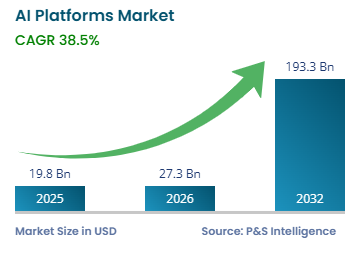
The AI platforms market size was USD 19.8 billion for 2025, and it will grow by 38.5% during 2026–2032, to reach USD 193.3 billion by 2032.
The market growth is driven by the enterprise migration from isolated AI pilots to production-scale deployment, supported by rising investment in cloud-native infrastructure and the rapid maturation of generative and agentic AI capabilities across model development, deployment, and governance workflows. The increasing adoption of large language models is prompting enterprises to adopt integrated AI platforms. Growing demand for end-to-end AI lifecycle management and expanding use of MLOps and LLMOps practices are broadening platform usage, while stricter regulatory requirements for responsible AI and model governance are adding compliance-driven urgency to adoption decisions. The growing need for scalable AI infrastructure is accelerating platform adoption across industries, while automated model monitoring and seamless integration with existing enterprise applications are extending this momentum across sectors.
Hyperscale investment is reinforcing this trajectory. For instance, the International Energy Agency (IEA) reports that capital expenditure among leading technology companies exceeded USD 400 billion in 2025. Continued investment in AI infrastructure and hyperscale data centres is driving this expenditure. Enterprise adoption trends are also supporting market growth, with the Organisation for Economic Co-operation and Development (OECD) indicating increasing AI adoption among firms across member economies. This adoption reflects sustained investment in platforms that support the complete AI model lifecycle, from development and deployment to monitoring and governance.
Key Market Insights
The AI infrastructure & enablement platforms category holds the largest market share, of 55%, in 2025, driven by growing investments in AI infrastructure and cloud computing.
The cloud category holds the largest market share, of 60%, in 2025, driven by its scalability, cost efficiency, and on-demand AI infrastructure.
The MLOps/AI engineers category will have the highest CAGR, of approximately 38.9%, driven by rising enterprise AI production deployments.
The BFSI category holds the largest market share, of 25%, in 2025, driven by early AI adoption for fraud detection, risk management, and decision-making.
North America holds the largest market share, of 40%, in 2025, driven by advanced cloud infrastructure, early enterprise AI adoption, and strong investment.
AI Platforms Market Trends and Drivers
AI Governance Frameworks and Explainability Tooling Are Key Trends
A defining trend reshaping the AI platform market is the rapid embedding of governance, risk management, and explainability capabilities directly into core platform architecture, rather than treating them as bolt-on compliance layers. Platform vendors are redesigning AI model development and deployment workflows to natively support risk documentation, bias testing, explainability, and lifecycle monitoring as regulatory scrutiny intensifies globally.
The National Institute of Standards and Technology (NIST) developed its Generative AI Risk Management Profile with input from a public working group of more than 2,500 participants, centering guidance on 13 distinct risk categories and more than 400 suggested risk management actions. Platform providers are increasingly aligning product roadmaps with such frameworks by embedding automated documentation, model cards, bias testing, governance controls, and continuous monitoring directly into AI development and deployment pipelines. This shift is redefining vendor selection criteria, with governance, transparency, and explainability capabilities becoming key differentiators alongside model performance. As additional jurisdictions finalize AI regulations, these governance capabilities are expected to evolve from competitive advantages into core platform requirements.
Enterprise Productivity Pressures and Economic Returns Are Biggest Drivers
The growing focus on measurable AI-driven productivity gains and return on AI investment is emerging as a key driver of the AI platforms market, encouraging enterprises to consolidate fragmented AI tooling into unified platforms that support the complete AI lifecycle. As boards and finance functions demand demonstrable returns on AI investment, organizations are shifting spending away from experimental, siloed tools toward AI platforms capable of managing the complete AI lifecycle at scale. According to the World Economic Forum's Future of Jobs Report 2025, 86% of employers expect AI and information processing technologies to transform their businesses by 2030, reinforcing enterprise demand for scalable AI platforms capable of supporting production-ready AI deployment across multiple business functions. This consolidation is improving operational efficiency and strengthening governance. Reduced integration complexity is accelerating enterprise adoption of comprehensive AI platforms.
The International Monetary Fund (IMF) estimates that AI adoption could increase the average annual global GDP growth rate by approximately 0.5% point between 2025 and 2030, underscoring AI's growing contribution to productivity and economic output. Enterprises are increasingly investing in integrated AI platforms that combine data management, model development, governance, deployment, and monitoring within a single environment, reducing vendor sprawl and simplifying implementation across business functions. As organizations continue to prioritize measurable business outcomes and return on AI investment, demand for comprehensive AI platforms is expected to strengthen throughout the forecast period.
AI Talent Scarcity and Skills Gaps Are Key Restraints
Despite strong enterprise demand, a persistent shortage of qualified AI and machine learning talent continues to constrain the pace of AI platform deployment across organizations of all sizes. Enterprises frequently possess the budget and executive sponsorship needed for AI initiatives but lack sufficient in-house expertise to configure, customize, integrate, and operationalize AI platforms effectively, extending implementation timelines and limiting the scale of enterprise AI deployments. The World Economic Forum's Future of Jobs Report 2025 identifies skill gaps as the leading barrier to business transformation through 2030, underscoring the critical role of AI and digital talent in enabling successful enterprise AI adoption.
In response, platform vendors are investing in low-code interfaces, automated machine learning (AutoML), AI-assisted development, and citizen-developer tools to reduce dependence on scarce specialized talent. Although these innovations are expected to ease adoption barriers over time, AI talent shortages are likely to remain a significant restraint on enterprise AI platform deployment throughout much of the forecast period.
Underserved Small and Medium Enterprise Segment Is Biggest Opportunity
An opportunity lies in the underserved small and medium enterprise (SME) segment, where AI platform penetration remains lower than among large enterprises despite growing demand for automation, analytics, and AI-driven decision-making. Cost constraints and integration complexity have historically restricted AI platform adoption among SMEs. Limited in-house technical expertise and concerns over implementation have compounded this restriction, leaving an untapped market for vendors offering simplified, scalable solutions.
According to the Organisation for Economic Co-operation and Development (OECD), 52.0% of large enterprises use AI technologies compared with only 17.4% of small enterprises. This gap highlights untapped market potential for AI platform providers. Platform vendors offering cloud-native, no-code and low-code development environments, pre-trained AI models, managed services, and industry-specific solutions are well positioned to accelerate adoption among resource-constrained organizations. As cloud delivery models continue to reduce implementation costs and technical barriers, the SME segment is expected to emerge as one of the most attractive long-term growth opportunities for the market.
AI Platforms Market Segmentation Analysis
Platform Type Analysis
The AI infrastructure & enablement platforms category holds the largest market share, of 55%, in 2025, driven by foundational compute, cloud, orchestration, storage, and model-serving capabilities required to develop, train, deploy, and scale AI applications across enterprises. Large-scale investments by governments, hyperscale cloud providers, and enterprises in AI infrastructure have reinforced this segment's dominance. These investments are expanding the compute and data resources needed to support production-scale AI workloads. The White House announced that more than 15 federal agencies have committed over USD 5 billion to expand the Genesis Mission, a national AI-for-science initiative that began at the U.S. Department of Energy, underscoring the scale of infrastructure investment supporting this segment.
The AI lifecycle management platforms category will have the highest CAGR, of approximately 38.7%, as enterprises transition from experimental AI initiatives to large-scale production deployments requiring continuous model monitoring, governance, retraining, version control, and performance optimization. As organizations manage expanding portfolios of AI and generative AI models, lifecycle management capabilities are becoming essential for maintaining model accuracy, regulatory compliance, and operational reliability, making them a core enterprise purchasing priority rather than an optional add-on.
The platform types analyzed in this report are:
AI Development Platforms
AI Lifecycle Management Platforms (Fastest-Growing Category)
AI Infrastructure & Enablement Platforms (Largest Category)
Deployment Mode Analysis
The cloud category holds the largest market share, of 60%, in 2025, driven by the scalability, lower upfront capital requirements, rapid provisioning, and access to on-demand AI infrastructure that cloud-native architectures offer for enterprises deploying AI at scale. Enterprises increasingly favor cloud delivery to access elastic GPU capacity, managed AI services, and continuous platform updates without investing in on-premises infrastructure. Eurostat reports that 52.7% of EU enterprises used paid cloud computing services in 2025, a 7.4 percentage point increase from 2023. This increase reflects the broader enterprise migration toward cloud-delivered technology platforms.
The hybrid category will have the highest CAGR, reflecting rising enterprise demand for architectures that combine cloud scalability with on-premises control over sensitive data and compliance-critical workloads. As organizations increasingly deploy AI across multiple environments, hybrid architectures provide the flexibility to balance performance, security, and regulatory compliance, making them the preferred choice for scaling enterprise AI. Regulated industries, in particular, are increasingly requiring deployment flexibility that pure cloud or pure on-premises models cannot deliver alone.
The deployment modes analyzed in this report are:
Cloud (Largest Category)
On-Premises
Hybrid (Fastest-Growing Category)
Functionality Analysis
The data management & preparation category holds the largest market share, of 30%, in 2025, driven by the foundational role that clean, well-governed data plays in every downstream AI workflow, with a large share of enterprise AI budgets still directed toward data readiness rather than model development itself. The European Commission's AI Act Article 10 requires that high-risk AI systems be developed using high-quality, well-governed training and validation datasets. This requirement formalizes data management as a compliance-critical platform capability across the EU market.
The model deployment & serving category will have the highest CAGR, driven by enterprises shifting investment from experimentation toward production-grade serving infrastructure capable of supporting real-time inference at scale. As organizations increasingly operationalize AI across business functions and deploy larger volumes of production models, demand for scalable deployment, inference, and model-serving capabilities is accelerating. Capabilities such as auto-scaling inference and multi-model serving are becoming key differentiators among platform vendors.
The functionalities analyzed in this report are:
Data Management & Preparation (Largest Category)
Model Development & Training
Model Deployment & Serving (Fastest-Growing Category)
Monitoring & Maintenance
Model Governance & Compliance
Model Fine-Tuning & Personalization
Explainability & Bias Management
Security & Privacy
User Type Analysis
The data scientists & ML engineers category holds the largest market share, in 2025, driven by its central role in model development, feature engineering, and experimentation across enterprise AI initiatives. Platform vendors continue to prioritize this user segment through advanced notebooks, experiment tracking, and model registry capabilities. The U.S. Bureau of Labor Statistics estimates that employment of computer and information research scientists, a category closely aligned with MLOps and AI engineering roles, will grow 20% from 2024 to 2034, much faster than the average for all occupations.
The MLOps/AI engineers category will have the highest CAGR, of approximately 38.9%, driven by the operational complexity of running AI systems reliably in production, including monitoring, retraining pipelines, and infrastructure scaling. As enterprises industrialize AI deployment, this user category is transitioning from a niche specialty into a standard enterprise IT function.
The user types analyzed in this report are:
Data Scientists & ML Engineers (Largest Category)
MLOps/AI Engineers (Fastest-Growing Category)
Business Analysts & Citizen Developers
AI Product Managers
IT & Cloud Architects
Organization Size Analysis
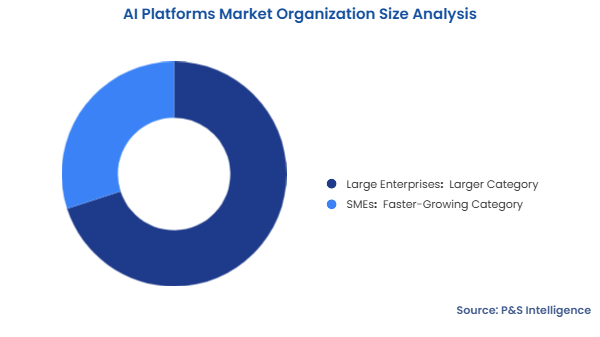
The large enterprises category holds the larger market share, of 70%, in 2025, reflecting their greater investment capacity, mature digital infrastructure, and widespread deployment of AI across multiple business functions. These organizations require enterprise-grade AI platforms with advanced capabilities for model development, governance, MLOps, security, and lifecycle management to support production-scale AI initiatives. According to the OECD, 40% of large firms across OECD countries use AI, compared with 11.9% of small firms, highlighting significantly higher AI adoption among large enterprises.
The SMEs category will have the higher CAGR, driven by their relatively low current AI penetration and the increasing availability of cloud-based AI platforms, subscription-based pricing models, and low-code/no-code AI tools that reduce adoption barriers. Government-led digital transformation initiatives and improved access to AI infrastructure are further accelerating AI adoption among SMEs, enabling them to scale AI capabilities without significant upfront investment.
The organization sizes analyzed in this report are:
Large Enterprises (Larger Category)
SMEs (Faster-Growing Category)
Industry Vertical Analysis
The BFSI category holds the largest market share, in 2025, reflecting the sector's early and sustained investment in AI for fraud detection, credit risk modeling, and algorithmic decision-making, supported by large historical data assets favorable to model training. The Bank for International Settlements highlighted AI's potential to improve data quality, operations, and decision-making at central banks in a January 2025 governance framework report, reflecting the financial sector's structured approach to AI platform adoption.
The healthcare & life sciences category will have the highest CAGR, of approximately 39.2%, driven by accelerating regulatory clearance of AI-enabled clinical tools and rising investment in diagnostic and drug-discovery applications. As regulatory pathways mature, healthcare organizations are moving from pilot deployments toward broader clinical integration of AI platforms. The U.S. Food and Drug Administration has authorized more than 1,000 AI-enabled medical devices through established premarket pathways, reflecting the accelerating regulatory foundation supporting healthcare AI platform adoption.
The industry verticals analyzed in this report are:
BFSI (Largest Category)
Healthcare & Life Sciences (Fastest-Growing Category)
Retail & E-commerce
Manufacturing
IT & Telecommunications
Automotive
Transportation & Logistics
Government & Defense
Energy & Utilities
Media & Entertainment
Education & Research
Others
Drive strategic growth with comprehensive market analysis
AI Platforms Market Geographical Analysis
North America AI Platforms Market Size
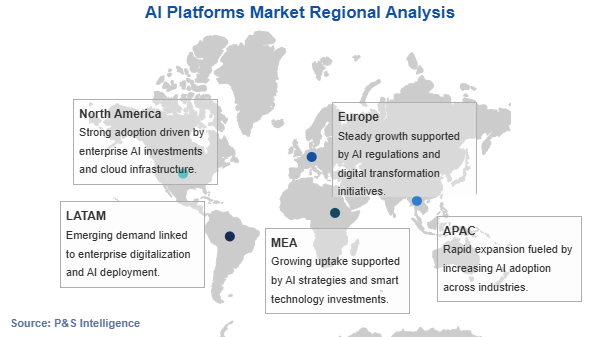
North America holds the largest market share, of 40%, in 2025, driven by the region's dense concentration of hyperscale cloud infrastructure, the earliest wave of enterprise generative AI adoption, and deep venture and corporate capital availability. Leading cloud providers headquartered in the region continue to expand proprietary model-development and MLOps tooling, embedding platform dependency early in enterprise AI journeys. A comparatively innovation-friendly regulatory environment has encouraged enterprises to accelerate the transition from AI pilots to production-scale deployments. The U.S. Census Bureau reports that AI use among U.S. businesses ranged between 17% and 20% from December 2025 through May 2026, rising to 37% among firms with 250 or more employees. This gap reflects stronger enterprise AI adoption among larger organizations and increasing demand for scalable AI platform capabilities.
Moreover, Canada is expected to witness growth during the forecast period, supported by government-led investments in artificial intelligence, a thriving AI research ecosystem, and increasing enterprise adoption of generative AI technologies. Statistics Canada reported that 12.2% of Canadian businesses used AI to produce goods or deliver services in the second quarter of 2025, up from 6.1% a year earlier, demonstrating accelerating enterprise AI adoption in Canada. The country's well-established AI research hubs in Toronto, Montreal, and Edmonton and continued investments under the Pan-Canadian Artificial Intelligence Strategy are reinforcing this momentum. This combination is accelerating demand for AI development, deployment, MLOps, and governance platforms across industries.
U.S. AI Platforms Market Size
The U.S. remains the largest country market for AI platforms in North America, supported by the presence of leading hyperscale cloud providers, a mature enterprise AI ecosystem, and sustained investment in generative AI, foundation models, and production-scale AI deployments. Enterprises across industries are increasingly adopting AI platforms to streamline model development, deployment, MLOps, governance, and monitoring. Continuous innovation by major cloud providers is accelerating enterprise migration from pilot projects to production environments. The Federal Reserve Board reports that its November 2025 Survey of Business Uncertainty estimated that approximately 78% of the U.S. labor force works at firms that have adopted AI, with about 54% working at firms that use large language models (LLMs). This gap reflects widespread enterprise AI adoption and increasing demand for AI development, deployment, and lifecycle management platforms. This growth is expected to continue, supported by sustained hyperscaler investments in AI infrastructure and rising enterprise adoption of generative AI. However, increasing compute and energy costs may moderate platform spending over the forecast period.
Asia-Pacific AI Platforms Market Size
Asia-Pacific will have the highest CAGR, of approximately 39.4%, driven by national AI strategies across China, India, Japan, and South Korea directing large-scale investment into cloud infrastructure and rapid enterprise digitization deepening platform demand across the region. Rising domestic cloud and hyperscaler capacity is lowering platform adoption costs for regional enterprises, while government-backed digital transformation programs are extending AI platform deployment across sectors such as manufacturing, financial services, healthcare, and public administration.
India is expected to be one of the key growth engines for the regional market, driven by rapid enterprise AI adoption, strong government support, expanding digital infrastructure, and increasing investments in cloud and AI technologies. The NASSCOM AI Adoption Index, cited by the Press Information Bureau (PIB), Government of India, reported that 87% of Indian enterprises were actively using AI solutions as of December 2025. This adoption level reflects enterprise AI momentum and increasing demand for AI development, deployment, MLOps, and lifecycle management platforms. Continued government initiatives under the IndiaAI Mission and expanding investments in cloud infrastructure are expected to accelerate enterprise AI platform adoption across the country.
China AI Platforms Market Size
China is the largest country market within Asia-Pacific, driven by the state-directed investment in AI infrastructure, an expansive base of domestic AI enterprises, and aggressive government targets for AI industrialization. Investment in supercomputing and data infrastructure has created scale advantages for domestic platform providers, while national policy continues to prioritize AI integration across manufacturing, healthcare, finance, and public-sector applications.
China's Ministry of Industry and Information Technology (MIIT) reported that the core AI industry surpassed 1.2 trillion yuan (approximately USD 173.9 billion) in 2025, with the number of AI companies exceeding 6,200. This scale underscores the country's expanding AI ecosystem and increasing demand for enterprise AI development, deployment, MLOps, and lifecycle management platforms.
The regions and countries analyzed in this report are:
North America (Largest Regional Market)
U.S. (Larger Country)
Canada (Faster-Growing Country)
Europe
Germany (Largest Country)
U.K. (Fastest-Growing Country)
France
Italy
Spain
Rest of Europe
Asia-Pacific (Fastest-Growing Regional Market)
China (Largest Country)
India (Fastest-Growing Country)
Japan
South Korea
Australia
Rest of APAC
Latin America
Brazil (Largest Country)
Mexico (Fastest-Growing Country)
Rest of LATAM
Middle East and Africa
Saudi Arabia (Largest Country)
South Africa
U.A.E. (Fastest-Growing Country)
Rest of MEA
AI Platforms Market Competitive Landscape
The market is semi-consolidated, characterized by a concentrated infrastructure layer and a fragmented tooling and application layer. A handful of hyperscale cloud providers, including Microsoft, Amazon Web Services (AWS), Google, Oracle, and IBM, dominate the infrastructure segment, supported by their extensive cloud infrastructure, AI compute capabilities, global data center networks, and established enterprise relationships. High capital requirements and barriers to entry limit competition at this layer. In contrast, the application layer remains highly competitive, with numerous specialized vendors such as Databricks, DataRobot, H2O.ai, and C3.ai competing through MLOps, AI governance, generative AI, AutoML, and industry-specific solutions. Continuous innovation and strategic partnerships are sustaining competition in the software layer. Additionally, acquisitions and the emergence of new AI startups are preventing full market consolidation.
Key Players in the AI Platforms Market:
Microsoft Corporation
Amazon Web Services, Inc.
Google LLC
IBM Corporation
Oracle Corporation
NVIDIA Corporation
OpenAI, Inc.
Databricks, Inc.
DataRobot, Inc.
H2O.ai, Inc.
C3.ai, Inc.
Salesforce, Inc.
SAP SE
Snowflake Inc.
Palantir Technologies Inc.
AI Platforms Market Developments
In May 2026, SAP SE launched the SAP Business AI Platform, unifying the company's Business Technology Platform, Business Data Cloud, and Business AI offerings into a single foundation for enterprise AI development and deployment. The launch positions SAP to compete more directly with hyperscaler-native AI platform offerings for its large installed enterprise customer base.
In February 2026, Palantir Technologies Inc. extended its multi-year Skywise partnership with Airbus. The extended partnership expands the Skywise aviation data platform to serve more than 50,000 daily users, strengthening Palantir's commercial footprint in the European aviation and industrial data sector beyond its traditional government base.
In June 2026, Databricks, Inc. agreed to acquire Panther, an AI-driven security operations center platform, to establish a new security lakehouse category combining unified data and agentic threat detection. The acquisition extends Databricks' platform into AI-native cybersecurity operations.
In October 2025, Oracle Corporation expanded its AI infrastructure partnership with NVIDIA Corporation, including the launch of OCI Zettascale10, which connects NVIDIA GPUs across multiple data centers into a unified supercomputing fabric. The expansion supports Oracle's Stargate infrastructure commitments and strengthens its position in large-scale AI compute delivery.
Frequently Asked Questions About This Report
How is generative AI transforming the AI Platforms Market?+
Generative AI is accelerating demand for AI platforms by enabling organizations to build, fine-tune, and deploy large language models, automate content creation, and develop intelligent applications across multiple industries.
Why are enterprises investing in AI platforms?+
Enterprises invest in AI platforms to automate business processes, improve decision-making, reduce operational costs, enhance customer experiences, and accelerate the development and deployment of AI solutions.
How are AI platforms supporting digital transformation?+
AI platforms enable organizations to integrate machine learning, predictive analytics, automation, and generative AI into business operations, accelerating digital transformation across industries.
How is MLOps improving AI platform adoption?+
MLOps streamlines the development, deployment, monitoring, and governance of AI models, enabling organizations to scale AI projects more efficiently and reliably.
What role does AI infrastructure play in AI platforms?+
High-performance GPUs, cloud computing, networking, and data storage form the foundation of AI platforms by providing the computational power required to train, fine-tune, and deploy advanced AI models.
Want a report tailored exactly to your business need?
Leading companies across industries trust us to deliver data-driven insights and innovative solutions for their most critical decisions. From data-driven strategies to actionable insights, we empower the decision-makers who shape industries and define the future. From Fortune 500 companies to innovative startups, we are proud to partner with organisations that drive progress in their industries.
Client Testimonials
Working with P&S Intelligence and their team was an absolute pleasure – their awareness of timelines and commitment to value greatly contributed to our project's success. Eagerly anticipating future collaborations.
McKinsey & Company
India
Unmatched Standards
Our insights into the minutest levels of the markets, including the latest trends and competitive landscape, give you all the answers you need to take your business to new heights
Complete Data Security
We take a cautious approach to protecting your personal and confidential information. Trust is the strongest bond that connects us and our clients, and trust we build by complying with all international and domestic data protection and privacy laws