AI Governance Market Size & Share Analysis - Trends, Drivers, Competitive Landscape, and Forecasts (2026 - 2032)
This Report Provides In-Depth Analysis of the AI Governance Market Report Prepared by P&S Intelligence, Segmented by Component (Solutions, Services), Deployment (Cloud, On-Premises), Organization Size (Large Enterprises, Small and Medium Enterprises), Technology (Machine Learning, Generative AI, Natural Language Processing, Computer Vision), End User (Banking, Financial Services, and Insurance, Healthcare and Life Sciences, Government and Defense, Retail and E-commerce, IT and Telecommunications, Manufacturing, Automotive, Media and Entertainment, Energy and Utilities), and Geographical Outlook for the Period of 2021 to 2032
Explore the market potential with our data-driven report
AI Governance Market Overview
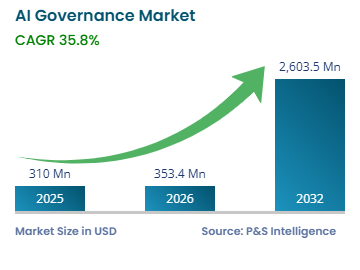
The AI governance market size was USD 310.0 million in 2025, and it will grow by 35.8% during 2026-2032 to reach USD 2603.5 million by 2032.
The AI governance market is expanding as organisations deploy artificial intelligence across critical business functions and require stronger oversight of automated decision-making systems. AI is increasingly being used in financial services, healthcare, customer engagement, cybersecurity, public administration, and enterprise operations, creating greater exposure to risks related to bias, explainability, data misuse, and model reliability. Organisations are responding by implementing governance frameworks that improve accountability, establish risk controls, and support compliance throughout the AI lifecycle. Regulatory developments across major economies are also encouraging enterprises to formalise governance practices before scaling AI deployments across business-critical environments.
The market is also benefiting from the rapid adoption of generative AI, machine learning operations, and cloud-based AI platforms that require continuous monitoring and policy enforcement. According to the International Monetary Fund, almost 40% of global employment was exposed to artificial intelligence in 2024, highlighting the growing influence of AI on workplace activities, operational processes, and decision-making across industries. Businesses are therefore seeking governance solutions that improve model transparency, validate outcomes, monitor performance, and maintain compliance with evolving regulatory requirements. Demand remains particularly strong in highly regulated sectors where organisations must demonstrate accountability for automated decisions and maintain detailed audit records. Rising investment in responsible AI initiatives, data governance programmes, and enterprise risk management is supporting the adoption of governance platforms that embed oversight directly into development and deployment workflows.
Key Market Insights
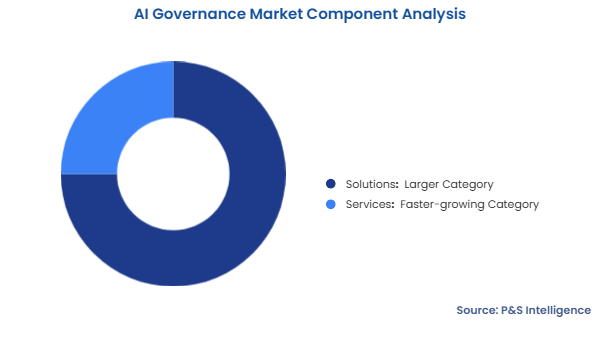
Solutions is the larger component, holding a market share of 75.0%, due to rising demand for centralised platforms that govern enterprise-wide AI deployments.
Large Enterprises are the larger organisation size category, holding a market share of 80.0%, because complex AI ecosystems require stronger oversight across multiple business functions and regulatory environments.
Generative AI is the fastest-growing technology category, registering a CAGR of 36.8%, driven by increasing adoption of large language models across customer service, software development, and knowledge management applications.
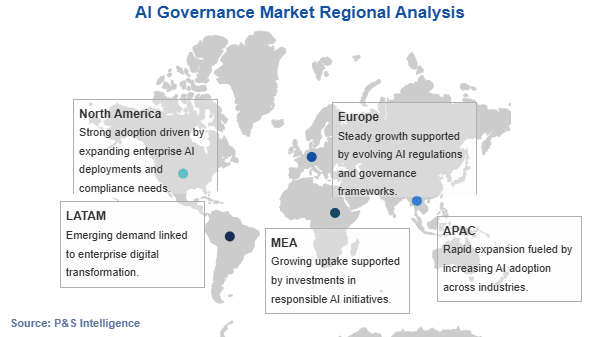
North America holds the largest regional share of 45.5%, due to extensive AI deployment across government agencies, financial institutions, healthcare organisations, and technology enterprises.
Asia-Pacific is the fastest-growing region, registering a CAGR of 37.0%, driven by expanding AI adoption across manufacturing, digital services, financial technology, and public-sector applications.
AI Governance Market Trends and Drivers
Integration of Governance Capabilities into Generative AI and Agentic AI Platforms Is a Major Trend
AI governance is increasingly shifting towards governance-by-design models, where oversight capabilities are embedded directly into generative AI and agentic AI environments. Organisations are moving away from separate compliance systems and adopting integrated platforms that combine model monitoring, policy enforcement, explainability, risk assessment, and audit management within AI workflows. According to F5, only 2% of global organisations were highly prepared to scale AI securely in 2025, while artificial intelligence was already present in 25% of applications on average. The growing gap between AI deployment and governance readiness is encouraging enterprises to integrate governance functions directly into operational environments.
According to ServiceNow, AI Control Tower was launched in 2025 to govern, manage, and secure AI agents, models, and workflows across enterprise ecosystems. These developments are increasing demand for platforms that provide continuous oversight across AI systems rather than periodic compliance reviews. Enterprises are seeking stronger operational control, improved accountability, and faster risk identification as AI agents become more autonomous across business functions.
Expanding Regulatory Requirements for Responsible AI Deployment Drives Market
The growing introduction of AI regulations, compliance frameworks, and responsible AI policies is accelerating demand for AI governance solutions. Organisations are under increasing pressure to demonstrate that AI systems operate transparently, securely, and in accordance with evolving legal and ethical requirements. Regulatory expectations now extend beyond data protection and include explainability, accountability, model validation, and continuous monitoring. According to the European Commission, the European Artificial Intelligence Act entered into force in 2024 and established common obligations for AI developers and deployers relating to risk management, transparency, and responsible AI use. Regulatory activity is also expanding globally.
According to the Organisation for Economic Co-operation and Development, the first global reporting framework for advanced AI developers was launched in 2025, with 13 leading AI developers committing to participate in the inaugural reporting process. The expansion of formal governance requirements is encouraging organisations to invest in platforms that document AI activities, support audits, enforce policies, and maintain compliance throughout the model lifecycle. Governance capabilities are therefore becoming closely linked with enterprise AI deployment strategies as organisations seek to scale AI while managing regulatory and reputational exposure.
Lack of Standardised Governance Frameworks Limits Market Expansion
The absence of universally accepted AI governance standards remains a major challenge for organisations operating across multiple jurisdictions and regulatory environments. Businesses often face different requirements relating to risk assessment, transparency, accountability, and model oversight, making it difficult to establish consistent governance practices across global operations. According to the Organisation for Economic Co-operation and Development (OECD), the OECD.AI Policy Navigator was a living repository of public AI policies and initiatives from more than 80 jurisdictions and organisations in 2025. The breadth of policy approaches highlights the fragmented governance landscape that organisations must navigate when deploying AI systems across regions and industries. This lack of standardisation increases implementation complexity and creates uncertainty regarding future compliance obligations. Organisations frequently need to adapt governance processes to different regulatory expectations, which can increase operational costs, lengthen deployment timelines, and slow investment decisions related to advanced AI governance platforms and services.
Expansion of AI Governance Adoption Across Small and Mid-Sized Enterprises Creates Market Opportunity
A significant opportunity is emerging from the growing adoption of artificial intelligence among small and medium-sized enterprises. AI tools are becoming increasingly accessible through cloud platforms, embedded applications, and industry-specific software, enabling smaller organisations to adopt AI for customer service, marketing, operations, cybersecurity, and decision support. According to the International Finance Corporation, micro, small, and medium-sized enterprises accounted for more than 90% of firms worldwide in 2025. This large business base represents a substantial opportunity for governance providers as AI adoption expands beyond large enterprises. Many smaller organisations lack dedicated compliance, legal, and risk-management teams, creating demand for governance solutions that simplify monitoring, policy enforcement, documentation, and regulatory reporting. Solution providers are increasingly positioned to deliver scalable and cost-effective governance platforms tailored to organisations with limited technical resources. This is creating opportunities for software vendors, consulting firms, and managed service providers to expand their customer base across underserved segments of the AI market.
AI Governance Market Segmentation Analysis
Component Analysis
Solutions is the larger category, holding a market share of 75.0%, because organisations require centralised platforms to monitor, govern, and manage AI systems throughout the model lifecycle. Demand is increasing as enterprises seek capabilities such as explainability, bias detection, compliance management, and governance automation within a single environment. According to Cisco, only 24% of organisations could control AI-agent actions using proper guardrails and live monitoring in 2025.
Services are the faster-growing category, registering a CAGR of 36.7%, as organisations seek specialised expertise to design, implement, and manage AI governance programs. Many enterprises lack internal resources capable of addressing evolving regulatory requirements, risk management frameworks, and governance best practices. Consulting, integration, deployment, and managed services are therefore becoming increasingly important.
Cloud is the larger and faster-growing category, holding a market share of 80.5% and registering a CAGR of 36.0%, because cloud environments have become the preferred foundation for modern AI development and deployment. Organisations benefit from scalability, flexible computing resources, centralised monitoring, and easier integration with governance tools. Cloud-based governance platforms also support continuous model oversight across distributed operations and multiple AI workloads. Growing adoption of generative AI, machine learning platforms, and AI-as-a-service offerings is further accelerating demand for cloud-native governance capabilities.
The deployment analysed in this report are:
Cloud (Larger and Faster-growing Category)
On-Premises
Organisation Size Analysis
Large Enterprises is the larger category, holding a market share of 80.0%, because these organisations manage complex AI ecosystems across multiple business functions, geographic regions, and regulatory environments. Governance requirements become more critical as AI deployments expand across customer operations, risk management, compliance, and decision-making processes. According to IBM, only 16% of AI initiatives had scaled enterprise-wide in 2025. Many organisations, therefore, require stronger governance frameworks before broader deployment.
Small and Medium Enterprises are the faster-growing category, registering a CAGR of 36.1%, as AI technologies become more accessible through cloud-based platforms and subscription-based services. Smaller organisations are increasingly integrating AI into customer engagement, operations, cybersecurity, and business analytics. As adoption expands, the need for governance tools that ensure responsible and compliant AI usage is becoming more important. Vendors are responding with simplified and cost-effective solutions, enabling SMEs to implement governance practices without requiring extensive internal expertise or large technology investments.
The organization size analysed in this report are:
Large Enterprises (Larger Category)
Small and Medium Enterprises (Faster-growing Category)
Technology Analysis
Machine Learning is the largest category, holding a market share of 40.5%, because it remains the foundation of most enterprise AI deployments across industries. Organisations rely on machine learning models for predictive analytics, fraud detection, risk assessment, recommendation systems, and process optimisation. The widespread use of these models creates significant demand for governance capabilities that can monitor performance, validate outcomes, manage risk, and maintain compliance.
Generative AI is the fastest-growing category, registering a CAGR of 36.8%, due to the rapid adoption of large language models across customer service, software development, content creation, and knowledge management functions. Organisations are increasing investment in governance tools because generative AI introduces risks related to hallucinations, bias, intellectual property, and model transparency. According to Microsoft, global generative AI adoption reached 16.3% during the second half of 2025, with approximately one in six people worldwide using generative AI tools.
Banking, Financial Services, and Insurance (BFSI) is the largest category, holding a market share of 25.0%, because financial institutions operate under strict regulatory requirements and depend on transparent, auditable decision-making processes. AI is increasingly used for fraud detection, credit assessment, compliance monitoring, and customer engagement, creating greater governance requirements. According to the World Economic Forum and NVIDIA, 84% of financial organisations were implementing or planning a framework to govern how AI is built, trained, used, and audited in 2024.
Healthcare and Life Sciences is the fastest-growing category, registering a CAGR of 36.5%, as organisations increasingly apply AI to diagnostics, clinical decision support, drug discovery, patient engagement, and operational management. The sensitive nature of healthcare data and the potential impact of AI-driven decisions create a strong need for governance, transparency, and model validation.
The end user analysed in this report are:
Banking, Financial Services, and Insurance (BFSI) (Largest Category)
Healthcare and Life Sciences (Fastest-growing Category)
Government and Defence
Retail and E-commerce
IT and Telecommunications
Manufacturing
Automotive
Media and Entertainment
Energy and Utilities
Others
Drive strategic growth with comprehensive market analysis
AI Governance Market Regional Outlook
North America AI Governance Market Analysis
North America holds the largest share, of 45.5%, because the region has been among the earliest adopters of enterprise artificial intelligence and has a highly developed ecosystem of cloud providers, AI developers, cybersecurity firms, and regulatory advisory organisations. Large enterprises across financial services, healthcare, defence, technology, and public administration are increasingly embedding governance controls into AI deployment strategies to address accountability and risk management requirements. The region also benefits from strong investment in responsible AI initiatives and enterprise compliance programs. The U.S. contributes significantly through its concentration of leading AI platform providers, advanced research activity, and widespread deployment of generative AI across commercial sectors.
U.S. AI Governance Market Analysis
The U.S. is the largest country market, because it possesses one of the world's most advanced artificial intelligence ecosystems, supported by major cloud providers, enterprise software companies, AI developers, and cybersecurity firms. AI is increasingly embedded across healthcare, financial services, defence, and technology operations where governance, accountability, and risk management are critical requirements. According to the U.S. Office of Management and Budget, federal agencies reported 3,611 individually documented AI use cases in 2025. The growing scale of AI deployment is increasing demand for governance platforms that support oversight, policy enforcement, model monitoring, auditability, and regulatory compliance across complex operational environments.
Canada AI Governance Market Analysis
Canada is experiencing steady growth due to its strong artificial intelligence research ecosystem and long-standing emphasis on responsible AI development. Government institutions, research organisations, and enterprises are actively promoting transparency, accountability, and trustworthy AI practices across multiple sectors. According to Statistics Canada, 12.2% of Canadian businesses used artificial intelligence to produce goods or deliver services in 2025, compared with 6.1% in 2024. The rapid increase in business adoption is strengthening demand for governance frameworks that improve model oversight, support responsible deployment, manage operational risks, and help organisations maintain confidence in AI-driven processes.
Asia-Pacific AI Governance Market Analysis
Asia-Pacific has the highest CAGR, of 37.0%, because organizations across the region are rapidly expanding AI deployment across manufacturing, electronics, telecommunications, digital services, and public sector modernization programs. Governments are introducing national AI strategies while enterprises increasingly seek governance capabilities that can support large-scale adoption without compromising transparency, security, or operational control. The region's growth is further supported by expanding digital economies and increasing investment in advanced AI infrastructure. China remains the largest country market due to extensive AI commercialization, strong industrial AI adoption, and large-scale integration of artificial intelligence across enterprise and government environments.
China AI Governance Market Analysis
China is the largest country market in Asia-Pacific, because artificial intelligence is widely deployed across manufacturing, digital commerce, financial technology, smart cities, and public-sector applications. Large-scale implementation is increasing the importance of governance mechanisms that address compliance requirements, operational risks, and security concerns. According to the Cyberspace Administration of China, 346 generative AI services had completed regulatory filings by 2025. The growing number of approved AI services is increasing demand for governance platforms that support transparency, monitoring, accountability, and compliance management as AI adoption expands across commercial and public-sector environments.
South Korea AI Governance Market Analysis
South Korea is experiencing rapid growth due to its advanced technology sector, strong semiconductor industry, and increasing investment in artificial intelligence innovation. Organisations are deploying AI across manufacturing, consumer electronics, mobility, and digital services, creating greater demand for governance and monitoring capabilities. According to the Organisation for Economic Co-operation and Development, 56.5% of Korean firms using AI reported that AI had replaced specific tasks within existing jobs in 2024. The growing integration of AI into day-to-day business operations is increasing the need for governance frameworks that improve oversight, support accountability, manage operational risks, and monitor AI-driven activities across enterprise environments.
Europe AI Governance Market Analysis
Europe represents a strategically important market due to its strong emphasis on trustworthy and regulated artificial intelligence deployment. The region's AI governance adoption is being shaped by extensive policy development, compliance requirements, and organisational focus on transparency, accountability, and data protection. Enterprises are increasingly integrating governance mechanisms into AI systems to align with evolving regulatory expectations and maintain operational trust. The U.K. remains the largest country market within the region owing to its mature financial services sector, active AI startup ecosystem, and growing enterprise use of advanced AI applications. France is emerging as the fastest-growing country as both public and private sector organisations accelerate investments in sovereign AI capabilities, responsible AI initiatives, and governance frameworks that support secure and compliant deployment across critical industries.
The regions and countries analysed in this report are:
North America (Largest Regional Market)
U.S. (Larger Country)
Canada (Faster-Growing Country)
Europe
Germany
U.K. (Largest Country)
France (Fastest-Growing Country)
Italy
Spain
Rest of Europe
Asia-Pacific (Fastest-Growing Regional Market)
China (Largest Country)
India
Japan
South Korea (Fastest-Growing Country)
Australia
Rest of APAC
Latin America
Brazil (Largest and Fastest-Growing Country)
Mexico
Rest of LATAM
Middle East and Africa
Saudi Arabia (Largest Country)
U.A.E.
South Africa (Fastest-Growing Country)
Rest of MEA
AI Governance Market Competitive Landscape
The global AI governance market is fragmented in nature, characterized by the presence of numerous participants offering a diverse range of solutions across responsible AI, model governance, regulatory compliance, risk management, explainability, monitoring, and AI lifecycle management. Market participants are continuously expanding their capabilities to address evolving regulatory frameworks and the increasing adoption of artificial intelligence across industries. The growing deployment of generative AI and agentic AI is further encouraging the development of advanced governance platforms that provide centralized oversight, policy management, transparency, accountability, and compliance capabilities. Innovation, strategic partnerships, technology integration, and platform expansion remain key strategies adopted by market participants to strengthen their presence and address the evolving AI governance requirements of enterprises worldwide.
Leading Companies in the AI Governance Market:
Microsoft Corporation
IBM Corporation
Google LLC
Amazon Web Services (AWS)
SAP SE
SAS Institute Inc.
Fair Isaac Corporation (FICO)
H2O.ai, Inc.
OneTrust, LLC
Credo AI
Dataiku
DataRobot, Inc.
Fiddler AI
Collibra
Informatica Inc.
AI Governance Market News
In May 2026, AWS introduced the AWS AI Security Framework, structured around infrastructure security, identity and data security, and AI application security, with governance and compliance spanning all three layers to support secure and governed AI adoption.
In April 2026, Microsoft announced the Agent Governance Toolkit, an open-source project released under the Microsoft organization and the MIT License. Microsoft describes it as providing runtime security governance for autonomous AI agents, covering areas such as deterministic policy enforcement, identity/trust, execution security, and reliability
In March 2026, Dataiku launched the Platform for AI Success and introduced Dataiku Agent Management as a standalone product. The release focused on cross-platform agent governance, business-impact validation, observability, and visibility across AI agents in operation.
In January 2026, Airia introduced AI Governance as a major component of its enterprise AI management platform. The release expanded governance capabilities with centralized visibility into AI agents and models, AI inventory management, risk classification, compliance and audit support, accountability workflows, and governance controls for enterprise AI deployments.
Frequently Asked Questions About This Report
What does the AI governance market include for organizations?+
It includes policies, platforms, controls, and workflows that guide responsible development, deployment, monitoring, and oversight of AI systems.
What factors are driving demand in the AI governance market?+
Growth is driven by expanding AI use, regulatory attention, ethical concerns, model transparency needs, and pressure for accountability.
Why are organizations adopting AI governance solutions across operations?+
Organizations adopt AI governance to define ownership, approve use cases, manage risk, document decisions, and align AI with policy.
How do AI governance solutions improve decision making and efficiency?+
These solutions improve oversight by connecting model inventories, risk reviews, testing evidence, monitoring, and approval workflows.
What challenges affect adoption of AI governance solutions today?+
Adoption is affected by unclear accountability, fast changing AI tools, limited skills, inconsistent data practices, and difficulty measuring AI risk.
Want a report tailored exactly to your business need?
Leading companies across industries trust us to deliver data-driven insights and innovative solutions for their most critical decisions. From data-driven strategies to actionable insights, we empower the decision-makers who shape industries and define the future. From Fortune 500 companies to innovative startups, we are proud to partner with organisations that drive progress in their industries.
Client Testimonials
Working with P&S Intelligence and their team was an absolute pleasure – their awareness of timelines and commitment to value greatly contributed to our project's success. Eagerly anticipating future collaborations.
McKinsey & Company
India
Unmatched Standards
Our insights into the minutest levels of the markets, including the latest trends and competitive landscape, give you all the answers you need to take your business to new heights
Complete Data Security
We take a cautious approach to protecting your personal and confidential information. Trust is the strongest bond that connects us and our clients, and trust we build by complying with all international and domestic data protection and privacy laws