AI in Network Market Size & Share Analysis - Trends, Drivers, Competitive Landscape, and Forecasts (2026 - 2032)
This Report Provides In-Depth Analysis of the AI in Network Market Report Prepared by P&S Intelligence, Segmented by Component (Solutions, Services), Deployment Mode (Cloud, On-Premises), Network Type (Wireless Network, Hybrid Network, Wired Network), Enterprise Size (Large Enterprises, Small and Medium Enterprises), End User (Telecom Operators, Cloud Service Providers, Data Centers, Government, Defense, Healthcare, Energy and Utilities, Manufacturing), and Geographical Outlook for the Period of 2021 to 2032
Explore the market potential with our data-driven report
AI in Network Market Overview
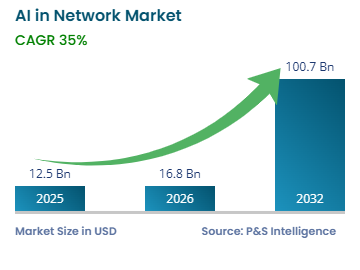
The AI in network market size was USD 12.5 billion for 2025, and it will grow by 35.0% during 2026-2032, to reach USD 100.7 billion by 2032.
The market is expanding because network environments are becoming more complex across enterprises, telecom operators, cloud providers, and public organisations. Rising use of cloud computing, remote work models, connected devices, streaming platforms, and real-time applications is increasing pressure on existing network infrastructure. Businesses now require intelligent systems that can automatically manage traffic flows, reduce downtime, improve network speed, and identify performance issues before operations are affected. AI-powered networking platforms are gaining adoption because they improve network visibility and automate operational processes without depending heavily on manual monitoring. The expansion of 5G infrastructure and edge computing is also increasing demand for intelligent network operations that can respond quickly to changing traffic conditions and user requirements.
Cybersecurity and operational efficiency are becoming major priorities for enterprises managing large digital environments. Businesses are facing higher risks from network failures, cyber threats, and unpredictable traffic spikes as more workloads move toward cloud-based platforms and distributed systems. AI is increasingly being used to detect abnormal network behaviour, optimise bandwidth allocation, automate troubleshooting, and support predictive maintenance across enterprise and telecom networks. According to the International Telecommunication Union, global fixed-broadband traffic reached 6 zettabytes in 2024, highlighting the growing pressure on networks from cloud services, streaming platforms, connected devices, and real-time applications. Telecom providers, enterprises, and data centre operators are therefore increasing investments in AI-driven network automation to improve service quality, strengthen network stability, reduce operational burden on IT teams, and support low-latency digital infrastructure environments handling large-scale AI workloads and data processing operations.
Key Market Insights
Solutions is the largest component, holding a market share of 75.0%, due to rising enterprise demand for AI-driven traffic optimisation and automation platforms.
Wireless Network is the largest network type, holding a market share of 60.5%, due to the expansion of 5G, IoT, and mobile broadband traffic volumes.
Telecom Operators are the largest end user, holding a market share of 25.5%, due to increasing mobile traffic and complex network infrastructure operations.
North America holds the largest share of 45.5% because of its advanced telecom infrastructure, hyperscale cloud data centers, and strong enterprise adoption of AI-driven networking technologies.
Asia-Pacific has the highest CAGR, of 41.0%, because the region is rapidly expanding digital infrastructure across both developed and emerging economies.
AI in Network Market Trends and Drivers
AI-Native Autonomous Networking Platforms are a major trend.
The industry is shifting toward AI-native and self-managing networks that can automatically detect congestion, optimise traffic flows, strengthen security, and resolve performance issues with minimal human intervention. Telecom operators, cloud providers, and enterprises are increasingly replacing traditional monitoring systems with platforms using real-time analytics, automation, and AI-assisted network operations. Generative AI tools are also being integrated into network environments to simplify troubleshooting and reduce manual configuration tasks for IT teams. Demand for AI-ready data centre networking is increasing as businesses expand high-performance computing and large AI workloads across distributed digital infrastructure environments.
According to the International Energy Agency, global data centre electricity consumption reached around 415 TWh in 2024, reflecting the growing infrastructure load created by AI workloads and high-performance computing operations. In 2025, Cisco launched the Silicon One P200 chip and Cisco 8223 routing system to support distributed AI workloads across multiple data centres. These developments are encouraging enterprises and telecom providers to modernise network architectures with intelligent automation, advanced routing capabilities, and scalable AI-driven infrastructure designed to manage rising traffic intensity and complex data processing environments.
Rising Network Complexity Across Cloud and 5G Infrastructure Drives Market
The market is growing because enterprises and telecom operators are managing increasingly complex network environments across cloud platforms, remote locations, edge systems, and connected devices. Rising digital traffic is creating continuous pressure on network performance, bandwidth allocation, and cybersecurity operations. Traditional monitoring tools are becoming less effective in handling large and dynamic network environments that require rapid traffic analysis and automated decision-making. According to the International Telecommunication Union, around 6 billion people, representing 74% of the global population, used the internet in 2025, increasing pressure on networks supporting cloud services, remote work, and digital platforms, Businesses are therefore adopting AI-based networking tools to improve network reliability, automate troubleshooting, strengthen traffic management, and reduce operational burden on IT teams managing distributed infrastructure.
According to the International Telecommunication Union, fixed-broadband penetration reached 20 subscriptions per 100 inhabitants in 2025, supporting rising demand for stable and high-performance network connectivity across connected homes, enterprises, and cloud-based systems. These conditions are increasing enterprise investment in AI-driven network automation platforms capable of maintaining connectivity quality, improving response speed, and supporting real-time digital operations across large-scale infrastructure environments.
High Integration Complexity and Data Privacy Concerns Restrict Market Growth
The market faces challenges because many enterprises and telecom operators continue to rely on legacy network infrastructure that does not integrate easily with modern AI-based networking systems. Deploying AI tools across large network environments often requires major architectural upgrades, software compatibility adjustments, and operational changes that can increase implementation time and create concerns regarding service disruption. Many organisations also face difficulties managing AI-driven network environments because of limited in-house expertise and shortages of skilled cybersecurity and network automation professionals. Data privacy concerns are also slowing adoption, particularly where AI platforms continuously analyse network traffic and user behaviour across cloud-connected systems.
According to the International Telecommunication Union, 105 countries remained in the establishing or evolving tiers of cybersecurity readiness in 2024, highlighting continuing gaps in governance, digital security capabilities, and cyber resilience frameworks. Enterprises managing sensitive operational data are therefore becoming more cautious regarding large-scale AI network deployment, especially where regulations surrounding data governance, AI decision-making, and cross-border information management remain unclear. These concerns are increasing deployment complexity for organisations attempting to modernise network operations while maintaining regulatory compliance and infrastructure stability across distributed digital environments.
Expansion of Edge Computing and AI Data Centres Creates New Growth Opportunities
The market is creating opportunities as enterprises, telecom operators, and cloud providers expand edge computing infrastructure and AI-focused data centres requiring intelligent traffic management and low-latency connectivity. AI workloads depend on stable data movement between cloud systems, edge devices, and processing infrastructure, increasing demand for networking platforms capable of automatically optimising performance across distributed environments. Telecom providers are also expanding private 5G and edge networks for manufacturing, healthcare, transportation, logistics, and smart city projects that require real-time connectivity and automated network control. Enterprises are increasingly investing in scalable networking systems that support predictive maintenance, AI-driven security, and real-time analytics across digital operations.
According to the International Telecommunication Union, 5G covered 55% of the global population in 2025, supporting broader deployment of low-latency digital infrastructure and advanced mobile connectivity services. Expanding 5G availability is encouraging organisations to adopt AI-driven traffic control systems, intelligent edge networking platforms, and automated network optimisation technologies capable of supporting growing volumes of connected devices and high-speed digital applications across commercial and industrial environments.
AI in Network Market Segmentation Analysis
Component Analysis
Solutions is the larger category, holding a market share of 75.0%, because enterprises and telecom operators primarily adopt AI in networking through software platforms that support automation, traffic optimisation, security monitoring, and performance management. These platforms help organisations manage cloud, wireless, and data centre networks through centralised analytics and automated operations without building separate internal tools. According to Cisco, 93% of surveyed organisations expected AI to increase infrastructure workloads in 2024, supporting demand for network automation, monitoring, and optimisation solutions.
Services is the faster-growing category, registering a CAGR of 35.9%, because many organisations require external expertise to deploy, integrate, and manage AI-based networking systems. These projects often involve legacy infrastructure, multi-vendor environments, and sensitive data flows, making specialised consulting and implementation services essential. Demand is also rising for managed services as enterprises seek continuous monitoring, AI model optimisation, troubleshooting, and cybersecurity support without significantly expanding their internal IT teams.
The components analysed in this report are:
Solutions (Larger Category)
Network Optimisation
Network Security and Cybersecurity
Network Traffic and Performance Management
Predictive Analytics and Maintenance
Network Automation and Orchestration
Others
Services (Faster-growing Category)
Consulting
Integration and Deployment
Support and Maintenance
Managed Services
Others
Deployment Mode Analysis
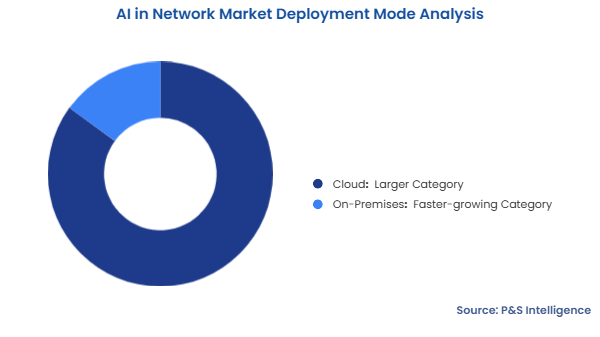
Cloud is the larger category, holding a market share of 85.0%, because cloud-based AI networking platforms offer greater scalability, flexibility, and centralized management across distributed enterprise environments. Organizations increasingly prefer cloud deployment for faster software updates, lower infrastructure costs, and real-time visibility into network performance across branches, data centers, and remote users. Cloud deployment also enables AI-driven automation, predictive analytics, and intelligent traffic management across hybrid and multi-cloud environments.
On-Premises is the faster-growing category, registering a CAGR of 35.5%, because enterprises operating in highly regulated industries require greater control over network infrastructure, latency, and sensitive operational data. Banking, healthcare, government, defense, and telecom organizations increasingly prefer on-premises AI networking solutions to strengthen cybersecurity, ensure regulatory compliance, and maintain data sovereignty. According to the International Telecommunication Union, 177 countries had at least one regulation on personal data protection, privacy protection, or breach notification in force or under development in 2024.
The deployment modes analysed in this report are:
Cloud (Larger Category)
On-Premises (Faster-growing Category)
Network Type Analysis
Wireless Network is the largest category, holding a market share of 60.5%, because mobile, Wi-Fi, 5G, and IoT environments generate highly dynamic traffic that requires continuous optimization and intelligent network management. According to the International Telecommunication Union, mobile broadband traffic reached approximately 1 zettabyte in 2023 and was estimated to approach 1.3 zettabytes in 2024, reflecting the increasing pressure on wireless network infrastructure.
The hybrid network is the fastest-growing category, registering a CAGR of 40.2%, because enterprises are increasingly integrating wired, wireless, cloud, edge, and private network environments to support digital transformation initiatives. Managing these interconnected environments requires AI-driven networking platforms capable of providing centralized visibility, intelligent traffic routing, automated security monitoring, and predictive network optimization.
The network types analysed in this report are:
Wireless Network (Largest Category)
Hybrid Network (Fastest-growing Category)
Wired Network
Enterprise Size Analysis
Large Enterprises is the larger category, holding a market share of 80.0%, because large organizations operate highly complex network environments across multiple offices, data centers, cloud platforms, and geographically distributed users. These organizations have greater financial resources and stronger requirements to minimize network downtime, strengthen cybersecurity, and automate network operations. AI-powered networking solutions enable them to monitor large volumes of network traffic, predict potential failures, optimize performance, and improve operational efficiency across complex digital infrastructure.
Small and medium enterprises are the faster-growing category, registering a CAGR of 40.0%, because SMEs are rapidly adopting cloud services, remote work technologies, and digital collaboration platforms while operating with limited IT resources. AI-powered networking solutions help these organizations automate network monitoring, enhance cybersecurity, and reduce manual troubleshooting without requiring significant infrastructure investments. The increasing availability of cloud-based networking platforms and managed service providers is also making advanced AI networking capabilities more affordable and accessible for SMEs. According to the World Bank, small and medium enterprises account for approximately 90% of businesses and more than half of global employment worldwide.
The Enterprise Sizes analysed in this report are:
Large Enterprises (Larger Category)
Small and Medium Enterprises (Faster-growing Category)
End User Analysis
Telecom Operators is the largest category, holding a market share of 25.5%, because telecom networks manage massive volumes of mobile, broadband, fiber, and core network traffic that require continuous performance optimization and intelligent network management. The rapid expansion of 5G infrastructure, edge computing, and private network deployments is further increasing demand for AI-driven network automation and predictive maintenance solutions. According to the International Telecommunication Union, the world had 9.2 billion mobile-cellular subscriptions and 99 mobile-broadband subscriptions per 100 inhabitants in 2025.
Cloud Service Providers is the fastest-growing category, registering a CAGR of 40.7%, because cloud providers are rapidly expanding hyperscale data centers, edge infrastructure, and AI computing environments to support growing enterprise demand for cloud-native applications and AI workloads. These environments require intelligent networking solutions capable of optimizing traffic routing, reducing latency, automating network operations, and maintaining high service availability across distributed infrastructure.
The end users analysed in this report are:
Telecom Operators (Largest Category)
Cloud Service Providers (Fastest-growing Category)
Data Centres
Government
Defense
Healthcare
Energy and Utilities
Manufacturing
Others
Drive strategic growth with comprehensive market analysis
AI in Network Market Regional Analysis
North America AI in Network Market Analysis
North America holds the largest share, of 45.5%, because the region has a highly developed digital ecosystem supported by advanced telecom infrastructure, hyperscale cloud data centers, and strong enterprise adoption of AI-driven networking technologies. Leading technology companies, cloud service providers, and telecom operators are actively investing in AI-powered network automation, intelligent traffic management, cybersecurity, and predictive network analytics to improve operational efficiency and network reliability. According to the OECD, capital expenditure related to AI infrastructure in the United States contributed approximately 1.1%–1.2% of U.S. GDP growth during the first half of 2025, reflecting substantial investment in AI computing infrastructure, cloud platforms, and advanced networking technologies. These investments are further strengthening the region's leadership in AI-enabled networking and supporting the modernization of large-scale digital infrastructure.
U.S. AI in Network Market Analysis
The U.S. is the largest country market, holding a significant share because enterprises, hyperscale cloud providers, and telecom operators are rapidly expanding AI-driven network infrastructure across data centres, cloud platforms, and edge computing environments. Businesses are increasing the adoption of AI-based network automation to support hybrid workplaces, cybersecurity operations, and large-scale digital services requiring stable and low-latency connectivity. According to the Federal Communications Commission, 5G-NR coverage at 35 Mbps downlink and 3 Mbps uplink reached around 106.4 million locations in 2024. Expanding high-speed connectivity infrastructure is encouraging stronger deployment of AI-enabled traffic optimisation, predictive network monitoring, and intelligent routing technologies across enterprise and telecom environments.
Canada AI in Network Market Analysis
Canada is witnessing steady growth because telecom operators and enterprises are expanding broadband infrastructure and cloud-based operations across geographically distributed regions. Businesses are increasingly investing in AI-powered network monitoring and intelligent traffic management systems to support remote work environments, digital services, and secure enterprise connectivity. Government-backed smart infrastructure projects and rising investment in digital communication systems are also increasing the adoption of AI-enabled networking technologies across commercial sectors. According to the Canadian Radio-television and Telecommunications Commission, 5G networks covered 94% of Canada’s population in 2024. Wider 5G availability is supporting stronger deployment of AI-driven network optimisation, automated performance management, and scalable digital infrastructure systems across enterprise and telecom environments.
Asia-Pacific AI in Network Market Analysis
Asia-Pacific has the highest CAGR, of 41.0%, because the region is rapidly expanding digital infrastructure across both developed and emerging economies. Telecom operators are accelerating 5G deployment, while governments are investing in smart cities, industrial automation, cloud computing, and AI-driven digital transformation initiatives. Manufacturing industries across the region are increasingly adopting AI-enabled networking solutions to support connected factories, robotics, and real-time industrial operations. The rapid expansion of hyperscale data centers, edge computing infrastructure, and enterprise cloud adoption is further increasing demand for intelligent traffic management, network automation, and AI-powered cybersecurity solutions. According to GSMA, the Asia-Pacific region is expected to account for more than half of the world's new mobile subscribers by 2030, driven by rapid digitalization and expanding 5G adoption across major economies. The growing digital ecosystem is accelerating investments in AI-enabled networking platforms capable of supporting high-speed connectivity, large-scale data processing, and increasingly complex network environments.
China AI in Network Market Analysis
China remains a major market because telecom operators, cloud providers, and industrial enterprises are rapidly expanding 5G infrastructure, AI data centres, and intelligent digital networks across manufacturing and urban infrastructure environments. Domestic technology companies are increasingly integrating AI into network operations to manage rising mobile traffic, connected industrial systems, and large-scale cloud ecosystems. Smart city projects, industrial internet development, and factory automation are also increasing the demand for AI-enabled traffic management and predictive network monitoring technologies. According to the National Bureau of Statistics of China, the country had 4.25 million 5G base stations by the end of 2024. Expanding 5G infrastructure is strengthening the deployment of intelligent network automation and AI-driven connectivity management across enterprise and telecom operations.
India AI in Network Market Analysis
India is the fastest-growing country market, registering a strong CAGR because telecom operators and enterprises are rapidly modernising digital infrastructure across urban and semi-urban regions. Rising mobile data consumption, cloud adoption, and internet connectivity are increasing pressure on telecom and enterprise network environments. Businesses are investing in AI-based networking platforms to improve operational efficiency, strengthen network reliability, and support large-scale digital services across banking, retail, healthcare, and IT sectors. According to the Ministry of Communications, India had 4.86 lakh 5G BTS installed in 2025. Expanding 5G deployment is encouraging stronger adoption of AI-enabled traffic optimisation, automated network management, and intelligent connectivity solutions supporting large-scale digital transformation programmes across enterprise and telecom infrastructure environments.
Europe AI in Network Market Analysis
Europe is experiencing stable growth in the market because enterprises across the region are increasingly investing in secure digital infrastructure, industrial automation, and AI-powered network management solutions to improve operational efficiency and strengthen cybersecurity. Telecom operators are modernizing broadband and 5G infrastructure to support rising demand for cloud services, connected devices, and enterprise digital applications. Countries such as Germany, the U.K., and France are expanding the adoption of AI-enabled networking technologies across manufacturing, automotive, healthcare, financial services, and public sector organizations. According to Eurostat, 20% of enterprises in the European Union with 10 or more employees used artificial intelligence technologies in 2025, up from 13.5% in 2024, reflecting rapidly growing enterprise adoption of AI across business operations.
The regions and countries analysed in this report are:
North America (Largest Regional Market)
U.S. (Larger Country)
Canada (Faster-Growing Country)
Europe
Germany (Largest Country)
U.K.
France (Fastest-Growing Country)
Italy
Spain
Rest of Europe
Asia-Pacific (Fastest-Growing Regional Market)
China (Largest Country)
India (Fastest-Growing Country)
Japan
South Korea
Australia
Rest of APAC
Latin America
Brazil (Largest Country)
Mexico (Fastest-Growing Country)
Rest of LATAM
Middle East and Africa
Saudi Arabia (Fastest-Growing Country)
U.A.E. (Largest Country)
South Africa
Rest of MEA
AI in Network Market Competitive Landscape
The market is moderately fragmented, characterized by the presence of global networking companies, cloud infrastructure providers, telecom equipment vendors, cybersecurity firms, and specialized AI networking solution providers. Competition is driven by continuous innovation in AI-powered network automation, intelligent traffic management, network analytics, cybersecurity, and AIOps capabilities. Leading vendors are strengthening their market position through strategic partnerships, acquisitions, product innovation, and integration with cloud, edge computing, and 5G ecosystems. At the same time, emerging companies are introducing specialized solutions for predictive maintenance, intent-based networking, network observability, and AI-driven performance optimization to address evolving enterprise requirements.
Top Companies in the AI in Network Market:
Arista Networks, Inc.
Broadcom Inc.
Cisco Systems, Inc.
Ciena Corporation
Extreme Networks, Inc.
Hewlett Packard Enterprise Company
Huawei Technologies Co., Ltd.
IBM Corporation
Juniper Networks, Inc.
Nokia Corporation
NVIDIA Corporation
Telefonaktiebolaget LM Ericsson
AI in Network Market Developments
In March 2026, Arista Networks announced the XPO (eXtra-dense Pluggable Optics) platform and established the XPO Multi-Source Agreement (MSA) to support next-generation AI networking fabrics. The solution delivers 12.8 Tbps per pluggable module and supports scale-up, scale-out, scale-across, and metro-reach AI data center architectures, while enabling 204.8 Tbps per Open Compute Project (OCP) rack unit, representing a 4× increase in front-panel density compared with 1600G-OSFP optics.
In February 2026, Cisco unveiled Silicon One G300, along with new Cisco N9000 and Cisco 8000 systems for AI data center networking. The launch also included optics and Nexus One management updates. The release centered on switching silicon, system-level networking hardware, and operational tools for large AI cluster environments.
In November 2025, Nokia expanded its data center networking portfolio with the 7220 IXR-H6 switch family and added AIOps capabilities to its Event-Driven Automation platform. The launch was tied to AI training and inference workloads, with the company positioning the hardware and automation updates for AI-focused data center networks.
In October 2025, Broadcom introduced Thor Ultra, an AI Ethernet network interface card for scale-out networking. The product release described support for Ultra Ethernet Consortium specifications and advanced RDMA functions. Broadcom placed the NIC within its Ethernet AI networking portfolio, alongside switching and interconnect products used in large AI infrastructure environments.
In August 2025, Hewlett Packard Enterprise Company announced new Mist agentic AI-native networking capabilities within the HPE Juniper Networking portfolio. The update added agentic AI-powered troubleshooting, expanded self-driving actions, a Large Experience Model, and AIOps features for data centers. The release was focused on network operations across wired, wireless, WAN, and data center domains.
Frequently Asked Questions About This Report
What does the AI in network market include for organizations?+
It includes AI tools that optimize networks, predict faults, detect anomalies, automate configuration, and improve service performance.
What factors are driving demand in the AI in network market?+
Growth is driven by complex traffic, 5G adoption, cloud applications, connected devices, and need for automated network operations.
Why are organizations adopting AI in network solutions across operations?+
Network operators adopt AI to reduce outages, manage capacity, detect security issues, and automate routine network management tasks.
How do AI in network solutions improve decision making and efficiency?+
These solutions improve operations by analyzing telemetry, predicting congestion, recommending fixes, and speeding response to network incidents.
What challenges affect adoption of AI in network solutions today?+
Adoption is affected by data quality, legacy equipment, model explainability, integration with operations tools, and trust in automation.
Want a report tailored exactly to your business need?
Leading companies across industries trust us to deliver data-driven insights and innovative solutions for their most critical decisions. From data-driven strategies to actionable insights, we empower the decision-makers who shape industries and define the future. From Fortune 500 companies to innovative startups, we are proud to partner with organisations that drive progress in their industries.
Client Testimonials
Working with P&S Intelligence and their team was an absolute pleasure – their awareness of timelines and commitment to value greatly contributed to our project's success. Eagerly anticipating future collaborations.
McKinsey & Company
India
Unmatched Standards
Our insights into the minutest levels of the markets, including the latest trends and competitive landscape, give you all the answers you need to take your business to new heights
Complete Data Security
We take a cautious approach to protecting your personal and confidential information. Trust is the strongest bond that connects us and our clients, and trust we build by complying with all international and domestic data protection and privacy laws