This Report Provides In-Depth Analysis of the Network Optimization Market Report Prepared by P&S Intelligence, Segmented by Component (Solutions, Services), Deployment (On-Premises, Cloud-Based, Hybrid), Organization Size (Large Enterprises, Medium & Small Enterprises), End-Use Industry (IT & Telecom, Healthcare, BFSI, Manufacturing, Retail & E-Commerce, Government & Public Sector, Education, Energy & Utilities, Transportation & Logistics, Media & Entertainment), and Geographical Outlook for the Period of 2021 to 2032
Explore the market potential with our data-driven report
Network Optimization Market Overview
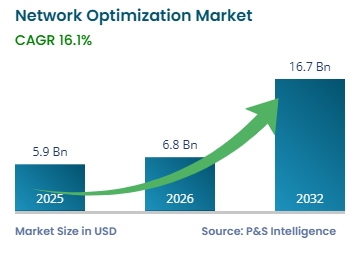
The network optimization market size was USD 5.9 billion for 2025, and it will grow by 16.1% during 2026-2032, to reach USD 16.7 billion by 2032.
The market is expanding rapidly because digital connectivity has become a core part of the global economic and social infrastructure. The fast growth in internet usage, broadband penetration, and enterprise digital transformation popularizes solutions that improve network performance, reduce latency, and enhance reliability. Now, businesses and public institutions are handling massive data volumes from cloud services, remote work, streaming, and IoT deployments. Thus, optimized networks have become critical to sustain network quality and operational efficiency, especially in regions developing advanced telecommunications infrastructure under national digital strategies.
As per the International Telecommunication Union, in 2025, around 6 billion people used the internet, showing the scale of connectivity growth and highlighting the pressure on networks. Fixed broadband and mobile networks handle multiple Zettabytes of data traffic every year, with mobile broadband traffic alone growing at nearly 19% per year. This showcases the rising demand for performance-enhancing network optimization.
Key Market Insights
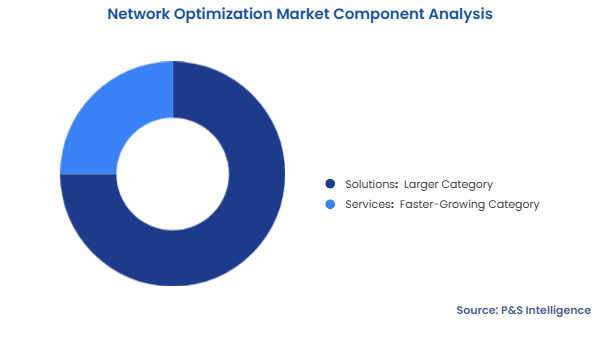
Solutions are the largest component with 75% share, supported by high adoption of SD-WAN, WAN optimization, and traffic management tools.
Services are the fastest-growing component, driven by the extensive outsourcing of performance management and optimization support.
On-premises deployment is dominant due to security and compliance needs, while cloud-based deployment records the fastest growth.
The IT & telecom industry holds a market share of 35%, due to its inherent dependence on high-performance networks to deliver data, voice, and digital services at scale.
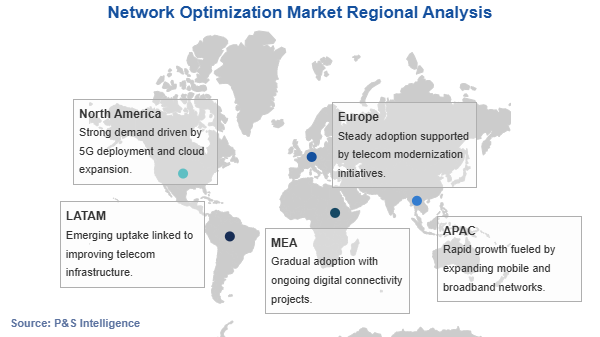
North America remains the largest regional market, whereas Asia-Pacific is the fastest-growing due to rapid digital transformation.
Network Optimization Market Emerging Trends
Integration of Intelligent Automation into Core Network Functions Is Major Trend
The integration of intelligent automation into core network functions, where AI-Driven optimization and intent-based, predictive network coordination are becoming central to performance enhancement. Organizations are moving toward real-time context-aware optimization from traditional traffic shaping and bandwidth management, which can autonomously adjust balance loads, configurations, and support distributed cloud and edge environments. With built-in security and observability, SD-WAN and hybrid networking are evolving into unified platforms, highlighting a broader shift to holistic network management rather than isolated performance tweaks. The growing complexity of digital environments, adoption of multi-cloud workloads, and need for scalable, adaptive network architectures drive this trend.
As per Cisco, by 2026, 60% of the organizations expect to have AI-enabled predictive automation across all network domains, shifting operations towards real-time, context-aware optimization. Further, 67% of the IT teams have begun adopting AI capabilities to simplify operations, automate complex tasks, and accelerate remediation of performance issues—indicating movement toward AI-powered network automation. Juniper Networks’ Data also shows that more than 80% of the enterprises consider AI crucial for unified network management and that around 81% of the sites at the largest enterprises will have SD-WAN by 2026. This highlights the wide adoption of automated networking platforms.
Demand for High-Performance, Reliable, and Secure Connectivity Drives Market
The market is driven by digital transformation and the ever-increasing demand for high-performance, reliable, and secure connectivity across enterprise and service provider networks. The volume and diversity of network traffic are growing rapidly as organizations are adopting cloud services, hybrid IT environments, remote work, and real-time applications. To provide users with low latency, resilient throughput, and consistent quality of experience, enterprises are pushed to invest in optimization solutions. Moreover, emerging technologies, such as IoT and 5G; multi-cloud architectures, and edge computing require more-dynamic and automated optimization to manage complexity and maintain service levels.
As per Ericsson, global mobile network data traffic is expected to more than double from 143 Eb per month in 2025 to 310 Eb per month by 2031 due to video, cloud, 5G, IoT, and real-time applications. This creates a substantial demand for high-performance, reliable connectivity. At the same time, 92% of the enterprises now use two or more public cloud providers for workloads, while over one-third use four or more, intensifying hybrid cloud and distributed networking requirements, as per Cisco. Moreover, 5G is quickly growing toward multi-billion global subscriptions, increasing network load and service exceptions. To ensure low latency, resiliency, and consistent quality of experience, organizations are being pushed toward dynamic optimization solutions.
Network Optimization Market Segmentation Analysis
Component Analysis
Solutions is the largest category, holding a market share of 75%, because it is a building block of network optimization strategies across service providers and enterprises. To enhance performance, visibility, and control, these solutions are embedded into the core network infrastructure. As digital transformation accelerates, organizations prefer a modular, solution-centric approach to provide real-time insights, automation, and end-to-end optimization across WANs, LANs, and cloud links. Solutions reduce latency, improve throughput, and allow integration with security and performance management. They are widely adopted as part of comprehensive network optimization portfolios due to their critical role in maintaining service quality across distributed environments.
Services are the fastest-growing category, registering a CAGR of 16.4%, due to inhouse skills gaps and ongoing support needs, which is why enterprises increasingly outsource complex network optimization tasks to experts. Professional and managed service offerings enable seamless deployment, customization, and continuous improvement of optimization systems as organizations adopt hybrid environments and multi-cloud architectures. Managed services, in particular, allow businesses to offload monitoring, tuning, and performance management, reducing internal overhead. Services are essential for integration, ongoing tuning, updates, and support as digital ecosystems grow more complex.
As per IBM, about 40% of workers will need reskilling as digital and AI transformation accelerates, contributing to outsourcing demand for professional and managed services. Moreover, many IT service providers have raised revenue forecasts due to continued growth in enterprise spending on outsourced IT and cloud services. This shows that managed offerings are increasingly used to offload monitoring, tuning, and performance management tasks.
The components analyzed in this report are:
Solutions (Larger Category)
Services (Faster-Growing Category)
Deployment Analysis
On-premises is the largest category, holding a market share of 50%, because many organizations still want to have direct control over their core networking infrastructure. Industries tend to maintain their networking environments internally, integrating optimization capabilities into their existing hardware and operational models with strict compliance, security, and data residency requirements. On-premises deployment supports high performance and deterministic control, key for mission-critical systems. One more thing that makes on-premises the default deployment model for network optimization solutions is that in many traditional enterprise environments, optimization is still a part of the integral IT strategy.
As per HPE, more than 94% of organizations have adopted cloud computing. Still, especially, for systems requiring high control, security, and compliance, this widespread adoption coexists with substantial on-premise workloads. Official infrastructure guidance also notes that on-premises environments provide greater control and data security, which are crucial factors in enterprise deployment decisions.
Cloud-based is the fastest-growing category, registering a CAGR of 16.5%. To seek scalable, flexible approaches to network optimization, many organizations are increasingly migrating their workloads to cloud platforms. Cloud adoption allows optimization services to be managed centrally, extend performance enhancements to distributed teams and applications, and reduces reliance on physical infrastructure. Cloud-centric optimization supports seamless integration, automated scaling, and rapid deployment as hybrid and multi-cloud strategies are becoming mainstream. The provision of optimization capabilities on demand drives the accelerated adoption of cloud-based models over traditional deployment options.
Microsoft’s Azure cloud business grew 39% year-over-year, demonstrating strong enterprise movement toward cloud platforms for compute and optimization needs. Moreover, global cloud infrastructure spending reached USD 882.5 billion in 2024, with forecasts for USD 2,273.8 billion by 2030.
The deployment modes analyzed in this report are:
On-Premises (Largest Category)
Cloud-Based (Fastest-Growing Category)
Hybrid
Organization Analysis
Large enterprises are the largest category, holding a market share of 65%, as they need complex, multi-site networks that need sophisticated performance management and traffic control capabilities. These organizations, with extensive infrastructure investments and mission-critical applications, prioritize optimization to maintain service continuity, reliability, and user experience. The need to support large employee bases or customer populations, their large IT budgets, and comprehensive digital transformation programs makes optimization a strategic priority. Therefore, large organizations represent the most significant share of enterprise investment in network optimization solutions and associated initiatives.
Almost 94% of large enterprises work on a cloud-first basis, thereby leading the broad digital transformation. Enterprise cloud expenditure can be significantly higher than SMB spending, with large enterprises spending USD 14.3 million annually on cloud services. Cloud computing is used by 94% of organizations with over 1,000 employees, while 54% of enterprises plan to migrate most of their workloads to the cloud in the near future.
SMEs are the fastest-growing category, registering a CAGR of 16.3%, as digital transformation and remote operations have expanded beyond the large corporations. The need for optimization is increasing among businesses adopting cloud services, hybrid work models, and real-time communication tools. With the availability of more-affordable, scalable optimization offerings and managed services, SMEs are more empowered to deploy these capabilities. The need to remain competitive, improve network reliability, and enhance digital experiences without large in-house IT teams drives rapid adoption among SMEs. About 63% of the SME workloads are now hosted in the cloud, and 62% of SMB data resides in public clouds.
The enterprise sizes analyzed in this report are:
Large Enterprises (Larger Category)
SMEs (Faster-Growing Category)
End-Use Industry Analysis
IT & telecom is the largest category, due to its inherent dependence on high-performance networks to deliver data, voice, and digital services at scale. The extensive networking environments that support connectivity across enterprises, consumers, and cloud ecosystem are managed by telecom operators, service providers, and IT infrastructure providers. Network optimization improves throughput, reduces latency, and enhances quality of service, ultimately offering customer satisfaction and business continuity.
As per the International Telecommunication Union (ITU), an estimated 6 billion people, or around three-quarters of the global population, used the internet in 2025, highlighting the scale of digital connectivity that IT & Telecom infrastructures must support. There are over 9.2 billion mobile-cellular subscriptions globally, and mobile broadband accounts for nearly 90% of all mobile subscriptions.
Healthcare is the fastest-growing category, as digital health technologies, telemedicine, connected medical devices, and cloud-based health records become mainstream. For delivering real-time patient data, remote consultations, and critical health services, performance, reliability, and secure connectivity have become essential. The demand for optimized networks that can support high traffic volumes and sensitive data flows has increased due to the increasing complexity of healthcare IT environments. As healthcare organizations modernize and digitize, they accelerate the adoption of network optimization to ensure performance, compliance, and quality of service, driving rapid growth in this category. The global digital health spending is expected to reach USD 1,269.08 billion by 2032, propelling at a rate of 20.89% between 2025 and 2032.
The end-use industries analyzed in this report are:
IT & Telecom (Largest Category)
Healthcare (Fastest-Growing Category)
BFSI
Manufacturing
Retail & E-Commerce
Government & Public Sector
Education
Energy & Utilities
Transportation & Logistics
Media & Entertainment
Drive strategic growth with comprehensive market analysis
Network Optimization Market Geographical Analysis
North America Network Optimization Market Analysis
North America is the largest regional market, capturing a share of 40%, due to its early adoption of advanced networking architectures and a mature enterprise networking landscape. Reliability, performance consistency, and security across complex, large-scale networks supporting cloud, data-center, and hybrid operational models are prioritized by organizations in this region.
U.S. Network Optimization Market Growth
The U.S. dominates the regional market because of its concentration of large enterprises, hyperscale cloud providers, and advanced service provider ecosystems. Massive volumes of enterprise traffic across distributed offices, data centers, and cloud environments are exist in the country, making network optimization a strategic requirement instead of an optional enhancement. The need for proactive network performance management is further increased by strong regulatory expectations around uptime, cybersecurity, and service continuity. Moreover, widespread adoption of remote work, digital platforms, and latency-sensitive applications such as collaboration tools and real-time analytics drives sustained demand for sophisticated optimization solutions across both private and public sector organizations.
In the U.S., nearly USD 89.6 billion is invested in communications infrastructure in 2024 by broadband providers, showing the priority placed on expanding and modernizing networks to meet high-performance, reliability, and scalability needs across cloud, data centers, and hybrid environments.
Canada Network Optimization Market Growth
Canada is emerging as the fastest-growing market in North America due to accelerated digital infrastructure expansion and increasing modernization of enterprise IT environments. Organizations across industries are moving toward more flexible and cloud-aligned architectures from legacy networking frameworks, creating fresh demand for optimization capabilities. As enterprises expand connectivity across geographically distributed locations, optimization solutions are increasingly adopted to maintain performance, manage traffic efficiently, and support evolving digital transformation initiatives, driving faster growth compared to more mature markets.
Asia-Pacific Network Optimization Market Analysis
Asia-Pacific is the fastest-growing region, with 16.2% CAGR, because of rapid digital expansion across emerging and developed economies. Due to large user bases, expanding enterprise digitalization, and ongoing infrastructure build-outs. The region experiences rising network complexity, which together increase the need for scalable and adaptable network optimization solutions.
China Network Optimization Market Growth
China represents the largest market in Asia-Pacific due to its vast digital ecosystem and extensive deployment of enterprise, industrial, and carrier-grade networks. A dense and complex traffic pattern, which requires continuous optimization, is generated by country’s large-scale cloud platforms, data centers, and smart infrastructure initiatives. To support manufacturing, e-commerce, logistics, and digital services, enterprises and service providers focus on maintaining network efficiency across high-volume environments. The scale of operations and the stress on performance stability across massive domestic networks make optimization a critical component of network management strategies in the country.
China shows the largest market in the Asia‑Pacific region for network optimization because of its vast digital ecosystem and large‑scale network infrastructure. China had approximately 1.803 billion mobile telephone users as of April 2025, with around 1.0809 billion 5G users, highlighting the scale and complexity of traffic that requires continuous optimization across enterprise, industrial, and carrier‑grade networks.
India Network Optimization Market Growth
India is the fastest-growing market as organizations expand digital connectivity to support economic growth and large-scale digitization initiatives. To serve a growing digital population, enterprises are increasingly deploying cloud-based applications, mobile-first platforms, and distributed networks. This quick expansion sometimes outpaces traditional network management capabilities, creating strong demand for optimization to ensure consistent performance. Moreover, increasing adoption of remote operations, digital payments, and online public services introduces new traffic patterns and performance requirements. Optimization solution plays a key role in sustaining service quality, driving market growth when networks scale quickly across urban and semi-urban regions.
India’s market is driven by fast digital connectivity expansion and large‑scale adoption of cloud and mobile technologies. According to official government data, India’s total telephone connections expanded from around 933 million in March 2014 to over 1.20 billion by March 2025, and internet connections increased from about 251 million to nearly 969 million by June 2024, highlighting massive growth in digital infrastructure and network usage that fuels strong demand for performance optimization solutions.
The regions and countries analyzed in this report are:
North America (Largest Regional Market)
U.S. (Larger Country)
Canada (Faster-Growing Country)
Europe
Germany (Largest Country)
U.K. (Fastest-Growing Country)
France
Italy
Spain
Rest of Europe
Asia-Pacific (Fastest-Growing Regional Market)
China (Largest Country)
India (Fastest-Growing Country)
Japan
South Korea
Australia
Rest of APAC
Latin America
Brazil (Largest Country)
Mexico (Fastest-Growing Country)
Rest of LATAM
Middle East and Africa
Saudi Arabia (Largest Country)
U.A.E. (Fastest-Growing Country)
South Africa
Rest of MEA
Network Optimization Market Share Analysis
The network optimization market is fragmented, because there is no single dominant entity in control. Instead, multiple telecom operators, infrastructure providers, cloud platforms, and enterprise technology companies compete in different regions. Fragmentation exists because requirements for optimizations are different in each sector. Mobile broadband, fixed broadband, enterprise IT network, 4G/5G systems, cloud environments, and national digital infrastructure have different needs. This is why different companies serve network optimization demands across disparate applications. Additionally, regional regulatory frameworks, localized digital development, and country-specific telecom ecosystems encourage participation from many enterprises, which fragments the competitive landscape rather than concentrating it.
Market activity is widely distributed geographically, with over 9.2 billion global mobile-cellular subscriptions in 2025 and mobile broadband now accounting for 89% of all mobile connections worldwide, as per the ITU. Penetration rates vary significantly among regions from 132 subscriptions per 100 inhabitants in the Americas versus 56 per 100 people in Africa. This means that the demand and optimization needs are spread across regions rather than dominated by one. Historical GSMA data further shows that Asia-Pacific represents about 55% of global unique mobile subscribers, with Europe and North America together accounting for smaller but substantial shares of the remaining user base.
Top Network Optimization Companies:
SolarWinds
Huawei Technologies
Nokia Corporation
ZTE Corporation
Infovista
Citrix Systems
NetScout Systems
Riverbed Technology
FatPipe Networks
Fortinet
Extreme Networks
F5 Networks
Akamai Technologies
CommScope
Ciena Corporation
Network Optimization Market News & Updates
In December 2025, Cisco introduced integrated SD-WAN and SASE networking offerings to simplify hybrid work networking and automate security enforcement across distributed enterprise environments.
In November 2025, Cisco expanded its secure enterprise network architecture with new capabilities to simplify campus and branch operations, accelerating AI-era network deployments.
In October 2025, Arista Networks unveiled next-generation data and AI center networking platforms with enhanced WAN routing and high-performance capabilities, optimizing enterprise network infrastructures.
In August 2025, Arista Networks expanded its AI-driven campus and branch networking offerings with the acquisition of the VeloCloud SD-WAN portfolio to streamline distributed connectivity.
Frequently Asked Questions About This Report
What are the primary benefits of implementing network optimization services?+
Optimization significantly enhances data transmission speeds, reduces operational latency, and lowers overall costs by improving the efficiency of existing infrastructure resources.
How does Artificial Intelligence significantly enhance modern network performance monitoring?+
AI-driven tools automatically predict potential system failures, optimize traffic routing in real-time, and reduce manual troubleshooting efforts through intelligent automation.
Which specific key metrics are critical for measuring network performance?+
IT teams primarily track latency, jitter, packet loss, and throughput to determine if the network meets essential application performance standards.
Why is comprehensive end-to-end visibility essential for hybrid cloud environments?+
Full visibility eliminates blind spots across dispersed architectures, allowing teams to monitor application performance seamlessly from on-premise servers to public cloud platforms.
How does SD-WAN technology effectively contribute to enterprise network optimization?+
SD-WAN improves connectivity by dynamically routing traffic over the best available path, reducing reliance on expensive MPLS lines while maintaining high performance.
What are the biggest challenges currently facing network optimization teams?+
Teams struggle with managing increasing network complexity, integrating legacy hardware with modern cloud tools, and closing the skills gap required for advanced automation.
Want a report tailored exactly to your business need?
Leading companies across industries trust us to deliver data-driven insights and innovative solutions for their most critical decisions. From data-driven strategies to actionable insights, we empower the decision-makers who shape industries and define the future. From Fortune 500 companies to innovative startups, we are proud to partner with organisations that drive progress in their industries.
Client Testimonials
Working with P&S Intelligence and their team was an absolute pleasure – their awareness of timelines and commitment to value greatly contributed to our project's success. Eagerly anticipating future collaborations.
McKinsey & Company
India
Unmatched Standards
Our insights into the minutest levels of the markets, including the latest trends and competitive landscape, give you all the answers you need to take your business to new heights
Complete Data Security
We take a cautious approach to protecting your personal and confidential information. Trust is the strongest bond that connects us and our clients, and trust we build by complying with all international and domestic data protection and privacy laws