AI in Medical Coding Market Size & Share Analysis - Trends, Drivers, Competitive Landscape, and Forecasts (2026 - 2032)
This Report Provides In-Depth Analysis of the AI in Medical Coding Market Report Prepared by P&S Intelligence, Segmented by Component (Software, Services), Deployment Mode (Cloud-Based, On-Premise, Hybrid), Coding Type (Inpatient Coding, Outpatient Coding, Professional Fee Coding), End User (Healthcare Providers, Healthcare Payers, Medical Billing Companies, Government Agencies), and Geographical Outlook for the Period of 2021 to 2032
Explore the market potential with our data-driven report
AI in Medical Coding Market Overview
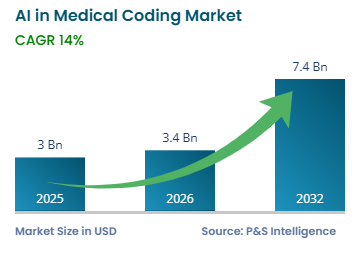
The AI in medical coding market size was USD 3.0 billion for 2025, and it will grow by 14.0% during 2026-2032, to reach USD 7.4 billion by 2032.
Healthcare organizations are increasingly adopting artificial intelligence in medical coding to improve coding accuracy, reduce administrative workloads, and manage growing volumes of clinical documentation. The market is expanding as hospitals, physician groups, and revenue cycle management providers seek technologies that can automate code identification from clinical notes, diagnostic reports, and electronic health records. AI-powered coding systems help streamline coding workflows, improve consistency in code assignment, and support faster claims processing. Growing pressure to optimize reimbursement performance, reduce claim denials, and maintain compliance with evolving coding standards is encouraging healthcare providers to integrate intelligent coding solutions into daily administrative operations.
The market is also benefiting from broader digital transformation across healthcare administration, where organizations are deploying artificial intelligence across operational functions rather than limiting adoption to pilot projects. Medical coding has become a practical area for implementation because coding accuracy directly influences reimbursement outcomes, audit preparedness, and revenue cycle performance. According to the International Telecommunication Union, 5.5 billion people used the internet globally in 2024, representing 68% of the world's population. The continued expansion of digital connectivity supports greater adoption of electronic health records, cloud-based healthcare systems, and digitally managed clinical documentation environments that generate the data required for AI-driven coding platforms. Advances in natural language processing, machine learning, and generative AI are further improving the ability of coding systems to interpret clinical language and support coding teams. Healthcare providers are increasingly using these technologies to improve documentation quality, strengthen coding accuracy, and enhance administrative efficiency across complex healthcare operations.
Key Market Insights
Healthcare Providers are the largest end-user category, holding a market share of 40.0%, due to constant pressure to improve documentation quality, optimize reimbursement, and reduce claim denials.
Cloud-Based is the largest and fastest-growing category, holding a market share of 65.0% and registering a CAGR of 14.8%, because it reduces infrastructure costs and simplifies software management.
Inpatient Coding is the largest coding type, holding a market share of 45.5%, due to complex diagnoses, procedures, comorbidities, and extensive clinical documentation requirements.
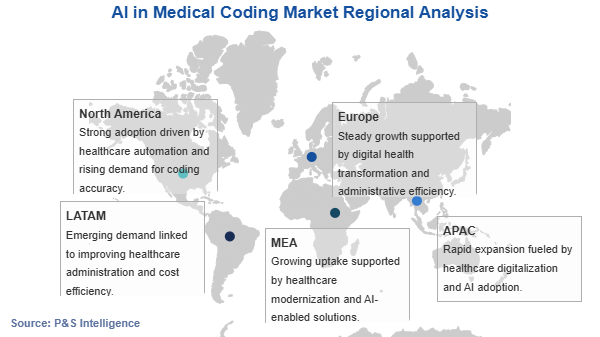
North America holds the largest share of 45.0%, due to widespread electronic health record utilization and strong adoption of revenue cycle management technologies.
Asia-Pacific is the fastest-growing region, registering a CAGR of 15.0%, driven by expanding healthcare IT investments and rising adoption of digital health technologies.
AI in Medical Coding Market Trends and Drivers
Generative AI-Powered Autonomous Coding Workflows Are a Major Trend
The AI in the medical coding industry is shifting from traditional AI-assisted tools toward generative AI platforms capable of interpreting clinical context and supporting larger portions of the coding workflow. Healthcare organizations are increasingly adopting solutions that can analyze physician narratives, discharge summaries, diagnostic reports, and clinical documentation while providing coding recommendations and identifying documentation gaps. According to the World Health Organization, ICD-11 included approximately 17,000 diagnostic categories and more than 130,000 clinical terms in 2025, with software support for up to 2,000,000 terms. The growing complexity of healthcare coding is increasing the need for advanced automation tools capable of interpreting extensive clinical terminology. In 2025, Netsmart Technologies, Inc. launched AlphaCoding, an artificial intelligence-powered clinical coding solution that reviews documentation, recommends diagnosis and procedure codes, and supports coder validation workflows. These developments are accelerating the transition toward workflow-driven coding environments where AI performs initial coding tasks while human coders focus on review, exception handling, and compliance oversight.
Rising Pressure to Reduce Claim Denials and Revenue Leakage Drives Market
Healthcare providers are increasingly investing in AI-powered medical coding solutions to strengthen reimbursement performance and reduce financial losses associated with coding errors and incomplete documentation. Accurate code assignment is essential for claims processing, payment approval, audit readiness, and revenue cycle management. As payer requirements become more detailed and documentation standards continue to evolve, healthcare organizations are seeking technologies that improve coding consistency and reduce administrative rework. According to the Organisation for Economic Co-operation and Development, healthcare spending across OECD countries averaged 9.3% of GDP in 2024. According to the Centers for Medicare & Medicaid Services, 77.17% of Medicaid improper payments in 2025 were associated with insufficient documentation. These financial and compliance pressures are increasing demand for AI-driven coding platforms that help identify documentation deficiencies, improve coding accuracy, support payment integrity, and strengthen revenue cycle performance across healthcare organizations.
Concerns Over Coding Accuracy in Complex Clinical Cases Restrain Market
Despite advances in artificial intelligence, healthcare organizations remain cautious about fully automating medical coding for complex clinical cases. Medical records often contain specialty-specific terminology, incomplete documentation, and nuanced physician language that requires contextual interpretation beyond automated code assignment. AI-generated recommendations frequently require human review to ensure compliance with coding standards, reimbursement requirements, and audit expectations. According to the World Health Organization, the 2024 ICD-11 update introduced more than 200 new allergen codes. The continued expansion of coding classifications increases the complexity of code selection and documentation review. Healthcare providers therefore continue to rely on coding professionals to validate recommendations, manage exceptions, and maintain coding accuracy, which can slow adoption of fully automated coding workflows.
Expansion of AI Medical Coding Adoption Among Small and Mid-Sized Healthcare Providers Creates Market Opportunity
A significant opportunity for the market is emerging from the growing accessibility of AI-powered coding solutions among small and mid-sized healthcare providers. Cloud-based platforms, software-as-a-service delivery models, and scalable deployment options are reducing barriers that previously limited adoption to large healthcare systems. Physician groups, outpatient centers, specialty clinics, and community healthcare organizations are increasingly seeking technologies that improve coding efficiency without expanding administrative staffing levels. According to the World Health Organization, the global health workforce exceeded 70 million workers in 2024, while workforce shortages remain a concern across healthcare systems. These staffing pressures are increasing interest in AI-enabled coding tools that help reduce administrative burdens, improve workflow efficiency, and support revenue cycle operations across a broader range of healthcare providers.
AI in Medical Coding Market Segmentation Analysis
Component Analysis
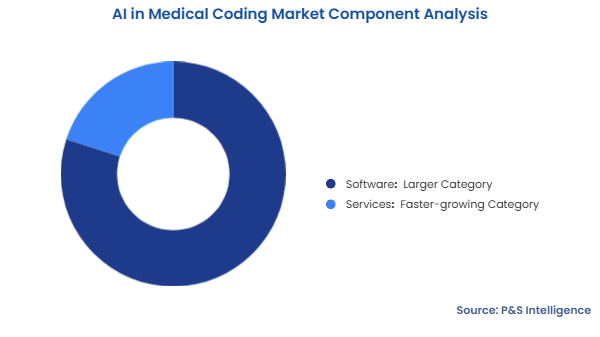
Software is the larger category, holding a market share of 80.0%, because AI-driven coding platforms serve as the foundation of medical coding automation across healthcare organizations. These solutions automate code assignment, analyze clinical documentation, support compliance monitoring, and integrate directly with electronic health records and revenue cycle systems. In 2025, CodaMetrix launched CMX CARE and a new Emergency Department coding automation module, demonstrating continued innovation in AI-powered coding software. Expanding platform capabilities enable providers to automate more coding workflows, improve coding consistency, and support broader deployment of AI across clinical and administrative operations.
Services are the faster-growing category, registering a CAGR of 14.2%, due to increasing demand for implementation support, workflow customization, training, system integration, and ongoing optimization of AI-based coding solutions. Many healthcare organizations lack internal expertise to deploy and manage advanced coding technologies effectively, creating strong demand for consulting and managed services. As AI applications become more sophisticated and regulatory requirements evolve, providers increasingly rely on specialized service partners to ensure successful deployment, performance improvement, compliance alignment, and long-term operational efficiency.
The components analysed in this report are:
Software (Larger Category)
Services (Faster-growing Category)
Deployment Mode Analysis
Cloud-Based is the largest and fastest-growing category, holding a market share of 65.0% and registering a CAGR of 14.8%, because healthcare organizations increasingly favor deployment models that reduce infrastructure costs and simplify software management. Cloud-based platforms support faster implementation, centralized data access, and seamless integration across hospitals, clinics, and payer networks. In 2026, AWS launched Amazon Connect Health, an agentic AI healthcare solution that includes medical coding capabilities for generating ICD-10 and CPT codes from clinical notes, reflecting continued investment in cloud-enabled coding technologies. Expanding cloud adoption allows healthcare providers to scale coding operations efficiently while maintaining access to continuously updated AI capabilities.
The deployment modes analysed in this report are:
Cloud-Based (Largest and Fastest-growing Category)
On-Premise
Hybrid
Coding Type Analysis
Inpatient Coding is the largest category, holding a market share of 45.5%, because inpatient encounters involve complex diagnoses, procedures, comorbidities, and extensive clinical documentation that require detailed coding review. Healthcare organizations place significant emphasis on coding accuracy in inpatient settings because reimbursement outcomes and regulatory compliance depend heavily on proper code assignment. According to the Centers for Medicare & Medicaid Services, the number of MS-DRGs increased to 773 in 2025 for inpatient and long-term care hospital payment systems, reflecting the complexity of inpatient reimbursement structures. This complexity continues to drive demand for AI-powered coding tools that improve accuracy, reduce manual effort, and support documentation integrity.
Outpatient Coding is the fastest-growing category, registering a CAGR of 14.5%, due to the ongoing shift toward outpatient care, ambulatory services, day procedures, and specialty clinic visits. Healthcare systems are increasingly managing larger patient volumes outside traditional inpatient settings, creating substantial coding workloads. AI-based coding solutions help organizations process these encounters more efficiently while maintaining coding accuracy and reimbursement quality. As outpatient services continue expanding across healthcare delivery models, demand for intelligent coding automation within this segment is rising rapidly.
The coding types analysed in this report are:
Inpatient Coding (Largest Category)
Outpatient Coding (Fastest-growing Category)
Professional Fee Coding
Others
End User Analysis
Healthcare Providers is the largest category, holding a market share of 40.0%, because hospitals, physician groups, specialty clinics, and integrated healthcare networks account for a substantial share of medical coding activities. These organizations manage large volumes of clinical documentation and require accurate coding to support reimbursement, claims processing, regulatory compliance, and revenue cycle management. According to the Centers for Medicare & Medicaid Services, 77.17% of Medicaid improper payments in 2025 were associated with insufficient documentation, highlighting the importance of accurate documentation and coding processes in supporting payment integrity.
Healthcare Payers is the fastest-growing category, registering a CAGR of 14.5%, as insurance organizations increasingly adopt artificial intelligence to improve claims processing, payment accuracy, utilization management, and fraud detection. AI-powered coding and clinical documentation technologies can help payers analyze medical records, validate submitted codes, identify discrepancies, and support more efficient claims review. According to the United States Government Accountability Office, by 2025 the Centers for Medicare & Medicaid Services had completed 899 managed care provider audits and opened 155 managed care plan audits, identifying more than USD 33 million in overpayments.
The end users analysed in this report are:
Healthcare Providers (Largest Category)
Healthcare Payers (Fastest-growing Category)
Medical Billing Companies
Government Agencies
Others
Drive strategic growth with comprehensive market analysis
AI in Medical Coding Market Regional Analysis
North America AI in Medical Coding Market Analysis
North America holds the largest share, of 45.0%, due to its established healthcare reimbursement ecosystem, advanced healthcare IT infrastructure, widespread electronic health record adoption, and strong focus on revenue cycle management. Healthcare organizations across the region are increasingly adopting AI-enabled coding solutions to manage growing volumes of clinical documentation, improve coding accuracy, streamline administrative workflows, and support reimbursement and compliance requirements. The region's mature digital healthcare infrastructure provides a strong foundation for the integration of artificial intelligence into medical coding and other administrative functions. According to the Office of the National Coordinator for Health Information Technology, 91% of U.S. office-based physicians used certified electronic health records in 2024, demonstrating the high level of digital clinical documentation across the region's largest healthcare market.
U.S. AI in Medical Coding Market Analysis
The United States represents the larger and faster-growing market for AI in medical coding due to its highly complex healthcare reimbursement system, extensive clinical documentation requirements, and widespread adoption of healthcare information technology. Healthcare providers are increasingly implementing AI-powered coding solutions to improve coding accuracy, reduce administrative workloads, strengthen revenue cycle performance, and support compliance with evolving coding standards. According to the Centers for Medicare & Medicaid Services, 77.17% of Medicaid improper payments in 2025 were associated with insufficient documentation. This highlights the financial impact of documentation and coding inaccuracies and reinforces the need for advanced technologies that can improve coding consistency, support documentation quality, reduce claim denials, and enhance operational efficiency across healthcare organizations.
Asia-Pacific AI in Medical Coding Market Analysis
Asia-Pacific has the highest CAGR, of 15.0%, supported by the rapid digitalization of healthcare systems, increasing investments in healthcare information technology, expanding electronic health record adoption, and growing use of artificial intelligence across healthcare operations. Healthcare organizations across the region are increasingly strengthening digital health infrastructure and adopting technologies that improve clinical documentation, data management, administrative efficiency, and healthcare delivery. According to the World Health Organization, eight of the 10 Member States in the WHO South-East Asia Region had developed national digital health blueprints by 2026, with five countries having endorsed these blueprints and progressing toward implementation. The increasing development of national digital health strategies, electronic health record systems, interoperable health information infrastructure, and AI-enabled healthcare tools is creating a stronger digital foundation for AI-powered medical coding solutions.
China AI in Medical Coding Market Analysis
China's market is supported by ongoing healthcare digitalization efforts and growing adoption of artificial intelligence across hospital operations. Healthcare institutions are implementing technologies that improve administrative efficiency, strengthen data management, and support standardized reimbursement processes. According to Xinhua News Agency, DRG and DIP payment models were implemented across all 393 medical insurance pooling areas in China in 2025. The nationwide expansion of standardized reimbursement systems is increasing the importance of accurate coding and documentation practices, creating favorable conditions for broader adoption of AI-enabled medical coding platforms.
India AI in Medical Coding Market Analysis
India is experiencing growing adoption of AI in medical coding as healthcare organizations expand digital operations and modernize administrative workflows. The country benefits from a large healthcare services ecosystem and increasing use of healthcare automation technologies. According to the Press Information Bureau of India, 79.91 crore ABHA accounts and 67.19 crore health records were linked through the Ayushman Bharat Digital Mission in 2025. The continued growth of digital health records is strengthening the healthcare data ecosystem and creating a larger foundation for AI-powered coding solutions that support documentation management and coding efficiency.
Europe AI in Medical Coding Market Analysis
Europe represents a significant market for AI in medical coding, supported by the region's advanced healthcare infrastructure, increasing digitalization of healthcare systems, and growing emphasis on clinical documentation, data interoperability, and administrative efficiency. Healthcare providers across the region are increasingly adopting digital health technologies to manage clinical information, streamline administrative processes, and improve the efficiency of healthcare delivery. The European Union's continued development of the European Health Data Space is also strengthening the digital foundation for healthcare data exchange, interoperability, and the wider use of electronic health records. According to the European Commission, the average eHealth maturity score across the EU-27 reached 87% in 2025, increasing by 4 percentage points from 2024, as Member States continued progressing toward the EU target of providing all citizens with access to their electronic health records by 2030.
The regions and countries analysed in this report are:
North America (Largest Regional Market)
U.S. (Larger and Faster-Growing Country)
Canada
Europe
Germany (Largest Country)
U.K. (Fastest-Growing Country)
France
Italy
Spain
Rest of Europe
Asia-Pacific (Fastest-Growing Regional Market)
China (Largest Country)
India (Fastest-Growing Country)
Japan
South Korea
Australia
Rest of APAC
Latin America
Brazil (Largest Country)
Mexico (Fastest-Growing Country)
Rest of LATAM
Middle East and Africa
Saudi Arabia (Largest Country)
U.A.E. (Fastest-Growing Country)
South Africa
Rest of MEA
AI in Medical Coding Market Competitive Landscape
The AI in medical coding market is fragmented, with participation from healthcare technology vendors, revenue cycle management companies, clinical documentation specialists, and artificial intelligence developers. The market includes various technology models, such as standalone medical coding platforms, cloud-based applications, and integrated revenue cycle management solutions. Competition is influenced by factors such as coding accuracy, workflow integration, specialty-specific capabilities, compliance support, interoperability, and AI performance. Companies are developing solutions for specific healthcare segments, coding specialties, clinical workflows, and geographic markets, resulting in a diverse competitive landscape. Continuous advancements in natural language processing, machine learning, and generative AI are expanding the capabilities of medical coding solutions and creating opportunities for specialized technology providers to enter and develop solutions within the market.
Leading Companies in the AI in Medical Coding Market:
Solventum Corporation
Optum, Inc.
CodaMetrix, Inc.
Fathom, Inc.
Nym Health, Inc.
Dolbey Systems, Inc.
R1 RCM Inc.
CorroHealth, Inc.
Oracle Corporation
AKASA, Inc.
AGS Health, LLC
Corti
Innovaccer, Inc.
Qventus, Inc.
Commure, Inc.
AI in Medical Coding Market Developments
In April 2026, Corti released Symphony for Medical Coding through its application programming interface for healthcare software teams. The model is built for coding tasks that require evidence review, guideline interpretation, and traceable code selection.
In March 2026, Innovaccer, Inc. launched Flow Capture as part of Flow by Innovaccer, its revenue cycle suite. The product reads signed encounter documentation, extracts clinical entities, maps diagnoses and procedures to billing codes, and applies payer and coverage rules before submission.
In February 2026, Qventus, Inc. launched the Care Gap and Coding Automation Suite for provider electronic health record workflows. The live suite identifies missed diagnoses, prompts clinical follow-up, and completes documentation while care is still active.
In March 2025, CodaMetrix launched a company rebrand while expanding its AI-powered autonomous coding platform across more than 25 health-system partners in 26 states. The company also highlighted its platform's ability to automate coding across multiple specialties and integrate with electronic health records.
In March 2024, Dolbey Systems, Inc. announced AI Assist, a generative AI capability for healthcare workflow automation that supports text analysis, summarization, transformation, and generation. The solution can also suggest ICD-10 billing codes and enhance clinical documentation, strengthening Dolbey's AI capabilities in medical coding and healthcare workflows.
Frequently Asked Questions About This Report
What does the AI medical coding market include for organizations?+
It includes AI solutions that analyze clinical documentation, recommend medical codes, and improve coding efficiency.
What factors are driving demand in the AI medical coding market?+
Demand is driven by coding complexity, increasing documentation volumes, reimbursement pressure, workforce constraints, and administrative efficiency needs.
Why are organizations adopting AI medical coding solutions?+
Organizations adopt these solutions to improve coding accuracy, reduce manual workload, identify documentation gaps, and improve revenue cycle performance.
How do AI medical coding solutions improve efficiency?+
They analyze clinical documentation, recommend codes, flag documentation gaps, and support coders in complex cases.
What challenges affect adoption of AI medical coding solutions?+
Key challenges include complex cases, documentation quality, system integration, coding requirements, and the need for human validation.
Want a report tailored exactly to your business need?
Leading companies across industries trust us to deliver data-driven insights and innovative solutions for their most critical decisions. From data-driven strategies to actionable insights, we empower the decision-makers who shape industries and define the future. From Fortune 500 companies to innovative startups, we are proud to partner with organisations that drive progress in their industries.
Client Testimonials
Working with P&S Intelligence and their team was an absolute pleasure – their awareness of timelines and commitment to value greatly contributed to our project's success. Eagerly anticipating future collaborations.
McKinsey & Company
India
Unmatched Standards
Our insights into the minutest levels of the markets, including the latest trends and competitive landscape, give you all the answers you need to take your business to new heights
Complete Data Security
We take a cautious approach to protecting your personal and confidential information. Trust is the strongest bond that connects us and our clients, and trust we build by complying with all international and domestic data protection and privacy laws