Medical Coding Market Size & Share Analysis - Emerging Trends, Growth Opportunities, Competitive Landscape, and Forecasts (2026 - 2032)
This Report Provides In-Depth Analysis of the Medical Coding Market Report Prepared by P&S Intelligence, Segmented by Service Provider (In-house, Outsourced), Classification System (International Classification of Diseases (ICD), Current Procedural Terminology (CPT), Healthcare Common Procedure Coding System (HCPCS)), End User (Hospitals & Clinics, Ambulatory Surgical Centers, Diagnostic & Imaging Centers), and Geographical Outlook for the Period of 2021 to 2032
Explore the market potential with our data-driven report
Medical Coding Market Future Outlook
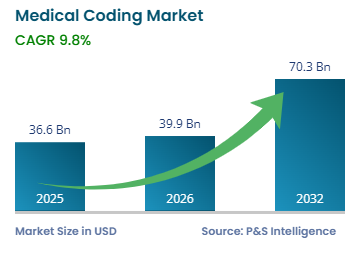
The medical coding market size was USD 36.6 billion for 2025, and it will grow by 9.8% during 2026–2032, to reach USD 70.3 billion by 2032.
This growth is supported by the accelerating adoption of electronic health records, the integration of artificial intelligence and natural language processing into coding workflows, and the increasing complexity of healthcare billing and reimbursement systems across hospitals, ambulatory surgical centers, and diagnostic facilities worldwide.
The demand for medical coding services is substantially influenced by the rising volume of patient encounters and the implementation of updated classification systems. The American Hospital Association reported that there were approximately 33.7 million hospital admissions in the United States in 2024. This creates significant demand for skilled medical coders and automated coding solutions to manage billing procedures and ensure reimbursement accuracy.
Key Highlights
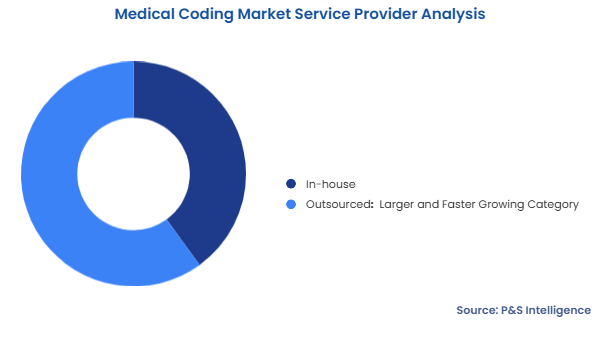
Outsourced medical coding services accounted for approximately 60% of global demand in 2025.
ICD remained the largest classification system segment in 2025, with 55% share, driven by its mandatory use in diagnosis reporting and reimbursement.
Hospitals & clinics represented approximately 70% of total market demand in 2025, due to high inpatient and outpatient coding volumes.
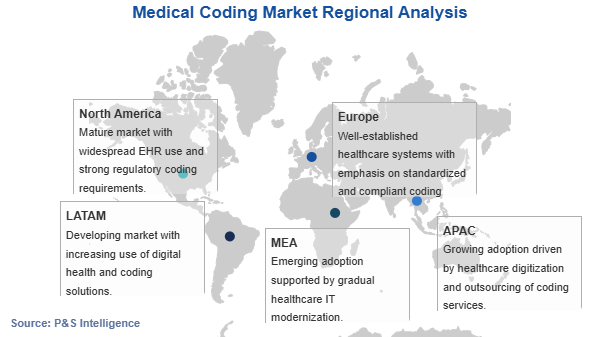
North America accounted for around 40% of the global medical coding market in 2025, supported by strict CMS coding regulations and widespread EHR adoption.
Asia-Pacific is the fastest-growing regional market, driven by healthcare digitization and medical coding outsourcing growth.
Germany is the largest country market in Europe, driven by mandatory diagnosis-related group (DRG)–based reimbursement, standardized clinical documentation requirements, and extensive hospital reporting obligations.
Medical Coding Market Trends & Drivers
Automation and Artificial Intelligence Integration Are Key Trends
Healthcare organizations worldwide are increasingly deploying artificial intelligence, natural language processing, and computer-assisted coding technologies to automate routine coding tasks, improve coding accuracy, and reduce turnaround times for claims submission. These technologies analyze clinical documentation to suggest appropriate diagnostic and procedure codes, reducing manual review requirements while maintaining compliance with coding standards. The U.S. Office of the National Coordinator for Health Information Technology reports that over 96% of U.S. non-federal acute care hospitals had adopted certified electronic health records by early 2020s. This significantly increases the volume of digital clinical documentation suitable for AI-assisted coding workflows.
The transformation extends beyond simple automation; AI-enabled coding tools increasingly provide real-time or near-real-time coding suggestions during documentation review, helping reduce coding backlogs and claims submission delays. The American Health Information Management Association (AHIMA) notes that computer-assisted coding is primarily used to support coder productivity and consistency rather than replace certified coding professionals, particularly for inpatient and complex specialty cases.
Despite technological advances, the U.S. Bureau of Labor Statistics projects employment of medical records specialists will grow by approximately 7% between 2024 and 2034. This reflects continued reliance on skilled human coders for compliance oversight, audit defense, and complex clinical judgment. The trajectory indicates sustained adoption of hybrid workflows combining automation efficiency with expert human validation.
Value-Based Care Models and Documentation Requirements Is Biggest Driver
The accelerating shift from fee-for-service to value-based reimbursement models fundamentally alters medical coding requirements, creating sustained demand for precise documentation and advanced coding practices. The Centers for Medicare & Medicaid Services has established multiple value-based programs that reward healthcare providers with incentive payments for quality of care rather than volume of services, requiring detailed coding of patient conditions, comorbidities, risk factors, and outcomes to support accurate risk adjustment and quality measurement.
Value-based care models including accountable care organizations, bundled payments, and quality-linked incentive programs require comprehensive capture of patient conditions, comorbidities, and risk factors through standardized coding systems such as hierarchical condition categories (HCCs). CMS reports that more than half of traditional Medicare beneficiaries are now attributed to providers participating in value-based or alternative payment models, significantly expanding the population subject to risk-adjusted coding requirements.
Additionally, the Organisation for Economic Co-operation and Development reports that OECD countries spent 9.3% of their GDP on health in 2024, with healthcare expenditure growth outpacing GDP in many developed economies, intensifying pressure to demonstrate value through accurate coding and data-driven quality reporting. This spending pressure intensifies payer and government focus on accurate coding, risk adjustment, and data-driven quality reporting to demonstrate value and control costs. In Europe, healthcare providers face growing pressure to improve coding accuracy for diagnosis-related group (DRG) payment systems and cross-border healthcare comparability within the EU.Top of FormBottom of Form
Medical Coding Market Segmentation and Category Analysis
Service Provider Analysis
The outsourced category holds the largest market share, of 60%, in 2025, and is also projected to register the fastest growth during 2026–2032, with 10.1% CAGR. This reflects healthcare providers' strategic shift toward external coding service providers to address persistent workforce shortages, reduce fixed labor costs, and access specialized coding expertise across multiple classification systems and medical specialties. Outsourced medical coding enables hospitals and healthcare facilities to scale coding capacity rapidly without the overhead associated with recruiting, training, and retaining in-house coding staff.
According to the U.S. Bureau of Labor Statistics, employment of medical records and health information specialists is projected to grow steadily through the next decade, indicating sustained demand and ongoing workforce constraints in the coding profession.
Moreover, the category is driven by the availability of offshore coding services from countries including India and the Philippines, where large pools of English-proficient, certified coders provide cost-effective solutions, while maintaining compliance with international coding standards. Both countries have established health information management training and certification ecosystems aligned with U.S. coding systems, such as ICD-10-CM, CPT, and HCPCS. This enables offshore teams to support U.S. healthcare providers under standardized quality assurance and audit frameworks.
The service providers analyzed in this report are:
In-house
Outsourced (Larger and Faster Growing Category)
Classification System Analysis
The ICD category holds the largest market share, of 55%, in 2025, supported by its designation as the global standard for clinical documentation and mortality and morbidity reporting established by the World Health Organization. Its International Classification of Diseases 11th Revision (ICD-11) contains approximately 17,000 unique diagnostic categories and more than 120,000 codable terms for comprehensive disease classification and health trend monitoring. This enables more precise clinical documentation and driving healthcare providers to invest in advanced coding infrastructure and specialized coders capable of navigating these comprehensive coding standards.
ICD codes serve as the foundation for healthcare billing and reimbursement across virtually all payment systems globally, with nearly universal adoption among hospitals, clinics, and other healthcare facilities for documenting patient diagnoses and conditions. The category’s dominance also reflects ICD codes' essential role in epidemiological surveillance, public health reporting, and clinical research, extending utility beyond billing applications.
The CPT category will have the highest CAGR, of 10.0%. This is fueled by the shift toward procedure-based billing models, adoption of ambulatory surgical centers and outpatient facilities requiring detailed procedure coding, and increasing granularity in CPT code sets enabling precise documentation of surgical techniques and medical services. CPT codes, maintained by the American Medical Association, serve as the primary system for documenting medical, surgical, and diagnostic services in the United States and select international markets, with particular importance in ambulatory care settings and physician practices. Growth is further supported by ongoing CPT code expansions accommodating emerging medical technologies, minimally invasive procedures, and telehealth services requiring dedicated coding frameworks.
The classification systems analyzed in this report are:
International Classification of Diseases (ICD) (Largest Category)
Current Procedural Terminology (CPT) (Fastest Growing Category)
Healthcare Common Procedure Coding System (HCPCS)
End User Analysis
The hospitals & clinics category holds the largest market share, of 70%, in 2025, driven by the substantial volume of inpatient and outpatient encounters requiring comprehensive medical coding for billing, quality reporting, and regulatory compliance purposes. Hospitals generate complex coding requirements spanning emergency department visits, inpatient admissions, surgical procedures, diagnostic services, and outpatient care, necessitating large coding departments or substantial outsourced coding arrangements. The CMS administers diagnosis-related group (DRG)–based payments for inpatient hospital services, where reimbursement is directly determined by the accuracy and completeness of ICD diagnosis and procedure coding. Large hospital systems maintain specialized coding teams for high-complexity services including trauma, critical care, and specialized surgical procedures requiring expert-level coding knowledge.
The ambulatory surgical centers category will have the highest CAGR. It is propelled by the rapid expansion of outpatient surgery volumes, favorable reimbursement policies encouraging procedure migration from hospital inpatient settings to ambulatory facilities, and lower facility costs making ambulatory surgery increasingly attractive to payers and patients. The Medicare Payment Advisory Commission reports that the number of Medicare-certified ambulatory surgical centers increased steadily between 2017 and 2021, reflecting continued expansion of outpatient surgical capacity.
Drive strategic growth with comprehensive market analysis
Medical Coding Market Geographical Analysis
North America Medical Coding Market Size
North America holds the largest market share, of 40%, in 2025, sustained by stringent regulatory frameworks, mature healthcare IT infrastructure, and widespread adoption of revenue cycle management solutions. The CMS mandates standardized coding systems, including ICD-10-CM, CPT, and HCPCS for Medicare and Medicaid claims processing, encompassing several billion healthcare claims processed annually across the United States.
Additionally, the healthcare expenditure averages over USD 4 trillion annually in the United States, with total national health expenditure reaching USD 4.5 trillion in 2022, approximately 17.3% of GDP, as reported by CMS National Health Expenditure Accounts. This creates substantial demand for accurate billing and coding services to optimize reimbursement and minimize claim denials. The region continues to witness accelerating adoption of AI-powered coding platforms and computer-assisted coding systems as healthcare providers seek to address persistent coder shortages while maintaining compliance with evolving coding standards and value-based reimbursement models.
U.S. Medical Coding Market Size
The United States holds the largest market share within North America in 2025, driven by comprehensive regulatory mandates and the high complexity of the U.S. healthcare reimbursement system. The CMS reports that Medicare fee-for-service alone accounts for over 1.2 billion claims annually, creating sustained demand for both in-house coding staff and outsourced coding services. The anticipated future transition from ICD-10 to ICD-11 in several healthcare systems globally, combined with ongoing updates to CPT and HCPCS codes, necessitates continuous training and investment in coding infrastructure.
Asia-Pacific Medical Coding Market Size
Asia-Pacific will have the highest CAGR, of 9.9%, driven by rapid healthcare infrastructure expansion, increasing insurance coverage, and government initiatives promoting healthcare digitization. The WHO reports that 14 countries and areas in the Asia-Pacific region had begun collecting or reporting health data using ICD-11 coding as of 2024, reflecting accelerating adoption of international coding standards across the region. China, India, Japan, and South Korea are implementing national health insurance programs requiring standardized medical coding for claims processing and healthcare quality monitoring. Many of these systems rely on centralized claims administration models, significantly increasing coding volume consistency and compliance requirements.
India Medical Coding Market Size
India represents the fastest-growing medical coding markets within Asia-Pacific, positioned as both a significant domestic market and a major global outsourcing hub for medical coding services. The Ayushman Bharat – PM-JAY government-backed health insurance program now covers over 500 million beneficiaries, significantly expanding hospital claims volumes that require standardized diagnosis and procedure coding. India's medical coding industry benefits from a large pool of trained coders, competitive labor costs, and strong English language proficiency, enabling Indian coding firms to serve healthcare providers across North America, Europe, and other developed markets. The Ayushman Bharat Digital Mission promotes nationwide digitization of health records and standardized health data exchange, reinforcing long-term demand for structured clinical documentation and medical coding expertise.
The regions and countries of the market are as follows:
North America (Largest Growing Region)
U.S. (Largest and Fastest-Growing Country Market)
Canada
Europe
Germany (Largest Country Market)
U.K. (Fastest-Growing Country Market)
France
Italy
Spain
Rest of Europe
Asia-Pacific (Fastest-Growing Region)
China (Largest Country Market)
India (Fastest-Growing Country Market)
Japan
South Korea
Australia
Rest of Asia-Pacific
Latin America
Brazil (Largest Country Market)
Mexico (Fastest-Growing Country Market)
Rest of Latin America
Middle East & Africa
Saudi Arabia (Largest Country Market)
U.A.E. (Fastest-Growing Country Market)
South Africa
Rest of MEA
Medical Coding Market Competitive Landscape
The market is moderately fragmented, characterized by the presence of diverse participants spanning software vendors, outsourcing service providers, revenue cycle management firms, and specialized coding companies. This fragmentation stems from the heterogeneous nature of coding requirements across healthcare settings, regional and country-specific variations in coding standards and regulatory frameworks, combination of technology products and professional services creating multiple competitive dimensions, and relatively moderate barriers to entry for specialized service providers targeting specific medical specialties or facility types.
Market concentration varies significantly between segments, with medical coding software demonstrating greater consolidation among established health IT vendors, while coding services remain highly fragmented across numerous regional and specialty-focused providers. Additionally, the competitive landscape continues evolving as technology advances in artificial intelligence enable greater coding automation while persistent coder shortages sustain demand for outsourced services, creating parallel growth trajectories for both software-driven automation and human-intensive service models.
Key Medical Coding Companies:
Optum Inc.
3M Company
Nuance Communications Inc.
GeBBS Healthcare Solutions
Aviacode Inc.
Omega Healthcare Management Services
AGS Health
Coronis Health
R1 RCM Inc.
Access Healthcare
MiraMed Global Services
Aquity Solutions
Medical Coding Market News & Updates
In November 2025, Netsmart Technologies Inc. launched AlphaCoding, an artificial intelligence-powered medical coding solution featuring Benny, an embedded AI coding assistant that provides near real-time, evidence-based coding recommendations aligned with CMS guidelines. The platform aims to reduce manual coding effort and improve compliance across post-acute care and human services provider settings.
In August 2025, Oracle Corporation announced plans to launch a new AI-backed electronic health record system, built on Oracle Cloud Infrastructure and developed independently of the traditional Cerner platform.
In November 2024, TowerBrook Capital Partners L.P. and Clayton, Dubilier & Rice LLC completed the acquisition of R1 RCM Inc. for USD 8.9 billion.
In September 2024, EQT Private Capital Asia agreed to acquire a controlling beneficial interest in GeBBS Healthcare Solutions Inc., a global revenue cycle management and medical coding services provider. The transaction enables GeBBS's expansion into new customer segments, strengthens in-house technology capabilities, and drives further merger & acquisition activity.
In January 2024, R1 RCM Inc. completed its acquisition of Acclara, Providence Health System's modular revenue cycle services business, and entered into a 10-year comprehensive revenue cycle management partnership with the latter.
Frequently Asked Questions About This Report
What will be the CAGR of the medical coding market between 2020 and 2030?+
The medical coding market is predicted to exhibit a 9.6% CAGR between 2020 and 2030.
On what basis has the medical coding industry been segmented?+
The medical coding industry is segmented on the basis of classification system, end user, and region.
What will be the value of the medical coding market in 2030?+
The medical coding market will attain a value of $42.4 billion in 2030.
Why will the medical coding industry demonstrate lucrative growth in APAC in future?+
The medical coding industry will exhibit rapid advancement in APAC because of the increasing digitization of patient records in South Korea and India.
Which regions are covered in the medical coding market report?+
APAC, LATAM, MEA, Europe, and North America are covered in the medical coding market report.
Want a report tailored exactly to your business need?
Leading companies across industries trust us to deliver data-driven insights and innovative solutions for their most critical decisions. From data-driven strategies to actionable insights, we empower the decision-makers who shape industries and define the future. From Fortune 500 companies to innovative startups, we are proud to partner with organisations that drive progress in their industries.
Client Testimonials
Working with P&S Intelligence and their team was an absolute pleasure – their awareness of timelines and commitment to value greatly contributed to our project's success. Eagerly anticipating future collaborations.
McKinsey & Company
India
Unmatched Standards
Our insights into the minutest levels of the markets, including the latest trends and competitive landscape, give you all the answers you need to take your business to new heights
Complete Data Security
We take a cautious approach to protecting your personal and confidential information. Trust is the strongest bond that connects us and our clients, and trust we build by complying with all international and domestic data protection and privacy laws