This Report Provides In-Depth Analysis of the AI-Based Personalization Engines Market Report Prepared by P&S Intelligence, Segmented by Component (Software, Services), Deployment (Cloud, On-Premises), Technology (Machine Learning & Deep Learning, Generative AI, Natural Language Processing, Collaborative Filtering, Content-Based Filtering, Hybrid Recommendation Systems, Reinforcement Learning, Predictive Analytics, Computer Vision & Emotion AI), Application (Website Personalization, Mobile App Personalization, Email & CRM Personalization, Display Advertising Personalization, Social Media Personalization, Voice & Conversational Interfaces), End Use (Retail & E-commerce, Healthcare & Life Sciences, Banking, Financial Services, & Insurance, Media & Entertainment, IT & Telecommunications, Travel & Hospitality, Education & E-learning, Automotive), and Geographical Outlook for the Period of 2021 to 2032
Explore the market potential with our data-driven report
AI-Based Personalization Engines Market Overview
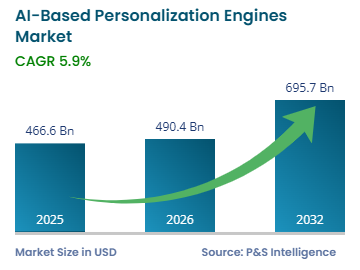
The AI-based personalization engines market size was USD 466.6 billion for 2025, and it will grow by 5.9% during 2026–2032, to reach USD 695.7 billion by 2032.
This growth is supported by the deepening integration of machine learning, generative AI, and natural language processing across website personalization, mobile app experiences, and CRM-driven marketing, positioning personalization engines as a core layer of enterprise digital infrastructure rather than a discretionary marketing tool.
The accelerating shift of commerce and customer engagement toward digital channels is reinforcing demand by widening the base of transactional and behavioral data available for model training. The U.S. Census Bureau reports that e-commerce sales in the United States totaled USD 1,233.7 billion in 2025, rising 5.4% from 2024 and accounting for 16.4% of total retail sales. This scale of digital transaction data feeds personalization algorithms across the industry. At the enterprise level, the OECD indicates that 20.2% of firms across member countries used AI technologies in 2025, up from 14.2% in 2024. This increase signals the mainstreaming of AI-enabled decisioning tools, including recommendation and personalization systems.
Key Market Insights
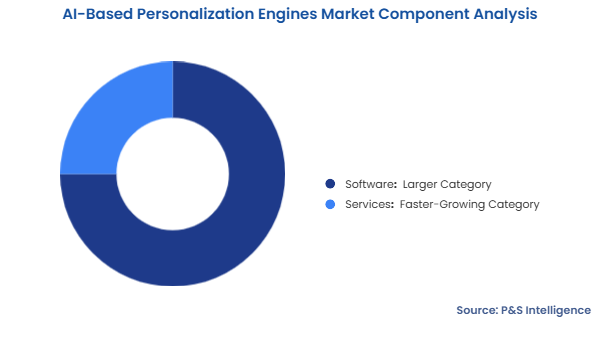
The software category holds the larger market share, of 75%, in 2025, driven by demand for scalable, cloud-based platforms.
The cloud category holds the larger market share, of 80%, in 2025, and will have the higher CAGR, of approximately 6.0%, driven by scalability and cost-efficient deployment.
The generative AI category will have the highest CAGR, of approximately 6.4%, driven by growing enterprise adoption of large language models.
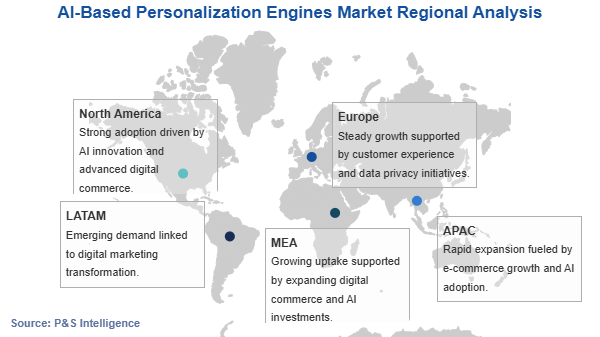
North America holds the largest market share, of 40%, in 2025, driven by mature cloud and digital ecosystems.
Asia-Pacific will have the highest CAGR, of approximately 6.8%, driven by rapid digitalization and government AI investments.
The software category holds the larger market share, of 75%, in 2025, driven by enterprise preference for scalable, cloud-based platforms that integrate seamlessly with customer relationship management (CRM), e-commerce, customer data platforms (CDPs), and digital experience ecosystems. Real-time analytics capabilities support this dominance further, and the category delivers personalized recommendations, content, and customer journeys across multiple digital channels. According to the U.S. Census Bureau's Business Trends and Outlook Survey, AI adoption among U.S. businesses reached 19.8% in May 2026, rising to 39.7% in the information sector, supporting demand for personalization software across industries.
The services category will have the higher CAGR, of approximately 6.1%, driven by increasing demand for consulting, implementation, system integration, AI model customization, managed services, and ongoing optimization. As enterprises deploy more sophisticated generative AI-powered personalization solutions, they increasingly require specialized expertise to integrate these platforms with existing IT infrastructure, ensure regulatory compliance, and maximize return on AI investments.
The components analyzed in this report are:
Software (Larger Category)
Services (Faster-Growing Category)
Deployment Analysis
The cloud category holds the larger market share, of 80%, in 2025, and it will have the higher CAGR, driven by greater scalability, lower upfront costs, and faster deployment. Cloud-based platforms provide seamless integration with customer relationship management, customer data platforms, e-commerce systems, and digital experience platforms, supporting continuous AI model updates and omnichannel personalization. International Energy Agency (IEA) data indicates that global data centre electricity demand grew by 17% in 2025, while capital expenditure by five major technology companies exceeded USD 400 billion, reflecting the rapid expansion of AI infrastructure. This capital expenditure reflects the expansion of AI infrastructure underpinning cloud-based AI deployment and supports the growing adoption of AI-based personalization engines.
The deployments analyzed in this report are:
Cloud (Larger and Faster-Growing Category)
On-Premises
Technology Analysis
The machine learning & deep learning category holds the largest market share, of 25%, in 2025, driven by its proven capability to process large volumes of structured and unstructured behavioral data. The capacity for continuous improvement in recommendation accuracy through iterative model training reinforces this position, and the ability to enable real-time personalization across digital channels extends its analytical reach. These technologies form the analytical foundation of AI-based personalization engines, supporting applications such as product recommendations, dynamic pricing, customer segmentation, and content optimization. OECD data indicates that 57.3% of information and communication technology (ICT) firms across member countries used AI technologies in 2025, the highest adoption rate of any industry sector. This adoption rate underscores the enterprise demand for advanced AI technologies that support personalization solutions.
The generative AI category will have the highest CAGR, of approximately 6.4%, driven by increasing enterprise adoption of large language models for dynamic content generation, conversational interfaces, personalized marketing, and real-time customer engagement. As organizations seek to deliver highly individualized digital experiences at scale, generative AI is becoming an increasingly important technology within AI-based personalization engines.
The technologies analyzed in this report are:
Machine Learning & Deep Learning (Largest Category)
Generative AI (Fastest-Growing Category)
Natural Language Processing (NLP)
Collaborative Filtering
Content-Based Filtering
Hybrid Recommendation Systems
Reinforcement Learning
Predictive Analytics
Computer Vision & Emotion AI
Others
Application Analysis
The website personalization category holds the largest market share, of 35%, in 2025, driven by its position as the primary digital customer touchpoint. Widespread adoption across e-commerce and enterprise websites reinforces this position, and the maturity of technologies supporting dynamic content delivery, behavioral targeting, and real-time product recommendations sustains it further. Businesses have historically prioritized optimizing website experiences before extending personalization capabilities to mobile applications, email, social media, and other digital channels.
The mobile app personalization category will have the highest CAGR, driven by accelerating mobile-first digital engagement, increasing smartphone usage, and rising demand for personalized in-app experiences. According to the International Telecommunication Union (ITU), mobile broadband subscriptions reached 99 per 100 inhabitants globally in 2025, accounting for 89% of all mobile subscriptions worldwide, up from less than 50% in 2015. This expansion in mobile connectivity is supporting greater adoption of AI-based mobile app personalization.
The applications analyzed in this report are:
Website Personalization (Largest Category)
Mobile App Personalization (Fastest-Growing Category)
Email & CRM Personalization
Display Advertising Personalization
Social Media Personalization
Voice & Conversational Interfaces
Others
End Use Analysis
The retail & e-commerce category holds the largest market share, of 25%, in 2025, driven by the widespread adoption of AI-powered product recommendations and personalized promotions across digital commerce platforms. Dynamic pricing, customer journey optimization, the extensive use of first-party customer data, and the direct relationship between personalization and conversion rates further reinforce this leadership and support sustained investment in AI-based personalization technologies.
The healthcare & life sciences category will have the highest CAGR, driven by the increasing adoption of AI-based personalization for treatment planning and medication adherence, as well as growing patient engagement and digital health services that are extending this momentum into new clinical applications. According to the U.S. Office of the National Coordinator for Health Information Technology (ONC), 95% of hospitals enabled patients to electronically view their clinical notes as of August 2025. This level of access highlights the expanding digital health infrastructure that supports personalized patient experiences.
The end uses analyzed in this report are:
Retail & E-commerce (Largest Category)
Healthcare & Life Sciences (Fastest-Growing Category)
Banking, Financial Services, & Insurance (BFSI)
Media & Entertainment
IT & Telecommunications
Travel & Hospitality
Education & E-learning
Automotive
Others
Drive strategic growth with comprehensive market analysis
North America AI-Based Personalization Engines Market Size
North America holds the largest market share, of 40%, in 2025, driven by the concentrated presence of major cloud and enterprise software vendors, mature digital advertising and e-commerce infrastructure, and enterprise data ecosystems built over more than a decade of CRM and cloud-platform investment. The region's data protection framework, anchored by the California Consumer Privacy Act and sector-specific federal rules, has pushed vendors toward compliant, consent-based personalization architectures that mature markets can adopt faster than newer digital economies.
Additionally, the Organisation for Economic Co-operation and Development (OECD) data indicates that 52% of large firms across OECD countries used AI technologies in 2025, compared with 17.4% of small firms. This adoption gap highlights the enterprise AI adoption environment that supports widespread deployment of AI-based personalization engines.
U.S. AI-Based Personalization Engines Market Size
The U.S. represents both the larger and faster-growing country market within North America, driven by the concentration of global hyperscale cloud providers and enterprise software vendors headquartered domestically, deep venture capital availability for personalization and martech startups, and one of the world's most digitally engaged consumer bases. Retail, media, and financial services enterprises have been early and sustained adopters of AI-driven recommendation and dynamic-pricing engines.
According to the U.S. Federal Reserve, based on U.S. Census Bureau Business Trends and Outlook Survey data, approximately 18% of U.S. firms had adopted AI by the end of 2025, while more than 20% expected to adopt AI during the first half of 2026, reflecting strong enterprise investment in AI technologies that support applications such as personalization engines.
Asia-Pacific will have the highest CAGR, of approximately 6.8%, supported by the rapid e-commerce penetration, expanding smartphone and internet access, and aggressive government-backed AI investment across China, India, and Southeast Asia. Domestic technology ecosystems in the region have developed personalization and recommendation capabilities.
In India, the Government approved the IndiaAI Mission with an outlay of over INR 10,300 crore to strengthen the country's AI ecosystem through investments in compute infrastructure, datasets, innovation, startup financing, and AI talent development, supporting broader enterprise adoption of AI-based personalization technologies. Growth is expected to accelerate further as generative AI models developed within the region achieve broader commercial deployment.
China AI-Based Personalization Engines Market Size
China is the largest country in the Asia-Pacific market, supported by extensive state-backed digital infrastructure investment, one of the world's largest e-commerce ecosystems led by domestic technology platforms, and rapid enterprise and consumer adoption of AI technologies across retail, media, finance, and digital services. These factors have accelerated the deployment of AI-based recommendation, content personalization, and intelligent marketing solutions across the country.
According to the China Internet Network Information Center (CNNIC), China had more than 1.12 billion internet users as of June 2025, with internet penetration reaching 79.7%. The report also states that, as of March 2025, 346 generative AI services had been officially registered with the Cyberspace Administration of China (CAC), reflecting the rapid expansion of China's regulated AI ecosystem and supporting wider adoption of AI-based personalization technologies.
The regions and countries analyzed in this report are:
The market is fragmented due to the presence of numerous global technology vendors, customer engagement platform providers, marketing automation companies, and niche AI startups. Although established companies such as Adobe Inc., Salesforce, SAP SE, Bloomreach, CleverTap, and Insider hold significant market positions, no single player dominates the market, resulting in intense competition. Vendors differentiate themselves through AI capabilities, generative AI integration, real-time decisioning, omnichannel personalization, industry-specific solutions, and cloud-native deployments. Additionally, continuous innovation, strategic partnerships, acquisitions, and the emergence of specialized AI personalization providers further intensify competition.
Leading Companies in the AI-Based Personalization Engines Market:
Adobe Inc.
Salesforce, Inc.
SAP SE
Bloomreach, Inc.
Oracle Corporation
MoEngage Inc.
Insider Pte. Ltd.
Mastercard Incorporated
Sitecore Corporation A/S
Optimizely, Inc.
Kameleoon SAS
Zeta Global Holdings Corp.
AI-Based Personalization Engines Market News
In June 2026, Zeta Global Holdings Corp. announced a strategic partnership with Palantir Technologies Inc. to build a unified enterprise AI infrastructure layer connecting operational intelligence, customer intelligence, and marketing execution. The partnership pairs Zeta's identity and decisioning data with Palantir's AI infrastructure to advance agentic, data-driven personalization at enterprise scale.
In April 2026, Adobe Inc. introduced CX Enterprise, an end-to-end agentic AI system featuring Adobe Engagement Intelligence, a decisioning engine optimized for customer lifetime value, alongside expanded Real-Time CDP profiles for deeper AI-driven personalization context. The launch extends Adobe's customer experience orchestration platform into fully governed, auditable agentic workflows.
In March 2026, Salesforce, Inc. launched Intent-Aware Search within Agentforce Commerce, powered by its acquisition of Cimulate. This launch introduces the industry's first commerce-optimized small language model context engine for real-time, natural-language product discovery, replacing static keyword search with conversational, intent-driven personalization for online retailers.
Frequently Asked Questions About This Report
What are the key factors driving the growth of the AI-Based Personalization Engines Market?+
Growth is driven by the rising demand for hyper-personalized customer experiences, increasing adoption of AI and machine learning, expansion of digital commerce, growing customer data availability, and the need to improve customer engagement and conversion rates.
What is the key trend in the AI-Based Personalization Engines Market?+
The major trend is the integration of generative AI and large language models (LLMs) to enable real-time content generation, predictive recommendations, conversational commerce, and hyper-personalized customer experiences.
What are the major challenges in the AI-Based Personalization Engines Market?+
Major challenges include data privacy regulations, cybersecurity risks, integration with legacy IT systems, algorithmic bias, and maintaining the quality and accuracy of customer data.
How is generative AI transforming AI-Based Personalization Engines?+
Generative AI enables automated content creation, intelligent product recommendations, personalized marketing campaigns, conversational AI assistants, and dynamic customer interactions in real time.
What opportunities are emerging in the AI-Based Personalization Engines Market?+
Opportunities include AI-powered customer journey orchestration, omnichannel personalization, predictive customer analytics, personalization for healthcare and financial services, and the adoption of agentic AI technologies.
Want a report tailored exactly to your business need?
Leading companies across industries trust us to deliver data-driven insights and innovative solutions for their most critical decisions. From data-driven strategies to actionable insights, we empower the decision-makers who shape industries and define the future. From Fortune 500 companies to innovative startups, we are proud to partner with organisations that drive progress in their industries.
Client Testimonials
Working with P&S Intelligence and their team was an absolute pleasure – their awareness of timelines and commitment to value greatly contributed to our project's success. Eagerly anticipating future collaborations.
McKinsey & Company
India
Unmatched Standards
Our insights into the minutest levels of the markets, including the latest trends and competitive landscape, give you all the answers you need to take your business to new heights
Complete Data Security
We take a cautious approach to protecting your personal and confidential information. Trust is the strongest bond that connects us and our clients, and trust we build by complying with all international and domestic data protection and privacy laws