Customer Data Platform Market Size & Share Analysis - Key Trends, Future Opportunities, Growth Strategies, and Forecasts (2025 - 2032)
This Report Provides In-Depth Analysis of the Customer Data Platform Market Report Prepared by P&S Intelligence, Segmented by Component (Platform/Software, Services), Deployment Mode (Cloud, On-Premises), Organization Size (Large Enterprises, SMEs), Application (Customer Analytics, Personalized Marketing, Customer Retention and Engagement, Predictive Analytics, Campaign Management), Industry (Retail and E-Commerce, BFSI, Media and Entertainment, Healthcare and Life Sciences, Travel and Hospitality, IT and Telecommunications, Manufacturing), Capability (Access, Analytics, Campaign), and Geographical Outlook for the Period of 2019 to 2032
Explore the market potential with our data-driven report
Customer Data Platform Market Analysis
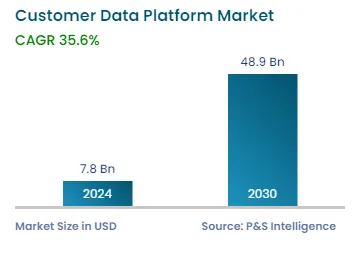
The global customer data platform market was valued at USD 7.8 billion in 2024, and it is projected to grow at a CAGR, of 36.3%, during 2025–2032, to reach USD 88.4 billion by 2032. The expansion of the market is primarily driven by the increasing need for organizations to unify fragmented customer data from multiple touchpoints, rising demand for real-time personalization at scale, and the accelerated shift toward first-party data strategies in response to third-party cookie deprecation and stringent data privacy regulations.
The customer data platform market is witnessing unprecedented growth as enterprises across industries recognize the critical importance of delivering seamless, personalized customer experiences across all channels. According to recent surveys, 93% of marketers find value in using CDPs to unify fragmented customer data, while 53% of advertisers view CDPs as critical to deliver consistent omnichannel experiences. This widespread adoption is transforming CDPs from niche marketing tools into enterprise-wide data infrastructure solutions that power not just marketing, but also sales, service, and customer success initiatives. The integration of artificial intelligence and machine learning capabilities is further enhancing CDP functionality, enabling predictive analytics, automated segmentation, and real-time decisioning that significantly improve customer engagement and business outcomes.
The market is also being shaped by the evolution of composable CDP architectures, which offer organizations greater flexibility and control over their customer data infrastructure. Built on the foundation of the modern data stack, the new CDP architecture is a lot more modular and adaptive to the enterprises’ needs, allowing businesses to leverage their existing data warehouse investments while adding CDP capabilities. This architectural shift, combined with the increasing importance of data privacy compliance and the need for zero-copy data solutions, is creating new opportunities for both established vendors and innovative startups in the CDP ecosystem.
Customer Data Platform Market Emerging Trends & Growth Drivers
AI and Machine Learning Integration Is Key Market Trend
The integration of artificial intelligence and machine learning technologies is revolutionizing how CDPs process, analyze, and activate customer data. Customer data platforms (CDPs) that are equipped with AI and ML capabilities help marketers understand and predict customers’ behavior in order to personalize customer experiences. This technological advancement is enabling organizations to move beyond simple segmentation to sophisticated predictive analytics and real-time personalization at scale.
Treasure Data includes a no-code/low-code interface as a part of the AI Agent Foundry, where users can build, test, and manage AI agents in natural language, democratizing access to advanced AI capabilities for non-technical users. This trend towards AI-powered, user-friendly interfaces is making CDPs more accessible to business users while simultaneously increasing their sophistication and value. Organizations are leveraging these capabilities to predict customer churn, identify upsell opportunities, optimize marketing spend, and deliver hyper-personalized experiences across all touchpoints.
The impact of AI integration extends beyond marketing applications. AI also enables CDPs to predict customer behavior using machine learning algorithms that analyze past interactions and transactions. These predictive capabilities enable the creation of more targeted outreach strategies and offerings. From automated data quality management to intelligent identity resolution and real-time journey orchestration, AI is becoming the backbone of modern CDP functionality, enabling organizations to extract maximum value from their customer data investments.
Rising Demand for First-Party Data Strategies Is Driving Market Growth
The impending deprecation of third-party cookies and evolving privacy regulations are fundamentally transforming how organizations approach customer data management. With the decline of third-party cookies and regulatory changes (GDPR, CCPA), the increasing importance of first-party data has become a critical driver for CDP adoption. Organizations are recognizing that building robust first-party data capabilities is no longer optional but essential for maintaining competitive advantage in an increasingly privacy-conscious marketplace.
Google has decided not to phase out third-party cookies in Chrome, opting instead for a system that gives users control over their privacy settings, but this shift in approach has not diminished the importance of first-party data strategies. Instead, it has reinforced the need for organizations to take control of their customer data destiny. CDPs enable businesses to collect, unify, and activate first-party data across all touchpoints, creating comprehensive customer profiles that can be used for personalization without relying on third-party tracking mechanisms.
The transition to first-party data is also being accelerated by consumer expectations for more transparent and trustworthy data practices. Seventy-nine percent of respondents in a Pew Research Center poll said they are very, or somewhat, concerned about how companies are using the data they collect, pushing organizations to adopt CDPs that provide robust consent management and data governance capabilities. This shift is creating a virtuous cycle where better data practices lead to increased customer trust, which in turn enables the collection of more valuable first-party data.
Customer Data Platform Market Segmentation Analysis
Component Analysis
The platform/software category dominated the customer data platform market in 2024 with 70% share. This is attributed to the increasing demand for comprehensive data unification solutions that can integrate seamlessly with existing enterprise technology stacks. Platform solutions generated 70% revenue in 2024, underscoring preference for all-in-one data unification. Organizations are prioritizing platform investments that offer core CDP capabilities, including data ingestion, identity resolution, segmentation, and activation, all within a unified interface that minimizes the complexity of managing multiple point solutions.
The services category is projected to witness the higher CAGR, of 36.8%, during the forecast period, driven by the increasing complexity of CDP implementations and the need for specialized expertise. Firms need outside architects, change-management skills, and compliance guidance to maximize platform ROI. As organizations seek to extract maximum value from their CDP investments, the demand for professional services, including consulting, implementation, integration; and managed services is accelerating. Service providers are developing industry-specific accelerators and pre-built integrations that can reduce deployment times by 30-40%, making CDP adoption more accessible to organizations of all sizes.
These components are covered:
Platform/Software (Larger Category)
Services (Faster-Growing Category)
Professional
Managed
Deployment Mode Analysis
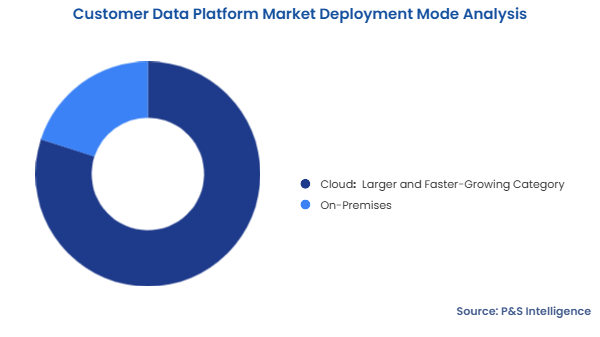
The cloud deployment mode held the larger market share in 2024, of 80%, and it also has the higher CAGR, of 37.2%, reflecting the broader enterprise shift toward cloud-first strategies. Cloud-based CDPs offer significant advantages, including scalability, reduced infrastructure costs, faster time-to-value, and seamless integration with other cloud-based marketing and analytics tools. Cloud-based CDP solutions that provide scalable data management services without requiring significant upfront investments in infrastructure are particularly generating great interest. The cloud deployment model enables organizations to handle massive volumes of customer data while maintaining the flexibility to scale resources up or down based on demand.
These deployment modes are covered:
Cloud (Larger and Faster-Growing Category)
On-Premises
Organization Size Analysis
Large enterprises dominated the customer data platform market in 2024 with 65% share, driven by their complex data ecosystems and substantial resources for digital transformation initiatives. These organizations typically deal with millions of customer records across multiple systems, channels, and geographies, making CDPs essential for creating unified customer views. Large enterprises are leveraging CDPs to break down data silos, enable cross-functional collaboration, and deliver consistent experiences across all customer touchpoints. Their adoption is further accelerated by the need to compete with digital-native companies that have built customer-centricity into their DNA from inception.
SMEs represent the faster-growing category with a projected CAGR of 36.6%, during 2025–2032, driven by the increasing digitization of operations and SMEs' growing adoption of cloud CDP services. The democratization of CDP technology through cloud-based, subscription models is making these powerful capabilities accessible to smaller organizations that previously couldn't afford enterprise-grade solutions. SMEs are particularly attracted to CDP solutions that offer quick time-to-value, pre-built integrations, and industry-specific templates that accelerate their digital transformation journey.
These organization sizes are covered:
Large Enterprises (Larger Category)
Small and Medium-sized Enterprises (SMEs) (Fastest-Growing Category)
Application Analysis
Customer analytics emerged as the largest application category in 2024, capturing 35% share, as organizations prioritize data-driven decision-making to understand customer behavior, preferences, and lifetime value. CDPs enable sophisticated analytical capabilities, including cohort analysis, attribution modeling, and predictive analytics that help organizations identify high-value customer segments, optimize marketing spend, and improve customer retention. The integration of AI and machine learning is further enhancing analytical capabilities, enabling organizations to uncover insights that would be impossible to detect through traditional analysis methods.
Personalized marketing is experiencing the highest growth rate with a CAGR, of 36.5%, during the forecast period, reflecting the increasing consumer expectation for relevant, contextual experiences across all touchpoints. 71% of consumers say they want consistent customer experiences across all channels, only 29% say brands deliver. CDPs are enabling marketers to move beyond basic demographic segmentation to behavioral and predictive segmentation, delivering truly personalized experiences at scale. This capability is particularly crucial as traditional targeting methods become less effective due to privacy regulations and the deprecation of third-party cookies.
These applications are covered:
Customer Analytics (Largest Category)
Personalized Marketing (Fastest-Growing Category)
Customer Retention and Engagement
Predictive Analytics
Campaign Management
Others (Data Management, Compliance)
Industry Analysis
The retail and e-commerce sector dominated the customer data platform market in 2024, accounting for 25% share, driven by the industry's inherent focus on customer experience and the abundance of customer interaction data across multiple channels. Real-time marketing systems built on central platforms, such as CDP, can take marketing strategies to the next level. The increasing competition in the retail and e-commerce markets is increasing the use of these platforms to reach suitable customers. Retailers are leveraging CDPs to unify online and offline customer data, enable real-time personalization, optimize inventory based on customer preferences, and deliver seamless omnichannel experiences that meet modern consumer expectations.
The IT and telecommunications sector is projected to witness the highest CAGR, of 36.9%, during 2025–2032, as 5G deployment generates unprecedented volumes of customer data and enables new use cases for personalization. Telecom operators are using CDPs to reduce churn through predictive analytics, optimize network investments based on usage patterns, and create personalized service bundles that maximize customer lifetime value. The integration of CDP data with network telemetry is enabling innovative use cases such as location-based services and real-time quality of service optimization.
These industries are covered:
Retail and E-commerce (Largest Category)
Banking, Financial Services, and Insurance (BFSI)
Media and Entertainment
Healthcare and Life Sciences
Travel and Hospitality
IT and Telecommunications (Fastest-Growing Category)
Manufacturing
Others
Capability Analysis
The analytics capability category held the largest share in 2024, of 45%, as organizations prioritize deriving actionable insights from their unified customer data. CDPs with strong analytics capabilities enable organizations to perform sophisticated analyses, including customer journey analytics, attribution modeling, and predictive scoring. These capabilities are essential for understanding customer behavior patterns, identifying opportunities for optimization, and measuring the impact of marketing initiatives. The integration of AI and machine learning is further enhancing analytical capabilities, enabling real-time insights and automated decision-making.
The campaign category is experiencing the fastest growth, with a projected CAGR of 36.9%, during the forecast period, driven by the need for orchestrated, cross-channel customer engagement. Modern CDPs are evolving beyond data management platforms to become orchestration engines that can trigger personalized campaigns across multiple channels based on real-time customer behavior. This capability is particularly valuable as organizations seek to deliver consistent experiences across an increasingly complex landscape of digital and physical touchpoints.
These capabilities are covered:
Access
Analytics (Largest Category)
Campaign (Fastest-Growing Category)
Drive strategic growth with comprehensive market analysis
Customer Data Platform Market Regional Market Performance
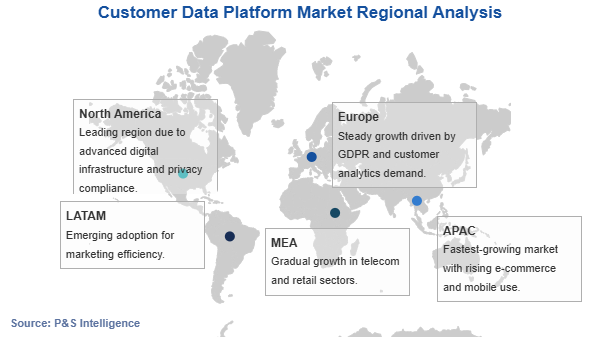
North America dominated the global customer data platform market in 2024, accounting for 60% share, driven by its advanced digital infrastructure, high adoption of marketing automation technologies, and emphasis on personalized customer experiences. The region's dominance is attributed to the presence of major CDP vendors, mature digital infrastructure, and enterprises' advanced data strategies. U.S. organizations, in particular, are at the forefront of CDP adoption, leveraging these platforms to compete in an increasingly digital marketplace.
The U.S. plays a pivotal role in advancing the customer data platform market growth through technological innovation, a robust digital infrastructure, and a thriving ecosystem of technology providers. U.S.-based companies lead in developing cutting-edge CDP solutions that leverage AI and machine learning for advanced customer analytics and personalized marketing. The implementation of privacy regulations, such as CCPA, has further accelerated CDP adoption as organizations seek compliant ways to leverage customer data. Additionally, retail e-commerce sales estimate for the first quarter of 2024 in the U.S. was USD 289.2 billion, creating massive volumes of customer data that require sophisticated management and activation capabilities.
Asia-Pacific is the fastest-growing regional market, with a CAGR, of 37.9%, during 2025–2032. The rapid digital transformation, increasing investments in customer-centric strategies, and the rising adoption of data-driven marketing across emerging economies are driving explosive growth in the region. Countries such as China, India, Japan, and South Korea are witnessing unprecedented digital adoption rates, creating vast amounts of customer data that organizations need to manage and activate effectively.
Governments and enterprises in countries such as India and China are accelerating digital initiatives, which have led to a surge in the collection and use of consumer data. Companies across sectors like retail, BFSI, and e-commerce are recognizing the need for unified customer profiles to drive personalized engagement and improve ROI. The region's growth is further supported by increasing smartphone penetration, expanding e-commerce ecosystems, and the emergence of digital-native businesses that are building customer-centricity into their core operations. Local and global CDP vendors are establishing strong presences in the region through partnerships and localized solutions that address specific market needs.
Based on geography, the market has the following categories:
North America (Largest Regional Market)
U.S. (Larger-Country Market)
Canada (Faster-Growing Country Market)
Europe
Germany (Largest Country Market)
U.K. (Fastest-Country Market)
France
Italy
Spain
Rest of Europe
Asia-Pacific (Fastest-Growing Regional Market)
Japan
China (Largest Country Market)
India (Fastest-Growing Country Market)
South Korea
Australia
Rest of APAC
Latin America
Brazil (Largest Country Market)
Mexico (Fastest-Growing Country Market)
Rest of LATAM
Middle East and Africa
Saudi Arabia (Largest Country Market)
South Africa
U.A.E. (Fastest-Growing Country Market)
Rest of MEA
Customer Data Platform Market Share Analysis
The customer data platform market exhibits a moderately consolidated structure, with the top 10 players collectively controlling approximately 65% of the total market share. Leading companies such as Salesforce, Oracle, Adobe, Treasure Data, and Tealium collectively accounting for approximately 40% of the total market share. This market structure reflects the diverse needs of enterprises and the specialized capabilities required across different industries and use cases. The competitive landscape is characterized by a mix of established enterprise software vendors who have added CDP capabilities to their suites and pure-play CDP specialists who continue to innovate and differentiate through advanced features and industry-specific solutions.
The market is witnessing increased competition as major technology vendors recognize the strategic importance of CDPs in the modern data stack. Salesforce has leveraged its robust CRM ecosystem to expand its CDP offering, unifying customer data across marketing, commerce, and service clouds to enable real-time personalization at scale. Oracle integrates its CDP capabilities with its larger suite of marketing and analytics tools, providing enterprises with a scalable solution for identity resolution, segmentation, and omnichannel activation. These enterprise vendors are leveraging their existing customer relationships and technology ecosystems to gain market share, while pure-play vendors differentiate through specialized capabilities and faster innovation cycles.
Top Customer Data Platform Companies:
Salesforce, Inc.
Adobe Inc.
Oracle Corporation
SAP SE
Microsoft Corporation
Tealium Inc.
BlueConic
Treasure Data (SoftBank)
Amperity
Zeta Global
Lytics
Simon Data
Customer Data Platform Market News
In January 2025, ContentStack Inc., a content management and digital experience platform; purchased Lytics Inc. to integrate the former’s platform with comprehensive content analytics, audience insights, and profile management capabilities.
In January 2025, Rokt bought mParticle Inc. for USD 300 million to offer better solutions for advertising, e-commerce, and customer experience.
In December 2024, Uniphore Technologies Inc., a provider of conversation processing solutions; acquired ActionIQ, which made it a foundation of a zero-data AI cloud.
In July 2024, BlueConic purchased Jebbit, a zero-party data platform; to enhance its first-party data collection capabilities and provide more comprehensive customer insights.
Want a report tailored exactly to your business need?
Leading companies across industries trust us to deliver data-driven insights and innovative solutions for their most critical decisions. From data-driven strategies to actionable insights, we empower the decision-makers who shape industries and define the future. From Fortune 500 companies to innovative startups, we are proud to partner with organisations that drive progress in their industries.
Client Testimonials
Working with P&S Intelligence and their team was an absolute pleasure – their awareness of timelines and commitment to value greatly contributed to our project's success. Eagerly anticipating future collaborations.
McKinsey & Company
India
Unmatched Standards
Our insights into the minutest levels of the markets, including the latest trends and competitive landscape, give you all the answers you need to take your business to new heights
Complete Data Security
We take a cautious approach to protecting your personal and confidential information. Trust is the strongest bond that connects us and our clients, and trust we build by complying with all international and domestic data protection and privacy laws