This Report Provides In-Depth Analysis of the Enterprise Artificial Intelligence Market Report Prepared by P&S Intelligence, Segmented by Deployment (Cloud, On-Premises), Technology (Natural Language Processing, Computer Vision, Machine Learning, Speech Recognition, Generative Artificial Intelligence), Organization Size (Large Enterprises, Small and Medium Enterprises), End User (Information Technology and Telecommunications, Banking, Financial Services, and Insurance, Retail and E-commerce, Healthcare, Manufacturing, Automotive, Media and Advertising, Government), and Geographical Outlook for the Period of 2021 to 2032
Explore the market potential with our data-driven report
Enterprise Artificial Intelligence Market Future Outlook
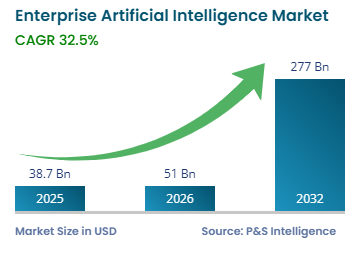
The enterprise artificial intelligence market size was USD 38.7 billion in 2025, and it will grow by 32.5% during 2026-2032 to reach USD 277.0 billion by 2032.
The enterprise artificial intelligence market is expanding as organizations increasingly integrate AI into core business functions to improve productivity, strengthen decision-making, and manage growing volumes of structured and unstructured data. Enterprises are moving beyond experimental projects and deploying AI across a growing range of customer service, business analytics, cybersecurity, workflow automation, software development, and operational management. The growing availability of cloud-based platforms has reduced deployment complexity and improved access to advanced AI capabilities, enabling organizations to scale intelligent applications more efficiently. At the same time, generative AI and intelligent automation technologies are encouraging businesses to redesign processes that previously depended on manual effort and fragmented workflows.
Moreover, growth is being supported by rising investments in digital transformation, expanding cloud ecosystems, and broader availability of enterprise-grade AI solutions. Businesses are increasingly seeking technologies that support predictive analytics, real-time decision-making, risk management, and operational optimization while maintaining governance and security standards. According to the Organisation for Economic Co-operation and Development (OECD), 20.2% of firms across reporting OECD countries used AI in 2025, up from 14.2% in 2024, indicating that enterprise adoption is progressing beyond early-stage pilots and limited deployments. The expanding use of AI across enterprise environments is increasing demand for platforms that can integrate with existing business systems, support workforce productivity, and improve the value extracted from organizational data. This wider adoption is also encouraging vendors to enhance scalability, industry-specific functionality, and governance capabilities as enterprises incorporate AI into long-term technology and operational strategies.
Key Market Insights
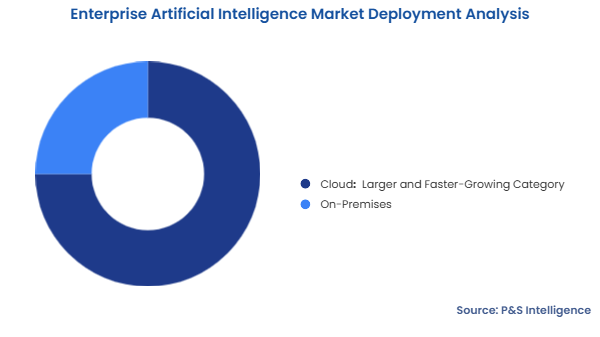
Cloud is the larger and faster-growing category, holding a market share of 75% and registering a CAGR of approximately 32.7%, owing to its scalability, cost efficiency, simplified deployment, and easy access to advanced AI capabilities through cloud-based platforms.
Machine learning is the largest category, holding a market share of 35%, driven by its role as the foundational technology behind enterprise artificial intelligence applications.
Large Enterprises are the larger organization size, holding a market share of 80%, due to extensive technology budgets, significant data resources, and broad adoption of cloud-based artificial intelligence platforms.
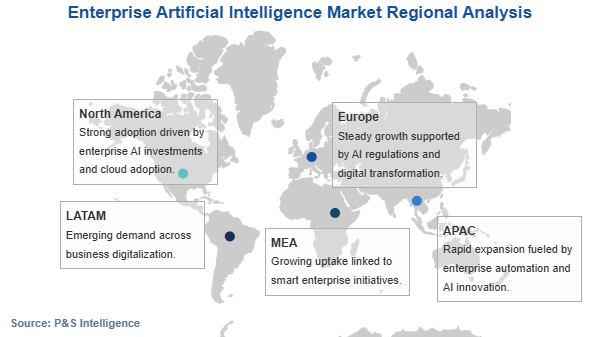
North America is the largest regional market, holding a market share of 40%, because the region benefits from a highly developed enterprise technology ecosystem, strong artificial intelligence investment activity, and early adoption of advanced digital solutions.
Canada is the faster-growing country, due to continued investment in research, commercialization, and workforce development that supports broader enterprise artificial intelligence adoption.
AI Copilots and Agentic Artificial Intelligence Integration Is a Major Trend
AI copilots and agentic artificial intelligence integration are emerging as a major trend as enterprises move beyond standalone AI tools and adopt systems capable of executing tasks, interacting with enterprise applications, and supporting daily business workflows. Organizations are increasingly adopting AI solutions that combine reasoning, automation, and secure access to enterprise data within governed environments, enabling more autonomous and efficient business operations. This shift is encouraging broader adoption across customer service, software development, business analytics, human resources, and operational functions where multi-step processes can be streamlined through intelligent agents.
In 2025, leading technology companies expanded their enterprise AI capabilities to support the growing adoption of AI copilots and agentic AI. For instance, Microsoft introduced Microsoft 365 Copilot Tuning and multi-agent orchestration capabilities within Copilot Studio, supporting the transition from individual AI assistants to coordinated enterprise agents, while International Business Machines Corporation expanded the capabilities of its watsonx Orchestrate platform with new agentic orchestration and governance features for enterprise workflows. These developments are increasing enterprise interest in AI platforms that can automate complex activities, improve workflow efficiency, strengthen business process integration, and accelerate enterprise-wide AI adoption across business functions.
Rising Enterprise Demand for Data-Driven Decision-Making Drives Market
Rising enterprise demand for data-driven decision-making continues to support growth in the enterprise artificial intelligence market. Organizations generate large volumes of operational, financial, customer, and transactional data and increasingly require technologies that can convert this information into actionable insights. AI solutions help businesses identify patterns, improve forecasting, optimize resource allocation, strengthen risk management, and support strategic planning. Competitive pressure is also encouraging organizations to adopt AI-powered decision-support solutions that enable faster, more informed decisions while improving operational efficiency across core business functions. According to the International Telecommunication Union, the number of internet users worldwide increased to 6.0 billion in 2025 from 5.8 billion in 2024, contributing to the continued growth of digital data that enterprises increasingly analyze using AI-powered solutions.
According to Eurostat, 39.85% of European Union enterprises performed data analytics in 2025 using either internal resources or external providers. Expanding digital activity and growing reliance on data analytics are increasing enterprise demand for AI solutions that can process large datasets, generate actionable business intelligence, support real-time decision-making, and improve operational performance across increasingly data-intensive business environments.
Data Privacy, Security, and Governance Challenges Limit Market Expansion
Data privacy, security, and governance challenges continue to limit enterprise artificial intelligence adoption because many AI systems depend on access to sensitive customer, financial, operational, and business data. Organizations must address regulatory compliance requirements, internal risk controls, data protection obligations, and concerns related to model transparency before deploying AI at scale. These challenges are particularly significant in highly regulated industries such as banking, healthcare, and government, where stringent governance requirements, regulatory compliance, and security standards slow enterprise AI deployment. According to Eurostat, 48.83% of European Union enterprises cited data protection and privacy concerns as a barrier to AI adoption in 2025. This caution is extending deployment timelines, increasing compliance review requirements, and slowing broader enterprise implementation of AI solutions across sensitive business environments.
Expansion of Industry-Specific Artificial Intelligence Solutions Creates Significant Market Opportunity
The expansion of industry-specific artificial intelligence solutions is creating significant opportunities as enterprises increasingly seek platforms designed for specialized operational requirements. Organizations increasingly prefer AI solutions tailored to industry-specific workflows, regulatory requirements, and domain expertise, reducing the need for extensive customization and accelerating deployment. Demand is growing across healthcare, financial services, manufacturing, retail, and telecommunications, where tailored AI capabilities can deliver faster implementation and clearer business outcomes. Oracle introduced its Oracle Health EHR platform for ambulatory providers in the United States in 2025, incorporating native AI agents and an open semantic AI foundation for integration and extension. This development highlights growing demand for sector-focused AI solutions and supports opportunities for vendors that deliver industry-specific functionality, operational value, and easier enterprise adoption.
Cloud is the larger and faster-growing category, holding a market share of 75%, due to its ability to provide scalable computing resources, simplified deployment, and access to advanced artificial intelligence capabilities. Cloud deployment enables enterprises to rapidly scale AI applications, reduce upfront infrastructure investments, accelerate implementation, and continuously access the latest AI models and platform innovations. Its flexibility also allows organizations to integrate AI with existing business systems while supporting growing data processing requirements across multiple business functions. According to Eurostat, 52.74% of European Union enterprises used paid cloud computing services in 2025. Widespread cloud adoption is strengthening demand for AI platforms that support rapid implementation, continuous innovation, data processing, and integration with business applications while reducing infrastructure complexity for organizations of different sizes.
The deployments analysed in this report are:
Cloud (Larger and Faster-Growing Category)
On-Premises
Technology Analysis
Machine learning is the largest category, holding a market share of 35%, driven by its role as the foundational technology behind enterprise artificial intelligence applications. Organizations widely use machine learning to analyze large volumes of business data, generate predictive insights, automate decision-making, optimize operations, and improve business intelligence across industries. Its broad deployment in fraud detection, predictive maintenance, demand forecasting, recommendation systems, and risk management continues to strengthen enterprise adoption. The growing integration of machine learning into cloud platforms, analytics solutions, and intelligent business applications further reinforces its leading position in the enterprise artificial intelligence market.
Generative AI is the fastest-growing category, registering a CAGR of approximately 32.9%, driven by rapid enterprise adoption of AI copilots, intelligent assistants, content generation, software development, document automation, and knowledge management solutions. Organizations are increasingly integrating generative AI into customer service, marketing, software engineering, and business workflows to improve productivity and automate complex tasks. According to the World Intellectual Property Organization (WIPO), over 25% of all generative AI patent publications recorded between 2014 and 2023 were published in 2023 alone, reflecting the rapid pace of innovation in generative AI technologies. The expanding availability of enterprise-grade large language models, multimodal AI capabilities, and cloud-based AI services is accelerating adoption across industries. Growing investments in generative AI platforms continue to increase enterprise demand for solutions that enhance operational efficiency, innovation, and business decision-making.
Large Enterprises are the larger category, holding a market share of 80%, due to extensive technology budgets, significant data resources, and broad adoption of cloud-based artificial intelligence platforms. These organizations frequently deploy AI across analytics, customer engagement, cybersecurity, operations, and computer vision applications, creating substantial market demand. According to Eurostat, 55.03% of large European Union enterprises used AI technologies in 2025, significantly above overall enterprise adoption levels. Their continued investment in digital transformation, advanced infrastructure, and enterprise-wide AI strategies is supporting adoption of sophisticated AI solutions designed to improve productivity, decision-making, and operational efficiency.
Small and Medium Enterprises are the faster-growing category, as improving access to cloud-based AI platforms and subscription-based solutions reduces barriers to adoption. Smaller organizations are increasingly using artificial intelligence to enhance productivity, automate routine tasks, strengthen customer interactions, and improve operational efficiency. The availability of prebuilt AI applications and managed services enables deployment without extensive technical resources. Growing digital transformation initiatives, increasing awareness of AI-driven business benefits, and expanding availability of affordable cloud-based AI solutions are accelerating Enterprise AI adoption among small and medium enterprises.
The organization sizes analysed in this report are:
Large Enterprises (Larger Category)
Small and Medium Enterprises (Faster-Growing Category)
End User Analysis
Information Technology and Telecommunications is the largest category, holding a market share of 25%, driven by its early adoption of advanced digital technologies and widespread deployment of artificial intelligence across core business operations. AI is widely deployed for network optimization, customer support automation, predictive maintenance, cybersecurity, and service management, enabling organizations to improve operational efficiency, service reliability, and network performance. The sector generates large volumes of data and requires continuous operational efficiency improvements, making AI a valuable strategic tool. Ongoing investments in digital infrastructure, cloud services, and intelligent network management continue to reinforce its leadership within the market.
Banking, Financial Services, and Insurance is the fastest-growing category, as organizations increasingly adopt artificial intelligence for fraud detection, risk assessment, compliance management, customer engagement, and financial decision-making. Increasing digital banking initiatives, rising transaction volumes, and growing regulatory requirements are accelerating enterprise AI adoption across organizations. According to Statistics Canada, 30.6% of finance and insurance businesses used AI to produce goods or deliver services in the second quarter of 2025. Growing adoption within financial institutions is increasing demand for AI solutions that can process large datasets, automate complex workflows, strengthen risk controls, and support more personalized customer experiences.
The end users analysed in this report are:
Information Technology and Telecommunications (Largest Category)
Banking, Financial Services, and Insurance (Fastest-Growing Category)
Retail and E-commerce
Healthcare
Manufacturing
Automotive
Media and Advertising
Government
Others
Drive strategic growth with comprehensive market analysis
Enterprise Artificial Intelligence Market Regional Outlook
North America Enterprise Artificial Intelligence Market Analysis
North America holds the largest share, of 40%, because the region benefits from a highly developed enterprise technology ecosystem, strong artificial intelligence investment activity, and early adoption of advanced digital solutions across industries. Large organizations continue integrating AI into cybersecurity, software development, customer engagement, and business operations, creating sustained demand for enterprise AI platforms. The presence of major cloud providers, AI model developers, and technology innovators accelerates commercialization and deployment across sectors. Enterprises in the region also possess extensive data assets and established digital infrastructure, enabling faster implementation of advanced AI capabilities. Continuous product innovation, expanding enterprise adoption of generative AI, and increasing investments in AI-driven productivity solutions continue to accelerate market growth across North America.
U.S. Enterprise Artificial Intelligence Market Analysis
The U.S. remains the leading market for enterprise artificial intelligence due to the presence of major AI developers, hyperscale cloud providers, enterprise software vendors, and a strong innovation ecosystem. Organizations across healthcare, finance, retail, and technology sectors continue to integrate AI into core business processes to improve productivity and automate operations. In 2025, the U.S. government introduced America's AI Action Plan to accelerate artificial intelligence innovation, expand AI infrastructure, and promote commercialization across industries, further strengthening the country's enterprise AI ecosystem. Growing enterprise adoption of AI is driving demand for platforms that support decision-making, workflow automation, customer engagement, and business intelligence while encouraging continued investment in advanced enterprise AI capabilities.
Canada is experiencing strong growth in enterprise artificial intelligence adoption through continued investment in research, commercialization, and workforce development. Businesses are increasingly deploying AI to improve operational efficiency, enhance customer experiences, and strengthen decision-making across public and private sectors. The country’s supportive innovation environment is encouraging broader implementation of intelligent business applications across multiple industries. According to Statistics Canada, 12.2% of Canadian businesses used AI to produce goods or deliver services in 2025. Growing enterprise adoption is supporting demand for AI solutions that improve productivity, streamline operations, and deliver greater value from business data and digital workflows.
Asia-Pacific is the fastest-growing regional market, registering a CAGR of approximately 33.4%, driven by rapid digital transformation, expanding cloud infrastructure, and growing enterprise technology investments across both developed and emerging economies. Organizations throughout the region are increasingly adopting artificial intelligence to enhance operational efficiency, improve customer engagement, and support business modernization efforts. The Government of India approved the IndiaAI Mission with an outlay of INR 10,371.92 crore to strengthen AI infrastructure and innovation, supporting enterprise AI adoption across industries. The market is also supported by large-scale digital ecosystems, expanding cloud adoption, increasing enterprise data generation, and rising demand for intelligent automation across industries. China leads the regional market through extensive AI deployment across manufacturing, e-commerce, financial technology, and smart enterprise applications. India represents the fastest-growing market, driven by accelerating digitalization, expanding startup activity, increasing cloud adoption, and growing enterprise demand for scalable AI solutions that support business growth and operational efficiency.
Europe Enterprise Artificial Intelligence Market Analysis
Europe benefits from a strong industrial base, advanced digital infrastructure, and increasing enterprise focus on responsible artificial intelligence deployment. The region places significant emphasis on governance, transparency, and regulatory compliance, encouraging organizations to adopt enterprise AI solutions that align with trusted and responsible AI practices. Manufacturing, automotive, financial services, and healthcare sectors remain key adopters of AI technologies for operational optimization and process improvement. Germany leads the regional market due to its large industrial sector and extensive use of AI in manufacturing and engineering environments. The United Kingdom records the fastest growth, supported by a vibrant technology ecosystem, strong enterprise software adoption, and increasing investment in AI-driven business transformation initiatives across service-oriented industries.
The regions and countries analysed in this report are:
The enterprise artificial intelligence market is fragmented, with a diverse mix of global technology providers, cloud platform companies, specialized AI software developers, analytics vendors, and emerging startups competing across multiple application areas. The broad scope of enterprise AI creates opportunities for companies to differentiate through industry expertise, proprietary models, deployment flexibility, data management capabilities, and integration services. New participants continue to enter the market with specialized offerings focused on generative AI, automation, cybersecurity, customer engagement, and business intelligence, further expanding the competitive landscape. At the same time, enterprises often select solutions based on specific operational requirements rather than relying on a single vendor across all AI functions. Continuous innovation, frequent product launches, strategic partnerships, and acquisitions enable companies to expand their enterprise AI capabilities and strengthen their competitive positioning.
Key Players in the Enterprise Artificial Intelligence Market:
Microsoft Corporation
Alphabet, Inc.
Amazon.com, Inc.
IBM Corporation
NVIDIA Corporation
SAP SE
Oracle Corporation
Hewlett Packard Enterprise Company
Intel Corporation
Accenture plc
Salesforce, Inc.
SAS Institute Inc.
C3.ai, Inc.
Palantir Technologies Inc.
ServiceNow, Inc.
SoftBank Group Corp.
ASAPP, Inc.
DataRobot, Inc.
Enterprise Artificial Intelligence Market News
In June 2026, SoftBank Group Corp. launched Patching as a Service in Japan, an AI-based cybersecurity solution delivered through SB OAI Japan GK. The service uses OpenAI technology and SoftBank Corp.'s operational experience to assess enterprise vulnerabilities, prepare remediation plans, and advise on implementation. SoftBank said outreach would begin with eligible companies supporting Japanese critical infrastructure, following internal testing on its own systems.
In May 2026, IBM Corporation introduced Red Hat AI Inference on IBM Cloud as a managed service for production AI inference. The service provides Red Hat AI inference capabilities on IBM Cloud with governance controls, model access, and operational management handled through the cloud service. IBM stated the service would be generally available in May, alongside a separate Red Hat OpenShift virtualization service.
In April 2026, ASAPP, Inc. launched a system of AI agents inside its Customer Experience Platform for enterprise customer service operations. The new release adds agents for discovery, development, simulation, insights, and optimization within the CXP environment. ASAPP described the system as a production setup for coordinating customer interactions, workflows, human review, policy execution, and operational visibility across service teams.
Frequently Asked Questions About This Report
What does the enterprise AI market include for organizations?+
It covers AI platforms, applications, data tools, and services that help enterprises automate work, improve decisions, and personalize digital operations.
What factors are driving demand in the enterprise AI market?+
Growth is driven by automation demand, rising data volumes, cloud adoption, better AI models, and pressure to improve productivity across departments.
Why are organizations adopting enterprise AI solutions across operations?+
Organizations adopt enterprise AI to improve forecasting, customer support, content handling, fraud detection, and workflow automation across daily business functions.
How do enterprise AI solutions improve decision making and efficiency?+
Enterprise AI improves efficiency by analyzing data faster, automating repetitive tasks, supporting employees, and turning complex information into usable business insights.
What challenges affect adoption of enterprise AI solutions today?+
Adoption is affected by data quality, security concerns, model trust, legacy system integration, governance gaps, and shortage of skilled AI teams.
Want a report tailored exactly to your business need?
Leading companies across industries trust us to deliver data-driven insights and innovative solutions for their most critical decisions. From data-driven strategies to actionable insights, we empower the decision-makers who shape industries and define the future. From Fortune 500 companies to innovative startups, we are proud to partner with organisations that drive progress in their industries.
Client Testimonials
Working with P&S Intelligence and their team was an absolute pleasure – their awareness of timelines and commitment to value greatly contributed to our project's success. Eagerly anticipating future collaborations.
McKinsey & Company
India
Unmatched Standards
Our insights into the minutest levels of the markets, including the latest trends and competitive landscape, give you all the answers you need to take your business to new heights
Complete Data Security
We take a cautious approach to protecting your personal and confidential information. Trust is the strongest bond that connects us and our clients, and trust we build by complying with all international and domestic data protection and privacy laws