Key Highlights
| Study Period | 2019 - 2032 |
| Market Size in 2024 | USD 73.6 Billion |
| Market Size in 2025 | USD 77.1 Billion |
| Market Size by 2032 | USD 114.2 Billion |
| Projected CAGR | 5.8% |
| Largest Region | APAC |
| Fastest Growing Region | APAC |
| Market Structure | Fragmented |

| Study Period | 2019 - 2032 |
| Market Size in 2024 | USD 73.6 Billion |
| Market Size in 2025 | USD 77.1 Billion |
| Market Size by 2032 | USD 114.2 Billion |
| Projected CAGR | 5.8% |
| Largest Region | APAC |
| Fastest Growing Region | APAC |
| Market Structure | Fragmented |
Explore the market potential with our data-driven report
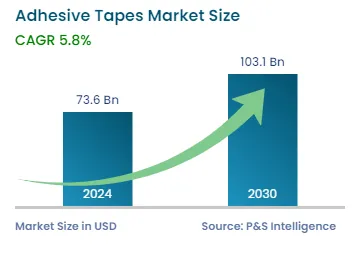
The adhesive tapes market size was USD 73.6 billion in 2024, and it will grow by 5.8% during 2025–2032, to reach USD 114.2 billion by 2032.
The market growth is primarily attributed to the expanding applications across healthcare and medical sectors, rapid growth in e-commerce packaging requirements, and increasing adoption of lightweight materials in automotive manufacturing. The market encompasses a diverse range of pressure-sensitive tapes, double-sided tapes, and specialty adhesive solutions that have become indispensable across multiple industries.
The e-commerce boom has created unprecedented demand for reliable packaging solutions, with adhesive tapes serving as the backbone of secure product transportation. Manufacturers are responding to increasing regulatory pressure and consumer demand for eco-friendly alternatives by developing biodegradable and recyclable tape solutions.
Additionally, the automotive industry's shift toward electric vehicles has opened new avenues for specialty adhesive tapes that contribute to weight reduction, thermal management, and vibration dampening, essential for optimizing EV performance and extending battery life.
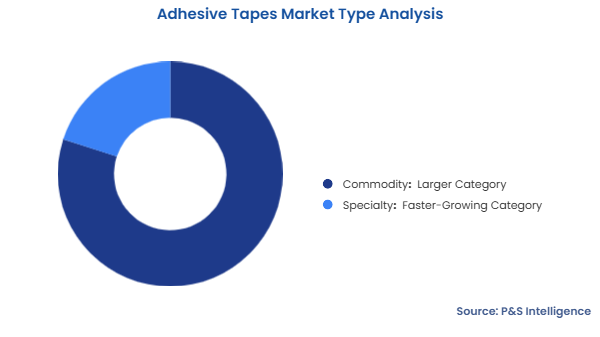
The commodity category held the larger market share, of 80%, in 2024, driven by widespread adoption in packaging, general industrial applications, and consumer use. This dominance stems from the high-volume consumption of standard adhesive tapes for everyday applications such as carton sealing, bundling, and basic bonding tasks. The cost-effectiveness and versatility of commodity tapes make them indispensable across various industries, particularly in the rapidly expanding e-commerce sector, where packaging efficiency is paramount.
The specialty category will have the higher CAGR. This accelerated growth is attributed to increasing demand for high-performance adhesive solutions in advanced applications such as electronics assembly, medical devices, and automotive manufacturing. Specialty tapes offer extreme temperature resistance, electrical conductivity, and biocompatibility, commanding premium prices and driving market value growth. The ongoing miniaturization in electronics and the complexity of modern manufacturing processes continue to create new opportunities for specialized adhesive tape solutions.
The types analyzed in this report are:
The hot-melt-based category held the largest market share, of 60%, in 2024. This is ascribed to its high usage in a variety of manufacturing processes, such as bookbinding, woodworking, construction, product assembling, and box or carton heat sealing. Hot-melt adhesives offer instant bonding capabilities, eliminating drying time and enabling immediate handling of packaged goods. The technology's solvent-free nature aligns with sustainability goals while providing excellent adhesion to various substrates, including recycled materials commonly used in modern packaging.
The water-based category will have the highest CAGR, due to the increasing demand for environment-friendly water-based adhesive products, coupled with regulatory support. Water-based adhesives offer comparable performance to traditional solvent-based systems while significantly reducing VOC emissions and environmental impact. This technology has gained particular traction in packaging applications where recyclability and eco-friendliness are increasingly important selection criteria. Manufacturers have successfully addressed historical limitations of water-based systems through advanced polymer chemistry, achieving improved water resistance and adhesion strength.
The technologies analyzed in this report are:
The packaging category held the largest market share, of 35%, in 2024, as these tapes are widely used across almost every industry for various applications. Moreover, the increasing trend of online shopping in emerging economies is boosting the demand for retail e-commerce packaging, which, in turn, requires these products for various purposes. Packaging tapes must deliver consistent performance across different climates and handling scenarios, driving continuous innovation in adhesive formulations and backing materials. As per the U.S. International Trade Administration, B2C ecommerce orders value is projected to reach USD 5.5 trillion by 2027.
The healthcare category will have the highest CAGR, due to the rising R&D spending in the sector, the increasing health consciousness among people, the escalating count of hospitals and ASCs, the growing demand for in-vitro diagnostics, and the surging launches of medical equipment and related products, including hydrophilic films, oral dissolvable films, and transdermal drug delivery patches. Additionally, the growing adoption of wearable health monitoring devices and the trend toward minimally invasive procedures are creating new application opportunities for medical-grade adhesive tapes with enhanced biocompatibility and extended wear properties.
The end users analyzed in this report are:
The acrylic category held the largest market share, of 65%, in 2024, due to the high demand for acrylic adhesive products, owing to their chemical and physical properties, lower cost, and vast applications in several end-use verticals, such as healthcare, automotive, and packaging. Acrylic-based adhesives provide excellent UV resistance, weatherability, and long-term stability, making them suitable for both indoor and outdoor applications. Their ability to bond to low-surface-energy substrates without primers has made them particularly valuable in automotive and electronics applications. The transparency and clarity of acrylic adhesives also make them preferred choices for optical applications and display assembly.
The silicone category will have the highest CAGR, primarily driven by the growing demand in the healthcare and electronics sectors, where its unique properties offer distinct advantages. Silicone adhesives maintain performance across extreme temperature ranges (−65 to 200 °C) and offer exceptional biocompatibility for skin contact applications. The growing market for wearable medical devices and the need for reliable adhesion in harsh electronic environments continue to drive adoption of silicone-based adhesive tapes.
The resin types analyzed in this report are:
The paper category held the largest market share, of 55%, in 2024, as they have a wide range of applications and are made of affordable paper with a rubber adhesive coating. They are also available in several colors, eco-friendly, temperature-resistant, and have superior adhesion. Paper-backed tapes excel in packaging, masking, and general-purpose applications where conformability and clean removal are essential. Manufacturers have enhanced paper backing performance through various treatments and coatings that improve moisture resistance and tensile strength.
The PP category will have the highest CAGR, driven by its excellent chemical resistance, moisture barrier properties, and cost-performance ratio. PP-backed tapes are increasingly preferred in industrial applications requiring durability and resistance to environmental factors. The material's recyclability also aligns with sustainability initiatives, while its printability makes it suitable for branded packaging applications in the e-commerce sector.
The battery materials analyzed in this report are:
Drive strategic growth with comprehensive market analysis
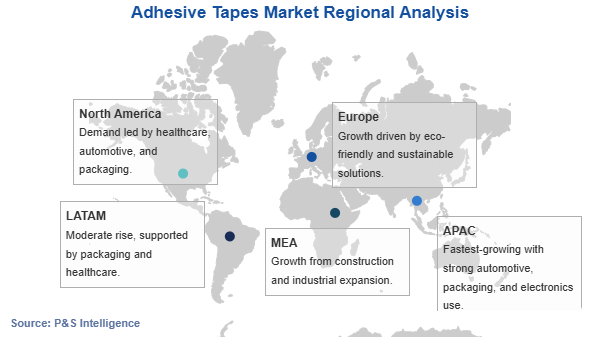
Asia-Pacific held the largest market share, of 40%, in 2024, and it will have the highest CAGR, of approx. 6.5%. This is ascribed to the easy availability of raw materials; the growing electrical and electronics industry, where these tapes are extensively used; the increasing demand from the automotive sector, owing to the escalating number of vehicles used for the transportation of goods as well as privately owned cars; and the presence of a large number of prominent manufacturers in the region.
Government initiatives supporting semiconductor manufacturing in China and India are creating additional demand for ultra-clean room compatible adhesive tapes used in wafer processing and chip assembly. India's adhesive tapes market is experiencing rapid expansion fueled by the Make in India initiative, growing automotive production, and increasing healthcare infrastructure investments. The establishment of new manufacturing facilities by both domestic and international tape manufacturers in India reflects the market's growth potential.
Japan has a significant market share in the Asia-Pacific region. According to the Japan Packaging Institute, the shipment value of the packaging industry in Japan was approximately YEN 6.16 trillion in 2023, reflecting a 1.4% increase from the previous year. This growth in packaging applications directly correlates with increased adhesive tape consumption. The region benefits from cost-competitive manufacturing, abundant raw material availability, and a skilled workforce that enables both high-volume commodity tape production and sophisticated specialty tape manufacturing.
China maintains its position as both the largest producer and consumer of adhesive tapes globally, with domestic demand driven by its massive e-commerce market and extensive manufacturing base. The country's dual circulation strategy, emphasizing domestic consumption alongside export growth, ensures a sustained demand for packaging and industrial tapes.
The North American market accounts for a significant share, driven by high per capita income, a growing number of key players, technological advancements, mushrooming construction rate, and mounting preference for packaged food, which leads to the growth of the packaging industry in the region.
The U.S. is a major revenue contributor to the regional market. This is due to the presence of key industry players, high R&D spending on healthcare, and growing e-commerce platforms in the country. Moreover, the usage of solvent-based adhesives is under strict monitoring by the U.S. Environmental Protection Agency (EPA), owing to their harmful environmental effects, such as the emission of VOCs. Thus, key players are involved in the R&D of water-based and hot-melt tapes to replace and match the standards and performance of solvent-based tapes. This factor is expected to generate growth opportunities for players operating in the market.
Europe accounts for a significant share of the market, due to the well-established automobile sector, the growing packaging industry, and the high acceptance rate of cutting-edge technology. The region leads global efforts in developing eco-friendly adhesive tapes, with manufacturers investing heavily in bio-based adhesives and recyclable backing materials. The European Union's circular economy policies and single-use plastic directives have accelerated the adoption of paper-based and compostable tape alternatives, particularly in packaging applications.
Germany remains the largest market within Europe, benefiting from its robust automotive industry and advanced manufacturing sector. The country's leadership in Industry 4.0 initiatives has driven demand for specialized adhesive tapes used in automated assembly processes and smart manufacturing applications. The ongoing transition to renewable energy sources has also created opportunities for adhesive tapes in solar panel assembly and wind turbine manufacturing, where long-term durability and weather resistance are critical requirements.
The geographical breakdown of the market is as follows:
The market is fragmented due to the presence of numerous global and regional players competing across different product segments and geographic markets. This competitive landscape is shaped by diverse customer requirements across industries, varying regional preferences, and the broad spectrum of adhesive tape applications ranging from basic packaging to sophisticated electronic assembly. The market remains accessible to smaller players who can compete effectively through niche specialization, regional focus, or innovative product development.
Want a report tailored exactly to your business need?
Request CustomizationLeading companies across industries trust us to deliver data-driven insights and innovative solutions for their most critical decisions. From data-driven strategies to actionable insights, we empower the decision-makers who shape industries and define the future. From Fortune 500 companies to innovative startups, we are proud to partner with organisations that drive progress in their industries.

Working with P&S Intelligence and their team was an absolute pleasure – their awareness of timelines and commitment to value greatly contributed to our project's success. Eagerly anticipating future collaborations.
McKinsey & Company
India
Our insights into the minutest levels of the markets, including the latest trends and competitive landscape, give you all the answers you need to take your business to new heights

We take a cautious approach to protecting your personal and confidential information. Trust is the strongest bond that connects us and our clients, and trust we build by complying with all international and domestic data protection and privacy laws


Customize the Report to Align with Your Business Objectives

Request the Free Sample Pages