This Report Provides In-Depth Analysis of the 3D Camera Market Report Prepared by P&S Intelligence, Segmented by Technology (Time-of-Flight, Stereo Vision, Structured Light), Type (Target Camera, Target-free Camera), Application (Professional Cameras, Smartphones and Tablets, Computers and Laptops, Robotics and Machine Vision, Other Applications), End Use (Consumer Electronics, Automotive, Industrial and Manufacturing, Healthcare, Security and Surveillance, Media and Entertainment, Aerospace and Defense, Other End Uses), and Geographical Outlook for the Period of 2022 to 2033
Explore the market potential with our data-driven report
3D Camera Market Outlook
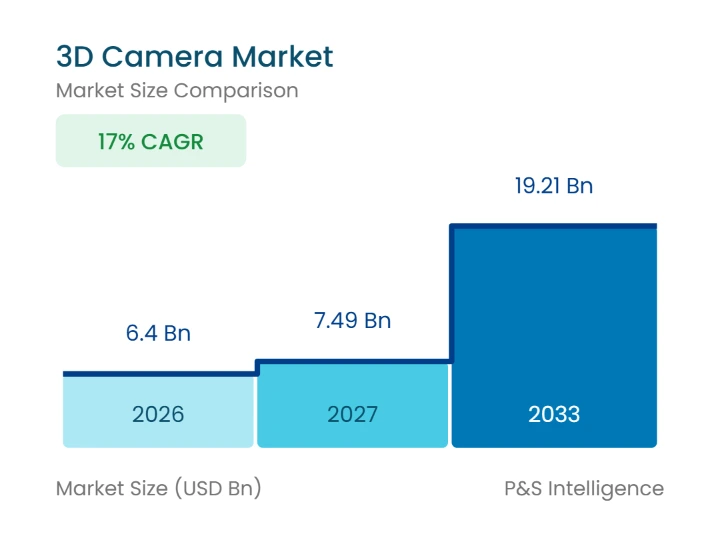
The 3D camera market stands at USD 6.40 Billion in 2026, and revenue is projected to climb to USD 7.49 Billion in 2027 before reaching USD 19.21 Billion by 2033, a 17.0% CAGR over 2027-2033. Robot builders, warehouse operators, carmakers, and device brands are paying for depth data because their machines have to judge distance, shape, and volume without a person checking the result. For camera and module makers, that spreads orders across factory, logistics, vehicle, and consumer design cycles that run on very different timetables.
Carmakers fitting driver-facing cabin cameras have opened a further sales channel beside robot cells and warehouse picking stations, which already rely on depth sensing to handle parts and parcels of varying size. As per the European Commission, every new passenger car and van in the European Union must carry an advanced driver distraction warning system from July 7, 2026. The rule sets the warning function and leaves the choice of sensor to carmakers, so only cabin programs that specify depth-capable cameras add revenue for camera suppliers.
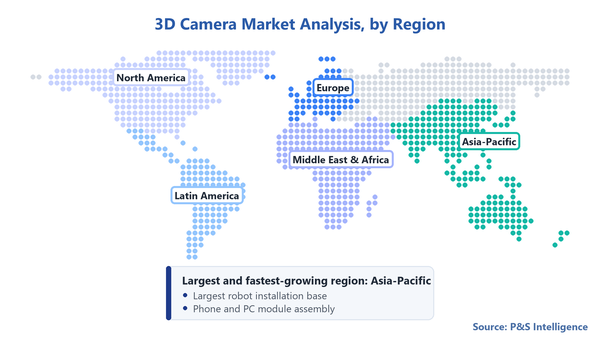
Asia-Pacific accounts for 36% of 3D camera market revenue in 2026 and is also projected to post the fastest growth, at an 18.9% CAGR during 2027-2033. Phone, PC, and robot assembly in China, South Korea, Japan, and Taiwan keeps embedded-module purchasing close to the region, while factory automation in China and India adds orders for standalone cameras. North America ranks second, propelled by warehouse automation and robot programs in the United States, where much of the spending goes into automating existing plants and distribution centers.
Key market insights
By technology, time-of-flight accounts for 41% in 2026, while stereo vision is set to expand at a 21.3% CAGR during 2027-2033.
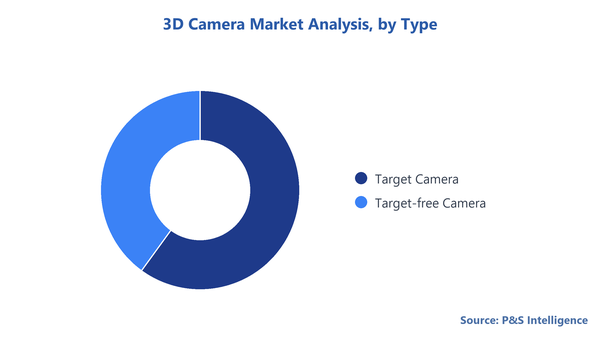
By type, target cameras hold 60% in 2026, while target-free cameras are forecast to advance at a 17.8% CAGR during 2027-2033.
By application, professional cameras represent 62% in 2026, while smartphones and tablets are expected to grow at a 21.7% CAGR over 2027-2033.
By end use, consumer electronics contributes 39% in 2026, while automotive is projected to rise at a 21.6% CAGR during 2027-2033.
By geography, Asia-Pacific commands 36% in 2026 and is also expected to lead growth with an 18.9% CAGR during 2027-2033.
3D Camera Market Drivers & Opportunities
General-industry robot buying is shaping depth camera specifications
Robot purchasing is spreading from car body shops toward electronics, plastics, metals, and life-science plants, and that shift changes the cameras robot makers and integrators specify. A welding or painting cell in a car plant handles parts that arrive in fixed positions, so it can run without depth sensing. Cells in general industry handle mixed parts, short batches, and loose items, and a robot can grip those reliably only once a depth camera has located them. Each such installation is therefore more likely to carry a depth camera.
Association for Advancing Automation data show North American companies ordered 28,984 robots worth about USD 1.89 billion in the first nine months of 2026, 9.6% more units than a year earlier, while automotive OEM orders stayed 17% below their prior-year level. Semiconductor and electronics plants posted the steepest third-quarter gain, at 97.6% in units. This order mix favors compact, factory-calibrated cameras sold through robot makers and integrators, because plants new to automation often lack in-house vision engineers to tune a camera themselves.
Rising online order volumes are fueling vision-guided picking purchases
Warehouse and parcel operators are automating item picking, palletizing, and package measurement, and each of those tasks needs a camera that reads shape and position before a robot or sorter acts. Online orders arrive as single items in every size and packaging type, which rules out the fixed fixtures used in factory cells. A depth camera lets a picking arm find the top item in a mixed tote and lets a dimensioning station measure a carton for billing and truck loading, so each automated station typically adds a camera to the order.
E-commerce accounted for 17.9% of U.S. retail sales in the third quarter of 2026, with online sales of USD 347.3 billion up 10.4% from a year earlier, according to the U.S. Census Bureau. The figure measures retail activity and does not count camera adoption. It does show that the volume of items flowing through fulfillment centers is still climbing. Operators usually add picking robots to existing buildings through integrator projects, so camera makers with certified links to widely used robot and warehouse software are more likely to reach project shortlists.
Mobile and humanoid robot programs are opening a volume channel for embedded depth modules
Makers of autonomous mobile robots, quadrupeds, and humanoids treat depth cameras as standard parts of the robot body, used for navigation, obstacle avoidance, and hand-eye coordination. That turns each depth-camera-equipped platform into recurring module demand. A factory cell may run one camera for years, whereas a mobile robot platform writes its cameras into the bill of materials, so a design win carries through every production run of that model and grows with the size of the fleet.
RealSense, the depth camera business spun out of Intel in July 2025, claims its cameras are embedded in 60% of the world's autonomous mobile robots and humanoid robots. Even read as a supplier's own figure, the claim shows how far these platforms already depend on off-the-shelf depth modules. As humanoid programs move from prototypes toward pilot fleets, camera makers holding design wins could see module volumes rise with each production ramp, while late entrants face requalification on established designs.
Falling handset shipments are limiting the consumer depth-module base
Smartphone brands have long been the anchor customers for embedded depth modules, and their unit volumes are now shrinking in major markets. Phone-module revenue depends on two numbers, handsets shipped and the share of models carrying front or rear depth sensing. When unit volumes fall, module makers need more depth-equipped models per brand just to hold revenue steady, and brands facing lower volumes have less room to add optional sensors that raise the bill of materials.
The China Academy of Information and Communications Technology recorded domestic-market smartphone shipments of 176 million units in the first nine months of 2026, down 12.8% from a year earlier. These are shipments into China's domestic market only and say nothing direct about depth-sensing attach rates. They do, however, shrink the base on which phone-module volumes are built. Module makers heavily exposed to Chinese handset brands face slower order books, so their phone revenue now depends on depth sensing spreading to more models per brand.
Segmentation Outlook
By technology
Time-of-flight accounts for 41% of 3D camera market revenue in 2026, the largest share among technologies. A time-of-flight system estimates depth from the travel time or phase shift of light reflected off a scene, and compact designs that pair one sensor with one emitter suit phones, laptops, headsets, and robot bodies where space and calibration effort are tight. Because the same design scales from consumer modules to industrial cameras, sensor and emitter makers spread development costs over large volumes. Device brands also value its ability to work in darkness, since the module supplies its own infrared light.
Stereo vision is projected to record the quickest growth among technologies, at a 21.3% CAGR during 2027-2033. Robot makers favor stereo cameras for outdoor and brightly lit sites, where strong sunlight can overwhelm the infrared emitters that other designs rely on, and for close-range manipulation. Orbbec's CES 2026 launches illustrate that demand, as the company unveiled a stereo camera designed for robotic wrist mounting and a rugged stereo model for outdoor robots such as commercial lawn mowers. Suppliers that pair stereo optics with on-camera depth processing cut integration work for robot builders.
By type
Target cameras hold 60% of revenue in 2026, the larger of the two types. Metrology, reverse-engineering, and quality-inspection teams buy them because reference markers or projected laser patterns let measurements reach the accuracy that part approval and dimensional reports demand. These purchases come out of capital budgets for inspection rooms and production lines and carry higher prices than embedded modules. Aerospace, tooling, and heavy-engineering users tend to keep a qualified measurement system once their inspection procedures reference it, which makes an incumbent supplier's position hard to displace.
Target-free cameras are set to expand at a 17.8% CAGR during 2027-2033, the quicker pace of the two types. They need no markers or scene preparation, so a robot, vehicle cabin, or handheld device can measure objects and people as they appear. That makes them the default choice for bin picking, mobile robot navigation, parcel dimensioning, and in-cabin sensing, where the scene changes constantly. Their spread also widens the buyer base from specialist metrology users to robot builders and electronics brands that buy cameras in production quantities.
Copyright P&S Intelligence. Reuse requires attribution under CC BY 4.0.
By application
Professional cameras represent 62% of revenue in 2026, the largest application. The category covers stereoscopic and volumetric capture rigs, reality-capture and photogrammetry cameras, and industrial-grade units bought by studios, surveyors, engineering firms, and inspection teams. Each unit sells for far more than a phone module because buyers pay for accuracy, ruggedness, and long-term support that consumer devices do not offer. Owing to that high value per sale, revenue stays concentrated in this category even as embedded modules spread into more devices.
Smartphones and tablets are expected to post the fastest growth among applications, at a 21.7% CAGR during 2027-2033. With handset unit volumes softening, that growth depends on more depth content per device, as brands add rear multizone time-of-flight sensors for autofocus and spatial capture alongside front-facing face authentication. Tablets and premium devices used for 3D scanning and design work add higher-value modules. Module makers able to shrink emitters and lenses into thinner bodies are better positioned for these sockets, since attach rates rather than shipments now set phone-module revenue.
By end use
Consumer electronics contributes 39% of revenue in 2026, more than any other end use. Phones, tablets, laptops, gaming systems, and mixed-reality headsets use depth cameras for face authentication, gesture control, and room mapping, and each design win commits a module maker to the production life of that model. Consumer brands buy on fixed annual product cycles, which gives qualified suppliers predictable volume but can concentrate revenue on a few large customers. Tight size, power, and cost limits keep the qualified supplier list short.
Automotive is projected to grow fastest among end uses, at a 21.6% CAGR during 2027-2033. Carmakers are adding driver- and occupant-facing cameras in the wake of distraction-warning rules, and depth data can help these systems judge head position, posture, and seat occupancy. Under Euro NCAP's 2026 rating protocols, a vehicle needs continuous eye- and head-tracking to reach the top scores, yet neither the ratings nor EU law prescribes depth sensing. A platform typically fixes its cabin camera for several model years, so a design award brings multi-year volume to suppliers already shipping automotive-grade parts.
The following segments are analyzed in this report.
By Technology
Time-of-Flight
Stereo Vision
Structured Light
By Type
Target Camera
Target-free Camera
By Application
Professional Cameras
Smartphones and Tablets
Computers and Laptops
Robotics and Machine Vision
Other Applications
By End Use
Consumer Electronics
Automotive
Industrial and Manufacturing
Healthcare
Security and Surveillance
Media and Entertainment
Aerospace and Defense
Other End Uses
Geographical Analysis
Asia-Pacific 3D camera market outlook
Asia-Pacific holds 36% of global 3D camera market revenue in 2026 and leads regional growth as well, with an 18.9% CAGR projected for 2027-2033. Phone, PC, and headset assembly in China, South Korea, Japan, Taiwan, and increasingly India keeps embedded-module purchasing close to the region's factories. Robot makers and industrial camera suppliers based in China, Japan, and South Korea build depth cameras into products sold worldwide. Factory owners in the region are also installing robots faster than anywhere else, which adds standalone camera demand on top of module volumes.
Figures from the International Federation of Robotics put China's 2025 installations at 354,000 of the more than 600,000 industrial robots added worldwide, and China is the region's largest market. Those installations measure the base of cells that could use vision guidance and do not count camera adoption itself. Even so, domestic camera makers selling into Chinese robot builders gain from that scale. India is among the region's fastest-growing markets, as electronics assembly and new component plants raise demand for both embedded modules and inspection cameras.
Copyright P&S Intelligence. Reuse requires attribution under CC BY 4.0.
North America market analysis
North America is the second-largest regional buyer of depth cameras, with demand weighted toward automation projects at existing plants and fulfillment centers in the United States and Canada. Adding robotic picking or package dimensioning to a running building usually means buying standalone cameras through a systems integrator. The U.S. Bureau of Labor Statistics estimates preliminary average hourly earnings of USD 26.87 for warehousing and storage employees in September 2026. That wage sizes the labor cost a picking cell can displace, not camera purchases, and a cell that removes manual handling from a costly shift recovers its price sooner.
Carmakers and component suppliers add a second channel, as engineering centers in the region specify cabin-monitoring cameras for vehicle platforms sold across several markets. Tariffs introduced in 2025 raised the landed cost of cameras and components built in Asia, and part of that increase has passed through to buyers as higher prices. Suppliers with local assembly, integrator networks, and software compatibility with installed robot fleets are better placed in the region than those competing on imported hardware price alone.
Europe market analysis
Europe holds a smaller share of revenue than Asia-Pacific and North America, with demand anchored in Germany, Italy, France, and Switzerland, home to machine builders, carmakers, and industrial camera makers that design 3D vision into equipment sold worldwide. EU vehicle-safety rules on driver distraction give the region a distinct automotive channel, because cabin cameras for new car and van programs are specified by European carmakers and their tier-one suppliers. That keeps European engineering teams central to automotive design wins even when the modules are built in Asia.
Industrial demand is recovering slowly. VDMA Machine Vision, part of the German engineering federation, reported 4% revenue growth for machine vision component makers in 2025 against a 6% decline for complete systems, and expects the European industry to grow by about 3% in 2026. These figures cover machine vision as a whole, of which depth cameras are one part. The split suggests plant engineers are buying more components to integrate themselves, which suits camera makers offering modular units with open software interfaces.
Latin America market analysis
Latin America contributes a smaller share of revenue, concentrated in Mexico and Brazil. Mexico's national statistics institute, INEGI, counted 3.25 million light vehicles produced in January-October 2026, 2.79 million of them for export, with output 3.95% below a year earlier. Those vehicles size the plant base, not camera purchases. Inspection and robot-guidance equipment on Mexican lines is often specified by parent engineering teams in the United States, Japan, or Germany, so camera orders there follow global platform decisions and favor suppliers already approved at headquarters level.
Brazil's demand comes from automotive, food-processing, and agricultural-machinery plants, where robot cells and grading systems use depth data to handle irregular items. Import duties and currency swings raise the landed price of cameras made abroad, so buyers tend to purchase through local distributors and integrators that bundle installation and support. Suppliers with regional distribution partners, Portuguese- and Spanish-language support, and local stock are better placed to win repeat orders across Brazil, Argentina, and Chile.
Middle East & Africa market analysis
The Middle East & Africa accounts for a smaller share of revenue, with buying centered on Israel, the United Arab Emirates, Saudi Arabia, and South Africa. Israeli defense, medical-imaging, and automotive-technology firms develop depth-sensing products for export, which creates engineering demand for evaluation units and modules. In the Gulf, airport, logistics-hub, and security projects buy depth cameras for people counting, access control, and baggage and parcel handling, usually through large integrators managing the whole project.
Saudi Arabia's Ministry of Industry and Mineral Resources runs a Future Factories Program that aims to move 4,000 factories from low-wage manual work toward automation. The program states a goal, not completed upgrades, but plants that do automate would need inspection and robot-guidance equipment. South Africa's vehicle assembly and mining sectors add a smaller pool of industrial buyers. Because most cameras reach the region through distributors and integrators, suppliers that appoint partners with security and logistics project experience are likely to reach end users sooner than those relying on direct sales.
The following geographies are analyzed in this report.
Asia-Pacific
China
India
Australia
Japan
South Korea
Taiwan
Europe
Germany
U.K.
France
Italy
Spain
Switzerland
Latin America
Brazil
Mexico
Argentina
Chile
Middle East & Africa
Saudi Arabia
U.A.E.
Israel
South Africa
North America
U.S.
Canada
3D Camera Market Competitive Landscape
The 3D camera market is highly fragmented, and no single supplier holds a commanding share of revenue. Demand splits across applications with little in common, from phone face-authentication modules qualified on cost and size, to metrology cameras qualified on accuracy, to robot cameras qualified on integration with motion software. A supplier strong in one application rarely carries its qualifications into another, so specialists keep their footholds. The structure is shifting at the edges as machine vision groups acquire depth-camera specialists, though those deals add product lines more than they concentrate overall share.
Competitors fall into recognizable clusters. Electronics and imaging groups such as Sony Group Corporation, Samsung Electronics Co., Ltd., and Panasonic Holdings Corporation bring depth-sensing image sensor and camera technology into consumer, professional, and automotive products. Industrial vision companies, including Cognex Corporation, Basler AG, SICK AG, and Zebra Technologies Corporation, sell standalone cameras with software and integrator support for factories and warehouses. Robot-focused depth specialists such as Orbbec Inc., Mech-Mind Robotics Technologies Co., Ltd., and Zivid AS compete on point-cloud quality, ruggedness, and fast integration with robot controllers.
Barriers to entry differ by cluster. Embedded-module suppliers need high-volume manufacturing and long qualification with device and vehicle makers, which favors established component groups. Industrial camera makers compete through integrator networks, software libraries, and certified interfaces to robot brands, so a newcomer with a capable camera can still struggle to reach project shortlists. For buyers, this spread of specialists keeps pricing competitive within each application, while switching costs rise once a camera is written into a robot program or a vehicle platform.
Major Companies in the 3D Camera Market:
Sony Group Corporation
Samsung Electronics Co., Ltd.
Canon Inc.
Nikon Corporation
Panasonic Holdings Corporation
Orbbec Inc.
Cognex Corporation
RealSense, Inc.
Basler AG
Teledyne Technologies Incorporated
Zebra Technologies Corporation
AMETEK, Inc.
Infineon Technologies AG
STMicroelectronics N.V.
ams-OSRAM AG
Lumentum Holdings Inc.
Mech-Mind Robotics Technologies Co., Ltd.
SICK AG
Zivid AS
3D Camera Market News & Developments
September 2026, Cognex Corporation signed a definitive agreement to acquire RealSense, Inc. for about USD 500 million in cash, with closing expected in the fourth quarter of 2026 subject to customary conditions. Once completed, the deal would add depth cameras for mobile robots, quadrupeds, and humanoids to Cognex's machine vision portfolio.
September 2026, Teledyne Technologies Incorporated, through its Teledyne e2v unit, introduced the Perciva ToF, an industrial-grade 3D time-of-flight camera built on its 832 x 600 Hydra3D+ sensor, with samples available on request. The camera targets logistics, robotics, inspection, and surveillance sites where varying outdoor light and interference from other systems degrade depth data.
September 2026, Mech-Mind Robotics Technologies Co., Ltd. listed on the Main Board of the Hong Kong Stock Exchange, offering 23.14 million H shares and earmarking nearly 30% of proceeds for global expansion and commercialization. Overseas markets supplied half of its 2025 revenue, so the listing funds a wider push for its industrial 3D vision systems outside China.
June 2026, STMicroelectronics N.V. introduced the VL53L9, a direct time-of-flight 3D module that maps 2,268 zones across a range from under 5 centimeters to 9 meters, with mass production scheduled from early July 2026. Its single-component, reflowable package lets robot, smart-building, and AR/VR device makers add multizone depth sensing as one board-mounted part.
March 2026, Basler AG launched its Stereo mini product line at LogiMAT 2026 as the first product of a technology partnership with Orbbec Inc., pairing Orbbec's depth-sensing chips and in-house manufacturing with Basler's pylon software and global sales reach. The line targets navigation, obstacle detection, and general robotics tasks in logistics and factory automation.
Last Updated: November 2026
Frequently Asked Questions About This Report
How big is the 3D camera market?+
The 3D camera market stands at USD 6.40 Billion in 2026, and revenue is projected to climb to USD 7.49 Billion in 2027 before reaching USD 19.21 Billion by 2033, a 17.0% CAGR over 2027-2033.
What is driving demand for 3D cameras?+
Robot builders, warehouse operators, carmakers, and device brands are paying for depth data because their machines have to judge distance, shape, and volume without a person checking the result.
Which region dominates the 3D camera market?+
Asia-Pacific accounts for 36% of 3D camera market revenue in 2026 and is also projected to post the fastest growth, at an 18.9% CAGR during 2027-2033.
Which 3D camera technology has the largest share?+
By technology, time-of-flight accounts for 41% in 2026, while stereo vision is set to expand at a 21.3% CAGR during 2027-2033.
Which end use is growing fastest in the 3D camera market?+
By end use, consumer electronics contributes 39% in 2026, while automotive is projected to rise at a 21.6% CAGR during 2027-2033.
Who are the key companies in the 3D camera market?+
Industrial vision companies, including Cognex Corporation, Basler AG, SICK AG, and Zebra Technologies Corporation, sell standalone cameras with software and integrator support for factories and warehouses.
Want a report tailored exactly to your business need?
Leading companies across industries trust us to deliver data-driven insights and innovative solutions for their most critical decisions. From data-driven strategies to actionable insights, we empower the decision-makers who shape industries and define the future. From Fortune 500 companies to innovative startups, we are proud to partner with organisations that drive progress in their industries.
Client Testimonials
Working with P&S Intelligence and their team was an absolute pleasure – their awareness of timelines and commitment to value greatly contributed to our project's success. Eagerly anticipating future collaborations.
McKinsey & Company
India
Unmatched Standards
Our insights into the minutest levels of the markets, including the latest trends and competitive landscape, give you all the answers you need to take your business to new heights
Complete Data Security
We take a cautious approach to protecting your personal and confidential information. Trust is the strongest bond that connects us and our clients, and trust we build by complying with all international and domestic data protection and privacy laws