This Report Provides In-Depth Analysis of the Vehicle Auxiliary Battery Market Report Prepared by P&S Intelligence, Segmented by Battery Type (Lithium-Ion, Nickel, Nickel-Metal Hydride, Solid-State, Ultracapacitors, Lead-Acid, Sodium-Ion), Voltage (<10 V, 10-15 V, >15 V), Battery Cell (Cylindrical, Prismatic, Pouch), Vehicle Type (Passenger Vehicles, Commercial Vehicles), Application (SLI Systems, Infotainment Systems), Sale Channel (OEMs, Aftermarket), and Geographical Outlook for the Period of 2019 to 2032
Explore the market potential with our data-driven report
Vehicle Auxiliary Battery Market Overview
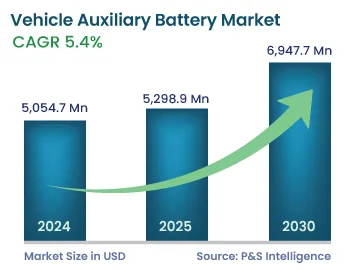
The vehicle auxiliary battery market size was USD 5.7 billion for 2025, and it will grow by 9.5% during 2025–2032, to reach USD 10.7 billion by 2032.
This growth is driven by the increasing electrification of vehicles, rising integration of electronic systems, and growing demand for energy storage beyond primary propulsion batteries. Auxiliary batteries are essential for supporting non-propulsion functions such as lighting, infotainment, safety systems, and advanced driver assistance systems (ADAS). With modern vehicles incorporating more electronic components, the demand for reliable auxiliary power sources is increasing significantly.
The International Energy Agency reports that global electric vehicle sales exceeded 14 million units annually, reflecting rapid electrification. In addition, the International Organization of Motor Vehicle Manufacturers reports that global vehicle production exceeded 93 million units in recent years, reinforcing the large installed base requiring auxiliary battery systems. These factors are significantly increasing the demand for both traditional and advanced auxiliary batteries across vehicle categories.
Key Market Insights
The lead-acid category holds the largest market share, of 30%, in 2025, driven by its cost-effectiveness, high reliability, and strong suitability for SLI applications.
The >15 V category will have the highest CAGR, of 10.8%, supported by the gradual shift toward higher-voltage auxiliary systems in advanced vehicle platforms.
The cylindrical category holds the largest market share, of 60%, in 2025, driven by its cost efficiency, standardized design, and suitability for large-scale manufacturing.
The SLI systems category holds the larger market share, of 65%, in 2025, driven by its fundamental role in vehicle operation, including starting, lighting, and ignition functions.
Asia-Pacific holds the largest market share, of 45%, in 2025, and it will have the highest CAGR, of 12.4%, driven by strong vehicle production and rapid electrification adoption.
Vehicle Auxiliary Battery Market Trends & Drivers
Electrification Is Multiplying Auxiliary Battery Demand Per Vehicle Is Key Trend
A major trend in the global vehicle auxiliary battery market is the transition toward distributed low-voltage architectures, where multiple auxiliary batteries are integrated within a single vehicle to manage distinct electrical loads. In battery electric and hybrid vehicle platforms, auxiliary batteries operate independently without reliance on alternator-based charging, marking a fundamental structural shift from conventional internal combustion engine designs, enabling a dedicated and uninterrupted power supply to critical systems such as control modules, safety functions, and onboard electronics. Vehicles are increasingly being designed with multiple auxiliary battery units, increasing per-vehicle battery demand and transforming traditional single-battery configurations into multi-battery systems.
This architectural evolution is driving changes in battery performance requirements and technology adoption. Auxiliary batteries are now expected to deliver higher cycle life, improved durability, and consistent performance under continuous electronic loads. According to the International Energy Agency, the global electric vehicle stock is projected to grow from fewer than 45 million units in 2023 to around 250 million units by 2030 under stated policies, with each vehicle incorporating dedicated auxiliary battery systems. The U.S. Department of Energy highlights the increasing role of low-voltage battery systems in supporting energy-efficient vehicle electronics. Ongoing industry investments are reinforcing supply capabilities, with Panasonic Energy Co. Ltd. initiating large-scale automotive lithium-ion battery production in North America, enhancing regional manufacturing capacity and supporting the growing demand for advanced vehicle battery systems.
Rising Global Vehicle Production and Electrification Synergy Is Biggest Driver
Global motor vehicle production remains the primary demand engine for auxiliary batteries, as every vehicle manufactured, regardless of powertrain, requires at least one auxiliary battery at the point of assembly. According to the International Organization of Motor Vehicle Manufacturers, global vehicle production increased from 92.7 million units in 2024 to 96.4 million units in 2025, reflecting steady expansion in automotive manufacturing output. This consistent production volume establishes a strong baseline demand for auxiliary batteries across OEM channels, providing structural stability to the market and largely insulating it from short-term economic fluctuations.
With the total vehicle fleet exceeding 1.4 billion units globally, replacement cycles of three to five years generate a predictable and recurring demand stream in the aftermarket. In addition, governments and regulatory bodies such as the European Commission are implementing stringent emission standards and promoting cleaner mobility transitions, indirectly supporting the need for advanced auxiliary battery systems in newer vehicle platforms, while emerging automotive manufacturing hubs in India, Mexico, and Southeast Asia are expanding production capacity, embedding auxiliary battery demand into new supply chains and contributing to sustained market growth. Moreover, capacity expansion initiatives by companies such as Amara Raja Energy & Mobility Limited, including the development of lithium-ion battery manufacturing facilities, are strengthening domestic production ecosystems and supporting the increasing demand for automotive battery solutions.
Volatility in Raw Material Prices Is Key Restraint
The vehicle auxiliary battery market is constrained by fluctuations in the prices of key raw materials, including lead, lithium, nickel, cobalt, and graphite. These raw materials are essential for manufacturing various battery chemistries, and their price volatility directly impacts production costs and profit margins for manufacturers. Supply chain disruptions, geopolitical factors, and uneven global distribution of these resources further contribute to pricing instability, making cost competitiveness and consistent material availability difficult to maintain when input prices fluctuate without predictable cycles.
The concentration of critical mineral reserves in a limited number of countries exposes manufacturers to trade restrictions, export controls, and sudden policy changes, while limited recycling infrastructure and low recovery rates for battery materials increase dependence on primary extraction. This dependence further tightens supply conditions and leaves procurement strategies vulnerable to upstream shocks. Currency fluctuations and rising transportation costs add to procurement challenges for globally operating manufacturers, weakening margin predictability and hindering long-term pricing stability across the auxiliary battery value chain.
The lead-acid category holds the largest market share, of 30%, in 2025, driven by its cost-effectiveness, high reliability, and strong suitability for SLI (starting, lighting, ignition) applications. Lead-acid batteries continue to dominate due to their proven performance in 12V systems and a well-developed recycling ecosystem that supports material recovery and cost stability. The International Energy Agency indicates that a significant share of the global vehicle fleet continues to rely on conventional powertrain configurations, supporting sustained demand for lead-acid auxiliary batteries.
The lithium-ion category will have the highest CAGR, of 10.1%, supported by its superior technical characteristics such as higher energy density, longer service life, and reduced weight compared to traditional chemistries. These batteries are increasingly being adopted in advanced vehicle platforms that require enhanced performance, durability, and thermal stability in auxiliary power systems. Lithium-ion variants, particularly lithium iron phosphate, are gaining traction due to their improved safety profile and longer cycle life, making them suitable for next-generation auxiliary battery applications.
The battery types analyzed in this report are:
Lithium-Ion (Fastest-Growing Category)
Nickel–Cadmium
Nickel-Metal Hydride
Solid-State
Ultracapacitors
Lead-Acid (Largest Category)
Sodium-Ion
Voltage Analysis
The 10-15 V category holds the largest market share, of 65%, in 2025, driven by its widespread adoption as the standard voltage range across vehicle electrical systems. This range, centered around the 12V architecture, supports essential functions such as ignition, lighting, and core vehicle operations, making it the most widely implemented configuration across passenger and commercial vehicles. Its long-standing standardization, high compatibility across platforms, and availability in multiple battery formats, including flooded, AGM, and EFB, continue to reinforce its dominant position in auxiliary battery applications.
The >15 V category will have the highest CAGR, of 10.8%, supported by the gradual shift toward higher-voltage auxiliary systems in advanced vehicle platforms. These systems are designed to deliver improved electrical efficiency by reducing current flow and associated resistive losses, enabling better performance for high-load applications. The transition toward higher-voltage configurations also supports the use of lighter wiring systems and enhances overall energy management within vehicles.
The voltages analyzed in this report are:
<10 V
10-15 V (Largest Category)
>15 V (Fastest-Growing Category)
Battery Cell Analysis
The cylindrical category holds the largest market share, of 60%, in 2025, driven by its cost efficiency, standardized design, and suitability for large-scale manufacturing. These cells offer strong mechanical stability and reliable thermal performance, making them well-suited for automotive operating conditions. Their uniform structure and compatibility with automated production processes enable consistent quality and efficient high-volume output, reinforcing their dominant position in auxiliary battery applications.
The pouch category will have the highest CAGR, of 12.6%, supported by its flexible form factor and efficient space utilization within constrained vehicle layouts. Its design enables better integration across varying battery pack configurations, allowing greater adaptability compared to rigid cell formats. This flexibility, combined with improved packaging efficiency, is increasing the adoption of pouch cells in advanced auxiliary battery systems.
The battery cells analyzed in this report are:
Cylindrical (Largest Category)
Prismatic
Pouch (Fastest-Growing Category)
Vehicle Type Analysis
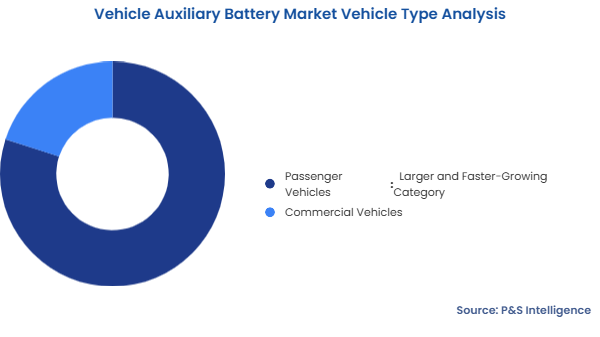
The passenger vehicles category holds the larger market share, of 80%, in 2025, and it will have the higher CAGR, of 9.7%, supported by its extensive global presence and consistent demand across both developed and emerging markets. The segment benefits from a broad application base, where auxiliary batteries are essential for core vehicle functions and standard electrical operations. Its dominance is further reinforced by the high volume of passenger vehicle ownership worldwide, making it the primary contributor to overall auxiliary battery consumption. According to the European Automobile Manufacturers’ Association, more than 10.5 million new passenger cars were registered across the European Union in 2023, highlighting the segment’s strong scale and continued contribution to auxiliary battery demand.
The vehicle types analyzed in this report are:
Passenger Vehicles (Larger and Faster-Growing Category)
Commercial Vehicles
Application Analysis
The SLI systems category holds the largest market share, of 65%, in 2025, driven by its fundamental role in vehicle operation, including starting, lighting, and ignition functions. Every internal combustion and hybrid vehicle requires an SLI system, ensuring consistent baseline demand for auxiliary batteries across the global vehicle fleet. Its universal integration and critical functionality make it the most widely adopted application segment. The U.S. Department of Energy notes that conventional 12V lead-acid batteries continue to dominate automotive SLI applications, reinforcing their large-scale deployment across vehicle platforms.
The infotainment system category will have the highest CAGR, of 9.2%, supported by the increasing incorporation of advanced digital interfaces and connected in-vehicle features. Modern vehicles utilize touchscreen systems, navigation modules, and integrated connectivity platforms that require continuous low-voltage power support.
The applications analyzed in this report are:
SLI Systems (Largest Category)
Infotainment Systems (Fastest-Growing Category)
Others
Sale Channel Analysis
The aftermarket category holds the larger market share, of 80%, in 2025, driven by the regular replacement cycle of auxiliary batteries, particularly lead-acid batteries. These batteries typically require replacement every three to five years, creating steady and recurring demand across the global vehicle fleet. The high replacement frequency, combined with the large installed base of vehicles in operation, ensures a stable and continuous revenue stream for aftermarket suppliers.
The OEM category will have the higher CAGR, of 10.2%, supported by ongoing advancements in vehicle design and increasing standardization of auxiliary battery systems across new vehicle platforms. Automakers are focusing on improving battery performance, durability, and integration within vehicle electrical systems, leading to greater value addition at the manufacturing stage. The U.S. Department of Energy notes that continuous improvements in battery durability and lifecycle performance are a key focus area in automotive research programs, supporting innovation-driven growth in OEM demand. In addition, in November 2025, Clarios LLC expanded its U.S. battery recycling capacity, targeting up to 400,000 metric tons, to strengthen domestic supply chains.
The sales channels analyzed in this report are:
OEMs (Faster-Growing Category)
Aftermarket (Larger Category)
Drive strategic growth with comprehensive market analysis
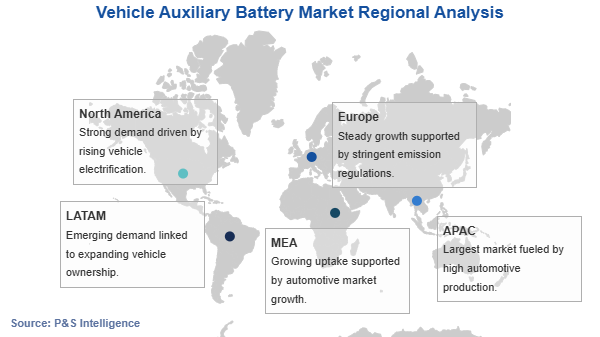
Asia-Pacific holds the largest market share, of 45%, in 2025, and it will have the highest CAGR, of 9.9%. This leadership position reflects the region’s strong automotive manufacturing ecosystem and high concentration of battery production capabilities. Japan and South Korea host some of the world’s leading battery manufacturers, including Panasonic, Samsung SDI, and LG Energy Solution, supporting technological advancement and large-scale battery supply across the automotive sector. In addition, the Japan Automobile Manufacturers Association reported that Japan produced more than 7.7 million passenger vehicles in 2023, reinforcing the country’s importance in the regional automotive value chain.
Australia is also witnessing the rising adoption of advanced vehicle technologies and battery-supported mobility systems. According to the Electric Vehicle Council, electric vehicle sales accounted for approximately 8.4% of all new car sales in Australia in 2023, reflecting increasing integration of battery-dependent vehicle platforms across the country. Meanwhile, the International Energy Agency confirmed that China’s electric car sales exceeded 11 million units in 2024, establishing China as the largest automotive battery demand center globally. Government initiatives across the region, including China’s NEV incentives, continue to support manufacturing expansion and long-term market growth.
India Vehicle Auxiliary Battery Market Size
India is the fastest-growing country market within Asia Pacific, supported by rising vehicle ownership and a large replacement-driven aftermarket. The country’s significant base of two- and three-wheelers, which predominantly rely on lead-acid or lithium-ion auxiliary batteries, creates a structurally distinct demand pattern compared to developed automotive markets. Domestic manufacturers such as Amara Raja Energy & Mobility and Exide Industries maintain extensive distribution networks across urban and rural regions, enabling strong aftermarket penetration.
Electric car registrations in India reached approximately 80,000 units in 2023, reflecting continued expansion in the passenger EV segment. According to the International Energy Agency, electric car sales in India recorded strong year-on-year growth in 2023, supported by policy initiatives such as the FAME II scheme and Production Linked Incentive (PLI) programs. These initiatives, along with ongoing investments in charging infrastructure and domestic battery manufacturing, are expected to sustain market growth and strengthen auxiliary battery demand over the forecast period.
North America Vehicle Auxiliary Battery Market Size
North America represents the second-largest regional market, characterized by a high-value mix of premium vehicle platforms and a well-established aftermarket replacement cycle. The United States drives regional demand through strong automotive sales and a mature vehicle ownership base, supporting consistent auxiliary battery demand across both OEM and replacement channels. The U.S. Department of Energy has identified improvements in 12V battery performance and durability as a key research priority, highlighting the continued importance of auxiliary battery systems in modern vehicles.
According to the U.S. Bureau of Transportation Statistics, the U.S. vehicle fleet exceeded 280 million registered vehicles, providing a substantial installed base that supports long-term replacement demand for auxiliary batteries. Canada contributes to regional demand through steady automotive production and clean energy initiatives. This integrated ecosystem strengthens North America’s position in the global auxiliary battery market.
The regions and countries analysed in this report are:
North America
U.S. (Larger Country)
Canada (Faster-Growing Country)
Europe
Germany (Largest Country)
U.K. (Fastest-Growing Country)
France
Italy
Spain
Rest of Europe
Asia-Pacific (Largest and Fastest-Growing Regional Market)
China (Largest Country)
India (Fastest-Growing Country)
Japan
South Korea
Australia
Rest of APAC
Latin America
Brazil (Largest and Fastest-Growing Country)
Mexico
Rest of LATAM
Middle East & Africa
Saudi Arabia (Largest Country)
U.A.E. (Fastest-Growing Country)
South Africa
Rest of MEA
Vehicle Auxiliary Battery Market Share Analysis
The market is fragmented due to the presence of numerous global and regional players operating across different battery chemistries and vehicle segments. The market includes lead-acid, lithium-ion, and emerging technologies, each requiring distinct manufacturing capabilities, allowing multiple companies to compete simultaneously. In addition, strong regional demand across Asia Pacific, Europe, and North America supports the growth of local manufacturers alongside established global firms. The aftermarket segment further increases fragmentation, as replacement demand is served by a wide network of distributors, retailers, and independent suppliers. While major companies maintain strong OEM partnerships, no single player dominates the market, and the diversity of applications and supply chains continues to drive competitive dispersion.
Key Players in the Vehicle Auxiliary Battery Market:
SAIC Motor Corporation Limited
GS YUASA Battery Germany GmbH
BYD Company Ltd.
Samsung SDI Co. Ltd.
LG Energy Solution Ltd.
Okaya Power Pvt. Ltd.
Exide Technologies
Clarios LLC
Panasonic Energy Co. Ltd.
Innovate Powering Electronic SL
Leoch International Technology Limited
Toyota Motor Corporation
Vehicle Auxiliary Battery Market News
In March 2025, Clarios LLC announced a USD 6 billion American energy manufacturing strategy, covering the expansion of 16 existing U.S. facilities. The initiative includes the commencement of advanced low-antimony battery production at its Toledo, Ohio plant, targeting 745,000 units annually from 2026, along with capacity upgrades at its Oconee, South Carolina facility to increase battery component output by 30 million parts per year. The initiative is intended to strengthen domestic critical mineral independence and support growing OEM demand for low-voltage auxiliary batteries.
In April 2024, GS Yuasa Battery announced the launch of a renewed ECO.R HV auxiliary VRLA battery series for Toyota hybrid vehicles, with commercial availability beginning in June 2024. The updated series improves performance across B20 and B24 battery sizes to support hybrid system activation requirements, strengthening the company’s position in the HEV auxiliary battery segment across Japan and other Asia Pacific markets.
In March 2024, Exide Technologies acquired BE-Power GmbH, a Germany-based specialist in lithium-ion battery and power module technologies. The acquisition expands Exide’s advanced battery management and high-voltage system capabilities, supporting broader automotive and industrial battery applications.
Frequently Asked Questions About This Report
How are auxiliary batteries used in vehicles?+
Auxiliary batteries support secondary electrical functions such as infotainment systems, lighting, power windows, ADAS features, and backup power for critical electronics in both conventional and electric vehicles.
What factors are driving the demand for vehicle auxiliary batteries?+
The demand is driven by increasing vehicle electrification, rising integration of electronic systems, growing adoption of start-stop technology, and enhanced in-vehicle comfort and safety features.
How is vehicle electrification impacting auxiliary battery demand?+
Vehicle electrification is increasing the need for reliable auxiliary power sources to support complex electronic architectures, ensuring stable performance of safety, communication, and entertainment systems.
What role do auxiliary batteries play in electric vehicles?+
In electric vehicles, auxiliary batteries power low-voltage systems such as control units, lighting, infotainment, and safety features, ensuring these functions operate independently from the main traction battery.
What challenges are associated with vehicle auxiliary batteries?+
Challenges include high costs of advanced battery technologies, limited lifecycle of traditional batteries, and environmental concerns related to disposal and recycling.
What technological advancements are shaping the vehicle auxiliary battery market?+
Advancements include the development of lithium-ion and solid-state batteries, improved battery management systems, and enhanced energy efficiency to support modern vehicle electronics.
Want a report tailored exactly to your business need?
Leading companies across industries trust us to deliver data-driven insights and innovative solutions for their most critical decisions. From data-driven strategies to actionable insights, we empower the decision-makers who shape industries and define the future. From Fortune 500 companies to innovative startups, we are proud to partner with organisations that drive progress in their industries.
Client Testimonials
Working with P&S Intelligence and their team was an absolute pleasure – their awareness of timelines and commitment to value greatly contributed to our project's success. Eagerly anticipating future collaborations.
McKinsey & Company
India
Unmatched Standards
Our insights into the minutest levels of the markets, including the latest trends and competitive landscape, give you all the answers you need to take your business to new heights
Complete Data Security
We take a cautious approach to protecting your personal and confidential information. Trust is the strongest bond that connects us and our clients, and trust we build by complying with all international and domestic data protection and privacy laws