This Report Provides In-Depth Analysis of the Uterine Fibroid Treatment Market Report Prepared by P&S Intelligence, Segmented by Type (Subserosal Fibroids, Intramural Fibroids, Submucosal Fibroids, Pedunculated Fibroids), Treatment (Medication, Surgery), End User (Hospitals, Ambulatory Surgery Centers), and Geographical Outlook for the Period of 2019 to 2032
Explore the market potential with our data-driven report
Uterine Fibroid Treatment Market Overview
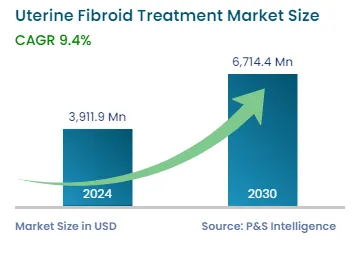
The uterine fibroid treatment market size was USD 3.9 billion in 2024, and it will grow by 9.4% during 2025–2032, to reach USD 7.9 billion by 2032.
The major factors contributing to the growth include the increasing prevalence of uterine fibroids among women of reproductive age, the growing female geriatric population, the surging prevalence of hormonal conditions among females, and changing lifestyles.
The substantial burden of uterine fibroids has led to significant innovations in treatment approaches, with minimally invasive procedures, such as Uterine Artery Embolization (UAE), laparoscopic myomectomy, and High-intensity Focused Ultrasound (HIFU), becoming more popular among patients seeking fertility-preserving options. Furthermore, the market has witnessed the introduction of advanced therapeutic devices and novel pharmacological treatments that offer improved patient outcomes with reduced recovery times.
Additionally, the expansion of healthcare infrastructure in developing countries, increased consciousness among the population about abnormalities, and the invention of new, more-effective techniques are contributing to the demand for uterine fibroid treatment. Moreover, many governments and commercial groups are emphasizing raising awareness of the early diagnosis of fibroids. For instance, the Fibroids Project aims to offer information about ongoing research, therapy options, and procedures for doctors and women. It is an online community that supports women to get rid of the condition.
Uterine Fibroid Treatment Market Trends & Drivers
Technological Advancements in Minimally Invasive Procedures Are Key Trends
The shift toward minimally invasive treatment options represents a significant trend reshaping the uterine fibroid treatment market.
Smaller incisions reduce post-operative pain and speed up recovery, which encourages widespread use of these procedures.
Advanced technologies such as MRI-guided focused ultrasound surgery and radiofrequency ablation have emerged as game-changing alternatives to traditional surgical approaches.
MR-guided focused ultrasound is a nonsurgical technique to destroy targeted areas of tissue without harming the surrounding tissue.
This innovative approach has gained FDA approval and is increasingly being adopted across major medical centers.
In 2015, the FDA expanded the label for MRI-guided focused ultrasound (MRgFUS) for uterine fibroids to include women who wish to preserve their fertility.
Similarly, radiofrequency ablation has shown promising results, with ablation diameters approaching 7 cm are now achievable in some cases.
The development of transcervical approaches has further expanded treatment options.
New devices that combine real-time imaging with targeted therapy delivery have improved procedural accuracy and patient outcomes.
These technological advances have not only enhanced treatment efficacy but also reduced hospital stays and recovery times, making them increasingly attractive to both patients and healthcare providers.
Additional innovations, including robotic-assisted myomectomy, next-generation HIFU systems, and AI-integrated imaging devices, are further enhancing procedural precision and patient outcomes.
The FDA approvals for these technologies, along with label expansions allowing fertility-preserving treatments, and evolving insurance reimbursement policies, are supporting a wider adoption of minimally invasive uterine fibroid therapies.
The clinical guidelines from the ACOG also encourage minimally invasive, uterine-sparing procedures, emphasizing outpatient care and reduced recovery times.
Growing Prevalence of Uterine Fibroids Is Biggest Driver
The rising incidence of uterine fibroids represents a key driver for this market.
According to a 2023 study, the incidence, prevalence, and the number of YLDs of uterine fibroids increased from 1990 to 2019 by 67.07%, 78.82% and 77.34%, respectively.
The burden of this condition varies significantly across demographics and regions.
A 2024 study published in JAMA Network Open confirmed that Black women are more likely to be diagnosed with uterine fibroids compared to non-Hispanic White women.
Several factors contribute to the increasing prevalence of uterine fibroids.
From 1990 to 2019, the age-standardized incidence of uterine fibroids increased most significantly in Tropical Latin America and South Asia.
The changing lifestyle patterns, delayed childbearing, and improved diagnostic capabilities have resulted in more women being diagnosed with the condition.
The racial disparities in fibroid prevalence have become more apparent, with a high prevalence of uterine fibroids among women in North America, resulting in the increasing demand for effective treatments.
The economic impact of uterine fibroids continues to grow substantially. Recent cost analyses have shown that the financial burden associated with the condition has increased significantly over the past decade.
This economic pressure, combined with the physical and emotional toll on affected women, has intensified the demand for effective treatment solutions across all market segments.
Organizations like the White Dress Project and the Fibroids Project play a crucial role in educating the public and healthcare providers about uterine fibroids, promoting research, and supporting affected women.
Moreover, Fibroids Awareness Month is celebrated every July to raise awareness about uterine fibroids and encourage early diagnosis and treatment.
The intramural fibroids category held the largest market share, of 45%, in 2024. This is attributed to the increasing occurrence of intramural fibroids among women globally. Typically, this type of fibroid could grow in the anterior, posterior, or fundal position, and seems to stay small in size as compared to other types of fibroids, although it has the potential to grow further. Furthermore, the intramural fibroids do not generally bulge outward or protrude into the uterine cavity and are rooted in the muscular uterus wall. Hence, there is a rising need for rapid abdominal diagnoses.
Moreover, the increasing need for research on various diagnosis technologies and a number of companies that are significantly focusing on launching innovative products for the treatment are contributing to the growth of the market. For instance, in August 2022, the FDA approved MYFEMBREE for the management of moderate-to-severe pain associated with endometriosis in premenopausal women, with a treatment duration of up to 24 months. The approval was based on positive results from the Phase 3 SPIRIT 1 and SPIRIT 2 trials, which demonstrated a reduction in dysmenorrhea and non-menstrual pelvic pain.
The submucosal fibroids category will have the highest CAGR, driven by improved diagnostic capabilities that enable earlier detection and the availability of specialized treatments such as hysteroscopic myomectomy that can effectively address these fibroids while preserving fertility.
The types analyzed in this report are:
Subserosal Fibroids
Intramural Fibroids (Largest Category)
Submucosal Fibroids (Fastest-Growing Category)
Pedunculated Fibroids
Treatment Analysis
The surgery category held the larger market share, of 70%, in 2024. This can be ascribed to the increased incidences of fibroids causing moderate-or-severe symptoms, including extreme pain and heavy bleeding. Although medications can help in case of mild symptoms, as a result, surgical methods are usually preferred by doctors for the removal of fibroids.
The hysterectomy category accounts for a major share under surgical techniques. This is due to the rising number of hysterectomy surgeries, as these are the most preferred and permanent solutions for treating uterine fibroids in women. According to the Centers for Disease Control and Prevention (CDC), approximately 600,000 hysterectomies are conducted every year in the U.S. In addition, as per the American College of Obstetricians and Gynecologists (ACOG), about a third of all women will undergo a hysterectomy by the age of 60. These high numbers are expected to support the market expansion during the projection period.
Furthermore, the rapid shift toward minimally invasive and non-invasive fibroid surgical procedures is expected to drive the market growth in this category. These surgeries involve small incisions, cause less post-operative pain, have lower complications, and offer speedy recovery, leading to their surging adoption. Advancements in robotic and laparoscopic-assisted surgeries are delivering efficacious treatment and quality that are further promoting their demand. Various market players are investing in research and development for launching surgical instruments helpful in these types of surgeries. MRgFUS is an emerging novel technology for the management of uterine fibroids. It is extensively used by medical professionals as it is one of the incisionless procedures. The device utilizes ultrasound beams that heat and remove specific tissue from the uterine cavity.
The medication category will have the higher CAGR, fueled by the introduction of novel oral GnRH antagonists and improved hormonal therapies. The development of new medical treatments, such as the selective progesterone receptor modulator (SPRM) ulipristal acetate (UPA), allowed a reduction or postponement of surgeries. The convenience of oral administration, coupled with improved side effect profiles compared to traditional GnRH agonists, has enhanced patient acceptance and compliance with medical therapy.
The treatments analyzed in this report are:
Medication (Faster-Growing Category)
Levonorgestrel
Gonadotropin-releasing hormone (GnRH) agonists
Progestin-releasing intrauterine device (IUD)
Tranexamic acid (Lysteda, Cyklokapron)
Surgery (Larger Category)
Non-invasive
MRI-guided focused ultrasound surgery
Minimally invasive
Uterine artery embolization
Radiofrequency ablation
Laparoscopic or robotic myomectomy
Hysteroscopic myomectomy
Endometrial ablation
Traditional
Abdominal myomectomy
Hysterectomy
End User Analysis
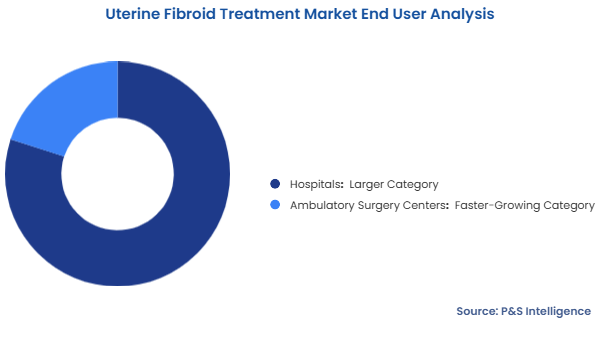
The hospitals category held the larger market share, of 80%, in 2024, due to the presence of highly developed infrastructure across hospitals. Hospitals serve as the primary centers for complex surgical procedures, including hysterectomy and myomectomy, and possess the necessary equipment and expertise for advanced minimally invasive techniques. In addition to that, better access to modern technologies for the treatment of uterine fibroids in healthcare facilities is accelerating the market growth in this category. Also, hospitals are highly developed to manage any complicated case and emergency associated with uterine fibroids through highly specialized doctors. Moreover, many large hospitals are putting emphasis on providing training to gynecologists and interventional radiologists in the area of robotic minimally invasive procedures and radiofrequency.
The ambulatory surgery centers will have the higher CAGR, due to the upgradation of this healthcare infrastructure and having access to quicker and more effective technologies. Further, these centers offer customized surgical environments, improved patient accessibility, highly efficient surgical teams, on-time scheduling, less operative and facility times, less potential exposure to nosocomial infections, lower treatment costs, and intensified quality control processes. These benefits of ASCs lead patients to shift their focus from hospitals to ambulatory settings. Furthermore, as per the Journal of the Society of Laparoscopic & Robotic Surgeons, there are more than 6,000 ASCs in the U.S., which account for roughly 35% of all the surgical procedures in the country and have 10% of surgical revenue.
The end users analyzed in this report are:
Hospitals (Larger Category)
Ambulatory Surgery Centers (Faster-Growing Category)
Drive strategic growth with comprehensive market analysis
Uterine Fibroid Treatment Market Regional Outlook
North America Uterine Fibroid Treatment Market Size
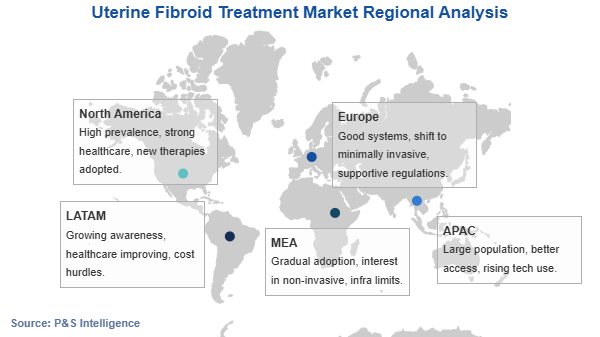
North America held the largest market share, of 40%, in 2024. This is attributed to the established healthcare industry in the U.S. and Canada, the rising cases of uterine fibroids, the easy accessibility of the latest technologies, and the increasing patient pool having hormonal disorders and uterine cancers in the region. Additionally, government initiatives, high reimbursement rates, and a rise in hysterectomy-associated surgical operations are further fostering the growth of the market for uterine fibroid treatment.
U.S. Uterine Fibroid Treatment Market Size
The U.S. dominates the market in North America due to an expanding patient pool with hormonal disorders, the rise in the prevalence of uterine cancer, and the presence of major industry players in the country. The country's advanced healthcare system, high healthcare expenditure per capita, and strong focus on women's health initiatives continue to drive market expansion. Major academic medical centers across the United States are at the forefront of developing and implementing novel fibroid treatments, including advanced imaging-guided therapies and next-generation medical devices.
Asia-Pacific will have the highest CAGR, of approx. 9.5%. This can be attributed to the increasing cases of abnormal uterine bleeding, irregular menstrual cycles among females, increasing per capita income leading to improved standard of living, rising healthcare spending, surging demand for better quality medical care, and mounting awareness about uterine fibroid treatment in the region. Moreover, the growing acceptance of uterine fibroids surgeries in emerging economies, such as India and China, is opening new growth opportunities for companies operating in APAC. The population of individuals aged 65 years and above will reach 356.6 million in China and 225.4 million in India by 2050. This demographic shift, combined with lifestyle changes, is expected to increase the burden of uterine fibroids in the region.
China Uterine Fibroid Treatment Market Size
China dominates the Asia-Pacific market, benefiting from its large population base and rapidly modernizing healthcare system. The country has witnessed significant investments in advanced medical technologies and women's health facilities. Government initiatives to improve maternal and reproductive health services have created opportunities for market growth.
India Uterine Fibroid Treatment Market Size
India represents the fastest-growing country market within Asia-Pacific, driven by increasing awareness, improving access to healthcare services, and growing medical tourism. Moreover, the adoption of minimally invasive procedures is accelerating as more specialized centers emerge across major cities. Initiatives like the But First, My Health campaign are raising awareness about abnormal uterine bleeding and modern diagnostic tools, further supporting the growth of the market.
The geographical breakdown of the market is as follows:
North America (Largest Regional Market)
U.S. (Larger Country)
Canada (Faster-Growing Country)
Europe
Germany (Largest Country)
U.K.
France (Fastest-Growing Country)
Italy
Spain
Rest of Europe
Asia-Pacific (Fastest-Growing Regional Market)
China (Largest Country)
India (Fastest-Growing Country)
Japan
South Korea
Australia
Rest of APAC
Latin America
Brazil (Largest Country)
Mexico (Fastest-Growing Country)
Rest of LATAM
Middle East and Africa
Saudi Arabia (Largest Country)
South Africa
U.A.E. (Fastest-Growing Country)
Rest of MEA
Uterine Fibroid Treatment Market Share
The market is semi-consolidated due to the presence of regional and emerging markets, where smaller hospitals, clinics, and local pharmaceutical companies compete for niche segments. The pharmaceutical segment shows more fragmentation compared with devices, as multiple companies develop and commercialize novel drug therapies, resulting in a semi-consolidated structure globally. Additionally, the presence of a wide variety of treatment options, medication, minimally invasive procedures, and surgical techniques contributes to a semi-consolidated landscape, with different players dominating specific treatment categories.
Key Uterine Fibroid Treatment Companies:
Myovant Sciences Ltd.
Medtronic plc
Minerva Surgical Inc.
Boston Scientific Corporation
Pfizer Inc.
INSIGHTEC Ltd.
Gynesonic Inc.
Hologic Inc.
Abbvie Inc.
ObsEva SA
Bayer AG
CooperSurgical Inc.
Uterine Fibroid Treatment Market News
In January 2024, Pfizer Inc., in collaboration with Sumitomo Pharma Co. Ltd., announced the approval of MYFEMBREE in Canada for the treatment of heavy menstrual bleeding linked to uterine fibroids in pre-menopausal women, marking a significant advancement in oral therapy options for fibroid management.
In November 2023, Gynesonics Inc. (now part of Hologic Inc.) received USD 42.5 million in investment funding to support the commercialization of its Sonata device.
Want a report tailored exactly to your business need?
Leading companies across industries trust us to deliver data-driven insights and innovative solutions for their most critical decisions. From data-driven strategies to actionable insights, we empower the decision-makers who shape industries and define the future. From Fortune 500 companies to innovative startups, we are proud to partner with organisations that drive progress in their industries.
Client Testimonials
Working with P&S Intelligence and their team was an absolute pleasure – their awareness of timelines and commitment to value greatly contributed to our project's success. Eagerly anticipating future collaborations.
McKinsey & Company
India
Unmatched Standards
Our insights into the minutest levels of the markets, including the latest trends and competitive landscape, give you all the answers you need to take your business to new heights
Complete Data Security
We take a cautious approach to protecting your personal and confidential information. Trust is the strongest bond that connects us and our clients, and trust we build by complying with all international and domestic data protection and privacy laws