U.S. Power Infrastructure Market Size & Share Analysis - Trends, Drivers, Competitive Landscape, and Forecasts (2025 - 2032)
This Report Provides In-Depth Analysis of the U.S. Power Infrastructure Market Report Prepared by P&S Intelligence, Segmented by Type (Transformers, Switchgear, Substations), Application (Industrial Power, Commercial Power, Residential Power), and Geographical Outlook for the Period of 2019 to 2032
Explore the market potential with our data-driven report
U.S. Power Infrastructure Market Overview
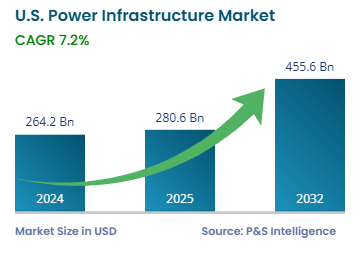
The U.S. power infrastructure market was valued at USD 264.2 billion in 2024, and this number is expected to increase to USD 455.6 billion by 2032, advancing at a CAGR of 7.2% during 2025–2032.
The industry is growing because of evolving clean energy systems and better technology. Solar power and wind energy will lead to future infrastructure additions thanks to government tax benefits and state renewable energy requirements. Storage batteries are reliable tools to protect grids and help renewable power come and go. EV charging networks and electric vehicle adoption will boost the need for expanded power systems that are based on modern grid technologies. Smart grids that use artificial intelligence and internet of things will work better while stopping power failures and helping us monitor energy use in real time. Public–private partnerships and innovative financing methods will help solve today's power grid problems and make sure our energy future stays reliable and sustainable.
U.S. Power Infrastructure Market Dynamics
Expansion of Renewable Energy Capacity Is Biggest Market Trend
The U.S. power infrastructure market is growing strongly as the country incorporates more renewable energy facilities into its power systems.
Renewable energy sources, especially solar and wind, have experienced rapid advancements due to improved technology, lower prices, and governmental policy support.
Renewable energy generation saw a growing market share in past years before expanding further to reach U.S. carbon emissions reduction targets.
The U.S. government's Inflation Reduction Act and state-level renewable energy standards make it more profitable for the country to use renewable power.
The adoption of renewable energy includes quick growth in storage solutions to handle renewable power variability.
Battery energy storage systems (BESS) systems at large utility scales store peak energy generation into batteries for use during times of excessive electricity demand.
New smart grid and microgrid technology allow renewable energy integration without compromising overall power network security.
Companies and utilities that goal for net zero will drive long-term demand for renewable energy, which represents a main part of power infrastructure development.
According to the Energy Information Administration, the country generated 894 kilowatt-hours of clean electricity in 2023.
The country aims to increase its solar energy capacity by 45% between 2024 and 2026.
Among renewable energy sources, biomass (60%), wind (18%), hydro (10%), and solar (11%) represent the largest portions of the country’s energy mix.
Since 2021, the government has invested over USD 10 billion in offshore wind farms.
Through programs such as the Inflation Reduction Act the US government now promotes renewable energy with more attractive tax credits for power generators plus energy storage equipment.
States demand that utilities use renewable energy by setting minimum usage standards that require investment in wind, solar, and energy storage development.
Electrification of Transportation and Government Support Drive Market
The power infrastructure market in the U.S. needs to change to support more electric vehicles, which leads to big growth.
To make electric vehicles successful across all community types, people need many charging options installed in public areas.
Federal and state agencies provide financial benefits to people who own EVs or set up charging stations to increase electric vehicle usage.
Utility companies and charging infrastructure developers work together to build reliable power supply systems throughout the country.
The use of EV charging stations helps developers design better systems for electric power delivery and demand adjustment in real time.
The increased use of electric vehicles drives faster transportation sector decarbonization while forcing upgrades to power systems that must handle growing electricity needs.
In 2024, electric vehicle sales in the U.S. rose to 1.6 million units, with their market share exceeding 10%, as per the International Energy Agency (IEA).
Awards and monetary support help modernize electrical networks sooner by adding advanced grid technology.
These new rules and policies protect the power grid from failures while making it simpler to bring renewable power online.
A strategic partnership of public and private entities leads to long-term investments that produce stable energy networks.
Forecasts indicate that electricity demand in the country is expected to grow by 50% by the middle of the century, which will require significant expansion and modernization of the grid.
U.S. Power Infrastructure Market Segmentation Analysis
Type Insights
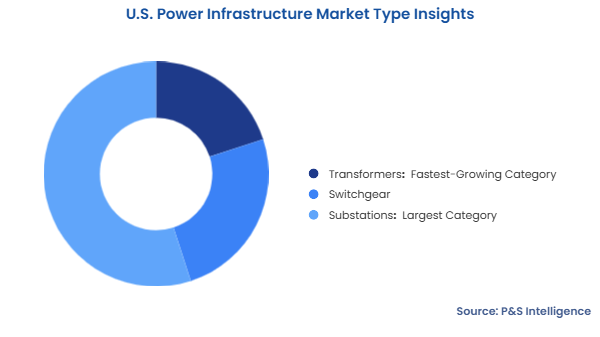
Substations are the largest category in the market, with a revenue share of 55% in 2024. The electrical grid depends on substations to both change voltage levels and deliver power across systems. Substation projects need extensive funding because their electrical systems demand sophisticated networks and dependable power delivery. Substations stand out as the primary segment in the electric power sector due to the necessary updates and infrastructure aging in the U.S.
Transformers are the fastest-growing category, with a revenue CAGR of approx. 7.5% in the forecast period. Transformers change voltages to make them usable for customers at the end of the energy system. The rapid rise of solar and wind energy on the grid demands special transformer designs and deployments because of their changing voltage patterns. Transformers experience market expansion because of power grid upgrading efforts and renewable energy projects while people demand better energy efficiency performance. The transformer market is growing rapidly because new digital monitoring and enhanced insulation technologies are being developed.
The types covered in this report:
Transformers (Fastest-Growing Category)
Switchgear
Substations (Largest Category)
Application Insights
Industrial is the largest category in the U.S. power infrastructure market, with a revenue share of 45% in 2024. The industrial power sector stands out as a major power user since production facilities and transportation networks across mining and chemicals demand high power use. Power infrastructure needs in the industrial sector account for a big part of our electricity market demand. The amount of power industrial facilities need remains steady over time as new businesses start and develop within economic growth. In 2023, the industrial sector consumed 1,025 Terawatt-hours of electricity, reflecting a 2.3% increase compared to 2020, as per the Energy Information Administration.
Residential is the fastest-growing category in the forecast period. Different factors strongly influence how quickly this sector grows. More homeowners convert to electricity-based systems, pushing up electrical usage because people are switching to electric vehicles and installing smart home equipment along with electric heaters. Home solar energy solutions become more important because people use fewer fossil fuels and choose renewable energy for their homes. The government supports sustainable lifestyles by awarding rewards for energy-saving homes and lowering carbon emissions. The residential power infrastructure industry grows rapidly because it must meet changing energy requirements and new technology deployments. As per the U.S. Census Bureau, residential construction spending in the U.S. stood at USD 1,626.6 billion in May 2025.
Major applications are:
Industrial (Largest Category)
Commercial
Residential (Fastest-Growing Category)
Drive strategic growth with comprehensive market analysis
U.S. Power Infrastructure Market Regional Outlook
The southern region is a prime revenue contributor, with 45% share. The area experiences strong population growth and urbanization, which intensifies energy demand. Many industrial and commercial facilities in the South lead to high electrical energy usage throughout the region. The area puts substantial resources into both upgrading its power systems and bringing online more renewable power, particularly solar generation. States that lead renewable energy development include Texas, Florida, and Georgia, where Texas produces the most wind power in the nation. The warm weather in this area makes air conditioning and cooling systems essential and fuels increased electricity usage. As per the EIA, Texas, New Mexico, West Virginia, Louisiana, and Oklahoma rank first, third, fifth, sixth, and seventh, respectively, in terms of electricity production in the country.
The regions analyzed in this report are:
Northeast
Midwest
South (Largest and Fastest-Growing Region)
West
U.S. Power Infrastructure Market Share
The market is fragmented due to several key factors. The market consists of numerous companies, from global multinationals to regional firms, that design products for transformer, switchgear, and substation applications. Many organizations focus on different parts of the U.S., so their multiple approaches fragment the market. Local energy requirements and infrastructure undertakings make buyers choose solutions from their specific regions over a centralized approach. As technology evolves through renewable energy and smart grid systems, new companies emerge with their unique solutions. Government renewable energy incentives help major and small companies enter the industry through separate business opportunities.
Key U.S. Power Infrastructure Companies:
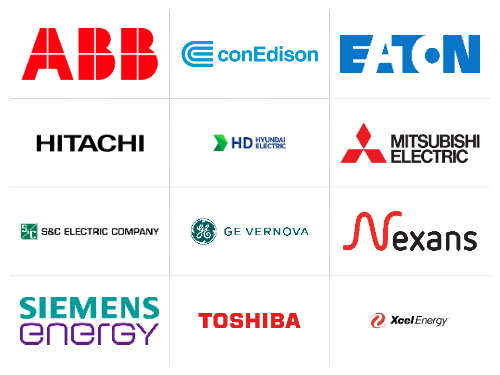
GE Vernova Inc.
ABB Ltd.
Siemens Energy AG
Toshiba Corporation
Eaton Corporation plc
Mitsubishi Electric Corporation
HD Hyundai Electric
Nexans SA
Hitachi Ltd.
S&C Electric Company
Xcel Energy Inc.
Consolidated Edison Inc.
U.S. Power Infrastructure Market News
In July 2025, ABB Ltd. signed an MoU with Paragon Energy Solutions to create integrated instrumentation, control, and electrification solutions for the nuclear sector of the U.S.
In June 2025, Mitsubishi Electric Corporation signed an MOU with GE Vernova Inc. to enhance their collaboration on power semiconductors for HVDC transmission systems.
In March 2025, Eaton Corporation plc announced plans to acquire Fibrebond Corporation, a U.S.-based company specializing in integrated modular power enclosures for data center, industrial, utility, and communications sectors, for USD 1.4 billion.
In February 2025, Eaton Corporation plc announced that it will invest USD 340 million in a new factory in California that will manufacture transformers. Beginning operations in 2027, the factory will employ 700 people.
In February 2025, GE Vernova Inc. announced plans to invest USD 10 million in its factory in Pittsburgh that manufactures electrification equipment.
In January 2025, Constellation announced plans to acquire Calpine Corp. for around USD 16.4 billion in cash and stock.
Want a report tailored exactly to your business need?
Leading companies across industries trust us to deliver data-driven insights and innovative solutions for their most critical decisions. From data-driven strategies to actionable insights, we empower the decision-makers who shape industries and define the future. From Fortune 500 companies to innovative startups, we are proud to partner with organisations that drive progress in their industries.
Client Testimonials
Working with P&S Intelligence and their team was an absolute pleasure – their awareness of timelines and commitment to value greatly contributed to our project's success. Eagerly anticipating future collaborations.
McKinsey & Company
India
Unmatched Standards
Our insights into the minutest levels of the markets, including the latest trends and competitive landscape, give you all the answers you need to take your business to new heights
Complete Data Security
We take a cautious approach to protecting your personal and confidential information. Trust is the strongest bond that connects us and our clients, and trust we build by complying with all international and domestic data protection and privacy laws