U.S. Health Insurance Market Size & Share Analysis - Key Trends, Future Opportunities, Growth Strategies, and Forecasts (2025 - 2032)
This Report Provides In-Depth Analysis of the U.S. Health Insurance Market Report Prepared by P&S Intelligence, Segmented by Insurance Type (Disease Insurance, Medical Insurance), Provider (Public, Private), Network (Preferred Provider Organizations (PPOs), Point of Service (POS), Health Maintenance Organization (HMOs), Exclusive Provider Organizations (EPOs)), Coverage (Term Insurance, Life-Time Coverage, Disease Insurance), Plan Type (Medical Insurance, Critical Illness Insurance, Family Floater Health Insurance), Age (Senior Citizens, Adult, Minors), Distribution Channel (Direct Sales, Brokers/Agent, Banks), and Geographical Outlook for the Period of 2019 to 2032
Explore the market potential with our data-driven report
U.S. Health Insurance Market Analysis
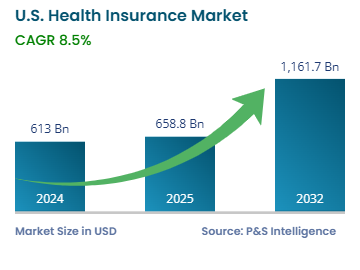
The U.S. health insurance market valued USD 613.0 billion in 2024, and this number is expected to increase to USD 1161.7 billion by 2032, advancing at a CAGR of 8.5% during 2025–2032.
The biggest drivers for the market are the rising prevalence of chronic diseases, aging population, rising Medicare enrollment, escalating healthcare costs, technological innovation, regulatory frameworks and government programs, employer-sponsored and individual coverage trends, and shift to value-based care. As per the Census Bureau, almost 92% of the country’s population, which is around 305.2 million, had health insurance in 2023. Moreover, as per the CMS, Medicaid, Medicare, and private insurance spending in the U.S. in 2023 stood at USD 871.7 billion, USD 1,029.8 billion, and USD 1,464.6 billion, respectively.
The market operates as one of the biggest and most intricate fields through the combination of private insurers, federal programs (Medicare and Medicaid), and employer-supported health insurance. A steady market expansion occurs because healthcare costs continue rising consumers demand full coverage and digital health services keep advancing in technology.
The recent trends in the market include the growing adoption of telemedicine, AI-driven underwriting, and value-based care models. The insurance market faces greater regulatory attention because new policies alter the possibilities for coverage protection while affecting prices. The market will steer toward individualized health plans and insurance products emphasizing wellness, which insurers plan to add preventive healthcare solutions to minimize future healthcare expenses.
U.S. Health Insurance Market Emerging Trends & Growth Drivers
Usage of AI and Advanced Analytics Is Trending in Market
The integration of AI, machine learning, and advanced analytics is allowing insurers to streamline operations, enhance customer experiences, and bring innovative health plans.
Senior health insurance products, including Medicare, continue to gain popularity due to the growing number of elderly people in the country.
The Inflation Reduction Act and healthcare policy modifications enhance access to coverage limits.
Healthcare costs are rising steadily, which leads people and their employers to search for broad insurance coverage.
Insurers use wellness programs and preventive care to lower costs in the short-term and long-term and deliver better health results.
Over 80% use AI/ML for claims processing and underwriting, cutting claim-handling time by up to 60% and reducing errors by 30%.
Around 50% employ AI for fraud detection and personalized policy recommendations, boosting customer satisfaction.
AI, ML, and advanced analytics streamline health insurance by automating claims processing, enabling real-time fraud detection, and improving risk assessment.
These tools enhance underwriting accuracy, reduce administrative costs, and deliver personalized policy recommendations.
They also improve customer service through chatbots and predictive insights, leading to faster decisions and better care coordination.
Growing Healthcare Burden and Costs Drive Market Growth
The rising prevalence of chronic diseases is a major driver of health insurance demand in the U.S.
Nearly 60% of adults suffer from at least one chronic condition such as diabetes, heart disease, or arthritis, with about 40% managing two or more.
As per the CDC, more than 370,00 people in the U.S. die of CVDs every year, while the American Cancer Society projects 2,041,910 cancer cases and 618,120 deaths in 2025.
Moreover, 38.4 million people suffer from diabetes, while the American Physiology Society estimates the incidence of neurodegenerative diseases, such as Parkinson’s disease, Alzheimer’s disease, and amyotrophic lateral sclerosis (ALS), at nearly 7 million.
These long-term health issues require continuous medical attention, medication, and monitoring, significantly increasing healthcare utilization and prompting individuals to seek comprehensive insurance coverage.
The aging population further amplifies this demand, as people aged 65 and older now represent over 17% of the U.S. population.
This demographic heavily relies on Medicare and related plans due to higher risks of hospitalization, prescription needs, and specialist care.
Hospital service, surgical procedure, and prescription drug prices have all risen steadily, with healthcare expenditures growing faster than the rate of inflation.
The average cost of a hospital stay now exceeds tens of thousands of dollars, pushing individuals and families to secure insurance to avoid severe financial strain during unexpected medical events.
Rising Insurance Premiums Are Key Restraint
Health insurance premiums continue to rise across 35 states and Washington DC as well as in Vermont where the cost increase exceeds USD 327 from USD 948 to USD 1,275 for the silver plan premium.
The health insurance expenses of employers will increase by 5.8% during 2025, which makes it the third year in a row to exceed 5% due to escalating medical costs and service usage.
The health insurance industry shows declining profit margins moving from 5.3% in 2020 to 2.7% in 2024 because rating agencies moved the sector from positive to negative ratings.
This was because of medical expense growth and regulatory challenges.
More than one million seniors face the challenge of finding new Medicare advantage plans because health insurers have left markets to minimize costs resulting in probable premium hikes and diminished benefits.
A growing number of U.S. citizens choose health cost-sharing ministries instead of traditional insurance because medical expenses exceed their budget although these plans provide minimal protection and create substantial dangers.
U.S. Health Insurance Market Segmentation Analysis
Insurance Type Insights
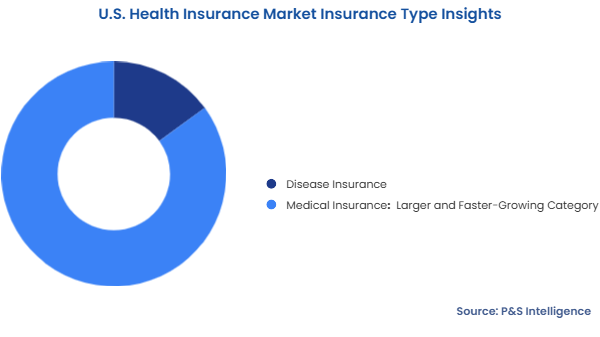
The medical insurance category dominates the market with a revenue share of 85% in 2024, and it will also have the higher CAGR, of 8.6%. Covered medical services under this segment extend from doctor check-ups through hospital care, surgeries, medication prescriptions, and preventive medical services, thus providing a broad choice for many consumers. Medical insurance has gained popularity because of preventive care and early diagnosis have become priorities for healthcare providers and payors.
Here are the insurance types studied in the report:
Disease Insurance
Medical Insurance (Larger and Faster-Growing Category)
Provider Insights
The private category accounted for the largest revenue share, of around 55%, in 2024, and this category is expected to witness the highest CAGR during the forecast period, of 8.3%. This is because employers adopt health plans through their benefits, and more people select individual market plans and the evolution of private health insurance products. Private insurers use advanced technology and personalized services to expand their customer reach and fulfill rising customer needs for full coverage flexibility. As per the CMS, private healthcare insurance accounted for the largest share in national health spending in the country in 2023, of 30%.
The providers covered in the report are:
Public
Private (Larger and Faster-Growing Category)
Network Insights
The preferred provider organizations (PPOs) category dominates the market with a revenue share of 50% in 2024. PPOs maintain their popularity because they let members access any healthcare provider without needing a referral during their visits while also giving coverage for out-of-network providers although at higher costs. Healthcare consumers who choose convenience and freedom in their healthcare choices prefer PPO networks.
Health maintenance organization (HMOs) is the fastest-growing category, with 8.9% CAGR. The decrease in plan availability does not stop HMOs from gaining popularity because consumers select them for their lower premium cost and their full-service care management approach that meets rising demand for economical healthcare alternatives.
The following are the networks studied in the report:
Health Maintenance Organizations (HMOs) (Fastest-Growing Category)
Exclusive Provider Organizations (EPOs)
Coverage Insights
The lifetime coverage category accounted for the largest revenue share, of around 40%, in 2024, because it offers complete and continuous coverage. The insurance type offers lasting protection since it protects its policyholders throughout their entire lives irrespective of their age or medical state. Structures offering lifetime coverage appeal to customers because this coverage combines savings features with continuous access to healthcare through a built-in investment component. Lifetime coverage continues to be favored by people who need stability and handle rising healthcare expenses during an aging demographic.
The coverages covered in the report are:
Term Insurance (Fastest-Growing Category)
Life-Time Coverage (Largest Category)
Disease Insurance
Plan Type Insights
The medical insurance category accounted for the largest revenue share, of around 85%, in 2024, and this category is further expected to maintain its position during the forecast period. This category offers complete protection and diverse medical services, which offer hospitalization, outpatient care, prescriptions, and preventive services to provide essential health benefits for individuals and families. Medical insurance covers extensive services that let people receive needed care while preventing their medical expenses from becoming insurmountable so it continues to be the market's leading health insurance category.
The plan types covered in the report are:
Medical Insurance (Largest Category)
Critical Illness Insurance
Family Floater Health Insurance (Fastest-Growing Category)
Others
Age Insights
The adult category accounted for the largest revenue share, of around 50%, in 2024, and this category is further expected to maintain its position during the forecast period. The high demand for employer-sponsored health plans and individual market policies pushes the market growth for working-age adults. The market comprises many individuals who need broad healthcare protection because of their multiple healthcare requirements resulting in substantial market expansion. The U.S. Census Bureau records that health insurance coverage reached 85.4% in adults aged 19 to 64. The agency also records that the population of people in this age group is the largest in the country, standing at 175,555,308 as of July 1, 2024.
The ages covered in the report are:
Senior Citizens (Fastest-Growing Category)
Adult (Largest Category)
Minors
Distribution Channel Insights
The brokers/agents category accounted for the largest revenue share, of around 35%, in 2024, and this category is expected to witness the highest CAGR during the forecast period, of 9.2%. This is due to their specialized consultative skills and advanced plan analysis abilities, which enable them to supply personalized suggestions tailored to both individual customers and their corporate clients. Clients and businesses depend heavily on brokers for managing their health insurance coverage because brokers help them select the right combination of affordability and protection. Insurance brokers preserve strong ties to both insurance carriers and clients through, which they can achieve better deals while helping customers with claim administration and policy renewal processes.
The different distribution channels covered in the report are:
Direct Sales
Brokers/Agent (Largest and Fastest-Growing Category)
Banks
Others
Drive strategic growth with comprehensive market analysis
U.S. Health Insurance Market Regional Market Performance
The Southern region is the market leader with 40% revenue, because Florida and Texas have high levels of enrolment. The numerous people and wide range of medical needs within these states contribute to their substantial role in individual health insurance. A high number of residents need Medicare and Medicaid services because they depend on government-supported health insurance programs for medical coverage. The increase in employer-based health coverage plans and the growth of self-employed individuals obtaining private health insurance enable the South to dominate the market. Healthcare variations alongside state regulatory differences have no negative impact on the South region's substantial enrollment in private and public health insurance plans.
The Southern region of the U.S. carries the highest population, of 132,665,693 (39% of the total in 2024. It also has the highest rates of chronic conditions such as hypertension, diabetes, obesity, and stroke. Preventable hospitalizations and longer inpatient stays are also more common in the South, particularly for cardiovascular and respiratory illnesses. Additionally, the region reports higher maternal mortality rates, lower insurance coverage, and reduced access to primary care services compared to other regions. These combined health disparities, driven by socioeconomic factors and gaps in healthcare infrastructure, contribute to the South being the most significantly burdened in terms of healthcare needs and outcomes.
Here are the regions covered in the report:
South (Largest Region)
West (Fastest-Growing Region)
Midwest
Northeast
U.S. Health Insurance Market Share Analysis
The market is moderately consolidated, with a few dominant players, such as UnitedHealth Group, Aetna, and Aviva Inc. These insurance providers use their large operations, extensive connection networks, and technology developments to stay competitively powerful. This market is a combination of consolidation and fragmentation because multiple small insurers maintain a regional presence and specialized business operations. The competitive environment results from massive customers acquired by the top players while smaller insurers maintain their market positions through regional reach.
Key U.S. Health Insurance Companies:
UnitedHealth Group
Aviva Inc.
Cigna Corp.
Allianz
Aetna Inc.
AIA Group Limited
Assicurazioni Generali S.P.A
AXA
The Zurich Insurance Group Ltd
Wellcare
Ping An Insurance
Providence Health Plan
U.S. Health Insurance Market Developments
In June 2025, the Centers for Medicare & Medicaid Services (CMS) finalized a rule to decrease health insurance premiums for individuals by up to 5% on average. It is anticipated that taxpayers will save USD 12 billion in 2026 by addressing the increase in improper enrollments within the Affordable Care Act (ACA) Exchanges, curbing unnecessary federal expenditures, and redirecting efforts toward making health insurance markets more affordable and sustainable.
In February 2023, UnitedHealth Group Inc. closed its USD 5.4-billion acquisition of home health business LHC Group.
In March 2025, a consortium led by Allianz SE and including T&D Holdings and BlackRock bought Viridium Group from Cinven Limited for USD 3.8 billion.
Want a report tailored exactly to your business need?
Leading companies across industries trust us to deliver data-driven insights and innovative solutions for their most critical decisions. From data-driven strategies to actionable insights, we empower the decision-makers who shape industries and define the future. From Fortune 500 companies to innovative startups, we are proud to partner with organisations that drive progress in their industries.
Client Testimonials
Working with P&S Intelligence and their team was an absolute pleasure – their awareness of timelines and commitment to value greatly contributed to our project's success. Eagerly anticipating future collaborations.
McKinsey & Company
India
Unmatched Standards
Our insights into the minutest levels of the markets, including the latest trends and competitive landscape, give you all the answers you need to take your business to new heights
Complete Data Security
We take a cautious approach to protecting your personal and confidential information. Trust is the strongest bond that connects us and our clients, and trust we build by complying with all international and domestic data protection and privacy laws