Two-Wheeler Hub Motor Market Size & Share Analysis - Trends, Drivers, Competitive Landscape, and Forecasts (2026 - 2032)
This Report Provides In-Depth Analysis of the Two-Wheeler Hub Motor Market Report Prepared by P&S Intelligence, Segmented by Vehicle Type (E-Bikes, E-Scooters and Motorcycles), Motor Power (<0.5 kW, 0.5, 1.5, >4 kW), Motor Architecture (Brushed Motor, Brushless Direct Current Motor, Permanent Magnet Synchronous Motor, Induction Motor), End Use (OEM, Aftermarket), and Geographical Outlook for the Period of 2021 to 2032
Explore the market potential with our data-driven report
Two-Wheeler Hub Motor Market Future Outlook
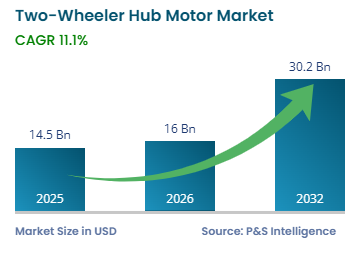
The two-wheeler hub motor market size was USD 14.5 billion for 2025, and it will grow by 11.1% during 2026–2032, to reach USD 30.2 billion by 2032.
The market growth is driven by the accelerating global transition toward electric two-wheelers, which is reshaping urban mobility across developed and emerging economies. Rising fuel costs have made electric alternatives commercially compelling at the household level. Tightening urban emission regulations are eliminating the operational viability of internal combustion two-wheelers in major city zones, and successive government incentive frameworks have sustained consumer and manufacturer confidence through multiple policy cycles. Hub motors, integrated directly into the wheel axle of electric bikes, scooters, and motorcycles, offer a mechanically simplified, low-maintenance drivetrain architecture, eliminating the need for chains, belts, and complex transmission systems, thereby reducing overall vehicle weight and maintenance frequency. This configuration is preferred by both original equipment manufacturers and aftermarket suppliers operating across price-sensitive and performance-oriented segments, as it enables scalable platform design and faster assembly timelines for high-volume electric two-wheeler production.
The broader electric two-wheeler revolution provides the structural foundation for hub motor demand. The International Energy Agency (IEA) reported that electric two- and three-wheelers accounted for around 15% of total two- and three-wheeler sales in 2024, making them the most electrified vehicle segment globally, with China, India, and Southeast Asia together accounting for approximately 80% of global electric two-wheeler sales that year. In India specifically, the IEA's Global EV Outlook 2025 indicates that approximately 1.3 million electric two-wheelers were sold domestically in 2024, with a significant share concentrated in low- and mid-power scooter categories that predominantly utilize hub motor configurations. A large and fragmented OEM ecosystem and policy continuity under successive FAME and EMPS incentive schemes underpinned this volume. This installed base creates a sustained and expanding demand pool that drives hub motor procurement at both the OEM and replacement cycle levels.
Key Market Insights
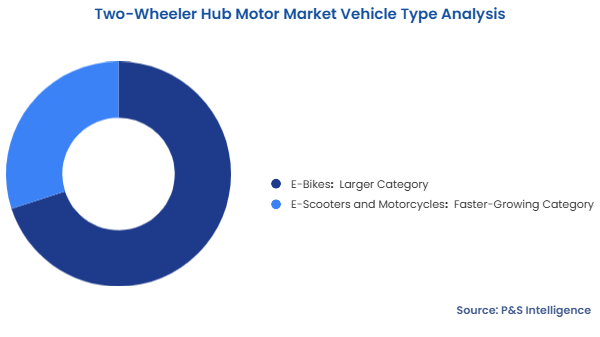
The e-bikes category holds the larger market share, of 70%, in 2025, driven by strong adoption and compatibility with hub motor-based pedal-assist systems.
The >4 kW category will have the highest CAGR, of approximately 11.2%, driven by rising demand for high-performance electric scooters and motorcycles across various applications.
The brushless direct current motor category holds the largest market share in 2025, of 45%, driven by high efficiency, durability, low maintenance, and superior speed control.
The OEM category holds the larger market share, of 75%, in 2025, driven by strong reliance on original equipment procurement.
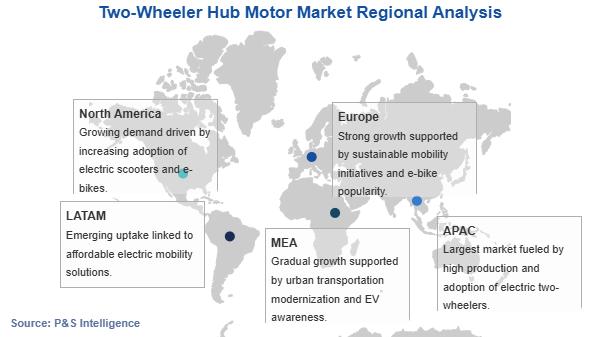
Asia-Pacific holds the largest market share, of 40%, in 2025, and it will have the highest CAGR, of approximately 12.0%, driven by strong manufacturing presence and rising electric two-wheeler adoption.
Two-Wheeler Hub Motor Market Trends and Drivers
Smart Motor Integration and Lightweight Architecture Are Key Trends
A fundamental transformation is underway in how hub motors are designed and sold, with market growth increasingly supported by the shift toward higher-value, technology-integrated motor systems. The market is transitioning from commodity-grade basic motors toward intelligent, connected drivetrain modules that incorporate regenerative braking, torque sensing, Bluetooth/CAN connectivity, real-time diagnostics, and over-the-air updates. This transition is reshaping the competitive basis on which hub motor suppliers compete and is elevating the average selling price and complexity of hub motor systems delivered to OEMs. Regenerative braking, enabled within brushless DC (BLDC) hub motor architectures, is now standard in new e-bike and e-scooter platforms. These systems recover energy during deceleration and feed it back to the battery, improving overall energy efficiency and extending vehicle range in urban stop-and-go conditions, thereby directly enhancing real-world vehicle performance without increasing battery size.
Motor weight has become a primary competitive parameter, as lightweight configurations improve vehicle handling, acceleration efficiency, and battery utilization in compact two-wheeler designs. MAHLE SmartBike Systems GmbH demonstrated this shift in June 2024, introducing the MAHLE X30 drive system, a rear hub motor delivering 45 Nm torque at a weight of only 1.9 kg, setting a new benchmark for power-to-weight performance in the hub motor category. The integration of smartphone connectivity, Hall-effect position sensing, and microcontroller-managed commutation within sealed hub motor units is blurring the boundary between the motor and the vehicle's electronic control architecture, enabling deeper system-level integration between drivetrain performance and vehicle control software. Hub motor suppliers with embedded software competency are positioned as structurally advantaged partners for OEMs seeking differentiated electric two-wheeler platforms. Suppliers operating on hardware-only specifications face margin compression from commoditization.
Government Emission Mandates and Electrification Incentives Are Biggest Drivers
The most consequential external force propelling the global two-wheeler hub motor market is the sustained and expanding framework of government emission regulations and direct purchase incentive programs, which are increasingly aligned with domestic manufacturing and supply chain localization objectives. These have collectively made electric two-wheelers the policy-preferred mobility solution in the world's highest-volume two-wheeler markets. These interventions do not merely encourage adoption. They structurally shift the economics of electric two-wheeler ownership in ways that directly drive OEM procurement and hub motor specification volumes, by reducing upfront vehicle costs and improving total cost of ownership parity with internal combustion alternatives. India's successive policy architecture illustrates this mechanism clearly. The FAME II scheme, operational from 2019 to March 2024 with a budget of INR 11,500 crore, provided demand subsidies that made electric two-wheelers cost-competitive with petrol scooters across multiple states. Its successor, the PM E-DRIVE scheme, notified in September 2024 with a total outlay of INR 10,900 crore through March 2026, continues to provide demand-linked incentives while emphasizing localized manufacturing requirements across key EV components, including drivetrain and motor assemblies, as outlined by the Ministry of Heavy Industries, thereby strengthening domestic hub motor production ecosystems and reducing import dependency.
The International Council on Clean Transportation confirmed that two-wheelers accounted for approximately 77% of total vehicle sales volume in India in Fiscal Year 2024–25, underscoring the structural scale through which this policy channel flows into hub motor demand, as high-volume vehicle segments amplify the impact of incentive-driven electrification. China's national NEV policy framework has similarly anchored hub motor demand at scale. Tax exemptions and subsidy programs have enabled widespread adoption of electric two-wheelers across urban and peri-urban markets, supporting large-scale OEM production and standardization of hub motor-based drivetrain platforms. As these policy environments mature and replicate across Southeast Asia, Europe, and parts of Latin America, the addressable market for hub motors will expand structurally, independent of fuel price fluctuations.
High Upfront Cost of Electric Two-Wheelers Is Key Restraint
Despite the structural tailwinds driving the market, the elevated purchase price of electric two-wheelers relative to internal combustion engine equivalents remains a key constraint on demand growth in price-sensitive developing markets, where affordability is the primary purchase decision factor. The International Council on Clean Transportation confirmed that upfront cost remains a major barrier to adoption, with price sensitivity directly suppressing electric two-wheeler uptake and limiting hub motor procurement in markets where subsidies are absent or reduced.
The lithium-ion battery pack remains the primary cost driver, accounting for a large share of total vehicle cost, which continues to keep overall vehicle prices elevated despite gradual cost reductions. In regions such as Sub-Saharan Africa, electric two-wheelers remain more expensive than comparable ICE motorcycles, and adoption is restricted without financing mechanisms such as battery-as-a-service models. As subsidies are reduced across key markets, adoption rates may moderate in the short term, thereby constraining hub motor OEM order volumes. Until cost parity with ICE vehicles is achieved under unsubsidized conditions, this pricing gap will continue to limit broader market penetration.
Emerging Markets and Aftermarket Replacement Are Biggest Opportunities
Two distinct demand vectors are opening incremental growth pathways for hub motor suppliers beyond the primary OEM new-vehicle channel. The first is the accelerating electrification of two-wheeler markets in emerging economies across Southeast Asia, Latin America, and Sub-Saharan Africa, geographies where two-wheelers are essential daily transport infrastructure. Indonesia has introduced financial support programs to accelerate electric two-wheeler adoption. The International Energy Agency reported approximately 250,000 electric two-wheeler sales in Vietnam in 2023. Other Southeast Asian markets are recording early-stage growth in adoption, creating new OEM-level demand for hub motor suppliers within previously ICE-dominated fleets.
The second vector is the aftermarket replacement cycle, where hub motors are subject to wear and performance degradation over time, creating a structurally recurring replacement demand stream. As the installed base of electric two-wheelers continues to expand, the aftermarket channel is emerging as a volume-relevant and margin-attractive segment. Suppliers offering upgraded hub motor systems with enhanced power output, regenerative functionality, or smart connectivity features are well-positioned to capture premium replacement demand. This opportunity grows as early electric two-wheeler fleets mature across key markets such as China, India, and Europe.
Two-Wheeler Hub Motor Market Segmentation Analysis
Vehicle Type Analysis
The e-bikes category holds the larger market share, of 70%, in 2025, driven by the suitability of hub motor architecture for pedal-assist propulsion systems and widespread adoption across consumer and fleet applications. Hub motor architecture is well-suited to pedal-assist propulsion systems, and rear hub configurations integrate within standard e-bike frame designs without requiring complex drivetrain modifications. This compatibility makes hub motors a cost-efficient electrification path compared to mid-drive systems, where affordability, ease of maintenance, and simplified design remain the primary purchasing considerations.
The e-scooters and motorcycles category will have the higher CAGR, of approximately 11.4%, driven by demand for higher-performance urban mobility solutions and the expanding use of electric two-wheelers in commercial applications such as last-mile delivery. India's PM E-DRIVE scheme promotes electric two-wheelers, with scooters targeted through dedicated incentive structures, accelerating segment adoption. As consumer preference shifts toward higher-powered electric mobility solutions, demand for hub motor configurations with greater power output and integration capabilities is expected to grow. In 2025, Schaeffler Technologies AG & Co. KG and NX Technologies publicly showcased their strategic collaboration at EICMA 2025, introducing high-voltage motor controller solutions for electric motorcycles.
The vehicle types analyzed in this report are:
E-Bikes (Larger Category)
E-Scooters and Motorcycles (Faster-Growing Category)
Motor Power Analysis
The <0.5 kW category holds the largest market share, of 45%, in 2025, driven by the dominance of low-powered e-bikes operating within the 250W regulatory threshold across European markets and most Asian jurisdictions. Low-powered e-bikes, including standard pedal-assist bicycles operating within the 250W regulatory threshold, account for the overwhelming majority of global hub motor volume across these regions. Regulatory standards such as EN15194 in Europe cap e-bike motor power at 250W, anchoring procurement within the sub-0.5 kW band. Sub-500W hub motors satisfy regulatory compliance while delivering adequate assist performance for urban commuting at low cost.
The >4 kW category will have the highest CAGR, driven by the increasing demand for high-performance electric scooters and motorcycles across consumer, commercial, and fleet applications. As OEMs expand into higher-power product tiers in the electric motorcycle category, targeting markets in North America, Europe, and premium urban segments in India and Southeast Asia, demand for hub motors exceeding 4 kW is expected to grow strongly.
The motor powers analyzed in this report are:
<0.5 kW (Largest Category)
0.5–1.5 kW
1.5–4 kW
>4 kW (Fastest-Growing Category)
Motor Architecture Analysis
The brushless direct current motor category holds the largest market share in 2025, driven by its high energy efficiency, long operational lifespan, low maintenance requirements, and superior speed control characteristics. BLDC motors use electronic commutation via Hall-effect sensors and controller units, eliminating mechanical wear associated with physical contact components. This architecture’s compatibility with regenerative braking systems further enhances its appeal for OEMs focused on improving overall energy efficiency in electric two-wheelers. Research published by the Institute of Electrical and Electronics Engineers demonstrates the feasibility and efficiency of BLDC-based regenerative braking systems in lightweight electric vehicles, supporting their widespread adoption across modern hub motor platforms.
The permanent magnet synchronous motor category will have the highest CAGR, of approximately 11.6%, driven by higher torque density, improved efficiency under variable load conditions, and superior thermal performance. Higher torque density, improved efficiency under variable load conditions, and superior thermal performance give PMSM architectures a performance advantage in demanding applications. PMSM architectures are adopted in high-performance electric scooters and motorcycles, where sustained power output and heat management are critical. As demand for higher-performance electric two-wheelers expands, OEM adoption of PMSM hub motors is expected to grow.
The motor architectures analyzed in this report are:
Brushed Motor
Brushless Direct Current (BLDC) Motor (Largest Category)
Permanent Magnet Synchronous Motor (PMSM) (Fastest-Growing Category)
Induction Motor
End Use Analysis
The OEM category holds the larger market share, of 75%, in 2025, reflecting the structurally dominant role of original equipment procurement in setting hub motor volumes. The OEM channel benefits from consistent demand tied to electric two-wheeler production volumes, which have expanded substantially across China, India, and Europe. In India alone, the 80 largest electric two-wheeler manufacturers accounted for a combined production capacity of approximately 10 million units in 2024, with announced capacity expected to increase to around 17 million units, highlighting the scale of OEM-driven demand supporting hub motor procurement.
The aftermarket category will have the higher CAGR, driven by the expanding installed base of electric two-wheelers and the resulting need for component replacement over time. Hub motors are subject to wear and performance degradation, creating a recurring demand stream for replacement and upgrade. The aftermarket channel additionally benefits from growing consumer interest in performance-upgrade hub motor kits offering enhanced power ratings, regenerative braking capability, or smart connectivity relative to the original OEM-fitted specification.
The end uses analyzed in this report are:
OEM (Larger Category)
Aftermarket (Faster-Growing Category)
Drive strategic growth with comprehensive market analysis
Two-Wheeler Hub Motor Market Regional Outlook
Asia-Pacific Two-Wheeler Hub Motor Market Size
Asia-Pacific holds the largest market share, of 40%, in 2025, and it will have the highest CAGR, of approximately 12.0%, driven by a well-established ecosystem of domestic manufacturers, extensive integration of hub motors across electric scooters and e-bikes, and accelerating electric two-wheeler adoption across China, India, and Southeast Asia. China continues to dominate the regional supply base. The International Council on Clean Transportation reported that China recorded the highest electric two-wheeler sales share globally at 54.8% in 2025, underscoring the scale of demand that underpins hub motor procurement across the region.
Investment and capability development across developed Asian markets are reinforcing regional growth. In Japan, Honda Motor Co., Ltd. announced plans to invest approximately USD 65 billion in electrification and software through FY2030, alongside expanding battery-swapping infrastructure and electric two-wheeler initiatives, while Yamaha Motor Co., Ltd. continues to advance its electric mobility portfolio. In South Korea, Hyundai Motor Company and LG Energy Solution are jointly investing in large-scale battery manufacturing capacity, strengthening the broader EV ecosystem. High-volume demand in emerging markets and technology-led investment in developed economies collectively support sustained hub motor adoption across the region.
India Two-Wheeler Hub Motor Market Size
India is one of the fastest-growing country markets within Asia-Pacific and among the most dynamic electric two-wheeler markets globally. The International Energy Agency reported that over 1 million electric two-wheelers were sold in India in 2024, reflecting the scale of an OEM ecosystem operating across a wide range of consumer price points.
The International Energy Agency reported that India's electric two-wheeler market hosted approximately 220 OEMs in 2024, up from 180 in 2023, with the top four manufacturers accounting for a large majority share of total sales, indicating a dynamic yet partially consolidated competitive landscape. Expanding charging infrastructure and localization initiatives are reinforcing electric two-wheeler adoption and hub motor demand across the country.
Europe Two-Wheeler Hub Motor Market Size
Europe is an established market for two-wheeler hub motors, driven by stringent emission regulations and the expansion of urban low-emission zones that are raising the cost of operating internal combustion engine two-wheelers across the continent. National-level incentives are accelerating the shift toward electric mobility, broadening the addressable market for hub motor suppliers. The transition to Euro 5 emission standards has increased compliance requirements for internal combustion engine vehicles, redirecting OEM and consumer procurement toward electric two-wheelers incorporating hub motor systems. Policy frameworks led by the European Commission under the European Green Deal promote zero-emission mobility and support investments in sustainable transport infrastructure, creating a regulatory environment that sustains the growth of electric two-wheelers and associated hub motor demand across the region.
Germany is a key country market within Europe, supported by a strong manufacturing ecosystem, advanced EV infrastructure, and the presence of leading component suppliers including Robert Bosch GmbH and Schaeffler Technologies AG & Co. KG. France is among the fastest-growing markets in the region, driven by national clean mobility incentives and the expansion of low-emission zones across major cities. These factors are driving electric scooter adoption for urban commuting and last-mile delivery applications.
The regions and countries analysed in this report are:
North America
U.S. (Larger Country)
Canada (Faster-Growing Country)
Europe
Germany (Largest Country)
U.K.
France (Fastest-Growing Country)
Italy
Spain
Rest of Europe
Asia-Pacific (Largest and Fastest-Growing Regional Market)
China (Largest Country)
India (Fastest-Growing Country)
Japan
South Korea
Australia
Rest of APAC
Latin America
Brazil (Largest Country)
Mexico (Fastest-Growing Country)
Rest of LATAM
Middle East & Africa
Saudi Arabia (Largest Country)
South Africa
U.A.E. (Fastest-Growing Country)
Rest of MEA
Two-Wheeler Hub Motor Market Share Analysis
The market is fragmented, driven by a large share of demand concentrated in China, where a broad ecosystem of domestic and often unorganized manufacturers operates at scale. These manufacturers supply cost-sensitive OEMs with locally produced components, keeping price pressure elevated across the market. The relatively low technological barriers associated with basic brushless DC hub motor production enable the entry of numerous small and mid-sized players, intensifying competition across price-sensitive segments. Additionally, OEM preference for localized sourcing in high-volume markets limits the penetration of global suppliers, while leading companies account for only a limited share of total market revenue across this dispersed mix of organized and unorganized participants.
Leading Companies in the Two-Wheeler Hub Motor Market:
Bafang Electric (Suzhou) Co., Ltd.
Taizhou Quanshun Electric Drive Technology Co., Ltd. (QS Motor)
Golden Motor Technology Co., Ltd.
Ananda Drive Techniques Co., Ltd.
Heinzmann GmbH & Co. KG
Schaeffler Technologies AG & Co. KG
Robert Bosch GmbH
Zhejiang Luyuan Electric Vehicle Co., Ltd.
Suzhou Shengyi Motor Co., Ltd.
Changzhou MXUS Technology Co., Ltd.
Jiangsu Xinri E-Vehicle Co., Ltd.
TDCM Corporation Ltd.
Two-Wheeler Hub Motor Market News
In January 2026, Robert Bosch GmbH introduced a new digital theft-protection ecosystem for Bosch-powered e-bikes, enabling owners to mark stolen vehicles within the Bosch platform and restricting system functionality, strengthening the value proposition of connected electric two-wheelers and supporting greater adoption of integrated electric drive systems.
In November 2025, Yadea Technology Group Co. Ltd. launched a European-focused electric two-wheeler lineup at EICMA 2025, including the Velax U and GS80 models featuring hub motor systems, fast-charging capability, and EU-compliant safety features.
In June 2025, Bafang Electric (Suzhou) Co. Ltd. introduced the H730 hub motor at Eurobike 2025, featuring its patented Gear Variable Transmission (GVT) technology with an integrated three-speed automatic gearbox. The 250W rear hub motor automatically shifts gears based on riding conditions and is designed for urban e-bikes, shared mobility fleets, and commuter applications. This range of applications expands Bafang's portfolio of integrated hub motor solutions.
In April 2025, QS Motor introduced its QS Motor 205 brushless DC hub motor platform for electric motorcycles, e-bikes, and cargo vehicles. The motor delivers high torque output and supports a wide voltage range. This performance profile addresses growing demand for high-performance hub motor solutions in electric two-wheeler applications.
Frequently Asked Questions About This Report
What factors are driving the adoption of hub motors in electric two-wheelers?+
The adoption is primarily driven by increasing demand for low-cost electric mobility, rising fuel prices, supportive government incentives for EVs, and the simplicity and compact design of hub motors which reduce maintenance and manufacturing complexity.
Why are hub motors widely used in electric scooters instead of mid-drive motors?+
Hub motors are preferred in electric scooters due to their lower cost, ease of integration, fewer moving parts, and suitability for urban commuting, where high torque and simple drivetrain systems are more important than high performance.
Which region has the highest demand for two-wheeler hub motors?+
Asia-Pacific dominates the market due to the large-scale adoption of electric scooters and e-bikes in countries like China and India, supported by strong manufacturing ecosystems and government policies promoting electric mobility.
What are the key challenges faced by the two-wheeler hub motor market?+
Key challenges include heat dissipation issues, lower efficiency at high speeds compared to mid-drive motors, dependency on Chinese supply chains, and performance limitations for high-power motorcycles.
How is battery technology influencing the hub motor market?+
Advancements in battery technology, such as higher energy density and faster charging, are enhancing the performance and range of electric two-wheelers, thereby increasing the demand for efficient hub motors.
What technological trends are shaping the hub motor industry?+
Key trends include the development of lightweight materials, improved motor efficiency, integration of smart sensors, better thermal management systems, and advancements in high-power hub motors for premium electric motorcycles.
Want a report tailored exactly to your business need?
Leading companies across industries trust us to deliver data-driven insights and innovative solutions for their most critical decisions. From data-driven strategies to actionable insights, we empower the decision-makers who shape industries and define the future. From Fortune 500 companies to innovative startups, we are proud to partner with organisations that drive progress in their industries.
Client Testimonials
Working with P&S Intelligence and their team was an absolute pleasure – their awareness of timelines and commitment to value greatly contributed to our project's success. Eagerly anticipating future collaborations.
McKinsey & Company
India
Unmatched Standards
Our insights into the minutest levels of the markets, including the latest trends and competitive landscape, give you all the answers you need to take your business to new heights
Complete Data Security
We take a cautious approach to protecting your personal and confidential information. Trust is the strongest bond that connects us and our clients, and trust we build by complying with all international and domestic data protection and privacy laws