This Report Provides In-Depth Analysis of the Turmeric Products Market Report Prepared by P&S Intelligence, Segmented by Product Type (Whole Turmeric, Processed Turmeric), Application (Food & Beverages, Pharmaceuticals/Nutraceuticals, Cosmetics & Personal Care, Textiles, Household/Retail), Distribution Channel (Direct/B2B, Indirect/B2C), Nature (Organic, Conventional), and Geographical Outlook for the Period of 2019 to 2032
Explore the market potential with our data-driven report
Turmeric Products Market Future Outlook
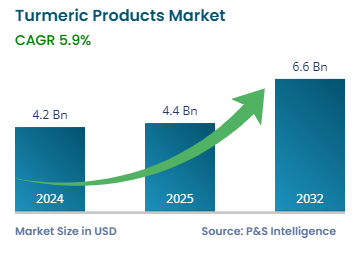
The turmeric products market size was USD 4.2 billion in 2024, and it will grow by 5.9% during 2025–2032, to reach USD 6.6 billion by 2032.
The market growth is primarily driven by increasing consumer awareness about the health benefits of turmeric, growing demand for natural and organic ingredients across food, pharmaceutical, and cosmetic industries, and the rising popularity of traditional medicine systems globally. The expanding application scope of turmeric products beyond their traditional culinary uses further contributes to the market growth.
The market has witnessed robust growth in the nutraceuticals and dietary supplements segment, where turmeric’s anti-inflammatory and antioxidant properties, particularly from its active compound curcumin, are increasingly valued. The clean-label movement and consumer preference for natural colorants over synthetic alternatives have positioned turmeric products as preferred ingredients in the food and beverage industry, driving substantial market growth during the forecast period. Additionally, to ensure proper safety and meet consumer demand, the FSSAI started special inspections in all states in March 2023. The agency now takes action against non-compliant nutraceuticals and health supplements with misleading product claims, ingredients exceeding RDI limits, and unapproved botanicals.
Turmeric Products Market Growth Factors
Technological Advancements Boosting Bioavailability & Usage Are Key Trend
The advanced extraction and formulation technologies to overcome curcumin's naturally low bioavailability are a key trend in the market.
Advanced delivery systems, including nanoparticles, liposomes, and micelles, are increasing the bioavailability of curcumin while improving its efficacy in therapeutic applications.
Companies are investing heavily in research to develop water-soluble curcumin formulations, microencapsulated products, and combination formulations that enhance absorption rates compared to standard turmeric powder.
These technological advancements have expanded application possibilities, enabling the development of functional beverages, dietary supplements with enhanced efficacy, and pharmaceutical formulations with improved therapeutic outcomes.
The innovation extends to sustainable extraction methods, with companies adopting supercritical CO2 extraction and other green technologies to produce high-purity turmeric extracts while minimizing environmental impact.
In 2023, Bharat Atomic Research Centre developed Turbovita, which is a liposomal nutraceutical formulation containing curcuminoids extracted from turmeric.
In 2024, BARC developed and patented four advanced curcumin delivery systems for pharmaceutical applications.
They include curcumin encapsulated in alginate beads, gelatine-based capsules, PEGylated liposomal curcumin, and a nasal-drop formulation.
These formulations help boost the water-solubility and bioavailability of curcumin, a compound with known anti-inflammatory, antioxidant, and anti-cancer properties.
Growing Health Consciousness and Preventive Healthcare Adoption Are Biggest Drivers
The increasing global focus on preventive healthcare and wellness has emerged as a primary driver for the turmeric products market.
Consumers worldwide are actively seeking natural solutions to manage chronic health conditions and boost immunity, particularly following the COVID-19 pandemic.
The bioactive compound curcumin, which constitutes 2–8% of turmeric, has demonstrated significant therapeutic properties including anti-inflammatory, antioxidant, antimicrobial, and potential anti-cancer effects.
Modern clinical research has validated many traditional uses of turmeric, with studies showing its effectiveness in managing arthritis, digestive disorders, metabolic syndrome, and cardiovascular conditions.
As per WHO, cardiovascular diseases are the leading cause of death, with an estimated 17.9 million deaths annually worldwide, creating substantial demand for natural preventive solutions.
This scientific validation, combined with growing consumer education about turmeric's health benefits, has led to increased incorporation of turmeric products in daily health regimens, particularly in developed markets where preventive healthcare spending is rising.
As per official government sources, in 2022–23, 3.24 lakh hectares were under turmeric cultivation in India with a production of 11.61 lakh tonnes, which was over 75% of global turmeric production.
Additionally, 1.534 lakh tonnes of turmeric and turmeric products, valued at USD 207.45 million, were exported by more than 380 exporters.
The first WHO Traditional Medicine Global Summit, hosted in August 2023 in Gandhinagar, Gujarat, was co-organized by the Indian government.
It aimed to promote evidence-based, integrative traditional healthcare practices worldwide.
Turmeric Products Market Segmentation and Category Analysis
Product Type Analysis
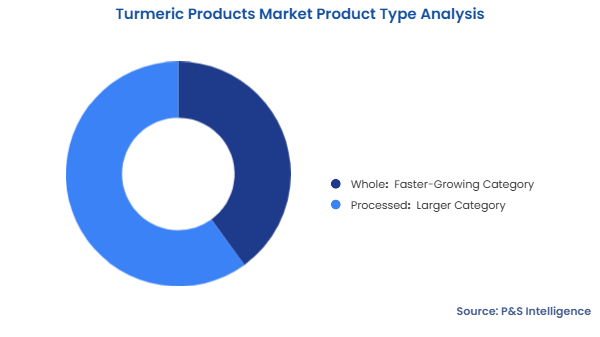
The processed category held the larger market share, of 60%, in 2024, primarily due to its versatility, extended shelf life, and ease of incorporation into various applications. This dominance is attributed to the growing demand for value-added turmeric products, including powders, extracts, essential oils, and standardized curcumin formulations that offer consistent quality and potency. The processed segment benefits from technological advancements in extraction and purification methods, enabling manufacturers to produce high-concentration curcumin extracts with enhanced bioavailability for pharmaceutical and nutraceutical applications.
The whole category will have the higher CAGR, as consumers are increasingly demanding natural, slightly processed, and clean-label ingredients. The increased health awareness after COVID-19 and interest in Ayurveda and traditional remedies have improved the usage of raw turmeric. Consumers prefer whole turmeric due to its authenticity and effectiveness, especially in Asia and export markets associated with sustainability and organic trends.
The product types analysed in this report are:
Whole (Faster-Growing Category)
Processed (Larger Category)
Powder
Pastes
Extracts
Essential oils
Capsules & tablets
Others
Applications Analysis
The food & beverages category held the largest market share, of 35%, in 2024, driven by the widespread use of turmeric as a natural colorant, flavour enhancer, functional ingredient, rising demand for natural flavouring agents, and health-promoting ingredients. The clean-label trend is forcing food producers to replace synthetic yellow dyes with turmeric in products ranging from dairy and beverages to snacks and ready-to-eat meals. The launch of turmeric-infused functional beverages, including golden milk products, turmeric lattes, and wellness shots, has further contributed to segment expansion.
The pharmaceutical/nutraceuticals category will have the highest CAGR, driven by increasing consumer preference for convenient dosage forms, standardized curcumin content, and the expanding dietary supplements market. The rising adoption of turmeric supplements for managing inflammatory conditions, supporting joint health, and boosting immunity has accelerated demand for encapsulated products. Additionally, innovations in formulation technologies, including the development of phospholipid complexes and nanoparticle-based delivery systems, have significantly improved the absorption and efficacy of turmeric capsules and tablets.
The indirect/B2C category held the largest market share, of 60%, in 2024, and it will have the highest CAGR, reflecting the strong retail presence of turmeric products across various consumer touchpoints. Within this segment, supermarkets/hypermarkets dominated with approximately 40% share of B2C sales, benefiting from their wide product assortment, competitive pricing, and one-stop shopping convenience. These large-format stores have expanded their natural and organic sections, dedicating significant shelf space to turmeric products ranging from culinary powders to dietary supplements.
Online/e-commerce is the fastest-growing subcategory due to the increasing adoption of digital platforms, convenience of home delivery, and access to a wider variety of specialized turmeric products, including premium organic variants and innovative formulations. E-commerce platforms have enabled smaller, specialized brands to reach global consumers, while subscription-based models for turmeric supplements have gained traction among health-conscious consumers. The channel's growth has been further accelerated by detailed product information, customer reviews, and competitive pricing available online.
The distribution channels analysed in this report are:
Direct/B2B
Indirect/B2C (Larger and Faster-Growing Category)
Convenience Stores
Online/E-commerce
Supermarkets/Hypermarkets
Specialty Stores
Others
Nature Analysis
The conventional category held the larger market share, in 2024, due to its cost-effectiveness, wider availability, and established supply chains. Conventional turmeric products remain the preferred choice for price-sensitive consumers and bulk industrial applications where organic certification is not a primary requirement. The segment benefits from higher yields per hectare and lower production costs, making conventional turmeric products more accessible to mass-market consumers, particularly in developing regions where price remains a key purchase decision factor.
The organic category will have the higher CAGR, of approx. 6.5%, driven by increasing health consciousness and willingness to pay premium prices for certified organic products. Consumers are willing to pay more for organic foods because they are free from harmful pesticides and have a high nutrient content, thereby being safe for long-term consumption. The organic segment's growth is particularly strong in developed markets where consumers associate organic certification with superior quality, safety, and environmental sustainability.
The natures analysed in this report are:
Organic (Faster-Growing Category)
Conventional (Larger Category)
Drive strategic growth with comprehensive market analysis
Turmeric Products Market Regional Growth Dynamics
APAC Turmeric Products Market Size
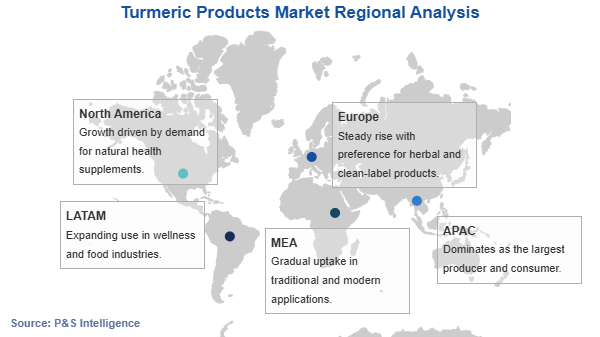
Asia-Pacific held the largest market share, of 40%, in 2024, because India is one of the world's largest producers, consumers, and exporters of turmeric, contributing over 80% of global production. The region benefits from favourable climatic conditions, established cultivation practices, and deep-rooted cultural usage of turmeric in ayurveda and traditional Chinese medicine. The increasing domestic consumption in countries like China, Japan, and Southeast Asian nations, where turmeric is extensively used in culinary applications and traditional remedies, further supports the market growth. The region's growing middle class, rising health awareness, and expanding food processing industry continue to drive demand for various turmeric products, from basic spice powders to sophisticated nutraceutical formulations.
India Turmeric Products Market Size
India is the largest and fastest-growing market not only in APAC, but globally. Turmeric products in India enjoy strong demand due to their wide-ranging applications across culinary, medicinal, and cosmetic sectors. In Indian households, turmeric is a staple spice used daily for flavouring and preserving food. It plays a key role in Ayurvedic medicine, known for its anti-inflammatory and healing properties. Increasing interest in natural wellness has expanded turmeric’s use in herbal teas, supplements, and skincare products. The cosmetic industry incorporates turmeric in creams, masks, and soaps for its skin-brightening effects. Its cultural and religious significance, especially in weddings and festivals, further sustains consistent domestic demand across urban and rural markets alike.
North America Turmeric Products Market Size
North America will have the highest CAGR, of approx. 6%, driven by increasing consumer awareness about turmeric's health benefits, rising adoption of functional foods and dietary supplements, and the growing influence of ethnic cuisines. In 2023, turmeric imports to the U.S. were valued at approximately USD 50.82 million, making it the world's largest importer of turmeric products.
The expansion of the natural products industry in North America, coupled with strong retail infrastructure and high consumer purchasing power, has created favorable conditions for premium turmeric products. The market is witnessing increased product innovation, with companies launching turmeric-based functional beverages, snack foods, and advanced dietary supplements targeting specific health conditions. Furthermore, the presence of stringent quality regulations and consumer preference for standardized, clinically-tested products has driven investments in research and development, resulting in high-quality turmeric formulations with enhanced bioavailability.
U.S. Turmeric Products Market Size
The U.S. dominates the North American market, and it will also have the higher CAGR in the forecast period. The demand for turmeric products in the U.S. is driven by rising interest in natural health and wellness. Turmeric is widely consumed in the form of dietary supplements, capsules, powders, and health drinks due to its perceived anti-inflammatory and antioxidant benefits. The spice is also increasingly used in functional foods, smoothies, and teas. In the beauty and skincare sector, turmeric is valued for its soothing and brightening effects, finding place in natural cosmetic formulations. Consumers seeking alternatives to synthetic additives and pharmaceuticals contribute to turmeric’s popularity, especially within health-conscious, vegan, and organic lifestyle communities across the country.
The geographical breakdown of the market is as follows:
North America (Fastest-Growing Regional Market)
U.S. (Largest and Fastest-Growing Country)
Canada
Europe
Germany (Largest Country)
U.K.
France (Fastest-Growing Country)
Italy
Spain
Rest of Europe
Asia-Pacific (Largest Regional Market)
China
India (Largest and Fastest-Growing Country)
Japan
South Korea
Australia
Rest of APAC
Latin America
Brazil (Largest Country)
Mexico (Fastest-Growing Country)
Rest of LATAM
Middle East and Africa
Saudi Arabia (Largest Country)
South Africa
U.A.E. (Fastest-Growing Country)
Rest of MEA
Turmeric Products Market Share
The market is fragmented with numerous players operating across different segments of the value chain, from cultivation and processing to distribution and retail. The fragmentation is particularly evident in the cultivation and primary processing segments, where thousands of farmers and small-scale processors, especially in India and other Asian countries, contribute to the global supply. Additionally, value-added segments such as standardized extracts and pharmaceutical-grade products show relatively higher concentration.
Key Turmeric Products Companies:
Everest Food Products Pvt. Ltd.
Mahashian Di Hatti Pvt. Ltd.
DS Spiceco Pvt. Ltd. (Catch Foods)
Jhaveri Industries (Badshah Masala)
Patanjali Ayurved Limited
Tata Consumer Products Limited
Eastern Condiments Pvt. Ltd.
Aachi Masala Foods Pvt. Ltd.
Synthite Industries Ltd.
Akay Flavours & Aromatics Pvt. Ltd.
Sabinsa Corporation
Indena S.p.A.
Givaudan S.A.
McCormick & Company Inc.
International Flavors & Fragrances Inc.
Turmeric Products Market News
In May 2025, Sabinsa Corporation introduced LactoBeet and showcased its curcumin portfolio as the Official Curcumin Sponsor at Vitafoods Europe 2025, strengthening its dominance in nutraceuticals and functional foods.
In April 2025, Sabinsa Corporation showcased its turmeric-derived LivLonga and Sabroxy at SupplySide Connect New Jersey, highlighting its leadership in clinically backed botanical ingredients.
In January 2025, the Indian government launched the National Turmeric Board’s first office in Nizamabad, Telangana, to boost the production and export of this commodity and products containing it.
In December 2024, Patanjali Ayurved Limited signed an MoU with three farmer– producer organisations in the Bahraich district of the state of Uttar Pradesh to buy 50,000 tonnes of turmeric every year for use in its products.
In July 2024, Sabinsa Corporation participated in Bio-Asia Taiwan Expo 2024, showcasing turmeric-derived ingredients such as Curcumin C³ Complex, strengthening its presence in East Asian botanical and functional ingredient markets.
In August 2024, Sabinsa Corporation explored partnerships with the University of Mysore and GKVK Bangalore for cooperative research and contract cultivation programs for high-quality turmeric and medicinal plants.
Want a report tailored exactly to your business need?
Leading companies across industries trust us to deliver data-driven insights and innovative solutions for their most critical decisions. From data-driven strategies to actionable insights, we empower the decision-makers who shape industries and define the future. From Fortune 500 companies to innovative startups, we are proud to partner with organisations that drive progress in their industries.
Client Testimonials
Working with P&S Intelligence and their team was an absolute pleasure – their awareness of timelines and commitment to value greatly contributed to our project's success. Eagerly anticipating future collaborations.
McKinsey & Company
India
Unmatched Standards
Our insights into the minutest levels of the markets, including the latest trends and competitive landscape, give you all the answers you need to take your business to new heights
Complete Data Security
We take a cautious approach to protecting your personal and confidential information. Trust is the strongest bond that connects us and our clients, and trust we build by complying with all international and domestic data protection and privacy laws