This Report Provides In-Depth Analysis of the Surgical Motors Market Report Prepared by P&S Intelligence, Segmented by Motor Type (Brushless DC, Brushed DC), Power Source (Battery-Powered, Corded Electric), Product Type (Drill, Saws, Reamers, Shavers/Arthroscopy Power Systems), High-Speed Burr Systems, Application (Orthopedic & Trauma, Spine, Neurosurgery/cranial, ENT/maxillofacial), End-User (Hospitals, Ambulatory Surgical Centers, Specialty Clinics/ Other Settings), and Geographical Outlook for the Period of 2021 to 2035
Explore the market potential with our data-driven report
Surgical Motors Market Overview
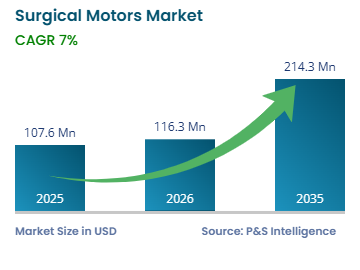
The global surgical motors market size was valued at approximately USD 107.6 million in 2025, and it is expected to grow at a CAGR of 7.0% during 2026–2035, reaching around USD 214.3 million by 2035. The market is being driven by the increasing volume of minimally invasive and precision-based surgical procedures, the rising prevalence of orthopedic and neurological disorders, and continuous advancements in motor efficiency, ergonomics, and battery-powered systems. Surgical motors are critical components of powered surgical instruments used across orthopedic, neurosurgical, ENT, dental, and other specialized procedures, where precision, torque control, reliability, and operating efficiency are essential for surgical performance.
The expanding burden of musculoskeletal and neurological conditions is strengthening the underlying demand for powered surgical systems. According to the World Health Organization (WHO), approximately 1.71 billion people globally live with musculoskeletal conditions, which are a major contributor to disability worldwide. Osteoarthritis alone affected approximately 528 million people globally in 2019, while fractures accounted for around 178 million new cases during the same year. In addition, WHO estimates that more than 3 billion people were living with a neurological condition in 2021, with neurological conditions collectively responsible for more than 11 million deaths annually. These conditions increase the need for orthopedic, neurosurgical, and other precision-based interventions, supporting demand for powered surgical instruments. The market is also witnessing a shift toward more efficient, less invasive, and procedure-specific surgical systems as healthcare providers seek to improve clinical outcomes while optimizing operating-room efficiency. The growing preference for minimally invasive and shorter-duration procedures is increasing the need for compact surgical motors that can provide precise speed and torque control while offering greater maneuverability.
Key Market Insights
Brushless DC (BLDC) holds the largest share, of 65.0% in 2025, due to superior efficiency, durability, and low maintenance requirements.
High-speed burr systems will witness the fastest growth, with a CAGR of 8.4%, driven by increasing demand for precision in minimally invasive procedures.
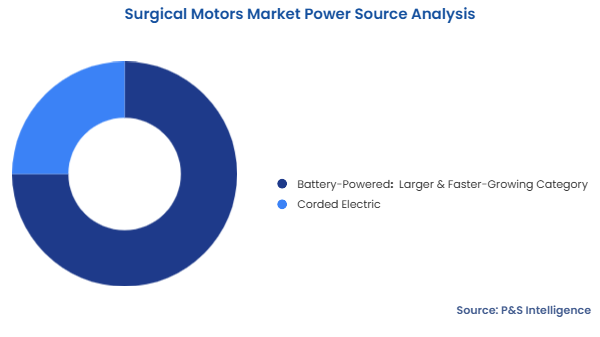
Battery-powered dominates with a share of 75.0%, supported by mobility, infection control benefits, and improved workflow efficiency.
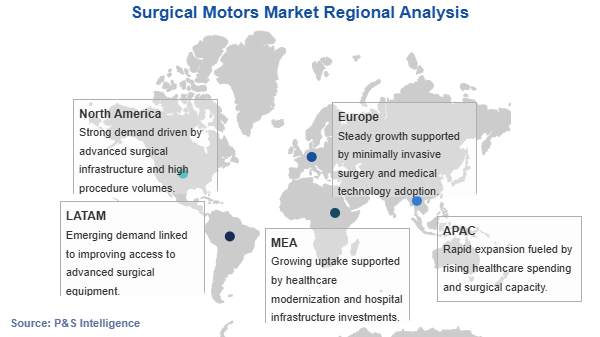
North America holds the largest market share, of 40.5% in 2025, due to advanced healthcare infrastructure and high surgical volumes.
Asia-Pacific is the fastest-growing region, with a CAGR of 8.4%, driven by expanding healthcare access and rising surgical demand.
Surgical Motors Market Trends and Drivers
Product Development Focus on Compact, Controllable Electric Drive Systems Is Key Trend
A defining trend in the surgical motors market is the increasing product development focus on compact, high-precision, and electronically controllable drive systems, particularly those based on brushless DC architectures. Manufacturers are redesigning motor platforms to reduce size and weight while improving torque stability, speed modulation, and thermal efficiency, enabling better maneuverability and precision during complex surgical procedures. This shift is aligned with the broader transition toward minimally invasive and microsurgical techniques, where space constraints and instrument control are critical determinants of surgical success.
Regulatory agencies such as the U.S. Food and Drug Administration (FDA) have seen a steady increase in approvals for electrically driven surgical instruments with integrated control systems, reflecting growing innovation in this domain. Additionally, the International Electrotechnical Commission (IEC) standards governing medical electrical equipment are reinforcing design improvements related to safety, electromagnetic compatibility, and operational precision. These developments are driving manufacturers to integrate digital control interfaces, programmable speed settings, and feedback-enabled systems into surgical motors. For instance, in July 2024, Portescap highlighted autoclavable micro-motion solutions for robotic surgery and smart surgical tools, including brushless motion systems capable of withstanding up to 1,000 autoclave cycles, reinforcing the industry’s focus on sterilization-compatible and high-performance motor technologies. Compact and electronically controlled drive systems are becoming central to next-generation surgical platforms, reshaping product differentiation and adoption patterns across hospitals and outpatient settings.
Demand for Consistent Performance and Repeatability in Complex Procedures Is Biggest Driver
The rising demand for consistent performance and procedural repeatability in complex surgical interventions is a key driver of the surgical motors market. Surgical outcomes in orthopedic, neurosurgical, and spine procedures are highly dependent on precision, stability, and reproducibility of instrument performance, particularly in tasks such as bone drilling, reaming, and cutting. Variability in motor speed, torque, or vibration can directly affect surgical accuracy and patient outcomes, increasing the need for advanced motor systems capable of delivering uniform performance across procedures. Clinical data from the World Health Organization (WHO) indicate that over 300 million major surgical procedures are performed globally each year, with a significant proportion involving high-precision interventions.
In addition, data from the Organisation for Economic Co-operation and Development show a continuous increase in surgical procedure volumes across member countries, driven by aging populations and rising chronic disease burden. Furthermore, the increasing adoption of minimally invasive and image-guided surgical techniques is intensifying the requirement for consistent motor performance, as these procedures allow limited margins for error. This demand is driving hospitals and surgical centers to prioritize high-quality, precision-engineered motor systems that ensure repeatable outcomes, thereby reinforcing procurement of advanced surgical motors and supporting sustained market growth.
Capital and Lifecycle Cost Sensitivity in Procurement Decisions Is Key Restraint
Capital expenditure constraints and lifecycle cost sensitivity remain significant restraints in the adoption of advanced surgical motor systems. While technologically advanced motors offer superior performance, they are associated with higher upfront costs, ongoing maintenance requirements, sterilization complexities, and periodic component replacement. Healthcare providers, particularly in public sector hospitals and emerging markets, often operate under strict budget limitations, making procurement decisions highly sensitive to total cost of ownership rather than just performance benefits.
According to the World Bank, healthcare spending in many low- and middle-income countries remains constrained, with limited allocation for capital-intensive medical equipment. Additionally, procurement frameworks in public healthcare systems often prioritize cost competitiveness and long-term value, delaying the adoption of premium surgical motor systems. The need for specialized servicing, battery replacement cycles, and compliance with sterilization protocols further increases lifecycle costs. These economic considerations are moderating the pace of adoption, particularly in cost-sensitive markets, despite growing clinical demand for advanced surgical tools.
Supplier Differentiation through Quality Discipline and Lifecycle Support Capabilities Is Biggest Opportunity
An important opportunity in the surgical motors market lies in supplier differentiation through strong quality discipline and comprehensive lifecycle support capabilities. As hospitals increasingly evaluate medical devices based on reliability, durability, and long-term serviceability, manufacturers are focusing on delivering consistent product quality alongside robust after-sales support, including maintenance services, training programs, and rapid servicing solutions. Regulatory frameworks such as ISO 13485 for medical device quality management systems and stringent post-market surveillance requirements are reinforcing the importance of quality assurance and lifecycle management. In addition, regulatory authorities such as the U.S. Food and Drug Administration emphasize post-market surveillance and device performance monitoring, while the European Commission Medical Device Regulation (MDR) framework mandates strict lifecycle traceability and safety compliance for medical devices.
Healthcare providers are prioritizing suppliers that can ensure minimal device downtime, consistent performance over extended usage cycles, and compliance with sterilization and safety standards. Additionally, the growing installed base of surgical motor systems is creating recurring demand for servicing, spare parts, and upgrades, enabling manufacturers to build long-term customer relationships and generate stable revenue streams. This shift toward lifecycle-based value propositions is creating a competitive advantage for companies that can combine product excellence with reliable support infrastructure, positioning them strongly in an increasingly performance-driven market environment.
Surgical Motors Market Segmentation Analysis
Motor Type Analysis
The brushless DC motors category holds the largest market share, of 65.0%, in 2025, and it will have the highest CAGR, of 7.3%, due to their superior efficiency, longer lifespan, and reduced maintenance compared to brushed motors. Their ability to deliver consistent torque and operate with minimal noise makes them highly suitable for precision surgical applications. Increasing regulatory emphasis on device reliability and performance consistency further supports their adoption. Brushed DC motors continue to be used in cost-sensitive settings due to their lower initial cost, while pneumatic motors remain relevant in specific high-power applications where compressed air systems are available.
The motor types analyzed in this report are:
Brushless DC (BLDC) (Largest & Fastest-Growing Category)
Brushed DC
Others
Power Source Analysis
The battery-powered category holds the larger market share, of 75.0%, in 2025, and it will have the higher CAGR, of 8.1%, due to the greater portability, maneuverability, and ease of handling offered by cordless systems, battery-powered surgical motors are increasingly preferred across surgical settings. These systems eliminate the need for power cords and direct connection to external power sources, providing greater freedom of movement and supporting efficient instrument handling within the surgical field. Battery-powered systems are particularly suitable for procedures requiring precise instrument positioning and flexible movement, as well as for ambulatory surgical centers where compact and portable equipment can support efficient workflows.
The drill category holds the largest market share, of 40.0%, in 2025, driven by drill systems underpinning bone preparation in fracture fixation, joint arthroplasty, and ligament reconstruction across orthopedics. Specialized drill systems enable craniotomy and vertebral access in neurosurgery, and high-speed drill systems underpin implant preparation and oral surgery in dental applications. This procedure breadth, spanning trauma, arthroplasty, spine, and ENT, sustains drill system dominance in hospital procurement volumes. Accessories and attachments contribute recurring revenue streams, reinforcing overall drill system volumes across procurement cycles.
The high-speed burr systems category will have the highest CAGR, of 8.4%, driven by the need for precision in neurosurgery, dental, and minimally invasive procedures. These systems enable finer control and reduced tissue damage, aligning with modern surgical requirements. High-speed surgical drill systems used in neurosurgery and ENT procedures typically operate within a rotational speed range of 40,000 to 80,000 RPM, enabling precise bone removal near critical anatomical structures.
The product types analyzed in this report are:
Drill (Largest Category)
Saws
Reamers
Shavers/Arthroscopy Power Systems
High-Speed Burr Systems (Fastest-Growing Category)
Application Analysis
The orthopedic and trauma category holds the largest market share, of 35.0%, in 2025, due to the high volume of procedures involving fracture fixation, joint replacement, bone preparation, and trauma management, all of which require powered drilling, sawing, and reaming systems. The broad use of surgical motors across trauma and orthopedic procedures, combined with the substantial global burden of musculoskeletal conditions, supports continued demand from this application. According to the World Health Organization (WHO), approximately 1.71 billion people globally live with musculoskeletal conditions, while 178 million new fractures were recorded worldwide in 2019, reinforcing the need for orthopedic and trauma interventions.
The spine category will have the highest CAGR, of 7.8%, driven by the increasing burden of spinal disorders and the growing adoption of minimally invasive and precision-based spine procedures. According to the WHO, 619 million people globally experienced low back pain in 2020, and the number of cases is projected to reach 843 million by 2050, largely due to population growth and ageing. The increasing need for precise bone removal, decompression, drilling, and implant preparation in spine procedures is supporting demand for advanced surgical motor systems with controlled speed, torque, and maneuverability.
The applications analyzed in this report are:
Orthopedic & Trauma (Largest Category)
Spine (Fastest-Growing Category)
Neurosurgery/cranial
ENT/maxillofacial
Cardiac/Thoracic
Others
End-User Analysis
The hospitals category holds the largest market share, of 65.5%, in 2025, due to the high concentration of complex surgical procedures, advanced operating-room infrastructure, and multidisciplinary surgical capabilities within hospital settings. Hospitals remain the primary end users of surgical motor systems because they perform a broad range of orthopedic, trauma, spine, neurosurgical, ENT, and other specialized procedures that require powered surgical instruments. The large volume and diversity of procedures performed in hospitals support continued procurement of surgical motors across different clinical departments.
The ambulatory surgical centers category will have the highest CAGR, of 8.1%, supported by the increasing shift toward same-day and outpatient surgical care. According to the OECD, the number of surgical procedures performed on a same-day basis has increased markedly across OECD countries, supported by advances in less invasive surgical techniques and improved anesthesia, while ambulatory surgery can also free hospital capacity for more complex cases. In the U.S., the 2025 AHRQ ASC database reports 6,499 CMS ambulatory surgical centers, highlighting the substantial and expanding institutional base for outpatient procedures. The growing use of ASCs for appropriate orthopedic, spine, ENT, and other procedures is therefore supporting demand for compact, portable, and efficient surgical motor systems.
Drive strategic growth with comprehensive market analysis
Surgical Motors Market Regional Analysis
North America Surgical Motors Market Size
North America holds the largest market share, of 40.5%, in 2025, due to its advanced healthcare infrastructure, high surgical procedure volumes, and strong reimbursement systems. The U.S. accounts for the largest share, supported by high healthcare expenditure exceeding USD 5.3 trillion annually, as reported by the Centers for Medicare & Medicaid Services. The presence of leading medical device manufacturers and early adoption of advanced surgical technologies further strengthen the region’s leadership. Additionally, the high prevalence of orthopedic and neurological disorders drives sustained demand for powered surgical instruments. For instance, in 2025, Stryker Corporation introduced advanced orthopedic power tool systems with battery-powered surgical solutions designed to improve precision, mobility, and torque control, supporting innovation in powered surgical instrumentation.
U.S. Surgical Motors Market Size
The U.S. is the larger country market for surgical motors in North America, supported by its substantial healthcare spending and well-established medical infrastructure. According to the Centers for Medicare & Medicaid Services (CMS), U.S. national health expenditures reached USD 5.3 trillion in 2024, equivalent to 18.0% of GDP, highlighting the country’s significant capacity for investment in healthcare services and medical technologies. This strong healthcare spending base, combined with a large network of hospitals and ambulatory surgical centers, supports continued procurement of powered surgical equipment. In addition, ongoing investments in advanced surgical technologies and the growing availability of specialized surgical services are supporting the adoption of surgical motor systems across orthopedic, trauma, spine, neurosurgical, and other procedure areas.
Asia-Pacific Surgical Motors Market Size
Asia-Pacific will have the highest CAGR, of 8.4%, driven by expanding healthcare access and rising government capital allocation, which are widening the addressable base for advanced surgical equipment across the region. India and China are the primary growth engines. Large patient populations and rising surgical volumes in both markets are generating sustained procurement demand for powered surgical instruments. Government programs including Ayushman Bharat in India and Healthy China 2030 are improving healthcare infrastructure and accessibility, enabling higher institutional adoption of advanced surgical equipment across public hospital networks. Japan’s aging population, with over 29% aged 65 and above, is also contributing to increased demand for surgical procedures, while South Korea and Australia are advancing robotic and high-speed motor adoption within private hospital networks.
China Surgical Motors Market Size
China is the largest country market in Asia-Pacific for surgical motors, driven by its large patient base and rapidly expanding healthcare infrastructure. According to China’s National Health Commission, the country had 2,817 tertiary public hospitals in 2022, reflecting the extensive base of higher-level healthcare facilities capable of performing complex and specialized procedures. The expansion and upgrading of these facilities are supporting demand for advanced surgical equipment across orthopedic, trauma, spine, neurosurgical, and other specialized procedures. Increasing availability of multidisciplinary services and advanced medical technologies within Chinese hospitals is further supporting the adoption of powered surgical systems and precision-based instruments.
India Surgical Motors Market Size
India is the fastest-growing country market within Asia-Pacific for surgical motors, driven by expanding private hospital capacity and increasing demand for advanced surgical equipment. According to the Government of India, 4,108 medical device manufacturers were licensed in the country as of March 2026, highlighting the expanding domestic medical-device manufacturing base. Government initiatives supporting indigenous production are further strengthening domestic capabilities, with 24 greenfield projects commissioned and production started for 57 medical-device products under the Production Linked Incentive scheme as of December 2025. This expanding manufacturing ecosystem, together with rising demand for specialized surgical procedures, is supporting the development and adoption of powered surgical instruments and surgical motor systems in India.
The regions and countries analyzed in this report include:
North America (Largest Regional Market)
U.S. (Larger Country Market)
Canada (Faster-Growing Country Market)
Europe
Germany (Largest Country Market)
France
U.K.
Italy
Netherlands (Fastest-Growing Country Market)
Rest of Europe
Asia-Pacific (Fastest-Growing Regional Market)
China (Largest Country Market)
India (Fastest-Growing Country Market)
Japan
South Korea
Australia
Rest of APAC
Latin America
Brazil (Largest Country Market)
Mexico (Fastest-Growing Country Market)
Rest of LATAM
Middle East & Africa
Saudi Arabia (Largest Country Market)
U.A.E.
South Africa (Fastest-Growing Country Market)
Rest of MEA
Surgical Motors Market Competitive Landscape
The global surgical motors market is semi-consolidated, with established medical device manufacturers holding strong positions across powered surgical systems, while regional and specialized manufacturers serve specific applications and price segments. Competition is primarily shaped by product reliability, motor performance, breadth of surgical power-tool portfolios, distribution capabilities, regulatory compliance, and after-sales service. The market includes a mix of established global manufacturers and regional and niche participants, with larger companies benefiting from broader product portfolios, established distribution networks, and technological capabilities. However, opportunities remain for smaller and specialized manufacturers, particularly in application-specific and cost-sensitive segments, resulting in a competitive structure that is concentrated among established participants while allowing regional and niche players to maintain a presence.
Key Players in the Surgical Motors Market:
Maxon International AG (maxon Group)
Nidec Corporation
Dr. Fritz Faulhaber GmbH & Co. KG
Portescap
MinebeaMitsumi Inc.
Johnson Electric Holdings Limited
Allied Motion Technologies Inc.
Buhler Motor GmbH
ElectroCraft Inc.
Orbray Co. Ltd.
Mabuchi Motor Electromag SA
Precision Microdrives Limited
Surgical Motors Market Developments
In January 2026, Maxon International AG expanded its ECX PRIME brushless DC motor range with sterilizable variants designed for medical handheld applications and autoclave compatibility.
In November 2024, Dr. Fritz Faulhaber GmbH & Co. KG introduced the MC 3602 B/MC 3606 B motion controller family for medical technology applications. The controllers are designed to support compact closed-loop motion systems used in powered surgical and robotic platforms.
In December 2023, Portescap introduced the M-Sense12A autoclavable magnetic encoder as part of its surgical motion solutions portfolio. The encoder is designed for integration into surgical devices requiring rotor-position feedback and is capable of withstanding over 2,000 sterilization cycles, supporting use in sterilizable medical environments.
Frequently Asked Questions About This Report
What is driving the growth of the surgical motors market?+
Growth is driven by increasing surgical volumes, rising incidence of trauma and chronic conditions requiring surgery, and growing demand for precision and efficiency in operating procedures.
What are the key trends shaping the surgical motors market?+
Key trends include the development of compact and lightweight devices, increasing adoption of battery-powered systems, and advancements in motor control for improved precision and reliability.
What are the major challenges in the surgical motors market?+
Major challenges include high procurement and maintenance costs, stringent regulatory approvals, and the need to ensure consistent performance under sterilization conditions.
How is technology impacting the surgical motors market?+
Technological advancements are improving motor efficiency, enabling better speed control, enhancing ergonomics, and supporting integration with advanced surgical systems.
What factors are increasing demand for surgical motors?+
Demand is increasing due to the growing aging population, rising prevalence of orthopedic disorders, and expanding access to surgical care in emerging markets.
Want a report tailored exactly to your business need?
Leading companies across industries trust us to deliver data-driven insights and innovative solutions for their most critical decisions. From data-driven strategies to actionable insights, we empower the decision-makers who shape industries and define the future. From Fortune 500 companies to innovative startups, we are proud to partner with organisations that drive progress in their industries.
Client Testimonials
Working with P&S Intelligence and their team was an absolute pleasure – their awareness of timelines and commitment to value greatly contributed to our project's success. Eagerly anticipating future collaborations.
McKinsey & Company
India
Unmatched Standards
Our insights into the minutest levels of the markets, including the latest trends and competitive landscape, give you all the answers you need to take your business to new heights
Complete Data Security
We take a cautious approach to protecting your personal and confidential information. Trust is the strongest bond that connects us and our clients, and trust we build by complying with all international and domestic data protection and privacy laws