Explore the market potential with our data-driven report
Sterile Filtration Market Outlook
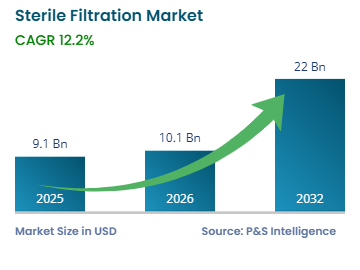
The sterile filtration market size was USD 9.1 billion in 2025, and it will grow by 12.2% during 2026–2032, to reach USD 22.0 billion by 2032.
The market growth is primarily driven by the increasing prevalence of chronic diseases worldwide, rising biopharmaceutical production, and stringent regulatory requirements for product sterility across the pharmaceutical, biotechnology, and food & beverage industries.
The expanding biopharmaceutical industry represents a critical growth catalyst for sterile filtration demand globally. The substantial disease burden necessitates continuous development and manufacturing of biologic drugs, vaccines, and therapeutic proteins that require sterile filtration to ensure product safety and efficacy.
Furthermore, the implementation of advanced filtration technologies, particularly in critical applications such as final product processing and virus removal, has become indispensable for meeting regulatory compliance standards set by agencies including the FDA, EMA, and other global health authorities. The technology's capability to remove microorganisms without affecting product integrity makes it essential for heat-sensitive biologics, vaccines, and parenteral drugs that cannot undergo terminal sterilization methods.
Sterile Filtration Market Emerging Trends
Technological Advancements in Membrane Materials Are Key Trends
Innovation in membrane technology continues to transform sterile filtration capabilities across applications.
Advanced polymer membranes, including modified polyethersulfone and polyvinylidene fluoride formulations, offer enhanced protein binding characteristics, improved flow rates, and superior chemical compatibility compared to traditional materials.
Such advancements allow for the more-effective processing of high-value biologics, minimizing product loss and ensuring sterility.
The integration of novel membrane surface modifications has addressed historical challenges such as protein adsorption and filter fouling, particularly critical for processing high-concentration formulations and complex biological molecules.
Manufacturers have developed asymmetric membrane structures that provide higher dirt-holding capacity and extended filter life, reducing operational costs and improving process economics.
Additionally, the emergence of virus-retentive filters with enhanced selectivity enables manufacturers to achieve robust viral clearance while maintaining high product recovery rates.
Rising Demand for Biologics and Advanced Therapeutics Is Biggest Driver
The pharmaceutical industry's shift toward biologics and advanced therapy medicinal products represents a fundamental driver for sterile filtration market expansion.
Studies predict global biologics sales revenue to increase from USD 48.1 billion in 2023 to USD 745.1 billion by 2030.
In 2024, the FDA's Center for Biologics Evaluation and Research approved 17 biologics license applications, including multiple cell and gene therapies, demonstrating the sustained pipeline of complex biologics requiring sterile processing.
These sophisticated therapeutic modalities, including monoclonal antibodies, recombinant proteins, and viral vector-based therapies, demand stringent sterile filtration protocols throughout their manufacturing processes to ensure product safety and maintain biological activity.
The complexity of biologic molecules necessitates specialized filtration approaches that preserve product integrity while achieving required sterility assurance levels.
Modern sterile filters must accommodate diverse product characteristics, from high-concentration protein formulations to sensitive cell therapy products, driving innovation in membrane materials and filter designs.
Manufacturing facilities are increasingly adopting single-use sterile filtration systems to minimize cross-contamination risks and reduce validation requirements, particularly important for multi-product facilities producing various biologics.
Sterile Filtration Market Segmentation Analysis
Product Analysis
The cartridge filters category held the largest market share, of 30%, in 2024, because this product offers more efficiency and cost-effectiveness. Additionally, it is more suitable for applications where dust needs to be completely removed or recovered. A cartridge filter consists of a piece of tube filtration equipment, which can be used in all sorts of industrial applications to meet various requirements. It can be used in dairy processing, water treatment, wine clarification, brewing, and pharmaceutical production. Apart from that, it can be used in reverse osmosis.
The capsule filters category will have the highest CAGR, due to their efficiency, ease of use, and regulatory compliance. Pre-sterilized and ready-to-use, they reduce contamination risk and eliminate the need for cleaning and validation. With high flow rates and large surface areas, they suit large-scale biopharmaceutical and pharmaceutical applications.
The products analyzed in this report are:
Membranes
Cartridge Filters (Largest Category)
Capsule Filters (Fastest-Growing Category)
Syringe Filters
Bottle-Top & Table-Top Filtration Systems
Accessories
Membrane Analysis
The PES category held the largest market share, of 25%, in 2024, because this material is highly suitable for the filtration and clarification of pharmaceutical and biological solutions. Interchangeable PES membranes are used in applications such as sample preparation, filtration, and infusion therapy because of their ability to eliminate fine particles, bacteria, and fungi. Moreover, they are inherently hydrophilic membranes that quickly wet and lead to faster filtration with a high flow rate and efficiency. In addition, owing to their longer life and low maintenance requirements, PES membranes have become widespread in the treatment of wastewater.
The PVDF category will have the highest CAGR, driven by its unique combination of mechanical strength and broad chemical compatibility. PVDF membranes excel in aggressive solvent environments and demonstrate superior durability in repeated steam sterilization cycles, making them increasingly preferred for multi-use applications and challenging filtration scenarios. The material's inherent low extractables profile and validation history support its adoption in critical pharmaceutical applications where product purity and patient safety are paramount.
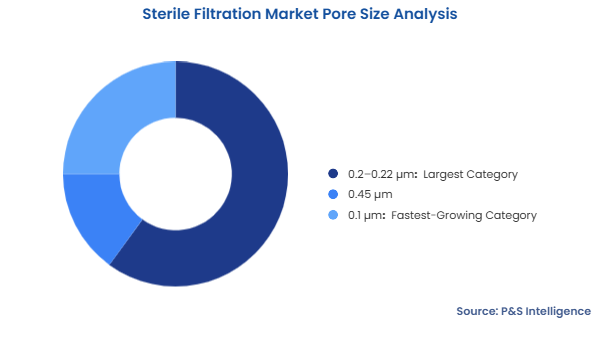
The 0.2–0.22 μm category held the largest market share, of 60%, in 2024, established as the industry standard for sterile filtration based on extensive validation demonstrating complete retention of bacteria and mycoplasma. The 0.2–0.22-µm pore size achieves an ideal balance of microbial retention and flow efficiency, allowing effective processing while complying with sterility regulations. The widespread acceptance of 0.2–0.22-µm filters across regulatory jurisdictions and their proven track record in diverse applications from final product filtration to process fluid sterilization reinforces their dominant market position.
The 0.1 μm category will have the highest CAGR, driven by increasing requirements for enhanced microbial control and virus reduction in biopharmaceutical manufacturing. These tighter filters provide additional safety margins for high-risk applications, particularly in advanced therapy medicinal products and plasma-derived therapeutics, where comprehensive pathogen removal is critical. The development of 0.1-µm high-flow membranes with reduced pressure drop characteristics has improved their economic feasibility for large-scale applications.
The pore sizes analyzed in this report are:
0.2–0.22 µm (Largest Category)
0.45 µm
0.1 µm (Fastest-Growing Category)
Application Analysis
The bio-process category held the largest market share, of 45%, in 2024, reflecting the critical role of sterile filtration throughout upstream and downstream bioprocessing operations. In bioprocesses, filters are generally used to remove unwanted particles, such as cell debris, from samples and kill viruses or other microorganisms in the same culture. In the bioprocessing industry, filtration is an important procedure as it ensures that the medicinal product is microbiologically safe for patients. It is considered crucial in the pharmaceutical industry to remove bacteria and reduce bioburden, in order to manufacture high-quality products.
The fill–finish process category will have the highest CAGR, propelled by expanding global vaccine production capacity and increasing manufacture of injectable biologics. The fill–finish stage serves as the last checkpoint for product sterility before administration, making sterile filtration absolutely critical for product safety and regulatory compliance. Advanced filling line configurations incorporating in-line sterile filtration, combined with isolator technology and single-use systems, enable more flexible and efficient operations while maintaining the high sterility assurance levels required for parenteral products.
The applications analyzed in this report are:
Bio-Process (Largest Category)
Pre-Filtration
Fill–Finish Process (Fastest-Growing Category)
Utilities Filtration
Virus Filtration
End User Analysis
The pharmaceutical & biopharmaceutical companies category held the largest market share, of 45%, in 2024, due to their widespread reliance on sterile filtration for drug development, clinical production, and commercial manufacturing. These companies operate under stringent regulatory oversight requiring validated sterile filtration processes for product safety, creating consistent demand for high-performance filtration solutions. The continuous pipeline of new biological drugs, including over 1,300 biopharmaceutical therapeutic candidates in clinical development, sustains long-term growth prospects for sterile filtration adoption in this category.
The CMOs & CROs category will have the highest CAGR, reflecting the industry trend toward outsourcing of pharmaceutical manufacturing and development activities. CMOs require flexible sterile filtration platforms capable of handling diverse client products and processes while maintaining regulatory compliance across multiple jurisdictions. The expansion of CMO capacity, particularly in emerging markets, combined with their need for state-of-the-art filtration technologies to attract pharmaceutical clients, drives accelerated adoption of advanced sterile filtration systems. Studies say that CRO service providers will make USD 179.2 billion and biologics CDMOs USD 39.0 billion by 2032.
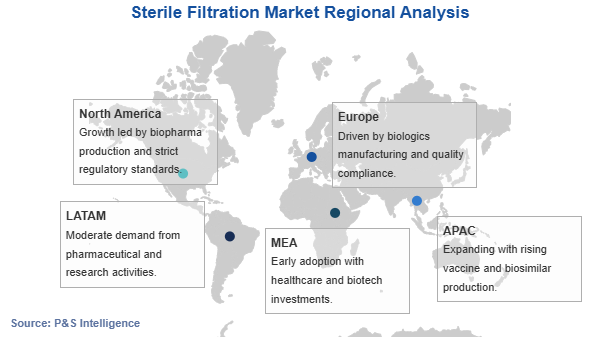
North America held the largest market share, of 40%, in 2024. The dominance of the continent on the sterile filtration market is due to the increasing R&D activities of pharma and biotech companies for drug development, rising healthcare expenditure, and rapid technological advancements. The presence of major pharmaceutical companies, coupled with a strong biotechnology ecosystem encompassing over 2,500 biotech firms, creates sustained demand for advanced sterile filtration technologies.
The region benefits from early adoption of innovative filtration technologies, including single-use systems and continuous manufacturing platforms that rely heavily on sterile filtration for process control. Furthermore, the implementation of advanced manufacturing technologies and quality-by-design principles in North American facilities drives demand for validated, high-performance sterile filtration systems that ensure product quality while improving operational efficiency.
Asia-Pacific Sterile Filtration Market Size
Asia-Pacific will have the highest CAGR, of approx. 12.5%, propelled by the rapid expansion of pharmaceutical manufacturing capacity and increasing healthcare investments across the region. The biopharmaceutical industry in Asia-Pacific benefits from favorable manufacturing costs, skilled workforce availability, and government initiatives supporting biotechnology sector development. Countries like China, India, and South Korea have established themselves as global manufacturing hubs for both generic and innovative pharmaceuticals, creating substantial demand for sterile filtration solutions.
The region is boosted by the rising domestic healthcare spending and a growing need for biologic treatments due to a surging chronic disease prevalence. According to the WHO, more than 80% of the global premature NCD deaths occur in low- and middle-income countries, with many concentrated in Asia Pacific nations experiencing rapid demographic transitions. This disease burden drives local pharmaceutical production and biosimilar development, necessitating the implementation of world-class sterile filtration capabilities to meet international quality standards and support both domestic consumption and export markets.
Japan Sterile Filtration Market Size
Japan represents a mature yet dynamic sterile filtration market within Asia Pacific, characterized by advanced pharmaceutical manufacturing capabilities and stringent quality requirements aligned with global standards. The country's pharmaceutical sector benefits from strong government support for innovation, particularly in regenerative medicine and cell therapy fields, where sterile filtration plays a critical enabling role. Japanese pharmaceutical companies' focus on biologics development and manufacturing excellence drives the adoption of cutting-edge filtration technologies.
The Japanese market demonstrates particular strength in developing novel filtration solutions for emerging therapeutic modalities, supported by collaboration between industry and academic institutions. Local regulations emphasizing product quality and patient safety create demand for validated sterile filtration systems that meet both Japanese Pharmaceutical and Medical Device Agency requirements and international standards.
The geographical breakdown of the market is as follows:
North America (Largest Regional Market)
U.S. (Larger and Faster-Growing Country)
Canada
Europe
Germany (Largest Country)
U.K. (Fastest-Growing Country)
France
Italy
Russia
Rest of Europe
Asia-Pacific (Fastest-Growing Regional Market)
China (Largest Country)
India (Fastest-Growing Country)
Japan
South Korea
Australia
Rest of APAC
Latin America
Brazil (Largest Country)
Mexico (Fastest-Growing Country)
Rest of LATAM
Middle East and Africa
Saudi Arabia (Largest Country)
South Africa
U.A.E. (Fastest-Growing Country)
Rest of MEA
Sterile Filtration Market Share
The market is fragmented due to the presence of numerous global and regional players, such as Merck Millipore, Sartorius, Pall Corporation, GE Healthcare, and Cytiva, operating across diverse product types, including capsule filters, cartridge filters, membranes, and syringe filters. Market fragmentation is further driven by varied applications like bioprocessing, virus filtration, utilities filtration, fill-finish, and pre-filtration, as well as regional differences in regulatory requirements. This fragmentation fosters competitive pricing, innovation, and adoption of advanced technologies, while partnerships and acquisitions continue in niche segments.
Key Sterile Filtration Companies:
Merck KGaA
Danaher Corporation
Sartorius AG
Thermo Fisher Scientific Inc.
The 3M Company
Parker Hannifin Corporation
General Electric Company (GE Healthcare division)
Porvair PLC (Porvair Filtration Group)
Alfa Laval AB
Sterlitech Corporation
Agilent Technologies, Inc.
QIAGEN N.V.
Sterile Filtration Market News
In February 2025, Thermo Fisher Scientific Inc. announced its acquisition of Solventum's purification and filtration business for approximately USD 4.1 billion. This move aims to bolster Thermo Fisher's position in the bioprocessing sector, enhancing its portfolio of tools and services for biopharmaceutical companies.
Want a report tailored exactly to your business need?
Leading companies across industries trust us to deliver data-driven insights and innovative solutions for their most critical decisions. From data-driven strategies to actionable insights, we empower the decision-makers who shape industries and define the future. From Fortune 500 companies to innovative startups, we are proud to partner with organisations that drive progress in their industries.
Client Testimonials
Working with P&S Intelligence and their team was an absolute pleasure – their awareness of timelines and commitment to value greatly contributed to our project's success. Eagerly anticipating future collaborations.
McKinsey & Company
India
Unmatched Standards
Our insights into the minutest levels of the markets, including the latest trends and competitive landscape, give you all the answers you need to take your business to new heights
Complete Data Security
We take a cautious approach to protecting your personal and confidential information. Trust is the strongest bond that connects us and our clients, and trust we build by complying with all international and domestic data protection and privacy laws