This Report Provides In-Depth Analysis of the Sodium Hydroxide Market Report Prepared by P&S Intelligence, Segmented by Product Process (Membrane Cell, Diaphragm Cell), Grade (50% Aqueous Solution, Solid), Application (Biodiesel, Alumina, Inorganic Chemicals, Organic Chemicals, Food, Pulp & Paper, Soaps & Detergents, Textiles, Water Treatment), and Geographical Outlook for the Period of 2021 to 2032
Explore the market potential with our data-driven report
Sodium Hydroxide Market Key Insights
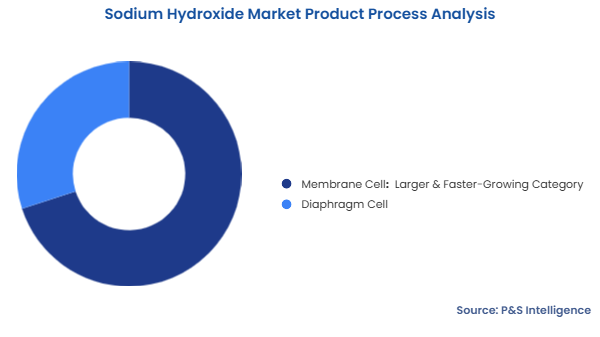
Membrane cell process holds the larger share, of 70%, and it will have the higher CAGR, of approximately 5.4%, due to energy efficiency and environmental compliance.
50% aqueous solution dominates the market with 75% share and it will have the higher CAGR, of approximately 5.7%, due to ease of handling and transportation.
Organic chemicals application holds the largest share, of 25%, driven by its extensive use in chemical synthesis.
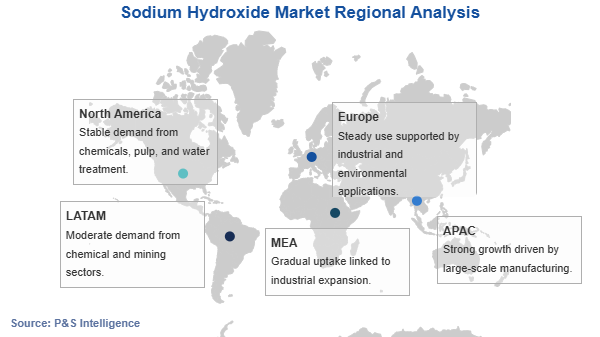
Asia-Pacific accounts for the largest market share, of 40%, supported by strong industrial base and chemical production.
Sodium Hydroxide Market Analysis
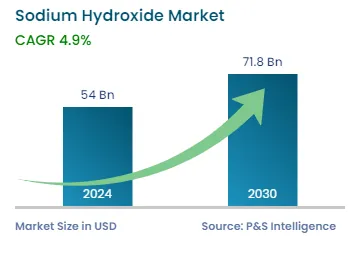
The sodium hydroxide market size was USD 56.1 billion for 2025, and it will grow by 5.0% during 2026–2032, to reach USD 78.8 billion by 2032.
This growth is driven by the expanding demand from chemical processing, pulp & paper, textiles, and water treatment industries, where sodium hydroxide (caustic soda) serves as a fundamental alkali for neutralization, pH control, and chemical synthesis. The increasing industrialization across emerging economies is significantly boosting consumption, particularly in Asia-Pacific. The chemical manufacturing sector remains a major growth backbone of the market, alongside alumina refining and pulp & paper industries, all of which require substantial volumes of sodium hydroxide for processing.
Environmental regulations are also playing a critical role in market expansion. Governments globally are enforcing stricter wastewater discharge norms. For instance, India’s Central Pollution Control Board (CPCB) mandates pH-neutral discharge of industrial effluents, increasing the use of sodium hydroxide in water treatment applications. Similarly, the U.S. Environmental Protection Agency (EPA) enforces industrial wastewater standards, further strengthening demand. In addition, infrastructure investments in water treatment facilities, supported by programs such as the Jal Jeevan Mission in India, are creating sustained demand for caustic soda.
Shift toward Energy-Efficient Membrane Cell Technology Is Key Trend
A major trend in the sodium hydroxide market is the transition toward membrane cell technology, replacing older diaphragm and mercury-based processes. Membrane cell technology offers higher energy efficiency, lower environmental impact, and improved product purity. This shift is aligned with global environmental regulations, including restrictions under frameworks such as the Minamata Convention on Mercury, which targets the phase-out of mercury-based industrial processes. The European Union has fully phased out mercury-based chlor-alkali production by 2023, resulting in near-complete adoption of membrane cell technology across the region.
According to the International Energy Agency (IEA), energy efficiency improvements in chemical production can significantly reduce operational costs and emissions. Membrane cell plants consume up to 30% less energy compared to traditional processes, making them economically and environmentally favorable. This transition is being widely adopted across developed and emerging markets, as manufacturers upgrade facilities to comply with environmental standards and improve operational efficiency, thereby accelerating the widespread adoption of membrane-based production.
Rising Alumina Refining Demand Is Biggest Driver
Expanding global primary aluminum production is one of the most structurally significant demand drivers for the sodium hydroxide market, driven by a direct and process-dependent demand relationship. The Bayer process, the universal method for refining bauxite into alumina, requires caustic soda for digestion, dissolution, and impurity removal at elevated temperatures and pressures, consuming it in substantial volumes per tonne of output across all stages of bauxite digestion. According to the International Aluminium Institute (IAI), global primary aluminum production reached 72.76 million tonnes in 2024, rising by 2.89% year-on-year. This sustained output expansion directly translates into incremental caustic soda demand, as alumina refining requires substantial volumes throughout the digestion process. In Indonesia, the government's ban on raw bauxite exports and push for domestic alumina refining has accelerated the development of new refining capacities, further strengthening regional demand for caustic soda.
The driver extends beyond current production volumes. Aluminum's increasing penetration in automotive lightweighting is reinforced by its expanding role in aerospace components and renewable energy infrastructure, as manufacturers target carbon emission reductions across production cycles. Emirates Global Aluminium has expanded its alumina refining operations through its Al Taweelah refinery, reinforcing integrated supply chains and sustaining long-term consumption of caustic soda in refining processes. With aluminum production projected to grow steadily through 2030, particularly across Asia-Pacific, the alumina–caustic soda demand link will remain one of the most durable growth vectors in the sodium hydroxide market.
High Energy Intensity and Raw Material Dependence Are Key Restraints
The sodium hydroxide market faces a key restraint in the form of high energy consumption and dependence on chlorine co-production. The chlor-alkali process, which produces sodium hydroxide, is highly energy-intensive, requiring approximately 2,500 kWh of electricity per tonne of output, making production costs sensitive to electricity prices. Electricity accounts for nearly 40–60% of total operating costs in chlor-alkali operations, as also highlighted by the International Energy Agency (IEA). During 2022–2024, elevated electricity prices in Europe led to reduced operating rates at chlor-alkali plants, constraining caustic soda supply and increasing price volatility.
Additionally, sodium hydroxide production is intrinsically linked to chlorine demand, as both are co-products. Fluctuations in chlorine demand can disrupt supply-demand balance for caustic soda, leading to price volatility. This dependency creates operational and economic challenges for manufacturers, particularly in regions with unstable industrial demand patterns.
Expansion of Water Infrastructure and Biofuel Production Is Biggest Opportunity
The expansion of water treatment infrastructure and biofuel production presents a significant opportunity for the sodium hydroxide market. Governments worldwide are investing in water purification and wastewater management systems. For instance, India’s Jal Jeevan Mission aims to provide piped water supply to all rural households, significantly increasing demand for water treatment chemicals. Similarly, increasing investments in municipal wastewater treatment and industrial effluent management across Asia-Pacific and the Middle East are further strengthening the consumption of caustic soda for pH regulation and neutralization processes.
Simultaneously, the growth of biodiesel production is creating new demand avenues. Sodium hydroxide is widely used as a catalyst in transesterification processes. According to the International Renewable Energy Agency (IRENA), global biofuel production continues to rise as countries aim to reduce carbon emissions. Government-supported biofuel blending mandates in major economies such as India, Brazil, and the United States are further accelerating biodiesel production, thereby supporting additional demand for sodium hydroxide in fuel processing applications. This dual demand from water treatment and renewable energy sectors is expected to create strong long-term growth opportunities for sodium hydroxide manufacturers.
Sodium Hydroxide Market Segmentation Analysis
Product Process Analysis
The membrane cell category holds the larger market share, of 70%, in 2025, and it will have the higher CAGR, of approximately 5.4%, driven by regulatory compliance requirements, higher product purity, and widespread industry adoption. Regulatory pressure to eliminate mercury-based processes and improve sustainability is accelerating its adoption globally. The process has increasingly become the preferred choice for new chlor-alkali plants, while the gradual upgrade of older facilities is further supporting its wider adoption. Its suitability for integration with modern process control systems and its ability to support continuous, large-scale operations make it well-aligned with current industrial requirements, reinforcing its strong position in the market.
The production processes analyzed in this report are:
Membrane Cell (Larger & Faster-Growing Category)
Diaphragm Cell
Grade Analysis
The 50% aqueous solution category holds the larger market share, of 75%, in 2025, and it will have the higher CAGR, of approximately 5.7%, due to its optimal concentration for direct industrial use, eliminating the need for additional dilution or dissolution. It is the naturally produced form in chlor-alkali processes, avoiding extra conversion costs associated with solid grades. Additionally, its compatibility with bulk handling systems and ability to support precise, automated dosing in continuous industrial operations drive its widespread adoption across chemical processing and water treatment industries. This dominance is further reinforced by strong end-use demand, particularly in the pulp and paper sector, where approximately 35 kg of caustic soda is required to produce one ton of market pulp, highlighting its critical role in large-scale continuous processing applications.
The organic chemicals category holds the largest market share, of 25% in 2025, driven by the extensive use of sodium hydroxide in chemical synthesis, including plastics, solvents, and intermediates. The expansion of the global chemical industry continues to reinforce this dominance. Additionally, its direct integration within the chlor-alkali production chain ensures steady availability and cost efficiency, further supporting its widespread industrial adoption.
The water treatment category will have the highest CAGR, supported by increasing investments in wastewater treatment infrastructure and stricter environmental regulations. The growing need for clean water and industrial effluent management is significantly driving demand. In North America, this is reinforced by regulatory frameworks such as the Clean Water Act, under which the U.S. Environmental Protection Agency mandates strict discharge standards, driving continuous chemical demand for pH control and wastewater treatment processes.
The applications analyzed in this report are:
Biodiesel
Alumina
Inorganic Chemicals
Organic Chemicals (Largest Category)
Food
Pulp & Paper
Soaps & Detergents
Textiles
Water Treatment (Fastest-Growing Category)
Drive strategic growth with comprehensive market analysis
Asia-Pacific holds the largest market share, of 40%, in 2025, and it will have the highest CAGR, of approximately 5.9%. The region's leadership is driven by large-scale industrialization, a well-established chemical manufacturing base, and strong downstream demand across textiles, pulp and paper, alumina refining, and water treatment. China dominates regional production, supported by its position as a leading global manufacturer of textiles and chemical intermediates, while India, Indonesia, Vietnam, and other ASEAN economies are emerging as high-growth demand centers due to rapid urbanization and expanding industrial infrastructure. A significant share of global chlor-alkali capacity is concentrated in Asia-Pacific, reinforcing its role as the primary hub for caustic soda production and consumption.
The Asian Development Bank, in its Asian Development Outlook July 2024, reports that developing Asian economies are projected to grow by 5.0% in 2024, supported by resilient domestic demand and improving export performance, with China and India leading industrial expansion. This sustained economic growth continues to drive demand for sodium hydroxide across key applications such as chemical processing, textile manufacturing, and water treatment. Additionally, the United Nations Educational, Scientific and Cultural Organization highlights that the Asia-Pacific population living under high or extremely high water scarcity increased from 1.1 billion to over 2.6 billion between 1975 and 2010, driving long-term government investment in water treatment infrastructure where sodium hydroxide is widely used for pH control and neutralization. From an industry perspective, companies such as Grasim Industries Limited have expanded chlor-alkali capacities in India to meet rising domestic demand from textiles, chemicals, and water treatment sectors.
China Sodium Hydroxide Market Size
China holds the largest position in the Asia-Pacific sodium hydroxide (caustic soda) market due to its scale-driven chlor-alkali industry, strong policy support, and extensive downstream demand supported by verified industrial data. China accounts for over 40% of global chlor-alkali production, making it the leading producer worldwide. According to the National Bureau of Statistics of China, the country’s caustic soda output has maintained steady annual growth of around 3–5%, reflecting consistent capacity expansion. This dominance is strongly supported by downstream demand, particularly from alumina refining, where China produced approximately 85.52 million tonnes of alumina in 2024, accounting for nearly 60% of global output. On the policy side, the government has implemented supply-side structural reforms and cleaner production standards to eliminate outdated capacity and promote energy-efficient membrane-cell technology.
Additionally, under the latest Five-Year Plan, authorities are encouraging industry consolidation and capacity control in alumina and related sectors to improve efficiency and sustainability. In terms of industry developments, major companies such as Xinjiang Zhongtai Chemical Co., Ltd. and Shandong Haihua Group Co., Ltd. have undertaken expansion and modernization projects, while production continues to shift toward energy-efficient regions like Inner Mongolia and Xinjiang.
India Sodium Hydroxide Market Size
India is the fastest-growing country market within Asia Pacific for sodium hydroxide, supported by strong expansion across its chemical manufacturing and textile sectors, which continue to scale with rising domestic consumption and export-oriented production. The Jal Jeevan Mission has allocated approximately USD 50 billion (around INR 3.6 lakh crore) toward rural water infrastructure, creating sustained demand for treatment chemicals across newly developed and upgraded facilities.
India's paper industry is also expanding, with increasing reliance on recovered fiber imports to support production, reinforcing the use of caustic soda in pulping and bleaching operations. On the supply side, DCM Shriram Limited commissioned a 300 TPD caustic soda flakes plant at its Jhagadia facility in Gujarat in March 2025, increasing total site capacity to 900 TPD, reflecting ongoing capacity additions to meet rising domestic demand across industrial sectors.
The regions and countries of the market are as follows:
North America
U.S. (Larger and Faster-Growing Country Market)
Canada
Europe
Germany (Largest Country Market)
U.K.
France (Fastest-Growing Country Market)
Italy
Spain
Rest of Europe
Asia-Pacific (Largest and Fastest-Growing Regional Market)
China (Largest Country Market)
India (Fastest-Growing Country Market)
Japan
South Korea
Australia
Rest of APAC
Latin America
Brazil (Largest and Fastest-Growing Country Market)
Mexico
Rest of LATAM
Middle East & Africa
Saudi Arabia (Largest Country Market)
South Africa
U.A.E. (Fastest-Growing Country Market)
Rest of MEA
Sodium Hydroxide Market Share Analysis
The market is semi-consolidated, characterized by the presence of large integrated chemical manufacturers with strong production capacities and established distribution networks. High capital investment requirements, significant energy dependency, and strict regulatory compliance act as key barriers to entry. Competitive dynamics are influenced by feedstock availability, production efficiency, and long-term supply contracts with end-use industries. Additionally, the market exhibits regional concentration of production due to high transportation costs and the hazardous nature of the product, which encourages localized supply structures and limits global trade intensity.
Top Companies in the Sodium Hydroxide Market:
Olin Corporation
Dow Inc.
Occidental Petroleum Corporation
Westlake Corporation
INEOS Group
Formosa Plastics Corporation
Shin-Etsu Chemical Co. Ltd.
Xinjiang Zhongtai Chemical Co. Ltd.
AGC Inc.
Hanwha Solutions
Tata Chemicals Limited
Solvay S.A.
DCM Shriram Limited
ANSA McAL Limited
Nobian Industrial Chemicals B.V.
Sodium Hydroxide Market News
In April 2025, DCM Shriram Limited commissioned a 300 tonnes-per-day (TPD) caustic soda flakes plant at its Jhagadia facility in Gujarat. This increased total flakes capacity at the site to 900 TPD, making it one of the largest single-location caustic soda flakes production facilities in India.
In November 2024, ANSA McAL Limited acquired BleachTech LLC for USD 327 million, gaining two U.S. chlor-alkali plants producing sodium hydroxide and related chemicals.
In February 2024, INEOS Inovyn launched its Ultra Low Carbon (ULC) range of chlor-alkali products, reducing the carbon footprint of caustic soda, caustic potash, and chlorine by up to 70% compared to European industry averages. The range, produced using renewable hydroelectric power at Rafnes, Norway and North Sea wind energy at Antwerp, Belgium, is certified under the ISCC PLUS scheme, enabling downstream customers to reduce Scope 3 emissions linked to their caustic soda supply chains.
In June 2023, Dow Inc. entered into collaborations to advance low-carbon chemical production and improve energy efficiency in manufacturing operations, aiming to reduce greenhouse gas emissions, lower energy consumption, and support the transition toward more sustainable chlor-alkali production processes.
Frequently Asked Questions About This Report
What will be the market size of the sodium hydroxide market by 2032?+
In 2032, the sodium hydroxide will be valued at USD 78.8 billion.
Which region is the largest in the sodium hydroxide market?+
Asia-Pacific is the largest region in the sodium hydroxide market due to its strong industrial base, high production capacity, and significant demand from countries such as China and India.
What factors are driving the growth of the sodium hydroxide market?+
Key growth factors include rising demand from chemical processing industries, increasing need for water treatment solutions, expansion of pulp and paper production, and growing use in cleaning and industrial applications.
What are the key opportunities in the sodium hydroxide market?+
Major opportunities include increasing investments in wastewater treatment infrastructure, rising demand in emerging economies, and growing adoption in sustainable industrial processes.
What are the major challenges in the sodium hydroxide market?+
The market faces challenges such as high energy consumption during production, stringent environmental regulations, and safety concerns associated with its highly corrosive nature.
Want a report tailored exactly to your business need?
Leading companies across industries trust us to deliver data-driven insights and innovative solutions for their most critical decisions. From data-driven strategies to actionable insights, we empower the decision-makers who shape industries and define the future. From Fortune 500 companies to innovative startups, we are proud to partner with organisations that drive progress in their industries.
Client Testimonials
Working with P&S Intelligence and their team was an absolute pleasure – their awareness of timelines and commitment to value greatly contributed to our project's success. Eagerly anticipating future collaborations.
McKinsey & Company
India
Unmatched Standards
Our insights into the minutest levels of the markets, including the latest trends and competitive landscape, give you all the answers you need to take your business to new heights
Complete Data Security
We take a cautious approach to protecting your personal and confidential information. Trust is the strongest bond that connects us and our clients, and trust we build by complying with all international and domestic data protection and privacy laws