This Report Provides In-Depth Analysis of the Sodium Benzoate Market Report Prepared by P&S Intelligence, Segmented by Grade (Food Grade, Pharmaceutical Grade, Industrial Grade), Form (Powder, Granules, Liquid), End User (Food & Beverage Industry, Pharmaceutical Industry, Personal Care & Cosmetics Industry, Agriculture Industry, Chemical & Industrial Manufacturing), Source (Synthetic, Natural), and Geographical Outlook for the Period of 2021 to 2032
Explore the market potential with our data-driven report
Sodium Benzoate Market Future Outlook
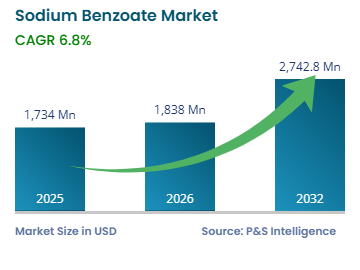
The sodium benzoate market size was USD 1,734.0 million for 2025, and it will grow by 6.8% during 2026-2032, to reach USD 2,742.8 million by 2032.
The market is expanding because sodium benzoate remains widely used as one of the key food preservatives across packaged food, beverages, pharmaceuticals, and personal care products, where shelf life and formulation stability are important. Food and beverage manufacturers are increasing production of ready-to-eat meals, flavoured drinks, sauces, processed snacks, and preserved products that require protection against bacteria, yeast, and mould during transportation and storage. Pharmaceutical companies are also using sodium benzoate in syrups and liquid medicines to maintain product safety and stability over longer usage periods. Personal care brands continue to use the preservative in water-based skincare, hygiene, and topical formulations where microbial protection is necessary for regulatory compliance and consistent product quality.
Rising demand for packaged and shelf-stable foods is strengthening sodium benzoate consumption across global food manufacturing because producers require dependable preservatives that maintain product safety throughout storage, transportation, and retail distribution. Food processors are expanding production of ready meals, bakery products, sauces, beverages, and preserved foods to meet increasing consumer demand for convenience and longer shelf life. According to the Food and Agriculture Organization of the United Nations, global cereal production reached 3,043 million tonnes in 2025, increasing 6.1% from 2024 and supporting higher volumes of processed food manufacturing worldwide. Additionally, expanding food production increases demand for preservation systems that protect product quality, reduce microbial spoilage, support large-scale distribution, and help manufacturers maintain consistent formulation performance across diverse packaged food and beverage applications.
Key Market Insights
Food Grade is the largest type, holding a market share of 60%, due to extensive usage across packaged foods, sauces, beverages, and processed snacks.
Granules are the fastest-growing form, registering a CAGR of approximately 7.1%, driven by rising adoption in automated manufacturing and controlled industrial processing operations.
The food and beverage industry is the largest end user, holding a market share of 35%, due to increasing packaged food production and expanding shelf-stable beverage consumption.
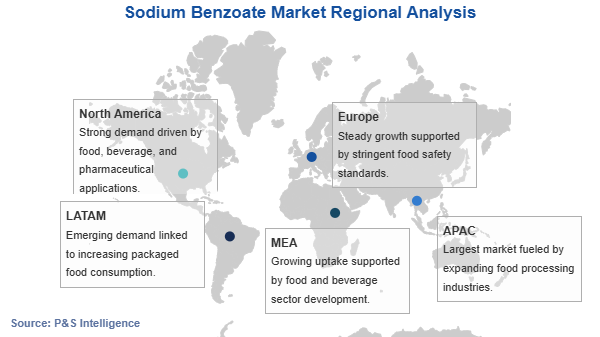
Asia-Pacific holds the largest share of 40% and has the highest CAGR of approximately 7.7%, driven by strong processed food manufacturing, beverage production, and chemical industry growth.
China holds the largest share due to strong chemical manufacturing infrastructure and large-scale processed food and beverage production capacity.
Sodium Benzoate Market Trends and Drivers
Shift toward Clean-Label and Alternative Preservation Solutions Is a Major Trend
Food, beverage, and personal care manufacturers are adopting cleaner preservation strategies as consumers increasingly prefer products with transparent ingredient labels. Companies are combining sodium benzoate with cultured ingredients and other label-friendly preservation technologies to maintain microbial protection without compromising product stability. According to the Food and Agriculture Organization of the United Nations General Standard for Food Additives, updated through the 48th Session of the Codex Alimentarius Commission in 2025, benzoates, including sodium benzoate, are permitted at a maximum level of 250 mg/kg, expressed as benzoic acid, in water-based flavored drinks. Furthermore, this supports continued use in regulated acidic beverage applications.
Additionally, sodium benzoate continues to retain strong demand in acidic beverages, fruit preparations, sauces, syrups, pharmaceuticals, and personal care products because it offers reliable antimicrobial performance, cost efficiency, and compatibility with large-scale manufacturing while giving formulators greater flexibility across different product categories.
Rising Demand for Packaged Food and Ready-to-Drink Beverages Drives Market
The market is growing because consumption of packaged food & beverages is increasing across urban and semi-urban areas, where consumers prefer products with longer shelf life and convenient storage. Sodium benzoate remains widely used in soft drinks, fruit beverages, sauces, jams, bakery fillings, and processed snacks because it performs effectively in acidic conditions and supports stable product quality during transportation and retail distribution. Food processing companies are also expanding production capacity as organised retail channels and online grocery platforms increase the availability of packaged consumer goods. According to the World Bank, the global urban population accounted for 57.56% of the total population in 2024, supporting stronger demand for packaged and convenience food products.
According to the Food and Agriculture Organization, global sugar crop output reached 2.2 gigatonnes in 2024, supporting large-scale production of sweetened beverages, syrups, jams, sauces, and preserved food products that require effective preservation systems. Growing packaged food production and expanding retail distribution networks are increasing preservative consumption across multiple industries. This is supporting long-term demand for sodium benzoate in food, beverage, and pharmaceutical applications where stable shelf life and product safety remain commercially important.
Growing Consumer Preference for Clean-Label Products Restrains Market Growth
Clean-label preferences are creating challenges for sodium benzoate manufacturers as food, beverage, and personal care companies reduce synthetic preservatives in selected formulations. Premium brands are reformulating products with cultured sugar, vinegar-based ingredients, fermented preservation systems, and plant-derived extracts to improve ingredient transparency while maintaining microbial protection. Regulatory reviews and greater consumer awareness are also encouraging manufacturers to evaluate preservative levels more carefully across different product categories.
According to the Food and Agriculture Organization of the United Nations Codex Alimentarius Commission working document published in 2025, benzoic acid, sodium benzoate, and potassium benzoate were proposed at a maximum level of 1,000 mg/kg, expressed as benzoic acid, for fermented soybean paste under the preservative provision. Furthermore, continued regulatory evaluation and product reformulation are encouraging companies to reserve sodium benzoate for applications where its antimicrobial performance, formulation compatibility, and cost efficiency remain difficult to replace while expanding naturally positioned preservation systems in selected product segments.
Expansion of Processed Food and Pharmaceutical Manufacturing in Emerging Economies Creates Market Opportunities
Growing manufacturing activity across emerging economies is creating new opportunities for sodium benzoate suppliers as packaged food, beverages, pharmaceuticals, and personal care production continue to expand. Food processors are increasing the output of shelf-stable products, while pharmaceutical manufacturers are producing more syrups, oral liquids, and liquid medicines that require dependable microbial protection during storage and transportation. Additionally, preservative suppliers are strengthening regional production and distribution capabilities to support expanding industrial demand.
According to the United Nations Industrial Development Organization Quarterly Report Q4 2025, global manufacturing production increased by 3.7% year over year and 0.5% quarter over quarter during the fourth quarter of 2025, while industrializing economies recorded 0.8% quarter-over-quarter growth. This expansion is supporting higher demand for sodium benzoate because larger manufacturing volumes, broader distribution networks, and longer product storage periods require reliable preservation systems that maintain product quality across large-scale consumer goods production.
Sodium Benzoate Market Segmentation Analysis
Grade Analysis
Food Grade is the largest category, holding a market share of 60%, because it is extensively used in packaged foods, carbonated beverages, sauces, jams, pickles, and processed snacks where microbial stability and shelf life are essential. Manufacturers prefer food-grade sodium benzoate because it performs effectively in acidic formulations and integrates easily into high-volume food processing. According to the Food and Agriculture Organization of the United Nations Codex Alimentarius Commission information document published in 2025, sodium benzoate is permitted at a maximum level of 1,000 mg/kg, expressed as benzoic acid, in pasteurized coconut milk. This regulatory recognition reinforces its widespread acceptance among food manufacturers, supports compliance with international safety standards, and encourages its continued use in large-scale commercial food preservation applications.
Pharmaceutical Grade is the fastest-growing category, registering a CAGR of approximately 7.0%, due to rising production of liquid medicines, syrups, oral suspensions, and topical formulations that require stable microbial protection during storage and transportation. Pharmaceutical manufacturers are increasing the use of high-purity preservative ingredients to maintain product stability and comply with quality standards. Expanding healthcare access, growing generic drug manufacturing, and increasing demand for over-the-counter medicines in developing economies are also contributing to stronger demand for pharmaceutical-grade sodium benzoate across global pharmaceutical production networks.
The grades analysed in this report are:
Food Grade (Largest Category)
Pharmaceutical Grade (Fastest-Growing Category)
Industrial Grade
Form Analysis
Powder is the largest category, holding a market share of 65%, because it offers easier storage, handling, transportation, and formulation compatibility across food, pharmaceutical, and industrial applications. Manufacturers prefer powder sodium benzoate due to its longer shelf stability and ability to blend efficiently into dry and liquid processing systems. The format is also widely used in packaged food manufacturing and beverage processing, where consistent preservative distribution is important for maintaining product quality. Large-scale industrial usage continues to support strong demand for powder-based sodium benzoate formulations.
Granules are the fastest-growing category, because granulated sodium benzoate provides lower dust formation, better flow properties, and easier handling during industrial processing operations. Manufacturers are increasingly adopting granule forms in automated production environments where accurate dosing and clean material transfer are important. According to the International Federation of Robotics, 542,000 industrial robots were installed worldwide in 2024, supporting the expansion of automated manufacturing lines that prefer easy-handling granular inputs. Growing investments in advanced processing equipment are increasing demand for granulated sodium benzoate across pharmaceutical, food, and chemical manufacturing facilities.
The forms analysed in this report are:
Powder (Largest Category)
Granules (Fastest-Growing Category)
Liquid
End User Analysis
Food & Beverage Industry is the largest category, holding a market share of 35%, because sodium benzoate is widely used in carbonated drinks, fruit beverages, sauces, bakery fillings, pickled products, and processed foods that require spoilage protection during storage and distribution. The expanding demand for packaged and shelf-stable products continues to increase preservative consumption across food processing operations. According to the United Nations Industrial Development Organization, the global food-products manufacturing output index reached 119.6 in Q2 2025 on a 2015=100 basis, reflecting the large scale of food manufacturing activity supporting preservative demand. This production growth continues to strengthen sodium benzoate consumption across processed food applications.
The pharmaceutical industry is the fastest-growing category, registering a CAGR of approximately 7.3%, because pharmaceutical companies are increasing production of syrups, oral liquids, medicated creams, and liquid formulations that require reliable preservation systems. Sodium benzoate is widely used across the Personal Care & Cosmetics Industry and pharmaceutical formulations to maintain product stability and prevent microbial contamination throughout storage and distribution cycles. Growth in healthcare spending, expansion of generic medicine manufacturing, and rising demand for pediatric and over-the-counter formulations are increasing preservative usage across pharmaceutical production facilities. Expanding pharmaceutical exports from developing countries are also supporting stronger long-term demand from this segment.
The end users analysed in this report are:
Food & Beverage Industry (Largest Category)
Pharmaceutical Industry (Fastest-Growing Category)
Personal Care & Cosmetics Industry
Agriculture Industry
Chemical & Industrial Manufacturing
Others
Source Analysis
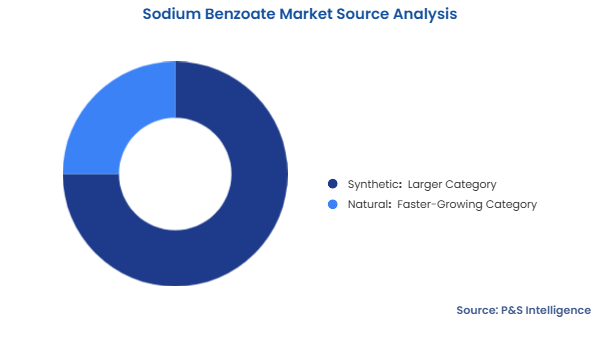
Synthetic is the larger category, holding a market share of 75%, because synthetic sodium benzoate is widely available, cost-effective, and easier to produce at a large commercial scale compared to naturally sourced alternatives. Food, pharmaceutical, and industrial manufacturers prefer synthetic variants due to consistent quality, reliable supply availability, and compatibility with high-volume production systems. The category also benefits from established manufacturing infrastructure and broad regulatory acceptance across multiple end-use industries. Strong demand for affordable preservation solutions in mass-market consumer products continues to support the dominance of the synthetic segment.
Natural is the faster-growing category, because consumers increasingly prefer clean-label products made with naturally positioned ingredients across food, beverages, and personal care. Manufacturers are investing in fermentation-based preservation systems and plant-derived alternatives to strengthen ingredient transparency while meeting product safety requirements. According to IFOAM – Organics International, global organic farmland remained at 98.9 million hectares in 2024, while global organic food and drink retail sales reached 145.0 billion euros. Additionally, expanding organic production and stronger consumer spending are encouraging companies to develop natural preservation technologies alongside lower-synthetic ingredient formulations for premium product lines.
The sources analysed in this report are:
Synthetic (Larger Category)
Natural (Faster-Growing Category)
Drive strategic growth with comprehensive market analysis
Sodium Benzoate Market Regional Outlook
Asia-Pacific Sodium Benzoate Market Analysis
Asia-Pacific holds the largest share of 40% and has the highest CAGR of approximately 7.7%, because the region has become a major hub for processed food manufacturing, beverage production, and industrial chemical processing. Countries across the region are expanding packaged food output to serve growing urban populations and modern retail networks. Beverage consumption is also increasing due to changing lifestyles and rising demand for ready-to-drink products. In addition, the Asia-Pacific has a strong manufacturing base for pharmaceuticals, personal care products, and food additives, which supports consistent sodium benzoate consumption. Local chemical manufacturers benefit from large-scale production infrastructure and easier raw material availability. Export-oriented food processing industries in countries such as China, India, Thailand, and Indonesia are also increasing preservative demand to maintain product stability during transportation and long storage cycles. Growing investments in domestic consumer goods manufacturing continue to strengthen regional market expansion.
China Sodium Benzoate Market Analysis
China is the largest country market, because the country has a large food processing industry, extensive beverage manufacturing capacity, and strong chemical production infrastructure. Manufacturers produce high volumes of packaged foods, sauces, preserved vegetables, soft drinks, and pharmaceutical products that require stable preservation systems. According to the National Bureau of Statistics of China, China's total grain production reached 706.5 million tonnes in 2024, increasing by 1.6% compared with 2023, supporting large-scale food processing activities and demand for preservation systems across processed food applications. Strong industrial supply chains and rising processed consumer goods production continue to support sodium benzoate demand across multiple manufacturing sectors.
India Sodium Benzoate Market Analysis
India is the fastest-growing country market because packaged food consumption, pharmaceutical manufacturing, and ready-to-drink beverage demand are increasing rapidly across urban and semi-urban markets. Growth in modern retail stores and online grocery platforms is also supporting higher preservative usage across processed food applications. The country’s large generic pharmaceutical industry continues to increase demand for sodium benzoate in syrups and liquid medicines requiring a stable shelf life. According to the Press Information Bureau of India, horticulture production reached 369.055 million tonnes in 2024–25, supporting large-scale fruit, vegetable, beverage, sauce, and preserved food processing activity. This expanding food processing base continues to strengthen preservative consumption across India.
North America Sodium Benzoate Market Analysis
North America holds a significant share because the region has a mature packaged food and beverage industry with strong demand for shelf-stable products, carbonated drinks, sauces, condiments, and pharmaceutical formulations. Food safety standards and strict quality control practices encourage the use of reliable preservation systems across manufacturing operations. The region also has high consumption of convenience foods, frozen meals, flavoured beverages, and oral care products that require microbial stability during storage and distribution. In addition, pharmaceutical and personal care companies in the U.S. and Canada maintain large-scale production of liquid and water-based formulations where preservatives remain necessary for product protection. Manufacturers are also investing in reformulation and preservative optimisation to balance product stability with changing consumer preferences around ingredient transparency. Strong retail infrastructure and large supermarket chains further support consistent demand for packaged consumer products across the region.
Europe Sodium Benzoate Market Analysis
Europe maintains a stable demand due to its established food processing sector and strong regulatory focus on product safety, labelling, and formulation standards. The region has a large market for bakery products, processed meat, sauces, fruit preparations, and packaged beverages, where preservation remains important for maintaining quality during storage and cross-border distribution. European manufacturers are also focusing on controlled preservative usage and optimised formulations to meet changing consumer expectations around clean-label products. Pharmaceutical and cosmetic industries in countries such as Germany, France, Italy, and the U.K. continue to use sodium benzoate in syrups, topical products, and personal care formulations that require microbial protection. In addition, the presence of multinational food and beverage companies, advanced manufacturing capabilities, and strong export activities continues to support steady market demand across the region.
The regions and countries analysed in this report are:
North America
U.S. (Larger Country)
Canada (Faster-Growing Country)
Europe
Germany (Largest Country)
U.K.
France (Fastest-Growing Country)
Italy
Spain
Rest of Europe
Asia-Pacific (Largest and Fastest-Growing Regional Market)
China (Largest Country)
India (Fastest-Growing Country)
Japan
South Korea
Australia
Rest of APAC
Latin America
Brazil (Largest Country)
Mexico (Fastest-Growing Country)
Rest of LATAM
Middle East and Africa
Saudi Arabia
U.A.E.
South Africa (Largest and Fastest-Growing Country)
Rest of MEA
Sodium Benzoate Market Share Analysis
The market is fragmented due to the presence of many regional and international manufacturers supplying sodium benzoate for food, beverage, pharmaceutical, cosmetic, and industrial applications. Competition is largely based on product quality, pricing, formulation compatibility, production capacity, and long-term supply agreements with end-use industries. Several small and mid-sized chemical companies operate alongside established global manufacturers, especially in the Asia-Pacific, where large-scale chemical production networks support broad market participation. Companies are also focusing on expanding distribution channels and improving manufacturing efficiency to strengthen their position in domestic and export markets. Since sodium benzoate is widely used across multiple industries and applications, buyers often source from different suppliers based on regulatory standards, product grade, and cost requirements. This broad supplier base and the availability of alternative regional manufacturers continue to keep the market structure highly fragmented.
Leading Companies in Sodium Benzoate Market:
LANXESS AG
Eastman Chemical Company
Wuhan Youji Holdings Limited
Tianjin Dongda Chemical Group Co., Ltd.
Tengzhou Tenglong Chemical Co., Ltd.
Foodchem International Corporation
FBC Industries, Inc.
Spectrum Chemical Manufacturing Corp.
Curie Co. Inc.
Macco Organiques Inc.
Vertellus Holdings LLC
Penta Manufacturing Company
Sodium Benzoate Market News
In July 2025, Curie Co. Inc. launched AmpliPQ, a high-performance sodium benzoate preservation system designed to extend the antimicrobial effectiveness of sodium benzoate across a broader pH range.
In January 2024, LANXESS AG introduced Kalaguard SB Scopeblue, an ISCC PLUS-certified renewable sodium benzoate preservative for cleaning product applications, supporting demand for sustainable preservation solutions.
Frequently Asked Questions About This Report
What is sodium benzoate mainly used for in food products?+
It is mainly used as an antimicrobial preservative that helps limit spoilage by controlling bacteria, yeast, mold, and other microbes.
Why is sodium benzoate preferred in acidic food and beverages?+
It works best in acidic products, making it useful in soft drinks, fruit-based beverages, sauces, pickles, and similar low-pH foods.
Which industries commonly use sodium benzoate as a preservative ingredient?+
It is commonly used in food and beverages, cosmetics, personal care, pharmaceuticals, and selected industrial formulations needing microbial protection.
Is sodium benzoate considered safe for use in food applications?+
It is permitted as a food ingredient when used under approved regulatory conditions, with authorities evaluating safety based on intended use.
How does sodium benzoate support shelf life in packaged products?+
It slows microbial growth and spoilage, helping packaged products maintain freshness, stability, and quality during storage, distribution, and consumer use.
Want a report tailored exactly to your business need?
Leading companies across industries trust us to deliver data-driven insights and innovative solutions for their most critical decisions. From data-driven strategies to actionable insights, we empower the decision-makers who shape industries and define the future. From Fortune 500 companies to innovative startups, we are proud to partner with organisations that drive progress in their industries.
Client Testimonials
Working with P&S Intelligence and their team was an absolute pleasure – their awareness of timelines and commitment to value greatly contributed to our project's success. Eagerly anticipating future collaborations.
McKinsey & Company
India
Unmatched Standards
Our insights into the minutest levels of the markets, including the latest trends and competitive landscape, give you all the answers you need to take your business to new heights
Complete Data Security
We take a cautious approach to protecting your personal and confidential information. Trust is the strongest bond that connects us and our clients, and trust we build by complying with all international and domestic data protection and privacy laws