This Report Provides In-Depth Analysis of the Smart Warehousing Market Report Prepared by P&S Intelligence, Segmented by Component (Hardware, Software, Services), Deployment Mode (Cloud, On-Premises), Technology (Internet of Things, Artificial Intelligence & Machine Learning, Robotics & Automation, Blockchain, Big Data & Analytics, Networking & Communication, Augmented Reality & Virtual Reality), Application (Order Fulfillment, Inventory Management, Asset Tracking, Warehouse Maintenance), Warehouse Size (Large, Medium, Small), End Use Industry (Transportation & Logistics, Retail & E-commerce, Manufacturing, Healthcare & Pharmaceuticals, Food & Beverage, Automotive, Energy & Utilities), and Geographical Outlook for the Period of 2021 to 2032
Explore the market potential with our data-driven report
Smart Warehousing Market Overview
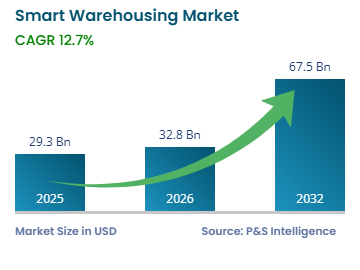
The smart warehousing market size was USD 29.3 billion for 2025, and it will grow by 12.7% during 2026–2032, to reach USD 67.5 billion by 2032.
This growth reflects the accelerating integration of robotics, internet of things sensor networks, artificial intelligence, and cloud-based warehouse management systems across fulfillment, storage, and distribution operations. Smart warehouses now function as core infrastructure for modern supply chains. Escalating e-commerce volumes and persistent labor shortages are reshaping how operators design and run distribution facilities. As same-day and next-day delivery expectations become standard, warehouse operators are deploying autonomous mobile robots (AMRs), automated storage and retrieval systems, and real-time inventory analytics to increase throughput, reduce picking errors, and maximize cubic space utilization. The U.S. Census Bureau reported that e-commerce accounted for 16.1% of total retail sales in 2024, up from 15.3% in 2023.
This structural demand for automated fulfillment capacity continues to build, and a growing emphasis on operational efficiency and cost optimization is accelerating investment in technologies that enhance warehouse productivity, optimize energy consumption, and lower the total cost to serve. Commercially, the market is evolving from discrete hardware purchases toward integrated, software-defined ecosystems that combine automation equipment with predictive analytics and orchestration platforms. This transition lets operators scale warehouse operations more efficiently while adopting sustainability-driven automation that reduces energy consumption and operational waste, supporting long-term market growth.
Key Market Insights
The hardware category holds the largest market share, of 60%, in 2025, due to the widespread deployment of AS/RS, AMRs, conveyors, sortation equipment, and sensor infrastructure.
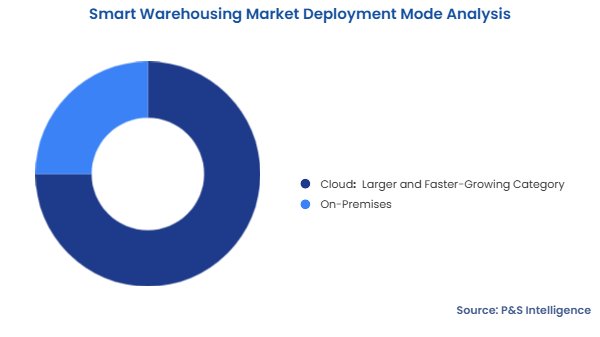
The cloud category holds the larger market share, of 75%, in 2025, and it will have the higher CAGR, of approximately 13.0%, driven by lower upfront capital investments, faster deployment, and greater scalability.
The IoT category holds the largest market share, of 35%, in 2025, driven by its role in enabling real-time connectivity and visibility across warehouse operations.
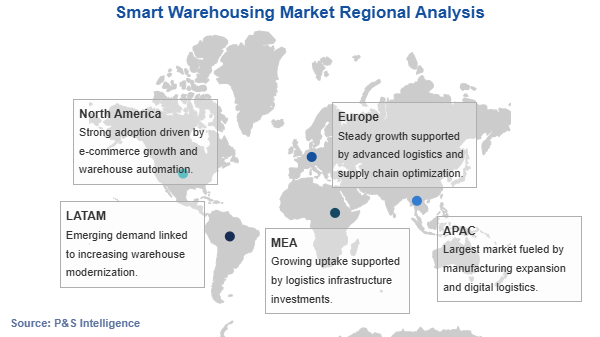
North America holds the largest market share, of 40%, in 2025, driven by early automation adoption and strong investments in warehouse technologies.
Asia-Pacific will register the highest CAGR, of 13.6%, driven by rapid e-commerce growth, manufacturing modernization, and government support for logistics digitalization.
Smart Warehousing Market Trends and Drivers
Robotics Density and Robot-as-a-Service Models Are Key Trends
A defining trend in the smart warehousing market is the shift from fixed, capital-intensive automation toward flexible, robotics-dense warehouse operations supported by subscription-based deployment models. As warehouses strive to improve operational agility, increase throughput, and respond to fluctuating order volumes, operators are moving beyond isolated conveyor and sortation systems to fleets of interoperable AMRs coordinated through cloud-based warehouse management platforms. This approach speeds deployment, eases scalability, improves space utilization, and reduces dependence on manual labor. The growing deployment of warehouse robotics reflects this transformation. According to the International Federation of Robotics (IFR), 102,900 professional service robots were sold for transportation and logistics in 2024. This total represents a 14% increase over the previous year and more units than any other professional service robot application category.
The rapid adoption of robot-as-a-service, which is transforming how warehouse operators invest in automation. The IFR reported that global RaaS fleets expanded by 31% in 2024, while RaaS deployments in the transportation and logistics sector increased by 42%. By shifting automation from large upfront capital investments to subscription-based operating expenditure models, RaaS lowers adoption barriers for small and medium-sized warehouse operators while improving deployment flexibility and scalability. As cloud connectivity, interoperability standards, and AI-driven fleet orchestration continue to advance, robotics-dense warehouse operations are expected to become a mainstream deployment model. This shift accelerates smart warehousing adoption and supports sustained market growth.
E-Commerce Acceleration and Chronic Labor Shortages Are Biggest Drivers
The convergence of relentless e-commerce growth and persistent warehouse labor shortages is the primary force propelling smart warehousing adoption. As order volumes fragment into large numbers of small, time-sensitive shipments, operators face throughput demands that manual labor alone cannot economically meet. Growing warehouse activity has increased workforce requirements. According to the U.S. Bureau of Labor Statistics, warehousing and storage employment was 34.0% higher in June 2024 than in February 2020. This increase reflects the rapid expansion of fulfillment and logistics operations.
Ongoing recruitment challenges, high employee turnover, and rising labor costs are encouraging warehouse operators to invest in AMRs, automated storage and retrieval systems, and AI-driven warehouse orchestration to maintain productivity and service quality. As automation improves operational efficiency, reduces dependence on manual labor, and enables faster order fulfillment, it is becoming a strategic necessity rather than a discretionary investment. This structural shift is expected to strengthen as e-commerce volumes continue to grow and customer expectations for rapid delivery continue to rise.
High Capital Requirements and Integration Complexity Are Key Restraints
Despite continued momentum, high capital requirements and multi-vendor integration complexity continue to constrain smart warehousing adoption, particularly among small and mid-sized operators. Greenfield smart warehouse development often requires substantial upfront capital investment, while integrating robotics, warehouse management systems, and enterprise resource planning (ERP) across multiple vendors creates considerable systems integration costs and technical risks. Many organizations also face difficulties in modernizing legacy warehouse infrastructure, as existing facilities often require extensive upgrades to support automated equipment and real-time digital connectivity.
The shortage of skilled personnel capable of deploying, integrating, and maintaining advanced automation systems increases implementation complexity, project timelines, and operational costs. Concerns regarding system interoperability, business disruption during deployment, and uncertainty over return on investment often delay purchasing decisions, particularly among cost-sensitive enterprises. Rapid technology evolution compounds the challenge by introducing obsolescence risk that complicates long-horizon investment decisions, and these barriers slow conversion of conventional warehouses and lengthen procurement cycles. The constraint is easing as modular automation, standardized interfaces, and RaaS subscription models reduce upfront commitments. This lower commitment threshold lets a broader base of operators adopt automation incrementally rather than through single large capital projects.
Nearshoring and Sustainability Mandates Are Biggest Opportunities
The reconfiguration of global supply chains through nearshoring, combined with tightening sustainability requirements, is creating new growth opportunities for the smart warehousing market. As manufacturers and retailers relocate production and distribution closer to end markets to improve supply chain resilience and reduce geopolitical and freight-related risks, new fulfillment centers and regional distribution hubs are increasingly being designed with automation embedded from the outset rather than added later through retrofits. This greenfield development creates opportunities for providers of robotics, warehouse management systems, automated storage and retrieval systems, and AI-enabled warehouse orchestration platforms.
Growing investment in sustainable logistics infrastructure strengthens the opportunity. According to the International Energy Agency (IEA), global energy investment is projected to reach approximately USD 3.3 trillion in 2025, with around USD 2.2 trillion directed toward clean energy technologies and infrastructure. The increasing focus on energy efficiency and decarbonization is encouraging warehouse operators to deploy AI-driven climate control, intelligent energy management, route optimization, and high-density storage systems that reduce energy consumption, operational costs, and carbon emissions while improving warehouse productivity. Expanding logistics infrastructure investment across Asia-Pacific and Latin America is positioning next-generation automated and sustainable warehouses as the preferred standard for new distribution facilities throughout the forecast period.
Smart Warehousing Market Segmentation Analysis
Component Analysis
The hardware category holds the largest market share, of 60%, in 2025, driven by the foundational capital role of physical automation, which includes automated storage and retrieval systems, AMRs, conveyors, sortation equipment, and sensor infrastructure. This equipment represents the single largest investment in any smart warehouse installation because hardware enables the labor savings, operational efficiency, and throughput gains that justify automation projects, anchoring procurement spending across large distribution centers.
The software category will have the highest CAGR, of approximately 12.9%, driven by the increasing adoption of AI-enabled warehouse management systems, cloud-native platforms, predictive analytics, and real-time inventory optimization solutions that orchestrate increasingly autonomous warehouse operations. As warehouses deploy more IoT-enabled devices and automation equipment, demand is rising for intelligent software platforms that integrate, monitor, and optimize connected assets through centralized control and data-driven decision-making. The U.S. National Institute of Standards and Technology (NIST) has identified IoT and smart connected manufacturing as enablers of interoperable, data-driven industrial systems. This designation underscores the growing importance of software platforms for managing connected assets and optimizing operational performance.
The components analyzed in this report are:
Hardware (Largest Category)
Software (Fastest-Growing Category)
Services
Deployment Mode Analysis
The cloud category holds the larger market share, of 75%, in 2025, and it will have the higher CAGR, driven by its ability to support real-time data access, centralized warehouse operations, and rapid deployment across distributed fulfillment networks. Cloud-based platforms enable seamless collaboration between warehouses, suppliers, and logistics partners while providing the flexibility to expand operations without significant infrastructure investments. The growing adoption of omnichannel retailing, multi-location inventory management, and data-driven warehouse optimization is accelerating demand for cloud deployments. Additionally, the subscription-based delivery model and continuous feature enhancements make cloud solutions an increasingly attractive option for organizations modernizing their warehouse operations.
The deployment modes analyzed in this report are:
Cloud (Larger and Faster-Growing Category)
On-Premises
Technology Analysis
The IoT category holds the largest market share, of 35%, in 2025, functioning as the connective foundation of smart warehousing by linking sensors, RFID tags, and connected equipment into real-time visibility networks. IoT's leadership stems from its role in enabling continuous inventory tracking and condition monitoring that underpin every other automation layer.
The AI & ML category will have the highest CAGR, of approximately 13.4%, driven by the increasing adoption of predictive analytics, demand forecasting, and autonomous decision-making to convert sensor data into optimized workflows. According to Eurostat, 13.5% of enterprises in the European Union with 10 or more employees used AI technologies in 2024, up from 8.0% in 2023. This rapid adoption of AI across business operations is deepening the deployment of AI-enabled warehouse management and automation solutions. The maturation of AI-driven slotting, robotics coordination, and real-time exception handling positions this category as the primary source of future differentiation.
The order fulfillment category holds the largest market share, of 40%, in 2025, driven by its central role in high-speed, accurate order processing in modern distribution, particularly for e-commerce and omnichannel operations. Rising demand for faster deliveries is accelerating investments in fulfillment automation. Automation delivers significant operational benefits, as AMRs, goods-to-person systems, and automated sortation solutions reduce cycle times, improve throughput, and minimize fulfillment errors at scale.
The inventory management category will have the highest CAGR, driven by the increasing need for real-time inventory visibility, predictive replenishment, and accurate demand planning across complex, multi-node supply chain networks. As organizations focus on reducing stock-outs, optimizing inventory levels, and improving working capital efficiency, demand for AI- and IoT-enabled inventory management solutions continues to accelerate. This segment is further supported by recent product innovations, such as Manhattan Associates' launch of AI-powered Wave Inventory Research Agent and Agent Foundry in 2025, which enhance inventory analysis, exception handling, and autonomous decision-making across warehouse operations.
The applications analyzed in this report are:
Order Fulfillment (Largest Category)
Inventory Management (Fastest-Growing Category)
Asset Tracking
Warehouse Maintenance
Others
Warehouse Size Analysis
The large category holds the largest market share, of 60%, in 2025, driven by their high operational complexity, large inventory volumes, and economies of scale, which justify investments in advanced automation technologies. Their high throughput requirements make robotics, automated storage and retrieval systems, and warehouse orchestration software more cost-effective, while their larger budgets support multi-vendor system integration.
The medium category will have the highest CAGR, of approximately 13.1%, driven by modular automation, robot-as-a-service models, and cloud-based platforms that lower upfront investment requirements. As automation solutions become more affordable and scalable, adoption is expanding rapidly among medium-sized warehouse operators.
The warehouse sizes analyzed in this report are:
Large (Largest Category)
Medium (Fastest-Growing Category)
Small
End Use Industry Analysis
The transportation & logistics category holds the largest market share, of 30%, in 2025, driven by its critical role in global supply chains, where warehouse efficiency directly influences lead times and delivery reliability. Third-party logistics providers and distribution operators have been early adopters of automation to manage high order volumes efficiently and improve operational productivity.
The retail & e-commerce category will have the highest CAGR, driven by the rapid expansion of online shopping, omnichannel fulfillment, and rising consumer expectations for faster and more accurate deliveries. DHL Group announced in 2025 that it has invested more than EUR 1 billion in warehouse automation over the previous three years and plans to deploy over 1,000 additional robotics units across its operations. This growing investment in automated fulfillment infrastructure responds to rising e-commerce demand.
The end use industries analyzed in this report are:
Transportation & Logistics (Largest Category)
Retail & E-commerce (Fastest-Growing Category)
Manufacturing
Healthcare & Pharmaceuticals
Food & Beverage
Automotive
Energy & Utilities
Others
Drive strategic growth with comprehensive market analysis
Smart Warehousing Market Regional Outlook
North America Smart Warehousing Market Size
North America holds the largest market share, of 40%, in 2025, driven by the region's early adoption of automation and robotics, a dense network of e-commerce fulfillment centers, and sustained capital investment by major logistics and retail companies. Structural growth in e-commerce continues to reinforce these investments. The U.S. Census Bureau reported that e-commerce sales accounted for 16.6% of total U.S. retail sales in the fourth quarter of 2025. This sustained expansion of online retail is deepening the need for automated fulfillment and intelligent warehouse technologies. A robust ecosystem of technology vendors, software providers, and system integrators accelerates smart warehouse deployment, letting operators implement advanced automation efficiently and sustain the region's market leadership.
Additionally, Canada is the fastest-growing country market in the region, driven by the rising e-commerce activity, expanding logistics infrastructure, and increasing investment in warehouse automation and supply chain digitalization. According to Statistics Canada, retail e-commerce sales increased by 3.6% to CAD 4.3 billion in December 2025, accounting for 6.1% of total retail trade. This growth reinforces demand for advanced warehousing and fulfillment solutions.
U.S. Smart Warehousing Market Size
The U.S. is the largest country market within North America, supported by a concentration of hyperscale e-commerce operators, third-party logistics (3PL) providers, and warehouse automation technology suppliers. The U.S. Census Bureau reported that fourth-quarter 2025 retail e-commerce sales reached USD 316.1 billion, a 5.3% increase over the fourth quarter of 2024. This growth sustains demand for high-throughput fulfillment automation and intelligent warehouse solutions, with ongoing workforce constraints further accelerating automation investments and reinforcing long-term market growth.
Asia-Pacific Smart Warehousing Market Size
Asia-Pacific will have the highest CAGR, of approximately 13.6%, driven by rapid e-commerce expansion, accelerating manufacturing modernization, and government-supported logistics digitalization and Industry 4.0 initiatives across China, India, Japan, and South Korea. Increasing investment in warehouse automation lets businesses enhance operational efficiency, improve order fulfillment, and scale logistics operations to meet rising consumer demand. According to the National Bureau of Statistics of China, online retail sales of physical goods reached CNY 13,081.6 billion in 2024, accounting for 26.8% of the country's total retail sales of consumer goods. This sustained expansion of digital commerce is deepening demand for intelligent warehousing infrastructure, and rising fulfillment activity reinforces the same trend.
China's State Post Bureau reported that the country's express delivery sector handled 174.5 billion parcels in 2024, a 21% year-on-year increase. This volume underscores the need for high-capacity, automated warehouse operations. Expanding cross-border trade, live-streaming commerce, quick-commerce business models, and increasing investment in logistics infrastructure are accelerating the adoption of robotics, internet of things, artificial intelligence, automated storage and retrieval systems, and cloud-based warehouse management systems across the region. This adoption supports sustained long-term market growth.
India Smart Warehousing Market Size
India is the fastest-growing country in the Asia-Pacific smart warehousing market, supported by the rapid e-commerce expansion, increasing warehouse automation, and government initiatives promoting digital commerce and logistics modernization. The Government of India's Open Network for Digital Commerce (ONDC) is strengthening the country's digital commerce ecosystem. As of January 2025, the ONDC network had expanded to more than 616 cities, with over 764,000 sellers and service providers registered and more than 154.4 million cumulative orders processed through December 2024. This expansion of digital commerce is deepening the need for advanced warehousing and fulfillment infrastructure, and increasing investment in logistics parks, Grade-A warehouses, and automated distribution centers is expected to accelerate the adoption of smart warehousing technologies across the country.
These regions and countries are analysed:
North America (Largest Regional Market)
U.S. (Larger Country)
Canada (Faster-Growing Country)
Europe
Germany (Largest Country)
U.K. (Fastest-Growing Country)
France
Italy
Spain
Rest of Europe
Asia-Pacific (Fastest-Growing Regional Market)
China (Largest Country)
India (Fastest-Growing Country)
Japan
South Korea
Australia
Rest of APAC
Latin America
Brazil (Largest Country)
Mexico (Fastest-Growing Country)
Rest of LATAM
Middle East & Africa
Saudi Arabia (Largest Country)
South Africa
U.A.E. (Fastest-Growing Country)
Rest of MEA
Smart Warehousing Market Share Analysis
The smart warehousing market is fragmented due to the presence of numerous global and regional companies offering specialized solutions across warehouse management systems, robotics, automated storage and retrieval systems, artificial intelligence, internet of things, and system integration services. No single company holds a dominant presence across all technology segments. This fragmentation produces intense competition and continuous innovation. Leading companies such as Honeywell International Inc., Zebra Technologies Corporation, Oracle Corporation, SAP SE, Manhattan Associates, Korber AG, Daifuku Co., Ltd., SSI SCHAEFER Group, and Swisslog Holding AG are investing in AI-powered warehouse software, AMRs, cloud-based WMS platforms, and integrated automation solutions. Strategic partnerships, acquisitions, product innovations, and geographic expansion are accelerating technology adoption and strengthening the overall growth of the market.
Top Companies in the Smart Warehousing Market:
Honeywell International Inc.
Zebra Technologies Corporation
Oracle Corporation
SAP SE
Manhattan Associates, Inc.
Korber AG
Daifuku Co., Ltd.
SSI SCHAEFER Group
Blue Yonder Group, Inc.
AutoStore Holdings Ltd.
Geekplus Technology Co., Ltd.
Swisslog Holding AG
Smart Warehousing Market Developments
In January 2026, Blue Yonder Group, Inc. introduced new AI-driven warehouse and logistics innovations, including an enhanced Warehouse Ops Agent, and reported optimizing over 23 million human warehouse tasks in the first 10 months of 2025, deepening the company's agentic-AI capabilities for unified supply-chain planning and execution.
In May 2025, Manhattan Associates, Inc. launched its Supply Chain Commerce Solutions on Google Cloud Marketplace and expanded its unified, cloud-native Manhattan Active platform with embedded AI agents, broadening cloud distribution and strengthening the company's warehouse and transportation orchestration capabilities.
In October 2024, Korber Supply Chain Software, a joint venture between Korber AG and KKR, completed the acquisition of MercuryGate International Inc., a transportation management system (TMS) provider, expanding Korber's supply chain execution portfolio by integrating transportation, warehouse, and order management capabilities. This integration strengthens end-to-end visibility, operational efficiency, and digital supply chain orchestration.
Frequently Asked Questions About This Report
How is artificial intelligence transforming smart warehouse operations?+
Artificial intelligence optimizes inventory, automates workflows, reduces errors, and improves warehouse efficiency and accuracy.
What role does the Internet of Things (IoT) play in smart warehousing?+
IoT enables real-time monitoring of inventory, equipment, and warehouse conditions through connected sensors and RFID devices. It enhances inventory accuracy, asset tracking, predictive maintenance, and operational visibility.
Why are autonomous mobile robots (AMRs) gaining popularity in warehouses?+
AMRs automate material movement, improve productivity, and accelerate order fulfillment through flexible warehouse navigation.
How does smart warehousing improve supply chain resilience?+
Smart warehousing provides real-time inventory visibility, automated replenishment, predictive analytics, and faster order processing, enabling businesses to respond quickly to demand fluctuations, disruptions, and supply chain bottlenecks.
What are the major challenges associated with implementing smart warehousing solutions?+
High initial investment, integration with legacy warehouse systems, cybersecurity risks, workforce training requirements, and the complexity of deploying advanced automation technologies are among the primary implementation challenges.
How are sustainability goals influencing smart warehouse investments?+
Organizations are adopting energy-efficient automation and AI-driven technologies to reduce energy consumption, waste, and carbon emissions while improving sustainability.
Want a report tailored exactly to your business need?
Leading companies across industries trust us to deliver data-driven insights and innovative solutions for their most critical decisions. From data-driven strategies to actionable insights, we empower the decision-makers who shape industries and define the future. From Fortune 500 companies to innovative startups, we are proud to partner with organisations that drive progress in their industries.
Client Testimonials
Working with P&S Intelligence and their team was an absolute pleasure – their awareness of timelines and commitment to value greatly contributed to our project's success. Eagerly anticipating future collaborations.
McKinsey & Company
India
Unmatched Standards
Our insights into the minutest levels of the markets, including the latest trends and competitive landscape, give you all the answers you need to take your business to new heights
Complete Data Security
We take a cautious approach to protecting your personal and confidential information. Trust is the strongest bond that connects us and our clients, and trust we build by complying with all international and domestic data protection and privacy laws