This Report Provides In-Depth Analysis of the Semiconductor Chemicals Market Report Prepared by P&S Intelligence, Segmented by Type (Acid & Base Chemicals, High-Performance Polymers, Adhesives, Solvents), Application (Photoresist, Cleaning, Etching, Deposition, Doping), End Use (Integrated Circuits, Optoelectronics, Discrete Semiconductors, Sensors), and Geographical Outlook for the Period of 2021 to 2032
Explore the market potential with our data-driven report
Semiconductor Chemicals Market Future Outlook
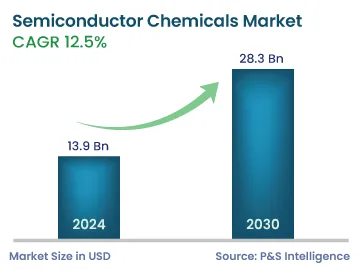
The global semiconductor chemicals market size was USD 16.3 billion in 2025, which is predicted to reach USD 31.9 billion by 2032, growing at a CAGR of 10.1% during 2026–2032.
Market expansion is being fueled mainly by rapidly growing demand for consumer electronics, the rapid implementation of artificial intelligence, and an explosion in the world-wide production of electric vehicles. As artificial intelligence transforms how computers are used across many sectors, it has created an unprecedented amount of growth in the semiconductor chemical market. In 2024, total semiconductor sales worldwide reached $627.6 billion, a 19.1 percent gain compared to 2023 (Semiconductor Industry Association). With this surge in semiconductor production comes an increase in the amount of specialized chemicals needed to perform various steps in the semiconductor manufacturing process such as wafer fabrication, etching, photolithography, and cleaning.
Another significant factor driving the growth of semiconductor chemicals is the large-scale adoption of electric vehicles. Electric vehicles require much more semiconductor components than do gasoline powered cars; the average electric vehicle uses approximately three times as many chips as does the average gasoline-powered vehicle.
Semiconductor Chemicals Market Dynamics
Consumer Demand for Green Products Is a Key Trend
Rapid adoption of artificial intelligence across industries is driving strong demand for advanced semiconductors, which in turn is increasing the consumption of high-purity semiconductor chemicals used in wafer fabrication and chip manufacturing.
AI chips, such as GPUs, TPUs, and specialized accelerators, require smaller process nodes and more complex manufacturing steps, significantly increasing the use of specialty chemicals including photoresists, etchants, CMP slurries, and cleaning chemicals.
Expansion of hyperscale and edge data centers to support AI workloads is accelerating global semiconductor production, directly boosting demand for semiconductor-grade chemicals.
Data centers require high-performance and energy-efficient chips, pushing manufacturers toward advanced logic and memory technologies that rely heavily on ultra-pure chemicals for defect-free fabrication.
Increasing investments in new semiconductor fabs and capacity expansions, particularly for AI and data-center-oriented chips, are strengthening long-term demand for semiconductor chemicals.
Advanced AI-driven chip architectures increase process complexity, leading to higher chemical consumption per wafer compared to conventional semiconductor manufacturing.
The shift toward advanced packaging technologies such as chiplets and 2.5D/3D integration for AI processors is further expanding the use of specialty chemicals and materials.
Growth in data-intensive applications such as cloud computing, machine learning, and big-data analytics is sustaining continuous demand for memory chips, increasing usage of wet chemicals and deposition materials.
Semiconductor manufacturers are prioritizing higher yields and lower defect rates for AI and data-center chips, driving demand for next-generation, high-purity, and contamination-controlled chemical solutions.
Booming Electric Vehicle Industry Is a Major Growth Driver
Rapid growth in electric vehicle production is significantly increasing demand for advanced components, directly driving growth in the related market.
Electric vehicles rely on complex electronic systems, batteries, and power management components, which require specialized materials and technologies at higher volumes than conventional vehicles.
Rising global EV sales are encouraging manufacturers to scale up production capacity, boosting consistent demand across the supply chain.
The International Energy Agency reported that global electric car sales surged by 35% in 2023, reaching over 14 million units.
Government incentives, emission regulations, and net-zero targets are accelerating EV adoption, indirectly strengthening market expansion.
EV powertrains require higher performance, efficiency, and reliability, increasing demand for advanced manufacturing processes and high-quality inputs.
Growing investment in EV manufacturing plants and gigafactories worldwide is creating long-term demand momentum for supporting materials and technologies.
According to Deloitte, electric vehicles require significantly more semiconductor content than conventional vehicles, with semiconductor costs per EV projected to surpass USD 1,500 by 2025 and USD 2,000 by 2030.
The shift from internal combustion engines to electric drivetrains increases the use of electronics, sensors, and energy-efficient systems, expanding market opportunities.
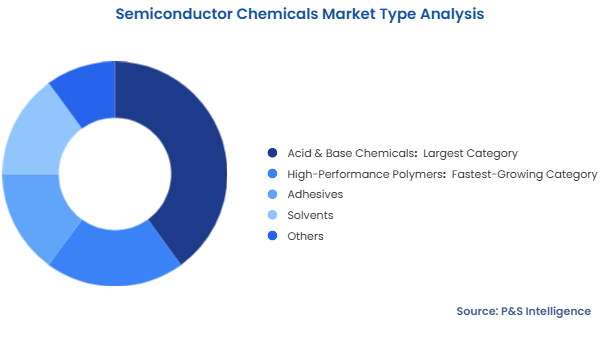
Acid & base Chemicals accounted for the largest type of semiconductor chemicals, 40%, in 2025. The large amount of acid and base chemicals used in many key semiconductor manufacturing processes, such as wafer cleaning, photoresist stripping, and surface preparation, have contributed to this. For example, hydrofluoric acid is used in silicon dioxide etch and native oxide removal, and sulfuric acid is used in piranha cleaning solutions for the removal of organics. As the transition to smaller process nodes increases the number of cleaning operations needed to be performed, the demand for high purity formulations of acid and base chemicals will continue to grow.
High-performance polymers are the fastest growing type of semiconductor chemicals during 2026 to 2032. High performance polymers offer thermal stability, chemical resistance, and mechanical strength that is ideal for advanced lithography and packaging applications. Extreme ultraviolet lithography (EUVL), which is being implemented into semiconductor manufacturing lines for leading edge process nodes, requires photoresist polymers that possess very specific photochemical properties. Advanced Packaging Technologies, such as Fan-Out Wafer-Level Packaging (FO-WLP) also require high- performance polymer materials for redistribution layers and protective coatings.
Photoresist accounted for the largest application of semiconductor chemicals, representing a market share of 35% in 2025. Photoresists are critical to the Photolithography Process that defines circuit patterns on semiconductor wafers. Photoresists are light sensitive materials that undergo chemical structural changes when exposed to UV light, allowing for the transfer of patterns onto the wafer with precision. To meet the demands of the rapidly progressing technology node (TN) roadmap (i.e., less than 5 nm), photoresist materials are requiring increasingly complex chemical formulations. Thus, the photoresist market will continue to grow as semiconductor manufacturers increase production of logic chips, memory devices, and power semiconductors for AI, automotive applications, etc.
Cleaning is the fastest growing application of semiconductor chemicals during the forecast period. The increasing complexity of semiconductor device architecture has created an increased need for cleaning. With each new process node, there comes additional cleaning challenges due to the reduced feature size making it more likely for Yield Limiting Defects (YLDs).
The applications analyzed here are:
Photoresist (Largest Category)
Cleaning (Fastest-Growing Category)
Etching
Deposition
Doping
Others
End Use Analysis
Integrated Circuits (ICs) represented the largest end use segment, accounting for a 70% market share in 2025. This is primarily due to widespread usage of ICs in consumer electronics, telecommunications equipment, automotive systems, industrial automation, etc. ICs are the fundamental building blocks of modern electronic devices, typically consisting of billions of transistors, diodes, and resistors on single silicon wafers. Due to the vast number of individual process steps required to manufacture advanced ICs, the use of semiconductor chemicals in these processes is extensive. Strong demand for IC fabrication chemicals will be sustained by the proliferation of AI Accelerators, high-bandwidth memory, and advanced logic processors.
Optoelectronics are the fastest growing end-use segment, during the forecast period. Optoelectronic devices include Light Emitting Diodes (LED's), Laser Diodes, Photodetectors, and Image Sensors, and all of these require specialized semiconductor materials and processing chemicals. Significant growth in optoelectronic semiconductor production is being driven by the automotive industry's adoption of LiDAR Sensors for Autonomous Driving Systems. Also, the expansion of Optical Communication Networks for 5G Infrastructure and Data Center Interconnects is creating additional demand for Compound Semiconductor Devices manufactured using specialized chemical processes.
The end uses analyzed here are:
Integrated Circuits (Largest End-Use)
Optoelectronics (Fastest-Growing End-Use)
Discrete Semiconductors
Sensors
Others
Drive strategic growth with comprehensive market analysis
Asia-Pacific dominated the semiconductor chemicals market with a 45% share in 2025. The Asia-Pacific region contains the highest concentration of semiconductor manufacturing capacity in the world, including leading foundries such as Taiwan Semiconductor Manufacturing Company (TSMC) and Samsung Foundry, as well as the major Integrated Device Manufacturers (IDM's). The concentration of semiconductor manufacturing in Asia-Pacific creates substantial demand for high-purity chemicals for all types of process categories.
China represents the largest market in the Asia-Pacific region, and is receiving strong support from aggressive government initiatives to develop domestic semiconductor manufacturing capability. The Chinese government's "Made in China 2025" program, which is focused on achieving semiconductor self-sufficiency, has led to massive investment in semiconductor fabrication capacity that will create correspondingly large requirements for processing chemicals. In July 2024, the Indian Government approved the "Semicon India" program, which has a total outlay of INR 76,000 crores for developing semiconductor and display manufacturing ecosystems.
North America Semiconductor Chemicals Market Size
North America is projected to grow at the highest CAGR of 10.2% during the forecast period. North America has large amounts of semiconductor fabrication equipment and plays a major part in advanced logic chips and other semiconductor products. Major semiconductor companies such as Intel, Micron Technology, and Texas Instruments are operating fabrication facilities throughout the region using significant volumes of high purity chemical materials to produce their semiconductor products.
The CHIPS and Science Act is dramatically changing the way the U.S. manufactures semiconductors. The act is providing $52.7 billion in federal money to support U.S.-based semiconductor R&D and manufacturing. TSMC is planning on investing $100 billion to build five new advanced fabrication plants in the U.S., which when combined with previous investments totals an estimated $165 billion of U.S. spending. Therefore, these increased capacities should significantly increase the demand for semiconductor chemicals throughout the region for all types of processes.
Europe Semiconductor Chemicals Market Growth
Europe represented approximately 12% of the global semiconductor chemicals market in 2025. There is a significant amount of semiconductor research and development occurring in Europe with many area-specific focuses; such as automotive semiconductors, power electronic semiconductors, and sensor-based semiconductors. Germany represents the largest portion of European semiconductor chemical consumption due to its large presence of semiconductor manufacturers and chemical suppliers. The European Investment Bank provides support to regional technology advancement programs that continue to enhance the semiconductor value chain within the region.
The European Union has launched an aggressive "Chips Act" with the goal of increasing Europe's percentage of global semiconductor production from 10 percent to 20 percent by 2030. To achieve this goal, the EU has allocated €43 billion in public and private funding to increase semiconductor production capabilities across all member states. Currently, there are several new fabrication facilities planned or currently being built including Intel facilities in Germany and STMicroelectronics facility expansions in France and Italy. As these new production capabilities are developed, they will create additional demand for semiconductor processing chemicals across the European region.
The regions and countries analyzed in this report are:
North America (Fastest-Growing Regional Market)
U.S. (Larger Country Market)
Canada (Faster-Growing Country Market)
Europe
Germany (Largest Country Market)
U.K. (Fastest-Growing Country Market)
France
Italy
Spain
Rest of Europe
Asia-Pacific (Largest Regional Market)
Japan
China (Largest Country Market)
India (Fastest-Growing Country Market)
South Korea
Australia
Rest of APAC
Latin America
Brazil (Largest Country Market)
Mexico (Fastest-Growing Country Market)
Rest of LATAM
Middle East and Africa
Saudi Arabia (Largest Country Market)
South Africa
U.A.E. (Fastest-Growing Country Market)
Rest of MEA
Semiconductor Chemicals Market Share
The semiconductor chemicals market exhibits a fragmented competitive structure due to the large number of chemical companies which are active globally and regionally and serve all segments of the semiconductor industry with various chemical process requirements, the market is highly fragmented. The fragmented nature of the market is indicative of the diversified applications of semiconductor chemicals each company has developed an area of technical specialization within a particular chemical category and deposition precursors.
Chemical companies have chosen to pursue vertical integration, so that they can grow their position in the market by expanding into both raw materials (upstream) and chemical formulation development (downstream). Chemical companies continue to be very active in mergers & acquisitions (M&A) and strategic alliances with both other chemical companies and semiconductor manufacturers, to develop new chemistry and broaden their geographic reach to meet the evolving needs of the semiconductor industry.
Key Semiconductor Chemicals Companies:
Merck KGaA
BASF SE
JSR Corporation
Tokyo Ohka Kogyo Co., Ltd.
Fujifilm Holdings Corporation
Kanto Chemical Co., Inc.
Entegris Inc.
Mitsubishi Chemical Corporation
Resonac Holdings Corporation
Sumitomo Chemical Co., Ltd.
DuPont de Nemours, Inc.
Kuraray Co., Ltd.
Semiconductor Chemicals Market News
In January 2025, Lam Research Corp. announced that imec qualified Lam's dry photoresist technology, improving resolution, throughput, and yield at extreme ultraviolet (EUV) lithography for future generation chips.
In August 2024, JSR Corporation announced plans to expand global development and production of leading-edge photoresists by establishing a new research and development base in Japan and constructing a semiconductor photoresist plant at its Korean subsidiary.
In January 2023, Merck acquired Mecaro Chemicals Inc., a South Korean semiconductor chemical manufacturer, strengthening its position in the Asian semiconductor materials supply chain and expanding its portfolio of advanced precursor materials.
In January 2023, JSR Corporation acquired additional shares of JSR Electronic Materials Korea Co. Ltd., consolidating its global position in the semiconductor chemicals business and expanding its product portfolio for advanced node manufacturing.
Frequently Asked Questions About This Report
What is the 2032 revenue estimation for the semiconductor chemicals market?+
The semiconductor chemicals market is projected to reach USD 31.9 billion by 2032.
How much is the semiconductor chemicals industry growth rate?+
The market will witness a CAGR of 10.1% during the forecast period.
What are the biggest drivers for the semiconductor chemicals market?+
Key drivers include expansion of semiconductor fabs increasing chip complexity and higher consumption of ultra high purity chemicals.
Which global trends impact the semiconductor chemicals industry?+
Major trends include technology node miniaturization EUV lithography adoption and regionalization of semiconductor supply chains.
What is the semiconductor chemicals market nature?+
The market for semiconductor chemicals is fragmented.
Want a report tailored exactly to your business need?
Leading companies across industries trust us to deliver data-driven insights and innovative solutions for their most critical decisions. From data-driven strategies to actionable insights, we empower the decision-makers who shape industries and define the future. From Fortune 500 companies to innovative startups, we are proud to partner with organisations that drive progress in their industries.
Client Testimonials
Working with P&S Intelligence and their team was an absolute pleasure – their awareness of timelines and commitment to value greatly contributed to our project's success. Eagerly anticipating future collaborations.
McKinsey & Company
India
Unmatched Standards
Our insights into the minutest levels of the markets, including the latest trends and competitive landscape, give you all the answers you need to take your business to new heights
Complete Data Security
We take a cautious approach to protecting your personal and confidential information. Trust is the strongest bond that connects us and our clients, and trust we build by complying with all international and domestic data protection and privacy laws