This Report Provides In-Depth Analysis of the Seed Technologies Market Report Prepared by P&S Intelligence, Segmented by Function (Seed Protection, Seed Enhancement, Precision Seeding), Technology (Seed Dressing, Seed Coating, Seed Pelleting, Seed Priming and Conditioning, Seed Disinfection, Precision Seeding), Crop Type (Cereals & Grains, Oilseeds & Pulses, Fruits & Vegetables, Other Crop Types), and Geographical Outlook for the Period of 2021 to 2032
Explore the market potential with our data-driven report
Seed Technologies Market Overview
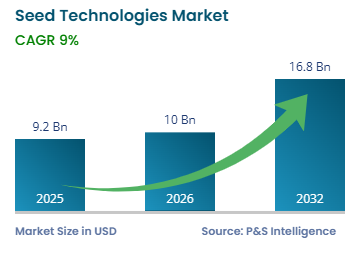
The seed technologies market size was USD 9.2 billion for 2025, and it will grow by 9.0% during 2026–2032, to reach USD 16.8 billion by 2032.
This growth is driven by increasing global demand for high-yield crops and the need to improve agricultural output from limited resources. Seed technologies, including coating, dressing, priming, and enhancement, play a critical role in improving overall seed performance and crop outcomes. As arable land per capita continues to decline, farmers are increasingly adopting advanced seed technologies to maximize yield per hectare.
The Food and Agriculture Organization reports that global food production must increase by 60% by 2050 to meet rising population demand, while agricultural land expansion remains limited. Additionally, the World Bank highlights that agriculture accounts for over 70% of global freshwater use, reinforcing the need for efficient and resilient crop systems. Government-supported initiatives promoting sustainable agriculture and precision farming are further accelerating the adoption of advanced seed technologies worldwide.
Key Market Insights
The seed enhancement category will have the highest CAGR, of approximately 9.4%, driven by increasing demand for improved seed performance and yield optimization.
The seed dressing category holds the largest market share, of 35% in 2025, driven by its cost-effectiveness, ease of application, and widespread adoption across large-scale commodity crop production.
The fruits & vegetables category will have the highest CAGR, of approximately 9.4%, driven by increasing consumer demand for high-value crops and improved nutritional intake.
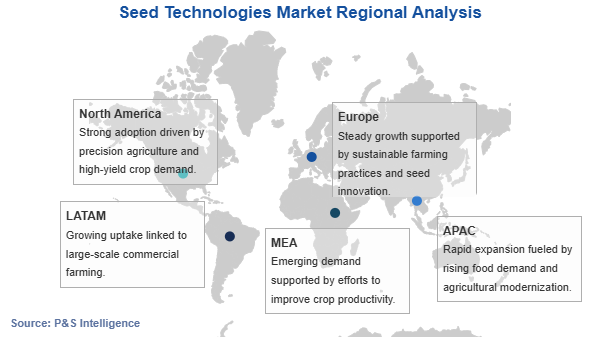
North America holds the largest market share, of 40%, in 2025, driven by advanced agricultural infrastructure, high adoption of precision farming, and strong institutional support for seed technologies.
Asia-Pacific will have the highest CAGR, of approximately 9.9%, due to strong agricultural economies, rising population demand, and increasing government support for productivity improvement.
Seed Technologies Market Trends and Drivers
Biological and Bio-Based Formulations Are Key Trends
A major structural shift reshaping the seed technologies market is the accelerating transition from conventional chemical-based seed treatments toward biological and bio-based formulations, including microbial inoculants, biostimulants, biofungicides, and bionematicides. This transformation is driven by regulatory, agronomic, and consumer pressures that are reducing reliance on purely chemical treatment solutions while strengthening the commercial viability of biological alternatives. Chemical seed treatment products are facing increasing regulatory scrutiny across key markets, with the European Union’s Farm to Fork Strategy targeting a 50% reduction in chemical pesticide use and risk by 2030.
Biological seed treatment formulations are expanding at a faster pace than the overall seed technologies market, with the development of integrated or combination formulations, where biological and chemical actives are applied within a single seed treatment package, emerging as a practical transition pathway. Industry participants are actively strengthening their biological capabilities through strategic investments and acquisitions. For instance, Corteva Agriscience acquired Symborg and Stoller to strengthen its biologicals portfolio and expand its presence in bio-based crop solutions.
Food Security Imperatives and Rising Seed Value Are Biggest Drivers
The primary driver of the seed technologies market is the widening gap between global food demand and the productivity capacity of existing agricultural systems under resource constraints. With the global population expected to approach 9.7 billion by 2050, pressure on food production systems continues to intensify, making enhancing per-hectare productivity a critical priority and driving reliance on advanced seed technologies that improve germination and early plant vigor and crop protection. The rising commercial value of high-performance seeds, including hybrid and genetically modified varieties, is reinforcing the adoption of seed-applied technologies. These premium seeds represent a considerable per-acre investment that farmers seek to protect.
Global investments and policy support for climate-smart agriculture are accelerating adoption of advanced seed technologies. The World Bank has scaled up financing for climate-smart agriculture, increasing annual investments to nearly USD 3 billion since the adoption of the Paris Agreement. The Government of India promotes seed treatment and distribution of certified seeds under programs such as the National Food Security Mission (NFSM). Climate variability and resource limitations are placing agricultural systems under mounting pressure making seed technologies a critical enabler of productivity and risk mitigation across both developed and emerging markets.
Regulatory Fragmentation and Smallholder Access Gaps Are Key Restraints
The primary structural restraint on the seed technologies market is the combination of regulatory fragmentation across geographies and persistent access barriers for smallholder farming populations that collectively represent a substantial share of global crop acreage. Regulatory frameworks governing seed treatment active ingredients, genetically modified seed approvals, and biological product registration differ significantly across the U.S., Europe, China, India, Brazil, and African markets, creating compliance costs that raise market entry barriers and extend commercialization timelines for advanced seed technologies.
The practical market consequence is a clear bifurcation in adoption patterns. Commercially advanced farmers in North America, Europe, and large-scale agricultural regions of Brazil demonstrate high adoption of premium seed technologies, while a significant proportion of smallholder farmers across South Asia, Sub-Saharan Africa, and Southeast Asia remain outside the addressable market due to affordability, awareness, and infrastructure constraints. Addressing these structural challenges will require sustained investment in farmer education, simplified application technologies, and regulatory harmonization; however, such barriers are expected to persist in the near term, moderating the pace of market penetration across high-potential but underpenetrated regions.
Precision Seeding Technology Integration Is Biggest Opportunity
An opportunity in the seed technologies market is emerging at the intersection of precision agriculture and seed-applied technologies, particularly in Asia Pacific and Latin America. Precision seeding technologies, including GPS-guided variable-rate planters, AI-driven seed placement systems, robotic seeding platforms, and integrated sensor networks, are transforming seed deployment into a data-driven, site-specific process. This transformation is generating increased demand for high-performance seeds that are uniformly coated, pelleted, or primed to ensure optimal planter flowability, accurate singulation, and consistent field performance, thereby strengthening demand for advanced seed treatment solutions as a direct consequence.
Institutional and policy support is accelerating this opportunity. The World Bank Group's AgriConnect initiative aims to double agriculture and agribusiness investment to approximately USD 9 billion annually by 2030, with a strong focus on climate-resilient agricultural systems and technology adoption across developing economies. The Food and Agriculture Organization highlights that global adoption of precision agriculture technologies is expanding across developing regions, as governments promote digital farming to enhance productivity and resource efficiency. National programs including China's Smart Agriculture Action Plan 2024–2028 and India's National Mission on High Yielding Seeds, are prioritizing precision farming integration and improved seed quality. This policy alignment is broadening demand for advanced seed technologies across emerging markets.
Seed Technologies Market Segmentation Analysis
Function Analysis
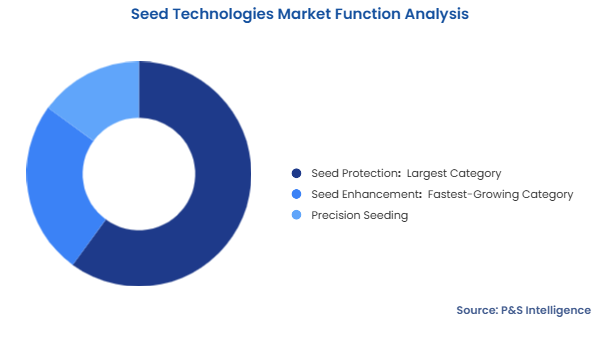
The seed protection category holds the largest market share, of 60%, in 2025, driven by its critical role in protecting seeds from pests, diseases, and environmental stress during early growth stages. Seed protection technologies, including chemical treatments and biological coatings, are widely used to ensure higher germination rates and crop survival. The Food and Agriculture Organization estimates that up to 40% of global crop production is affected by pests and diseases, highlighting the importance of seed protection solutions in improving agricultural productivity.
The seed enhancement category will have the highest CAGR, of approximately 9.4%, driven by increasing demand for improved seed performance and yield optimization. Enhancement technologies such as priming and nutrient coating improve germination speed, stress tolerance, and crop uniformity. Increasing focus on improving crop establishment and performance under variable climatic conditions is accelerating the adoption of seed enhancement solutions.
The functions analyzed in this report are:
Seed Protection (Largest Category)
Seed Enhancement (Fastest-Growing Category)
Precision Seeding
Technology Analysis
The seed dressing category holds the largest market share in 2025, driven by its cost-effectiveness, ease of application, and widespread adoption across large-scale commodity crop production. Its lower treatment cost per hectare and compatibility with existing seed processing infrastructure make it the preferred choice in price-sensitive agricultural markets. Additionally, its ability to provide effective multi-pathogen control with minimal processing complexity reinforces its strong adoption across large-scale farming systems. The International Seed Federation highlights that seed treatment adoption is widely prevalent in major cereal crops, reinforcing the strong market position of seed dressing technologies.
The seed coating category will have the highest CAGR, of approximately 9.7%, driven by increasing adoption of precision planting technologies and the growing need for improved seed performance and input efficiency. The rising use of precision planters requires uniform seed size and enhanced flowability, which is effectively achieved through advanced coating technologies. Furthermore, increasing regulatory focus on reducing chemical dust-off and improving environmental safety is accelerating the transition toward polymer-based seed coating solutions. The Food and Agriculture Organization emphasizes the growing importance of input-use efficiency and precision agriculture, supporting the rapid expansion of seed coating technologies.
The technologies analyzed in this report are:
Seed Dressing (Largest Category)
Seed Coating (Fastest-Growing Category)
Seed Pelleting
Seed Priming and Conditioning
Seed Disinfection
Precision Seeding
Crop Type Analysis
The cereals & grains category holds the largest market share, of 45%, in 2025, driven by their extensive cultivation area and consistent agronomic importance. Crops such as wheat, rice, and maize account for a significant portion of global agricultural output. Additionally, cereals are widely cultivated under diverse agro-climatic conditions, increasing the need for seed protection and treatment solutions. The Food and Agriculture Organization reports that global cereal production exceeds 2.8 billion tonnes annually, reinforcing strong demand for seed technologies in this segment.
The fruits & vegetables category will have the highest CAGR, driven by increasing consumer demand for high-value crops and improved nutritional intake. These crops require advanced seed technologies to ensure quality, yield, and resistance to environmental stress. The growing adoption of protected cultivation and high-value horticulture farming is significantly boosting demand for precision seed technologies. Furthermore, higher per-acre returns and shorter crop cycles encourage farmers to adopt advanced seed enhancement solutions. According to the Food and Agriculture Organization (FAO), global fruit and vegetable production exceeds 2.1 billion tonnes annually, with vegetables contributing approximately 1.17 billion tonnes and fruits around 933 million tonnes, highlighting strong growth potential for advanced seed technologies in this segment.
The crop types analyzed in this report are:
Cereals & Grains (Largest Category)
Oilseeds & Pulses
Fruits & Vegetables (Fastest-Growing Category)
Other Crop Types
Drive strategic growth with comprehensive market analysis
Seed Technologies Market Geographical Analysis
North America Seed Technologies Market Size
North America holds the largest market share, of 40%, in 2025, driven by advanced agricultural infrastructure, high adoption of precision farming technologies, and strong institutional support for advanced agricultural technologies. The United States leads the region due to its large commercial farming sector, widespread use of GM and treated seeds, and strong seed technology R&D ecosystem. The region benefits from highly mechanized farming systems and widespread use of treated and enhanced seeds across large-scale commercial agriculture. The United States Department of Agriculture reports that U.S. farm cash receipts exceed USD 500 billion annually, with crops such as corn, soybean, and wheat accounting for a significant share, reinforcing demand for seed protection and treatment technologies.
The region is also characterized by strong regulatory and research support for agricultural innovation. The National Institute of Food and Agriculture funds multiple programs focused on crop resilience, seed quality, and pest management. Additionally, adoption of genetically improved and treated seeds exceeds 90% for major crops such as corn and soybean in the U.S., reflecting deep penetration of advanced seed technologies. The widespread use of biotechnology traits and integrated seed solutions further strengthens market maturity and adoption levels in the region.
Asia-Pacific Seed Technologies Market Size
Asia-Pacific will have the highest CAGR, of approximately 9.9%, driven by large agricultural economies, rising population pressure, and increasing government focus on improving crop productivity. The region accounts for a significant share of global agricultural output, with countries such as China and India leading in crop production. China is the world’s largest producer of cereals, with annual grain production exceeding 650 million tonnes, creating a strong base for large-scale adoption of advanced seed technologies. The Food and Agriculture Organization highlights that Asia plays a major role in global agricultural production, supporting sustained demand for seed technology solutions.
Governments across the region are actively promoting seed quality improvement and modern farming practices. In Japan, the Ministry of Agriculture, Forestry and Fisheries emphasizes advanced seed development and precision agriculture, particularly in rice cultivation, where production exceeds 7 million tonnes annually, supporting the adoption of high-quality and treated seeds. National programs focused on high-yield seeds, hybrid seed distribution, and crop protection are accelerating adoption of seed technologies across the region. The increasing shift toward high-yield varieties and improved seed replacement rates is further supporting market expansion, while the expansion of horticulture and high-value crops continues to drive growth in seed enhancement technologies.
India Seed Technologies Market Size
India is the fastest-growing market for seed technologies, driven by strong government support for agricultural productivity, increasing adoption of certified and hybrid seeds, and the expansion of modern farming practices. The country has a large and diverse agricultural base, reinforcing the importance of high-quality and treated seeds in improving farm outcomes. The Ministry of Agriculture and Farmers Welfare reports that India’s total foodgrain production reached 332.298 million tonnes in 2023–24, reinforcing the need for continuous improvements in seed performance. Government programs such as the National Food Security Mission and Seed Village Programme are promoting the use of high-quality seeds and seed treatment practices, directly supporting demand for advanced seed technologies.
In addition, the rapid expansion of horticulture and high-value crop cultivation is accelerating the adoption of seed enhancement technologies. India produces over 320 million tonnes of fruits and vegetables annually, making it one of the largest producers globally. These crops require high-performance seeds with improved germination, disease resistance, and uniform growth, increasing reliance on technologies such as seed coating, priming, and pelleting. As farmers increasingly shift toward yield optimization and climate-resilient agriculture, demand for advanced seed technologies in India is expected to grow at a rapid pace.
The regions and countries analyzed in this report include:
North America (Largest Region)
U.S. (Larger Country Market)
Canada (Faster-Growing Country Market)
Europe
Germany
U.K.
France (Largest Country Market)
Italy
Spain (Fastest-Growing Country Market)
Rest of Europe
Asia-Pacific (Fastest-Growing Region)
China (Largest Country Market)
India (Fastest-Growing Country Market)
Japan
South Korea
Australia
Rest of APAC
Latin America
Brazil (Largest Country Market)
Mexico (Fastest-Growing Country Market)
Rest of LATAM
Middle East & Africa
Saudi Arabia (Fastest-Growing Country Market)
South Africa (Largest Country Market)
U.A.E.
Rest of MEA
Seed Technologies Market Competitive Landscape
The market is semi-consolidated because a limited number of global agro-biotech companies dominate advanced seed innovation, particularly in genetic engineering, hybrid seed development, and trait improvement. Companies such as Bayer, Corteva Agriscience, Syngenta, and BASF hold strong positions in research, intellectual property, and global seed commercialization. At the same time, the market includes a wide base of regional seed companies, public breeding institutions, and local producers that supply crop-specific and geography-specific varieties. These players are especially active in developing economies where localized seed demand is high and agricultural practices vary significantly. Innovation and IP ownership remain concentrated, while production and distribution are widely spread across multiple smaller participants.
Leading Companies in the Seed Technologies Market:
Bayer AG
Corteva Agriscience
Syngenta Group
BASF SE
UPL Limited
FMC Corporation
Nufarm Limited
Sumitomo Chemical Co., Ltd.
Croda International Plc
Syensqo SA/NV
KWS SAAT SE & Co. KGaA
Limagrain
Sakata Seed Corporation
DLF Seeds A/S
AgReliant Genetics
Seed Technologies Market News
In March 2026, Syngenta Group announced a GBP 100 million investment to establish its BioSTaR bioscience research hub in the U.K., focused on biological crop protection and AI-supported agricultural innovation.
In August 2025, Bayer AG introduced Yoalo, a biological seed-applied biostimulant for corn based on Bacillus velezensis, designed to enhance early root development and nutrient availability through improved nutrient solubilization activity.
In April 2025, Nufarm Limited launched Pretium SDS, a biological soybean seed treatment formulated with natamycin to control Sudden Death Syndrome and Red Crown Rot, expanding biological disease management options for soybean growers.
In November 2024, Lallemand Plant Care introduced LalRise Shine DS seed treatment for corn and dry beans to improve root vigor, nutrient uptake, and early-stage crop establishment.
Frequently Asked Questions About This Report
How are biological innovations influencing seed technology adoption?+
Biological innovations are driving adoption by offering eco-friendly alternatives to chemical treatments, improving soil health, enhancing nutrient uptake, and supporting sustainable agricultural practices.
How does climate variability impact seed technology demand?+
Climate variability increases demand for advanced seed technologies that enhance tolerance to drought, temperature stress, and irregular rainfall, ensuring stable crop performance under changing conditions.
What role does digital agriculture play in seed technology advancement?+
Digital agriculture supports seed technology by enabling data-driven decisions, optimizing planting strategies, improving seed placement accuracy, and integrating precision farming techniques.
How are regulatory frameworks shaping seed technology development?+
Regulatory frameworks influence development by setting standards for seed treatment safety, environmental impact, and approval of biological and genetically enhanced solutions, impacting product innovation and commercialization timelines.
What challenges affect the large-scale adoption of seed technologies?+
Key challenges include high initial costs, limited farmer awareness in developing regions, regulatory complexities, and variability in field performance under different agro-climatic conditions.
Want a report tailored exactly to your business need?
Leading companies across industries trust us to deliver data-driven insights and innovative solutions for their most critical decisions. From data-driven strategies to actionable insights, we empower the decision-makers who shape industries and define the future. From Fortune 500 companies to innovative startups, we are proud to partner with organisations that drive progress in their industries.
Client Testimonials
Working with P&S Intelligence and their team was an absolute pleasure – their awareness of timelines and commitment to value greatly contributed to our project's success. Eagerly anticipating future collaborations.
McKinsey & Company
India
Unmatched Standards
Our insights into the minutest levels of the markets, including the latest trends and competitive landscape, give you all the answers you need to take your business to new heights
Complete Data Security
We take a cautious approach to protecting your personal and confidential information. Trust is the strongest bond that connects us and our clients, and trust we build by complying with all international and domestic data protection and privacy laws