This Report Provides In-Depth Analysis of the Seed Coating Market Report Prepared by P&S Intelligence, Segmented by Additive Type (Polymers, Binders, Colorants, Active Ingredients, Minerals), Process (Film Coating, Pelleting, Encrusting), Crop Type (Cereals & Grains, Fruits & Vegetables, Oilseeds & Pulses, Flowers & Ornamentals), Coating Type (Synthetic, Bio-Based), Form (Liquid, Solid), and Geographical Outlook for the Period of 2021 to 2032
Explore the market potential with our data-driven report
Seed Coating Market Overview
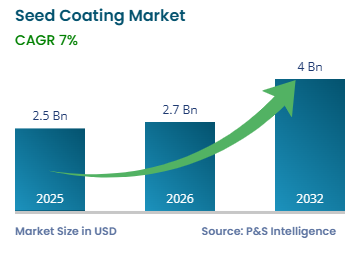
The seed coating market size was USD 2.5 billion for 2025, and it will grow by 7.0% during 2026–2032, to reach USD 4.0 billion by 2032.
The market is driven by the accelerating integration of precision agriculture across major farming economies, which is reshaping the demand profile for seed enhancement technologies. Rising demand for high-yield and stress-tolerant crop varieties is directing grower investment toward performance-optimized seed inputs. Seed coatings function as targeted delivery systems for fungicides, insecticides, micronutrients, and bio-based biologicals. Seed coating technologies including film coating, pelleting, and encrusting processes enable controlled delivery of active and protective agents directly onto seed surfaces, improving germination consistency, seedling vigor, and early-season pest resistance.
The USDA National Agricultural Statistics Service reports that a significant share of major U.S. crops including corn, soybean, and wheat are planted using treated seeds, with adoption rates exceeding 90% in crops such as corn and soybean. The USDA National Agricultural Statistics Service further indicates that the United States maintains over 320 million acres of cropland. This land base underscores the large-scale applicability of seed treatment technologies across extensive agricultural systems. Moreover, growing food security imperatives are reinforcing this demand trajectory. The Food and Agriculture Organization indicates that global food production will need to increase by approximately 50% by 2050 compared to 2012 levels to meet the dietary demands of a population projected to reach around 9.7 billion. These pressures are compelling input manufacturers globally to invest in performance-enhancing and sustainable coating formulations.
Key Market Insights
The polymers category holds the largest market share, of 35%, in 2025, driven by their role as the foundational substrate of most commercial seed coating formulations.
The active ingredients category will have the highest CAGR, of 7.2%, driven by rising demand for value-added coatings and integrated delivery systems combining multiple inputs in a single application.
The liquid category holds the larger market share, of 75%, in 2025, and it will have the higher CAGR, driven by its widespread use across film coating and slurry treatment processes.
The pelleting category will have the highest CAGR, of 7.4%, driven by the increasing need for uniform seed size and compatibility with precision planting equipment such as vacuum seeders.
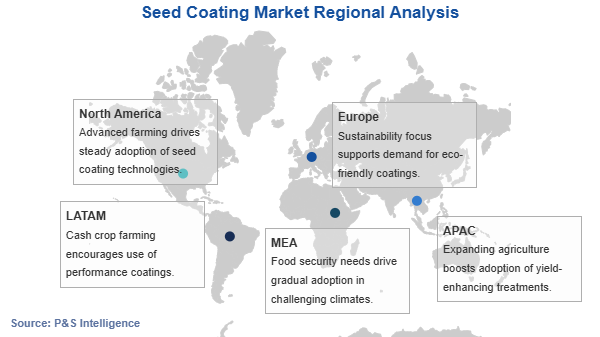
North America holds the largest market share, of 40%, in 2025, while Asia-Pacific is the fastest-growing region in the seed coating market.
Seed Coating Market Trends & Drivers
Shift toward Biological and Biodegradable Coating Materials Is Key Trend
The global seed coating market is undergoing a fundamental material transition. The agrochemical industry is pivoting away from petroleum-derived synthetic polymers toward bio-based, biodegradable coating formulations. Regulatory pressure across major agricultural markets is the primary accelerant. Neonicotinoid-based coatings have long served as the commercial standard for insecticide delivery in seed treatment systems. These coatings are now facing mounting restrictions across major agricultural markets. The European Union's Farm to Fork Strategy mandates a 50% reduction in overall pesticide use and risk by 2030. These obligations are directing coating manufacturers toward safer and more targeted active ingredient systems across EU agricultural markets. A study estimates that between 31,000 and 42,000 tonnes of microplastics are applied to European agricultural soils annually through sewage sludge recycling. This contamination scale is reinforcing regulatory pressure to transition toward biodegradable coating materials across European agricultural systems.
Coating material manufacturers are accelerating development of starch-based, chitosan-derived, cellulose, and alginate polymer formulations. These formulations maintain agronomic performance while decomposing naturally in soil environments without generating microplastic residues. Beyond regulatory compliance, the performance attributes of bio-based coatings are expanding commercially. Microencapsulation technologies embedded within bio-based carrier matrices are enabling precision delivery of biostimulants, plant growth-promoting rhizobacteria (PGPR), and mycorrhizal fungi directly at the seed–soil interface.
Food Security Imperatives and Arable Land Degradation Are Biggest Drivers
Accelerating global food security pressures are compelling farmers, input manufacturers, and policymakers to deploy performance-enhancing seed technologies at scale. The Food and Agriculture Organization and global land degradation assessments indicate that approximately 1.7 billion people live in areas affected by land degradation where crop productivity has declined. A significant share of global cropland is experiencing soil degradation due to erosion, organic carbon loss, and intensive agricultural practices.
These degradation dynamics increase the demand for seed coating solutions that compensate for compromised soil environments. Coating inputs applied at sowing improve germination rates and strengthen seedling vigor in soils with diminished natural productivity. The Food and Agriculture Organization estimates that over 33% of the world's soils are moderately to highly degraded. This degradation level is reducing agricultural productivity and constraining input efficiency across major cropping systems globally. The World Bank highlights that land degradation affects more than 3.2 billion people globally.
Coating formulations incorporating micronutrients, biofertilizers, and soil conditioners are increasingly used to support crop performance in degraded cropping systems across South Asia, sub-Saharan Africa, and Latin America. Coating technologies in North America and Europe support more efficient input use by concentrating protective and nutritional delivery at the seed level. As food demand continues to outpace productivity gains on existing cropland, investment in advanced seed coating inputs is expected to remain elevated.
Biological Seed Treatments Driving Coating Innovation Is Biggest Opportunity
The rapid commercialization of biological seed treatments encompassing microbial inoculants, biocontrol agents, biostimulants, and plant growth-promoting rhizobacteria (PGPR) is creating strong demand for advanced coating formulations. These treatments require specialized carrier systems capable of maintaining microbial viability during storage, transport, and field application. This requirement is driving demand for technically differentiated coating systems beyond conventional chemical delivery platforms. This integration improves operational efficiency and reduces handling complexity at the farm level.
The Food and Agriculture Organization highlights biological inputs as central to sustainable agricultural intensification. The European Commission supports the commercialization of biological inputs through the EU Fertilising Products Regulation (EU) 2019/1009. These regulatory provisions are establishing a defined compliance and commercialization pathway for biological active ingredient manufacturers operating across EU agricultural markets. The partnership between Syensqo and Bee Vectoring Technologies to develop the CR-7 biological control agent into seed treatment formulations for soybeans demonstrates the convergence of biological inputs with advanced coating technologies across high-value crop segments.
Regulatory Complexity and High Formulation Costs Are Key Restraints
The seed coating market faces structural constraints from the complexity and cost of advanced coating formulations. These constraints are most acute in developing agricultural economies where smallholder farmers represent the majority of the farming population. The Food and Agriculture Organization reports that five out of every six farms globally are smaller than two hectares, operating only around 12% of agricultural land and producing approximately 35% of the world’s food. This prevalence defines the scale of cost-sensitive farming systems that limit adoption of advanced seed inputs. High-performance coatings incorporating biodegradable polymers, biological active ingredients, and controlled-release architectures require specialized manufacturing capabilities and precision application systems. These systems remain limited or economically inaccessible across rural markets in Sub-Saharan Africa, South Asia, and Southeast Asia.
The higher cost of advanced coated seeds, particularly for biological and multi-functional formulations, limits affordability for smallholder farmers who typically rely on low-cost and conventional inputs. The World Bank highlights that credit and financial constraints are a major barrier to the adoption of modern agricultural technologies. Input costs frequently exceed the financial capacity of smallholder farmers. This gap constrains uptake of performance-optimized seed inputs across low-income agricultural systems. Regulatory fragmentation across jurisdictions compounds market entry complexity. Varying approval requirements for biological and coating inputs are increasing compliance costs and delaying commercialization timelines across multiple markets.
Seed Coating Market Segmentation Analysis
Additive Type Analysis
The polymers category holds the largest market share, of 35%, in 2025, driven by their role as the foundational substrate of most commercial seed coating formulations. Polymers serve as the binding matrix that ensures uniform adhesion across the seed surface and enables controlled delivery of nutritional and protective inputs at the seed level. The superior film-forming properties of polymer coatings improve seed flowability and reduce dust-off during mechanical handling. These properties also enhance compatibility with automated precision planting systems. This compatibility is indispensable across high-throughput corn, soybean, and wheat coating operations where planting equipment reliability is directly tied to farm profitability.
The active ingredients category will have the highest CAGR, of 7.2%, driven by rising demand for value-added coatings and integrated delivery systems combining multiple inputs in a single application. The growing adoption of biological inputs including nitrogen-fixing microbes and plant growth-promoting rhizobacteria is strengthening this segment. CropLife International reflects the growing industry focus on biological crop protection solutions, supporting the expansion of biological seed treatments as a fast-growing active ingredient category within the global seed coating market.
The additive types analyzed in this report are:
Polymers (Largest Category)
Binders
Colorants
Active Ingredients (Fastest-Growing Category)
Minerals
Others
Process Analysis
The film coating category holds the largest market share, of 60%, in 2025, driven by its operational versatility, cost-effectiveness, and compatibility with high-speed seed treatment systems. Film coating applies a thin, uniform polymer layer without altering seed size or weight. This dimensional consistency ensures compatibility with small seeds and high-speed treatment equipment. Precise delivery of fungicides, insecticides, micronutrients, and colorants is enabled through the film coating process, supporting efficient large-scale seed treatment operations. Scalable seed treatment technologies ensure uniform crop protection across major cereal production systems globally.
The pelleting category will have the highest CAGR, of 7.4%, driven by the increasing need for uniform seed size and compatibility with precision planting equipment such as vacuum seeders. Pelleting standardizes seed dimensions for mechanical handling, enhancing singulation accuracy and reducing seed wastage across greenhouse and open-field production systems in Asia-Pacific and Europe. The American Seed Trade Association represents ongoing industry efforts to advance seed technologies, supported by continued investment in seed enhancement infrastructure aimed at improving planting precision and operational efficiency.
The processes analyzed in this report are:
Film Coating (Largest Category)
Pelleting (Fastest-Growing Category)
Encrusting
Crop Type Analysis
The cereals & grains category holds the largest market share in 2025, driven by the extensive global cultivation of staple crops such as wheat, rice, corn, and barley. Seed coating formulations applied to cereal crops protect against soil-borne pathogens that suppress early seedling development. Germination uniformity requirements under variable temperature and moisture conditions sustain consistent demand for performance-optimized coating inputs. The Food and Agriculture Organization reports that global cereal production reached approximately 2.84 billion metric tons in 2024/25.
The fruits & vegetables category will have the highest CAGR, of 7.3%, driven by the rising global consumer demand for fresh produce, broadening the commercial base for performance-optimized vegetable seed inputs. Pelleted and film-coated vegetable seeds improve germination uniformity under controlled environment conditions. Enhanced compatibility with transplanting machinery supports adoption of coated vegetable seeds in mechanized production systems. The USDA National Institute of Food and Agriculture highlights specialty crop production including fruits and vegetables, as a priority investment area.
The crop types analyzed in this report are:
Cereals & Grains (Largest Category)
Fruits & Vegetables (Fastest-Growing Category)
Oilseeds & Pulses
Flowers & Ornamentals
Others
Coating Type Analysis
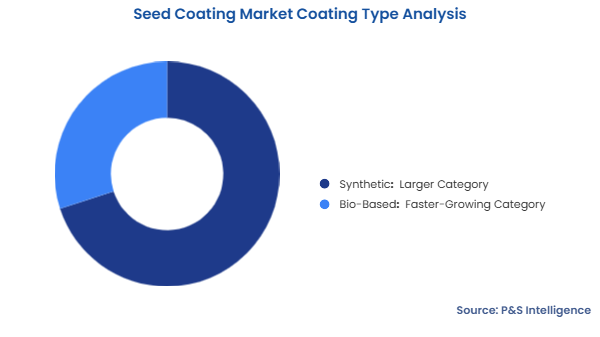
The synthetic category holds the larger market share, of 70%, in 2025, driven by consistent performance, cost efficiency, and broad compatibility with active ingredient chemistries. Cost efficiency at industrial scale positions synthetic formulations as the default coating choice for high-volume commercial seed treatment operations. Proven regulatory histories across major agricultural markets support market authorization in multiple jurisdictions. Petroleum-derived film polymers and synthetic fungicide and insecticide delivery matrices deliver superior shelf stability and mechanical strength during seed handling.
The bio-based category will have the higher CAGR, driven by regulatory pressure on synthetic coating materials, expanding sustainability initiatives across agrochemical manufacturers and input distributors, and growing farmer preference for environmentally compatible inputs. The European Commission has introduced measures to restrict intentionally added microplastics under its broader chemicals strategy. These restrictions are compelling coating formulators to accelerate the development of biodegradable and bio-polymer alternatives across seed coating applications.
The coating types analyzed in this report are:
Synthetic (Larger Category)
Bio-Based (Faster-Growing Category)
Form Analysis
The liquid category holds the larger market share, of 75%, in 2025, and it will have the higher CAGR, driven by its widespread use across film coating and slurry treatment processes. Liquid formulations enable uniform distribution of active and inert components through modern seed treatment systems. Compatibility with multiple inputs including fungicides, insecticides, micronutrients, and colorants enables consolidated delivery in a single application. The USDA National Agricultural Statistics Service indicates that a significant portion of treated seed acreage in the United States utilizes liquid-based applications. Compatibility with precision agriculture practices and biological treatments is broadening adoption across both developed and emerging agricultural markets.
The forms analyzed in this report are:
Liquid (Larger and Faster-Growing Category)
Solid
Drive strategic growth with comprehensive market analysis
Seed Coating Market Geographical Analysis
North America Seed Coating Market Size
North America holds the largest market share, of 40%, in 2025. The region's highly mechanized agricultural infrastructure and widespread adoption of precision farming technologies underpin this position. Major row crops including corn, soybeans, and canola rely extensively on coated seeds. The United States and Canada operate a highly developed commercial seed coating ecosystem. Agrochemical distributors, seed treatment service facilities, and active ingredient manufacturers collectively provide the supply infrastructure at industrial scale.
The USDA National Agricultural Statistics Service reports that U.S. farmers planted over 90 million acres of corn in 2023. The U.S. Environmental Protection Agency regulates the registration and use of seed treatment chemicals under the Federal Insecticide, Fungicide, and Rodenticide Act (FIFRA). Ongoing EPA evaluations of neonicotinoid seed treatments and pollinator protection measures are directing formulation development toward safer and more targeted coating chemistries. This evolving regulatory and commercial landscape is further supported by industry expansion initiatives, as demonstrated in November 2024 when Clariant AG partnered with Red River Specialties to expand the distribution of specialty seed coating materials across North America, strengthening supply chain access and reinforcing market growth.
Asia-Pacific Seed Coating Market Size
Asia-Pacific will have the highest CAGR, of 7.1%, propelled by rising food demand from a population base exceeding 4.6 billion, rapid adoption of modern farming practices in China, India, Japan, and Southeast Asia, and an accelerating transition from traditional to high-efficiency seed enhancement technologies. Government-led agricultural modernization programs are catalyzing the adoption of coated seeds across large-scale staple crop systems and expanding commercial horticulture. For instance, in Japan, the Ministry of Agriculture, Forestry, and Fisheries is promoting smart agriculture under its national digital transformation initiatives. Australia's Department of Agriculture, Fisheries and Forestry is advancing sustainable agriculture through programs focused on productivity enhancement and efficient input use.
Moreover, the Union Budget 2025–26 introduced the National Mission on High-Yielding Seeds to strengthen research and promote over 100 climate-resilient seed varieties, expanding the demand for advanced seed treatment and coating technologies in India. Additionally, under the Seed Village Programme, more than 6.85 lakh seed villages were developed, producing 1,649.26 lakh quintals of quality seeds and supporting around 2.85 crore farmers in improving access to certified seeds and crop productivity. This policy-driven momentum is complemented by growing commercialization of biological solutions, as seen in December 2024 when BioConsortia, Inc. partnered with New Zealand-based Hodder and Taylors Ltd. to introduce nitrogen-fixing microbial seed treatment technologies, accelerating the adoption of advanced seed coating solutions across the Asia-Pacific region.
China Seed Coating Market Size
China represents a major market for seed coating in the Asia-Pacific, driven by the country's vast agricultural base and sustained population pressure on food production, generating sustained demand for seed enhancement inputs. Government-directed investment in modern seed technologies is reinforcing this demand across China's commercial and smallholder farming systems, supported by policy frameworks such as the Seed Law of the People's Republic of China, which strengthens seed innovation, intellectual property protection, and the commercialization of improved crop varieties, along with the 14th Five-Year Plan for Agriculture that emphasizes seed industry development, modernization of breeding technologies, and enhanced agricultural productivity. Rice, corn, and wheat are intensively cultivated across China's agricultural systems.
Seed coating treatments improve germination uniformity and early-season pest resistance across high-density planting conditions. Consistent nutrient uptake enhancement at scale further sustains demand for coating inputs. The Food and Agriculture Organization FAOSTAT database indicates that China maintains approximately 108 million hectares of arable land. This land base sustains year-round demand for seed enhancement technologies across rice, corn, and wheat cultivation systems.
The regions and countries of the market are as follows:
North America (Largest Regional Market)
U.S. (Larger and Faster-Growing Country Market)
Canada
Europe
Germany (Largest Country Market)
U.K.
France (Fastest-Growing Country Market)
Italy
Spain
Rest of Europe
Asia-Pacific (Fastest-Growing Regional Market)
China (Largest Country Market)
India (Fastest-Growing Country Market)
Japan
South Korea
Australia
Rest of APAC
Latin America
Brazil (Largest Country Market)
Mexico (Fastest-Growing Country Market)
Rest of LATAM
Middle East and Africa
Saudi Arabia (Fastest-Growing Country Market)
South Africa (Largest Country Market)
U.A.E.
Rest of MEA
Seed Coating Market Share Analysis
The market is fragmented due to the presence of multinational agrochemical companies alongside numerous specialized firms and contract seed enhancement providers operating across different product segments. No single company dominates across all coating materials, processes, or crop applications, as product requirements vary significantly between polymers, biological carriers, and active ingredient formulations. This specialization allows multiple players to maintain competitive positions within niche areas. Additionally, regional service providers and contract coaters further diversify the landscape. While large companies benefit from scale and distribution, technological differentiation and segment-specific expertise prevent market consolidation, resulting in a competitive environment with distributed market participation.
Major Companies in the Seed Coating Market:
BASF SE
Bayer AG
Syngenta Group
Corteva, Inc.
UPL Limited
FMC Corporation
Nufarm Limited
Sumitomo Chemical Co., Ltd.
ADAMA Agricultural Solutions Ltd.
Croda International Plc
Clariant AG
Germains Seed Technology
Aginnovation, LLC
Incotec Group B.V.
Syensqo SA
BrettYoung Seeds Ltd.
BioConsortia, Inc.
Bee Vectoring Technologies International Inc.
Seed Coating Market News
In July 2025, Aginnovation, LLC acquired a majority stake in Centor Europe, a Netherlands-based specialty seed enhancement company, to strengthen its seed coating capabilities and expand its presence in the European market.
In October 2024, Incotec Group B.V. launched Disco Blue L-1523, a microplastic-free film coat formulated for sunflower seeds at the Euroseeds Congress 2024. The product advances Incotec's Mission Zero sustainability program and aligns with evolving regulatory focus on reducing microplastic use in agricultural inputs.
In March 2024, BrettYoung Seeds Ltd. completed a USD 20 million investment in NorthCore, a new 60,000 sq. ft. commercial seed processing facility designed for advanced cleaning, sorting, and packaging of turf and specialty seed products.
Frequently Asked Questions About This Report
What is the current size of the seed coating market?+
The seed coating market was valued at USD 2.5 billion in 2025.
Which region dominates the seed coating market?+
North America dominates the seed coating market.
What factors are driving the seed coating market?+
Key drivers include rising demand for higher crop yields, adoption of precision agriculture, and increasing use of biological and sustainable farming inputs.
What are the opportunities in the seed coating market?+
Growth opportunities lie in bio-based coatings, expansion in emerging markets, and increasing demand for sustainable agricultural solutions.
Want a report tailored exactly to your business need?
Leading companies across industries trust us to deliver data-driven insights and innovative solutions for their most critical decisions. From data-driven strategies to actionable insights, we empower the decision-makers who shape industries and define the future. From Fortune 500 companies to innovative startups, we are proud to partner with organisations that drive progress in their industries.
Client Testimonials
Working with P&S Intelligence and their team was an absolute pleasure – their awareness of timelines and commitment to value greatly contributed to our project's success. Eagerly anticipating future collaborations.
McKinsey & Company
India
Unmatched Standards
Our insights into the minutest levels of the markets, including the latest trends and competitive landscape, give you all the answers you need to take your business to new heights
Complete Data Security
We take a cautious approach to protecting your personal and confidential information. Trust is the strongest bond that connects us and our clients, and trust we build by complying with all international and domestic data protection and privacy laws